Monday, April 2, 2012

Lugangstas


Many localities in Taiwan are famous for their eats, and people will travel long distances for the sole purpose of feasting on snacks in the places for which they are noted, even if they can find the same foods in their local neighborhoods or night markets. Pictured above is an oyster omelet 蚵仔煎, one of several dishes that brings the hordes to the small town of Lukang (Lù​gǎng) 鹿港. It was also my lunch this afternoon, which we spent in...Lugang. 

Around the corner from the restaurant was the T'ienhou Temple (Tiānhòu gōng) 天后宮, one of the oldest and most famous temples in Taiwan. In celebration of Matsu's (Mā​zǔ) 媽祖 birthday, a large image of the goddess, along with a couple of her attendants, had been erected outside the temple:


Pictured below is the Main Hall. Tianhou Temple was an oasis of calm in a hectic world, a chance to quietly contemplate the meaning of it all in an atmosphere of serenity and...oh, who am I kidding? The temple was a non-stop cacophonous assault on the eardrums, inside and outside, with the sounds of exploding firecrackers going off every few minutes:


Mazu not only brings in the crowds, she attracts the dollars as well. Tianhou Temple had its own onsite gift shop, with T-shirts, baseball caps, amulets and charms, CD's and cute figurines helping to fill up the temple's coffers, and all of it tax-free, of course. Which didn't stop us from buying some stuff:


Chungshan Road (Zhōng​shān lù) 中山路, the main road leading to Tianhou Temple. On weekends and holidays, it's a charming pedestrian-only street lined with quaint little shops and...OK, I'll stop it. Zhongshan Road was, as usual, a teeming mass of humanity. I'd be willing to wager that for most of the folks pictured below, this wasn't their first time to Lugang. It's an indication of the limited number of places to go and things to do in Taiwan. Lugang does attract a lot of foreign visitors, but they make up only a small percentage of the crowd that descends on this little town virtually every non-working day. People visit the same tourist spots again and again and again, to see the sights and to snack, of course:


One thing especially annoying about the crowd scene above was the presence of scooter riders. Despite the densely packed street, idiots on their bikes still insisted on riding through the hordes, beeping their horns in irritation at anyone they deemed slowing them down too much. It's an unfortunate scene repeated up and down Taiwan - the failure of those in charge to create, and enforce, pedestrian-only zones on holidays and weekends. While the folks around me were presumably enjoying their foods, I was fantasizing about how satisfying it would feel to swing a baseball bat around and knock some of those 屁眼's off of their machines.

Back in reality, we continued walking around the streets of Lugang. Below can be seen Nanching Temple (Nán​jīng gōng) ​南京宮, built in 1784, and the Lukang Assembly Hall 鹿港公會堂, dating from 1928 and now serving as an art and culture center. And in the middle is a vendor demonstrating one of the boomerangs he had for sale:


A cake shop called the Zhèng​ Yù Zhēn Cake Store 鄭玉珍餅舖, now under its fourth generation of ownership by the Zheng family. Its significance to our family was that the owners let Amber use the bathroom in the back, saving us the hassle of having to fight through the crowds on the street outside to reach the public toilet. For their kindness, we bought a couple of packages of sweets. Pamela was surprised to find that behind the traditional-looking showroom and kitchen was a modern house. Business, apparently, has been very good for the Zhengs:


Mother and daughter pose on Yáolín Street 瑤林街, part of the Old Market Street 古市街 area of Lugang:


Father and daughter pose by the Half-Sided Well 半邊井, built by a wealthy family so that the serfs and proles could also use the spring water that used to be underground there. Although it only took a few seconds for my wife to take the shot, crouching like that was murder on my おばさん-like knees:


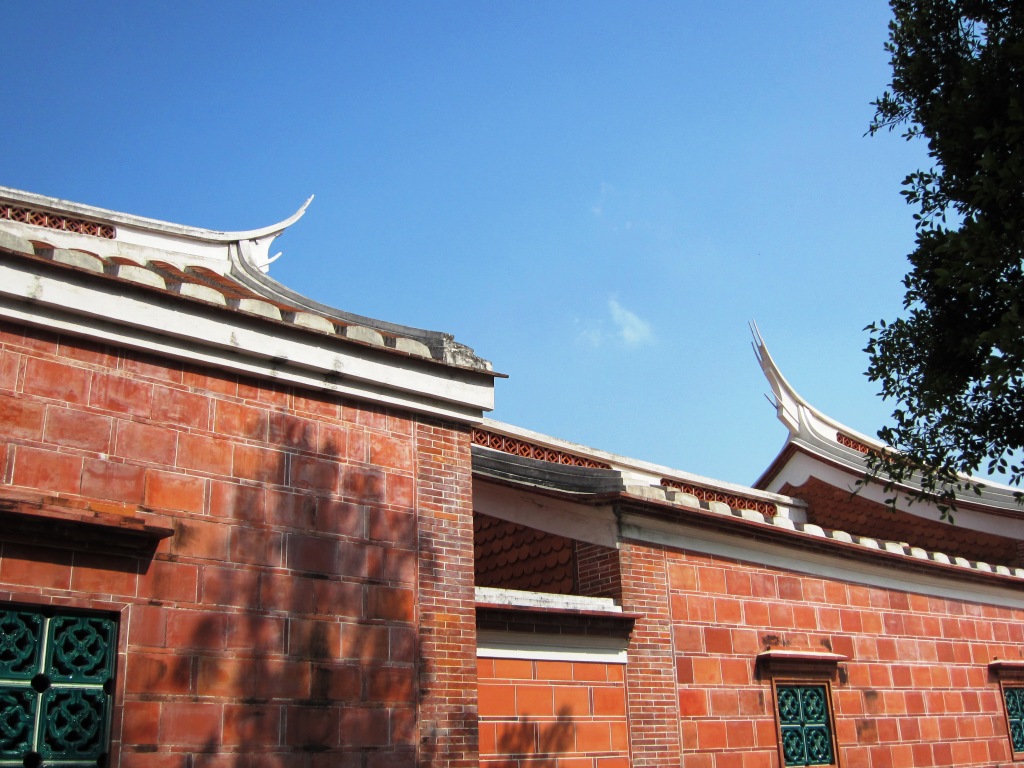
Lugang may be noted for its old buildings, but looking out over the rooftops revealed it to be an ordinary Taiwanese town in most respects:


Along Zhongshan Road are several shops where the craftsmen residing within have been recognized by the government as "Living Heritage" artists. The Wú Dūn-hòu Lantern Shop 吳敦厚燈舖  is one such establishment. The old gentlemen painting some characters on a lantern as we passed by was presumably Mr. Wu himself. In many travel articles that I've read, the writer will stop to talk with such skilled craftspeople, learn about the history of their business and take a photo or two of the artisan in action. I'm too shy to do that. Instead, I crossed Zhongshan Road in order to take this picture:


I guess I've been here too long, but tourist spots such as Lugang have changed greatly in recent years. Eons ago when I first came to Taiwan (circa 1998), Lugang and its ilk were much more atmospheric...as in run down, borderline derelict. Sure, the crowds were there, but not in the numbers you see today. When Taiwan switched to the five-day work week sometime around 2002, it sparked a leisure boom, and the Lugangs of Taiwan have been given a facelift in the years since. Things are better organized, with more signs pointing the way, and building facades and streets have been spruced up. The range of souvenirs and foods on sale have expanded as well, with lots more cutesy souvenirs and crafts on display, and more ethnic-type snacks to munch on. While the cash registers are no doubt ringing up a happy jingle these days, something has been lost in the rush to cash in. In Lugang's case, the best example was probably the Osmanthus Alley Artists Village 桂花巷藝術村. Once a street of decaying Japanese-era dormitories, the wooden buildings were torn down and replaced with...ersatz Japanese-style "bungalows", all housing the kinds of 很可愛-type handicrafts that appeal to a certain young female demographic. Welcome to the 21st-century version of Lugang, sanitized for your protection:


Temple, old brick house and oddly-shaped "modern" residence:


At my insistence, we eschewed the freeway and instead headed for home along west-central Taiwan's less-than-idyllic coast. Having to wait for 90 seconds at a red light proved to be too long for one scooter rider:


The way that we took was a grim one - elevated expressways, factories, flat terrain, power lines and wind turbines lined virtually the entire route. The sunset deserved better surroundings than it was given here:


En route we stopped off at an all-you-can-eat hotpot 火鍋 restaurant in Wuch'i (Wú​qī) 梧棲. Sitting in a decaying concrete building situated along a busy highway in a gloomy industrial district, with the locals unsure how to react to the presence of a barbarian in their midst, while dining on food of questionable freshness - this place was definitely not the kind of establishment enthusiastic Western bloggers living happy, public transportation-dependent lives in Taiwan's capital metropolis will ever probably set foot in. Welcome to the Taiwan that I know all too well:

Saturday, March 31, 2012

Houli Roller

On a pleasant Saturday afternoon, what better way to help a sick little girl get over a spring cold than by having her get out in the fresh air? OK, this is central Taiwan, where "fresh" isn't the first adjective that immediately springs to mind when thinking about the atmosphere, but the weather wasn't too bad today - warm, but not hot, and skies that were actually blue. So, after lunch, we drove to the nearby town district of Hòu​lǐ 后里, one end of the 4.5 kilometer (2.8 miles)-long Houfong​ Bicycle Trail 后豐自行車綠廊. Amber came prepared with her Hello Kitty ハローキティ bike (still with training wheels attached) and Toys "R" Us helmet, but before hitting the trail, we crossed the road from the parking lot to check out some horses.

Ask many Taiwanese the first word that comes to mind when they think of Hòu​lǐ, and the answer will probably be "saxophones". But around these here parts, the town district is also known for its military stables 后里馬場. This afternoon, a number of horses were being put through their paces around an equestrian course, leaping over various vaults:


When Amber was very small, she was bitten on the finger by a horse during a music festival in Hòu​lǐ, and for the longest time afterward, she was terrified of the animals. Fortunately, she's since gotten over that fear:


Returning to her own four-wheeled steed, Amber set off on the bicycle trail, with Dad lagging behind on foot. Eventually, we came to the No. 9 Tunnel 九號隧道, which was built by the Japanese, and used by trains operating on the now defunct Old Mountain Line. Amber didn't cycle the entire 1.3 kilometers (0.8 miles), but she did venture inside for the first time:


Back outside, and posing for a photo...along with three young people doing what many Taiwanese youth seem to enjoy doing - taking a picture of themselves leaping into the air, which will no doubt later be posted to their Facebook pages:


Stopping for a sausage break on the ride back to the parking lot. Wherever people assemble in Taiwan, food, drink and souvenir vendors will also congregate:


Watching Amber on her bike this afternoon, I realized it's probably time to remove the training wheels, and let her attempt to master the art of cycling on two wheels. She's keen on the idea, but said she would like to practice in our apartment building courtyard first before going out on the bike paths again. Fair enough. 

加油!

Thursday, March 29, 2012

Visatations

When the American Institute in Taiwan 美國在台協會 beckons, you answer. And when the AIT asks you to be at their offices at 7:45 on a Wednesday morning, you will do like us - go up the day before and give yourself a 24-hour trip to Taipei 台北. Pamela and I both went to work on Tuesday morning, while Amber attended her kindergarten as usual, but following lunch, the three of us went by taxi to the U-Bus 統聯客運 station in beautiful downtown Fēng​yuán 豐原, where we caught the 1:30 bus to the Taipei Bus Station 台北轉運站. Upon alighting, we made our way to the Taipei Metro 台北捷運, got on the subway and, four stops and one transfer later, got off at Dà​ān Station 大安站.

Amber makes her way along the concourse between the bus and MRT stations

From the subway, it was a short walk to the Dolamenco Hotel, our choice of accommodation for that fine Tuesday evening. The room was small, as was the bed - Amber ended up sleeping on a small sofa that night, which we pushed up against one side of the bed so that she wouldn't fall off. But the price (NT1980/$67) and the location (just a few minutes' walk from the AIT) couldn't be beat.


That evening we got back on the MRT to do what tourists do in Taipei, visit one of the city's large night markets. In our case, it was to Shì​lín Night Market 士林夜市. We rode the MRT at the peak of the evening rush hour, but having navigated Tōkyō's 東京 claustrophobia-inducing subway network for the better part of a decade, I find Taipei's system to be far less stressful. And to the local denizens credit, people gave up their seats so that a tired and sick little girl (Amber has been suffering from a cold these past few days) could sit down. In any event, it was only a short ride from Dà​ān to Jiàntán Station 剑潭站, the closest stop to the night market.

Now I don't claim to be an old Taipei hand, but back in 1999, and again in 2001, I paid visits to Shì​lín in the company of Japanese and American friends. The night market was in all its glory back then, at the center of a busy warren of narrow streets packed with clothing stands. It was dirty, noisy and odoriferous, and all the more fun and exciting because of it. However, soon after my second visit, the Taipei city government, in all its infinite wisdom, decided the market needed to be "improved" by relocating to a more modern structure. The result is an even more cramped site, made worse by its location in a basement. The atmosphere has been ruined as the crowds (including large tour groups made up of Chinese tourists) are herded like cattle into a more sterile, less inviting environment:


My dainty, coquettish wife, with her ever so sensitive and delicate sense of smell, insisted that we retreat back to street level, where we found a small eatery with better circulation. Pamela, who couldn't stand the lack of "fresh air" down in the basement, then proceeded to happily chow down a plate of stinky tofu 臭豆腐 (Amber and I had steak).


After dinner, we took a stroll through the older part of the market, dominated by clothing stalls. Amber needed little encouragement to strike a pose:


By this point, it was starting to get late, and we had an early appointment at the AIT the following morning, so it was time to bid the moon and Venus "goodnight" and take the MRT back to Dà​ān.


The next day, we were done at the AIT by 9:30, and headed back to our hotel for a late breakfast before packing up and checking out.  After storing our bag in a locker somewhere in the bowels of Taipei Station 台北車站, it was back again on the MRT Tamsui Line 淡水線, this time to Yuánshān Station 圓山站. From the station's platform could be seen evidence that not all is sweetness and tolerance in Taiwan's religious scene:


I remembered this sign from Patrick Cowsill's blog. Erected by an organization called the True Enlightenment Education Foundation  正覺教育基金會, the slogan warns that:

Tibetan Buddhism is definitely not Buddhism; the lamas are not Buddhist monks or nuns

Another sign on the building read:

To avoid religious sexual abuse, please stay away from the lamas of Tibetan Buddhism

Putting the last sentence into a Google search led to this, er, "enlightening explanation".

Meanwhile, back in the real world, you might be wondering at this point why we had come to Yuánshān in the few hours that we had left in Taipei. To visit a couple of nearby historic temples, perhaps? Or to take a taxi to see a restored old house? Wrong on both counts. If your spouse is Taiwanese like mine is, there is a strong chance that you'll end up having the taxi driver drive you from the MRT station to the Taipei Expo Park 花博公園, the remnants of the Taipei International Flora Exposition. Pamela particularly wanted to see the Pavilion of Dreams 夢想館, described thusly in the Wikipedia entry:

The building showcases Taiwan's cutting-edge technology in addition to flowers. A 3.5-ton artificial flower hangs from the ceiling, responding to beats in music. In an exhibition room, flat screens showcase 3D images of flowers without the need to use special glasses...A wall of 3-meter-tall liquid crystal glass panels show lifelike projections of flowers in the wild.

As the name of this blog makes clear, I'm something of a curmudgeon. I found the New Age vibe to be a bit too much. There were other things I would've done in Taiwan's largest city than spend time pursuing my "dream flower", but Pamela seemed satisfied and Amber, free at her age of any pretensions, accepted the Pavilion of Dreams for what it was trying to do and enjoyed herself very much as a result. 


Mother and daughter outside in the Xīn​shēng Park Area 新生園區. In the background can be seen the Grand Hotel 圓山大飯店: 


 My "Dream Flower"

Taking a taxi from Xīn​shēng Park directly to Taipei Station turned out to be a little cheaper than returning by a cab to Yuánshān Station, and riding the MRT back to where our bag had been stored. Following a late lunch in one of the food courts on the second floor of the station, and a bit of window shopping in one of the underground malls beneath it, we found ourselves on the 4:00 Tze-Chiang 自強 limited express, and got back to Fēng​yuán on time, at 6:02 p.m., where I went straight to my evening job from the train station, while Amber and Pamela had dinner at the local MOS Burger モスバーガー before taking yet another taxi home (I walked back from school).

And that's how we spent 24 hours in Taipei, from late Tuesday afternoon to late Wednesday afternoon. Who knows? The next time I go to the AIT might be under somewhat different circumstances.

Somewhere between Bǎn​qiáo 板橋 and Táo​yuán 桃園


Sunday, March 25, 2012

Factory Fodder

Highlights of our zhōu​mò:

Amber had a modeling session on Saturday that lasted into the afternoon. That evening, my wife decided we not only had to have steak, but that we had to eat it at the Taichung Steak House, the place to go...if you like dining on an industrial scale. The dining room was huge, and close to capacity, which unsurprisingly ruled out having any sort of quiet meal. And while there was a wide of variety of foods to choose from, all of it tasted bland - institutionalized cuisine in a giant canteen. Avoid it.


Fortunately for me, a bottle of White Beer, courtesy of the North Taiwan Brewing company, was waiting patiently for my return home. Craft beers, especially local ones, aren't easy to find in this country, so if you should come across a bottle such as this one, don't avoid it:


Early in the afternoon on Sunday: First, it was lunch at the Taichung Fish Market, not to be confused with the fish market located next to the port in Wú​qī 梧棲. No, this Taichung Fish Market can be found next to the No. 1 Freeway in the city itself. The last time we went there was a few years ago, not long after it had first opened, and unsurprisingly the people there were packed in like sardines. This time, things were much quieter, so much so that many of the stalls in the center of the building have been replaced by a giant vegetarian restaurant...in the heart of a fish market. At least the seafood here was much better than what we had last night at the steak house, though even here I couldn't escape from the Taiwanese tendency to serve sushi 寿司 and sashimi 刺身 that is still half-frozen. For Amber, today was her first time to enjoy a Ramune ラムネ:


Mid-Sunday afternoon: Following lunch, we drove to Wù​fēng 霧峰, intent on "stepping back into history at (a) landmark Taiwan mansion" (as an article from last November in The Seattle Times described it). In other words, we were planning on visiting the Lin Family Mansion and Garden. Judging by the tone of that last sentence, you would be correct in assuming that things didn't quite go as planned. For some unknown reason, the mansion was shut. A sign posted at the side of the complex indicated that only people who were part of certain groups were allowed to tour the buildings, so we had to content ourselves with the outside of what was once the mansion of a powerful family in the Wù​fēng area:

My wife keeps knocking, but she can't get in


Camera in hand, Pamela took an interest in the details of the exteriors:


While the mansion may have been off-limits this afternoon, the gardens were open to all. Now a part of Míngtái High School  明台高中, touring the grounds meant the afternoon wasn't a waste of time after all:

The view from above a tomb. I'm sure the students of Míngtái High love studying next to a grave

Mother and daughter pose on a stage set in an artificial pond. Connected by bridge is a small house where members of the Lin family would apparently watch dances being performed.

This house across the street from the high school was apparently not part of the Lin Family complex. In other words, I was trespassing on private property when I took this picture.

Later that afternoon: We returned to Fēng​yuán 豐原 from Wù​fēng, but my wife wasn't ready to go home just yet. Taking a right onto Nányáng​ Road 南陽路, we found ourselves climbing Route 88, which took us to the other side of the mountain, and through villages we had never heard of, before eventually ending up in Shí​gāng 石岡. 


Following dinner and some shopping, it was 7:00 by the time we got home. If you can figure out how to get into the mansion, I'm sure the Lin complex would make for a very interesting excursion. Wikipedia has an informative article on the mansion and garden. Maybe next time I might actually do some research before heading out.