Saturday, February 1, 2014

Price gouging the Buddhist way


Pictured above is Jìng'ān Temple 静安寺, one of Shànghăi's 上海 most striking Buddhist temples, with a history as colorful as its outward appearance. With a history that dates back to the 3rd century, Jing'an Temple became notorious in the 1930's under its gangster-like abbot, Khi Vehdu, whose almost 7 foot-tall esteemed personage, not to mention his seven concubines, were kept under protection by White Russian bodyguards. The Communists didn't take kindly to these interpretations of Buddhism, and the temple was converted to a plastics factory before eventually burning down in 1972. What you see today is an expensive reconstruction, primarily in Burmese teak, which makes for a remarkable contrast with the surrounding high-rise buildings (restoration work is still going on in the rear of the complex). During this Lunar New Year, it's also one of the city's biggest rip-offs, with the usual 30 RMB ($4.95) admission price ballooning to an astounding 100 RMB ($16.50).


The reason for the hefty hike was supposedly for a special New Year's event being held on the first floor of the main building, involving flowers, incense and various other miscellany, which required a separate admission ticket. The catch was that there was no way to avoid paying for the additional ticket - it was 100 RMB to get inside the temple, with no other options provided. Clearly, the business-savvy abbots running the modern-day version of Jing'an Temple have learned how to cash in on the holiday travel cash-cow bonanza.


With nothing else better to do (both wife and child were occupied this afternoon) and having made the effort to get there, I ended up paying to go in. At least the high price kept the visitor numbers relatively low - while it was busy, it wasn't packed like so many other famous spots are during the long holiday break. 


Once you get over the sticker shock, there are things worth seeing. The main Mahavira hall features a silver Buddha that stands 8.8 meters (28.9 feet) high and weighs 15 tonnes (16.5 tons). 


One side hall features a 6.2 meter (20.3 feet)-high statue of Guānyīn 观音, the Buddhist goddess of mercy, carved out of camphor wood...


...while the hall on the opposite side of the main plaza contains an image of Sakyamuni made out of jade that stands 3.86 meters (12.7 feet) tall. The sculptors were Burmese, judging from the names written at the base of the statue. 


People were trying to toss coins into the giant incense holder standing in front of the main hall.


The many visitors prostrating themselves in front of the above-mentioned icons appeared sincere in their devotions, but the temple as a whole reeks of commerce, where profit comes before salvation and is no doubt a reflection of where modern Chinese society is rapidly heading. Nevertheless, Jing'an Temple is an impressive sight and probably worth a visit if you have time to kill while passing through Shanghai. Just avoid it during the Lunar New Year to save yourself a nasty case of price gouging. 


After visiting the temple (and fleeing the conveniently located gift shop, where prices were also similarly inflated), I crossed the street to Jing'an Park 静安公园. Despite it being filled with families and couples, I was able to snag a bench, where I dined on a sandwich and a couple of cookies purchased from a conveniently-located Subway franchise. 


One last look at Jing'an Temple before heading down Nánjīng West Road 南京西路.


Close by is the Shanghai Children's Palace 少年宫. It's an activities center for children housed in a mansion built in 1918 by the Kadoorie family, Sephardic Jews who were one of the biggest investors in Shanghai prior to World War II. I would've liked to have paid the entrance fee to have a look at the rooms inside, but without Amber along, I didn't see much point in going in this afternoon. 


With time to kill and in no particular hurry to get home, I decided to walk back from the Jing'an area instead of taking the Metro or the bus, a distance of 7.7 kilometers (4.8 miles) according to Google Maps that took me about 100 minutes at a leisurely pace. Pictured above is a typical Shanghai street scene.


When was the last time you stayed at a Howard Johnson's this impressive? Come to think of it, when was the last time you stayed at a HoJo's? I'm old enough to remember when going out to eat at a Howard Johnson's restaurant was a big deal for the family.


Traffic on normally busy West Yán'ān Road 延安西路 was noticeably lighter today, probably due to the Lunar New Year holiday, which is perhaps why this elderly gentlemen felt unperturbed walking in the left-turn lane.


Tasteless public art in a public park


The point where the Yan'an Elevated Road 延安高架路 meets the Inner Ring Elevated Road  内环高架路.


Apparently, someone thought that statues of stampeding horses were just what one intersection needed.


Hideous though it may be, this flower sculpture does serve as a very useful landmark when navigating the way home.




Friday, January 31, 2014

Horsing around

My daughter models her finest Spring Festival 春节 duds

A Happy Lunar New Year (I hesitate to use the word "Chinese" in deference to our Korean and Vietnamese friends) to you all as today marks the beginning of the Year of the Horse. It sounded like a war zone outside our home yesterday evening with all the firecrackers and fireworks going off, and the detritus was everywhere to be seen on the ground today. As this will be our first Spring Festival in China, over the next few days it will be interesting to see how the holiday is observed here compared to Taiwan. 


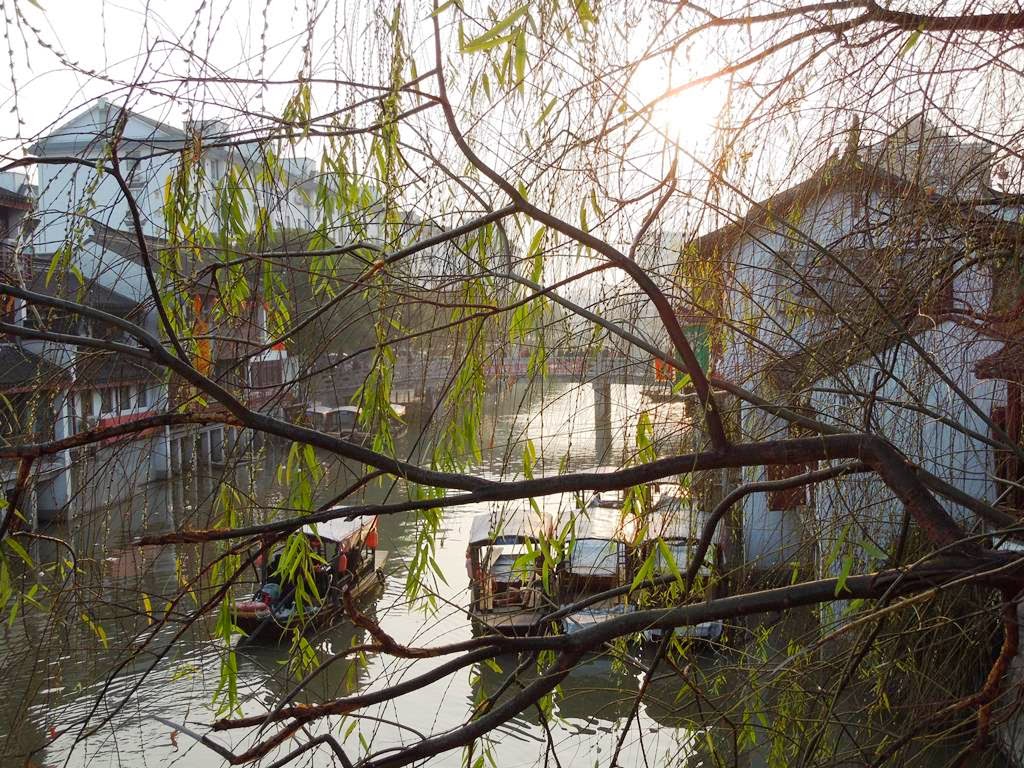
One thing both places have in common is that the sightseeing spots will be extremely crowded, aka  人山人海. The photo above was taken in Qībăo 七宝, a so-called "water town" that lies within the Shànghăi 上海 city limits. I had already visited the area last year on Columbus Day, but my wife suggested going again this afternoon. The most direct way for the us to get there was by bus, a short but jarring ride (the driver was apparently never taught how to gradually accelerate and decelerate) highlighted by a shouting match between a middle-aged woman who had tried to hold a vacant seat for her elderly father and another elderly gentleman who managed to get to it first. Never a dull moment in China.


Amber displays a sweet confection known as huàtáng 画糖, which you may notice has been formed into the shape of a rabbit (at my daughter's request). The look on the old woman's face probably sums up how it feels to have to battle the hordes everywhere you go during the holidays. As an outsider, it's easy to stand to the side and be amused by the situation, knowing you only have to put up with this for the relatively short time you're going to be in the country (plus it's easier to just go abroad during peak Chinese travel periods). But until the average Chinese worker can be assured that he/she will be able to take their allotted vacation time at their jobs without fear of retribution, most people will have no choice but to utilize the three long holiday periods (the Lunar New Year, May Day and the national day holiday on Oct. 1) to hit the road and see the sights of their vast country.


Places like Qibao are no more than glorified excuses to buy cheap souvenirs and gorge on snack foods.


Speaking of which, my wife decided that she absolutely had to have a wooden back scratcher.


This small stretch of canal is why Qibao is known as a "water town". A number of such settlements that have learned how to rake in the tourist 元 can be found in the greater Shanghai area.


Pamela encouraged me to take a picture of this teahouse because of the architectural style of its roof, but barbarian that I am, I couldn't really appreciate the significance of it. 


The quest for snacks is a never-ending one


My daughter loves quail eggs. Stacked behind her are piles of chicken meat wrapped in "dirt", as my wife describes it.


Pamela purchased some chicken stomachs from this food stand (they weren't bad, actually).


茄子!


A closer look at what you can see in the background in the above photo of Amber and me.


A quieter side entrance. Something to remember the next time we visit Qibao.


Banging the drum slowly. I'm not sure why there is a dated reference to the 2010 World Expo, which was held in Shanghai that year.


New Year decorations outside one of Shanghai's many huge shopping malls. Pamela wonders why there aren't any such temples of consumption in our neighborhood, but I doubt our wealthy neighbors would want the proletariat rabble such places no doubt attract.


The first day of our Lunar New Year holiday finished with my wife's favorite choice for dinner - hotpot 火锅. The bus ride home was a lot less dramatic, though we still had to hold on for dear life so as not to go sprawling in the aisle.

新年快乐!


Sunday, January 26, 2014

Here Comes Dr. Sun


It's supposed to be the world's largest annual migration: the hundreds of millions of Chinese migrant workers who return to their hometowns before the onset of the Lunar New Year, aka the Spring Festival 春节, which this year begins on January 31. Things are supposedly peaking right about this time, but you wouldn't have known it judging the relative lack of crowds this Sunday afternoon at Shànghăi's 上海 main railway station  上海火车站.


I went there hoping to see and photograph the immense numbers of people I was expecting to find lined up outside the station. Instead, the expansive plazas (Chinese city planners love huge, open spaces) on both the northern and southern sides of the train station were relatively empty. Even the lines at the ticket window were not very long. Sure, there were plenty of people pushing themselves and their belongings through the ticket gates, but the scene wasn't even remotely like the news images I had seen in recent years of the sea of humanity attempting to return home in what for many is the only chance they'll have all year to see the families and hometowns. Either I was too early or too late, or the authorities have gotten better about scheduling additional trains to handle the passenger loads.


From the Shanghai Railway Station, I made my way (alone, as my daughter was at home recovering from a cold and my wife wanted to rest) via the Metro to the French Concession area 法租界, one of Shanghai's nicer districts. From the Xīntiāndì Metro station 新天地站, it was a ten-minute walk to Fùxīng Park 复兴公园. Laid out by the French in 1909, it's one of the city's more pleasant green spaces.


Throughout the park, groups of old men could be seen playing card and board games...


...while a handful of elderly people were still doing tai chi exercises 太極拳, even in the middle of the afternoon.


The Chinese parasol trees 梧桐 were looking barren in the winter air, but in the heat of a sweltering Shanghai summer, they're no doubt a welcome sight.


Today was an ideal day for kite-flying, a popular activity in China


Nobody was paying any attention to the fathers of Communism


I'd assumed these groups of men were intent on watching some sort of Chinese version of chess, but in fact they were engaged in discussion amongst each other. A bystander told me they were "complaining about the Communist Party."


Reading newspapers posted on reading boards, in a scene that probably was a lot more common in the past than in this day and age of the Internet (even one that is heavily censored behind the Great Chinese Firewall).


The 1933 St. Nicholas Church 圣尼古拉斯教堂 is a short walk from the west gate of Fuxing Park. It started out as a Russian Orthodox house of worship, before morphing into a washing machine factory and then a French restaurant. It now houses Kinloch, a "Scottish cafe". 


Also close to Fuxing Park is the Former Residence of Sun Yatsen 孙中山故居, consisting of the Shanghai home of the "Father of the Country" and "forerunner of democratic revolution" (top) and a museum dedicated to the time he spent in the city and as the president of the Republic of China 中华民国 (bottom).


Dr. Sun Yat-sen 孙中山. Considered a great hero in both China and Taiwan, he was the first president and founding father of the R.O.C., and author of The Three Principles of the People 民族主义, a work of political philosophy as much fun to read as Das Kapital. Truth be told, although he had long worked toward the overthrow of China's imperial system, the 1911 Wŭchāng Uprising 武昌起义 caught him unprepared. His tenure as the country's first republican president was less-than-successful, as he was soon pushed aside by Yuán Shìkăi 袁世凱, who briefly made himself emperor before dying in 1916. Even with Yuan out of the way, Sun was never able to see his vision of a modern Chinese state realized, due to in large part to opposition from warlords. Following his death in 1925, Sun's Kuomintang party 国民党 was taken over by Chiang Kai-shek 将中正, who led it down an increasingly authoritarian, corrupt path that resulted in defeat at the hands of the Chinese Communist Party 中国共产党 forces and a hasty retreat to Taiwan.


Photography wasn't allowed in this national shrine. Sun's home, especially, is considered sacred ground where plastic covers have to be placed over your shoes before you're allowed to venture inside and have a look at what is a fine example of an affluent family's house in Shanghai in the early years of the 20th century. The museum next-door has some interesting displays, including Sun's uniform as well as a mini-revolver that he carried on his person. The English captions, however, assume that Western visitors are already familiar with this period in Chinese history and that there's no need to go into any background or give the items and photographs any sort of context.


From the Nationalists to the Communists: down Sīnán Road 思南路 from the Sun residence is a house that was briefly occupied back in 1946 by none other than Zhōu Ēnlái. Photography isn't allowed inside here, either, though the bare room decorations ensure that you aren't missing much by not being able to do so. The house has a terrace in the back with rattan chairs that gives it some colonial atmosphere, somewhat ironic considering the former occupant.


Next door, there's a small but pleasant garden, and an adjoining building that manages to overcome the dull (Communist) party-themed displays on the ground floor.


Zhou is still looked upon favorably by many Chinese, as he was seen as being more moderate and pragmatic than Máo Zédōng 毛泽东. That being the case, you don't survive as long as Zhou did in the eat-your-young world of internal CCP political machinations without making a number of morally questionable compromises, and Zhou shares at least some of the blame for the tens of millions of Chinese who perished under the idiocies that were the Great Leap Forward 大跃进 and the Cultural Revolution 文化大革命.


The neighborhood where Sun and Zhou lived is still filled with Western-style buildings from that era, including the house across the street from Zhou's that was used as a KMT outpost to spy on him. It's great to see the houses being lived in, though at least one had poles sticking out from the side with laundry hanging from it. This being Shanghai, there has to be at least one horribly-pretentious commercial/residential district, patronized by the city's nouveau riche and homesick expats. In this case, it's called Sinan Mansions, located halfway between the Nationalists (the Sun residence) and the Communists (the Zhou residence). Much like modern-day China, you might say...