Has it really been three weeks since my last post? My, how the time flies when you're not having fun. For lack of a better word, I've been feeling blase about life here in Shànghăi 上海, and the weather the past few weekends hasn't been ideal for mood enhancement, unless you enjoy being outside when it's cold and drizzly. I haven't been a recluse these last few weeks - we've gone out to department stores, restaurants and such, and I've taken a few long walks around the neighborhood. It's just that I haven't been seeing or doing anything interesting enough to generate a blog post (I have posted a few photos to Facebook). I'm not sure if today's outing to Lónghuá Temple 龙华寺 and the Martyrs Memorial 龙华烈士陵园 was anything out of the ordinary, either, but I've got to do something with all the photos I took this afternoon, so here goes...

The first thing you see as you approach the temple is the pagoda. 44 meters (144 feet) high, it dates back to CE 977.

Until the 1910's, when some of the Western-style bank buildings being put up in the International Settlement area began to overtake it, the pagoda was the tallest structure in Shanghai.


The temple itself also has a similarly long history, going back to the 10th century and making it the city's oldest monastery. The current buildings inside the complex are of much more recent vintage, being only about a hundred years or so in age, but the temple still retains its original layout, resembling a scaled-down version of the Forbidden City in the way hall follows on from hall once you've bought your entry ticket and made your way through the front gate.


Tourists such as ourselves were outnumbered this afternoon by serious devotees. Plenty of offerings and prostrations were to be seen in front of the various religious statues.


And there was certainly some impressive Buddhist statuary to behold in the different halls located on the temple grounds.


Despite the recent rainy weather, temperatures in Shanghai have apparently been warmer than usual this winter, and a couple of cherry trees at Longhua Temple were starting to bloom.

The one unpleasant aspect of visiting the temple was having to deal with the beggars outside the main entrance. While you would have to be extremely cold-hearted not to feel some pity for these poor unfortunates, their aggressive panhandling and zeroing in on Westerners whom they feel must be easier targets to lay guilt trips on made me think twice about giving anyone anything. I've donated spare change to people asking for charity on the Metro and in the streets, but if I had given one beggar some "alms" today, the others would no doubt have quickly converged on me and my family and wouldn't have let us alone. And it isn't just the disabled: in front of the pagoda and before going inside the temple, my wife was conned into buying what looked a Topps Buddha bubblegum trading card from a guy dressed like a monk. Pamela offered him 20 RMB ($3.25), but the "monk" complained, saying others had paid him upwards of 300 RMB ($48.80). When she told him to take it or leave it, however, our man of the Buddha took it and quickly left. Scenes like this are virtually non-existent in Japan and fairly rare in Taiwan, but unfortunately seem to be very commonplace in China.

Lunchtime. Though Longhua Temple had an onsite vegetarian restaurant, my carnivore spouse can't bear to have even one meatless meal, so we ended up eating at a place across the street (in case you're wondering about my daughter's bandaged hand, she broke her left pinkie finger a few weeks ago by falling down while carrying a large stone for some strange reason, and somehow dropping it on her finger in the process).

Next door to Longhua Temple is the Longhua Cemetery of Martyrs, a large park which memorializes those who died in the name of Chinese Communism. Communists the world over used to commemorate fallen heroes and significant events by erecting grotesque statues and sculptures, and the Chinese Communist Party was no exception. Here, Amber poses in front of the Children's Heroes Sculpture.


The Independence Democracy Liberation Construction Sculptures. Pamela couldn't understand why the figures on these and other statues in the park resembled muscular and big-breasted Western males and females. Neither could I.

The statues of the Martyrs Memorial seemed frozen in time while outside, Shanghai continued its mad rush into the 21st century.
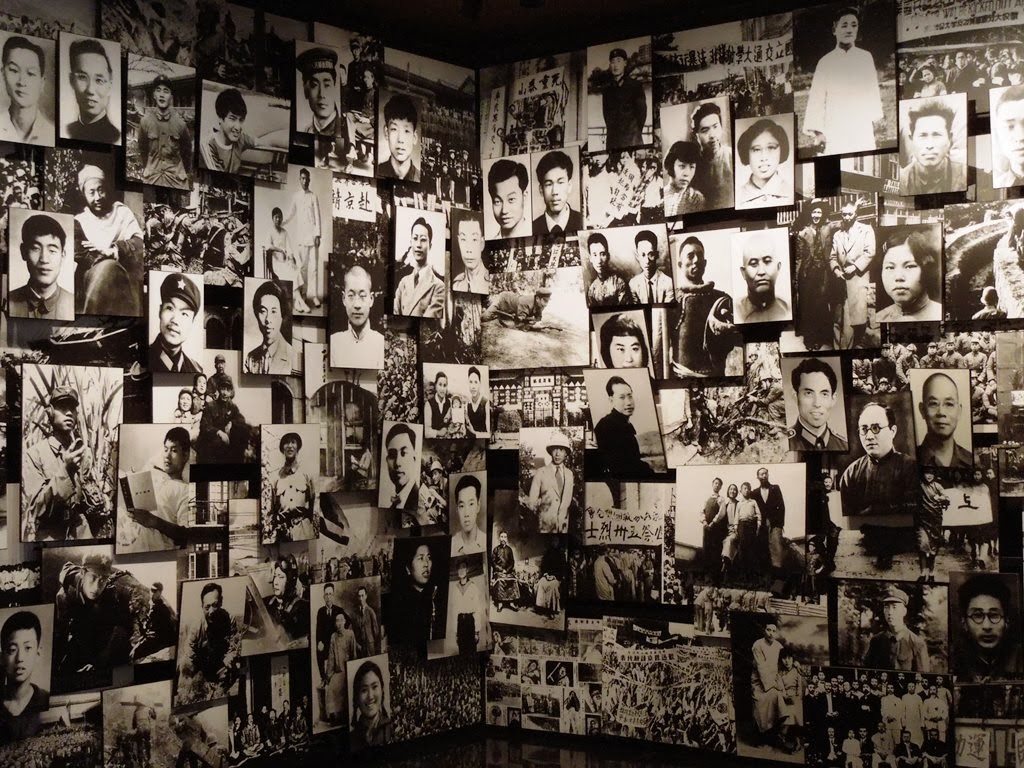
In the center of the grounds stands the Memorial Museum, devoted to those who gave their lives - some at the hands of the Kuomintang (KMT) 国民党 (Shanghai was the site of a notorious massacre in 1927), others killed fighting the Japanese (and, later, the Americans in Korea), and even some who were killed during engineering projects or police officers who died in the line of duty after the establishment of the People's Republic in 1949.

It was sobering how many of the idealistic martyrs commemorated in the hall were only in their twenties and thirties when their lives were snuffed out. Frustratingly, the English captions only gave their names, hometowns and positions in the party at the time of their deaths, leaving the facts of how they were killed reserved for those who could read Chinese. Too many of the English-language explanations were of the "glorious-" or "heroic deaths in battle" variety. My daughter said it best when she wished all war could be stopped.


The most sobering photos were those showing the executions

On the other hand, some of the paintings were bizarre, like this one of a group being led to the execution ground (the park housing the Martyrs Memorial was built on the site where the KMT put 800 people to death for political crimes between 1928 and 1937). It was more Christian than Communist.

My favorite painting was this one of a battle during the Korean War. American soldiers on the right are being cut down by heroically-depicted Chinese "volunteers". Most of the 250 martyrs memorialized in the hall, though, were victims at the hands of fellow Chinese, and not of Japanese devils or American imperialist paper tigers.

Somehow, I find it hard to believe that the idealistic young pioneer struck the Socialist-building pose as the flood waters engulfed him.


The Unknown Martyrs Sculpture and some actual graves


Amber demonstrates some joie de vivre (the pyramid in the background is the Memorial Museum) while the Tampa Bay Rays meet the Aggression with One Mind Sculpture.

Behind the Liberating Shanghai Sculpture was a lone tai chi practitioner


