Thursday, February 26, 2015

Lunar New Year: Chiran and Ibusuki

Chiran 知覧

All that driving around on Sakurajima 桜島 the day before must've had an effect on me, because that evening, back at the hotel and before going to bed, I decided that instead of using buses and trains to get around the next day as originally planned, we would rent another vehicle and drive to Chiran and Ibusuki 指宿, our intended day trip destinations. And so it came to pass that following breakfast on Friday morning, we strolled over to a nearby car rental agency, and for just ¥7020 (less than $60) we found ourselves behind the wheel of a Nissan. With an easy-to-program GPS (just enter the phone number of your destination, choose a route and off you go), it was an easy drive out of Kagoshima 鹿児島 and to the small town of Chiran. 


A Doll Festival 雛祭り display at Chiran tourist information center

Chiran was the site of an airfield that served as a base for the kamikaze 神風 suicide pilots during the last phases of the Second World War. There's now a museum commemorating the young men whose lives were so tragically wasted, but as much as I wanted to visit it, with a nine year-old in tow it probably wouldn't have been the best choice for a family outing:


Instead we took advantage of the fact that Chiran is also home to a cluster of samurai houses 武家屋敷 dating back to the 18th century. The houses are still occupied and thus can't be entered, but seven of them have opened up their gardens for the public to come in and have a look. Most of them consist of plants and rocks designed to conjure up images of Chinese landscape paintings, with the Japanese twist of using nearby hills as "borrowed scenery". All seven are evocative of a time before Japan was forced to open up to the Western world in the mid-19th century:

No. 1 - the garden of Saigō Keiichirō 西郷恵一郎:


No. 2 - the garden of Hirayma Katsumi 平山克己:


No. 3 - the garden of Hirayama Ryōichi 平山亮一:


No. 4 - the garden of Sata Mifune 佐多実舟:


No. 5 - the garden of Sata Tamiko 佐多民子:


No. 6 - the garden of Sata Naotada 佐多直忠:


No. 7 - the garden of Mori Shigemitsu 森重堅:


All that garden appreciation soon worked up an appetite, so the three of us had lunch at a restaurant specializing in soba そば and udon うどん noodle dishes:


On this trip Amber carried a monkey on her back in the form of Calpis Soda カルピスソーダ:


Back in the car and eschewing the coast road, we drove inland, stopping at one point to admire the view looking down on Ibusuki...:


...and the familiar shape of Kaimon-dake 開聞岳, a 922 meter-high mountain that I would've hiked had I been going solo on this trip:


At Pamela's suggestion, we made a brief stop at Lake Ikeda 池田湖, the largest lake in Kyūshū 九州 and home to Japan's own version of the Loch Ness Monster, Issie イッシー. Amber checked out one unconfirmed sighting of the creature:


It was mid-afternoon when we rolled into Ibusuki, a seaside/hot spring resort town that was unsurprisingly quiet on a chilly day in late February. 


Ibusuki is most famous in Japan for sand baths 砂むし. How it works is that you buy a ticket and change into a yukata 浴衣, then walk down to the beach, where attendants bury you up to your neck in hot (over 50°C), black volcanic sand. As we couldn't take pictures, here is what it ideally looks like:


Despite an initial bout of nerves, the experience proved to rather enjoyable. At first it felt like being entombed in concrete, but once I established that I would be able to move my arms and legs, I could lie back and let the warmth sink in. Because of the cold weather and the threat of rain, all the sand bathing took place under cover, with bathers lining up and waiting for a spot to become free:


After the suggested ten minutes were up (though you can lie there for as long as you like), we trooped back into the Saraku 砂楽 bathhouse to wash of the sand, and then relax in the hot spring. All is right with the world when soaking in a Japanese onsen 温泉:


We followed the coast for the return trip to Kagoshima, stopping at one point to admire the view of Sakurajima, still puffing away in the dimming daylight:


I spent the Nineties living in Tōkyō 東京, and it was that intense urban experience that first defined what life in Japan meant for me. In 2004-2005, however, my wife and I lived in Yokkaichi 四日市, a suburban city within commuting distance of Nagoya 名古屋, where most people got around by car and did their shopping at large (by Japanese standards) shopping malls with plenty of parking spaces. In many of my travels throughout Japan in the years since, I've spent time in a number of similar small cities and large towns, and the drive back to Kagoshima was a familiar one, as I recognized many of the shops and restaurants that lined the highway as we approached the city (some of which would be unfamiliar to residents of Tokyo, Ōsaka 大阪 and other major metropolises). 

Back in Kagoshima, we filled up the Nissan at a gas station and returned it to the car rental agency, then walked over to the shopping plaza connected to Kagoshima-Chūō Station 鹿児島中央駅. Dinner was tonkatsu とんかつ, a favorite of Amber's and mine:


At the end of an enjoyable day we returned to our home for the three nights we stayed in Kagoshima, the Hotel Gasthof ホテルガストフ. The triple room could barely contain the three of us and our things, but it was comfortable, and only five minutes' walk from Kagoshima-Chuo Station. Plus the hallways had a funky period ambiance to them:


One of the products for which Kagoshima is noted is sweet potatoes, known in Japan as Satsuma-imo サツマイモ (Satsuma 薩摩藩 being the name of the former feudal domain that included Kagoshima). While on our drive around Sakurajima the day before we purchased two Satsuma-imo products, one a jam (sweet, sticky and delicious) and the other a craft beer 地ビール, the latter serving as a nightcap for this Friday:




Lunar New Year: Sakurajima

Sakurajima 桜島

As an admitted Japanophile, last year was a difficult time in that it was the first year since 1988 that I never stepped foot on Japanese soil for any purpose whatsoever - not for travel, not in transit and certainly not to return to a home and a job. Thanks to my better half, however, all is right with the world again early in 2015 as it was her suggestion we visit Japan during the Lunar New Year holiday. Pamela initially wanted to travel to the northernmost island of Hokkaidō 北海道 to experience some snow, but the thought of being surrounded by thousands of Chinese tourists led us instead in the opposite direction, to the city of Kagoshima 鹿児島, on the southern island of Kyūshū 九州. There were still plenty of Mandarin-speaking visitors there, but many of them were from Taiwan, and in any event we were fortunate not to run into any large tour groups. 

We left Shànghăi 上海 last Thursday afternoon, and arrived at Fukuoka Airport 福岡空港 almost at the scheduled time of 5:15. The airport there is one of my favorites, mainly due to the fact it's only two stops on the subway to Hakata Station 博多駅, a claim to convenience that few major urban airports can make. By 7:00 in the evening local time the three of us were seated on the Kyūshū Shinkansen 九州新幹線 for the 138-minute bullet train ride to Kagoshima-Chūō Station 鹿児島中央駅:


Kagoshima's most famous attraction is an impressive one. Not many cities in the world are situated just 4 kilometers from an active volcano. Sakurajima is only a 15-minute ferry ride across Kagoshima Bay, and on Friday morning we took a tram from Kagoshima-Chuo to the port:


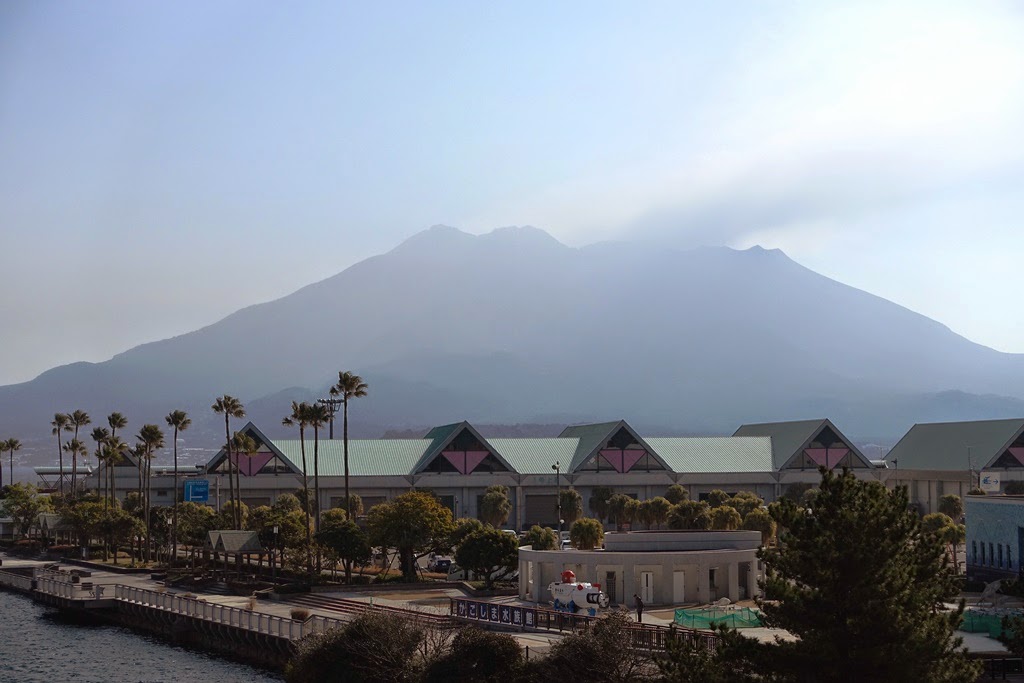
As we approached the west coast of Sakurajima, the volcano was smoking away:


A single, 40-kilometer road makes a circuit around the former island, and we rented a car from a small shop across the road from the ferry terminal. First stop was the visitor's center, where there were displays on the volcano, including photographs from a massive eruption in 1914, the lava flows of which connected the southeastern half of Sakurajima to the mainland, thus ending its status as an island:


In the rear of the center was a long foot bath 足の湯, comfortably warming in the chilly winter air:


Our road tour really began with the drive up to the Yunohira Lookout 湯之平展望台, 373 meters above sea level and providing views of the Kita-dake 北岳 and Naka-dake 中岳 peaks. Smoke could be seen rising from the still-active Minami-dake peak 南岳 in the background:


The view toward Kagoshima city was also pretty impressive on this clear day. Much of the land visible in the photo below was the result of lava flows from the 1914 eruption:


From the lookout, we continued on our circuitous route, enjoying the views out to sea on our left:


Looking to the right, we were greeted by a sight none of us had ever seen in person: a volcano in the throes of an eruption. Knowing that this happens numerous times on a daily basis on Sakurajima was little comfort as the ash cloud seemingly made its way toward us:


The scale of the 1914 eruption is best realized by the sight of this Shintō 神道 shrine gate. This torii 鳥居 once stood three meters high, until it was covered in ash:


Almost as astounding as the ongoing eruptions is the fact that people live at the foot of the volcano. The buried torii lies in front of a school, and we had lunch at a cafe across the road. Afterward, we stopped off at a small store, where Sakurajima's famous giant daikon 大根 radishes were growing in the plot in the back (in contrast the local mandarin oranges, mikan みかん, are tiny, a result of the same rich volcanic soil).


The best place to see Minami-dake in action is the Arimura 有村 Lava Observatory. Below, Amber checks out one of the many shelters located around Sakurajima, a sobering reminder that another major eruption likes the ones in 1914 and 1946 could happen at any time:


And as I was pondering the necessity of the shelters, Minami-dake erupted yet again:


By this point on our journey, our clothes were covered in a light coating of ash and dust:


In the southern part of Sakurajima is the Karasujima 烏島 Observation Point, built over the same 1914 lava flows that engulfed a small island that used to be located 500 meters offshore:


After dropping off the car, it was time for a selfie before getting back on the ferry for the ride back to Kagoshima:


Amber became quite attached to the mikan plush toy that she bought at the visitors center. It would be her constant companion on our trip:


Back in the city, we took a tram to the Tenmonkan shopping arcade 天文館本通アーケード:


Images of local hero Saigō Takamori 西郷隆盛 can be seen all around Kagoshima. Saigo was one of leaders of the Meiji Restoration 明治維新 that ended centuries of feudal rule and started Japan on its drive toward modernization, only to become a tragic hero when he rebelled against the new government after fearing that the reformers were moving ahead too quickly. The Satsuma Rebellion ended in failure and Saigo's death, but his ultimately futile resistance is still admired in modern-day Japan (and served as the inspiration for that ridiculous Tom Cruise vehicle The Last Samurai):


Dinner in Tenmonkan was okonomiyaki お好み焼き, a dish often described as a "Japanese pancake", though it bares little resemblance to what that word conjures up in North America. Mine was a seafood mix garnished with seaweed and bonito fish flakes. Japan is a land of many attractions, and sampling some of the cuisine is (or ought to be) one of the definitive highlights of any visit:


Following dinner, we walked back to the Kagoshima-Chuo Station area. While Pamela retired to our hotel, my daughter and I decided to try out the Ferris Wheel located atop the Amyu Plaza アミュプラザ shopping center next to the station building. Amber elected to ride in the "skeleton" car - the one with the transparent floor and sides. A little unnerving, but a fun way to end the day: