Monday, August 10, 2015

State of the Union

A few observations made during the two weeks that we've been back in the United States:

1.) People are nice. Clerks are always wishing you a great day, police officers point you in the direction of their favorite seafood restaurants and drivers are courteous. OK, so being friendly to customers is part of the job, and were I a young African-American male, I would probably be extremely careful in my interactions with local law enforcement. But after having driven in Taiwan and China for the last several years, it's wonderfully refreshing to be in a land where cars stop to let you cross the street on foot or to pull into traffic from a side road when you're driving, and where traffic laws are actually regulations, and not just guidelines.

2.) Talk to strangers for a few minutes, and you're bound to walk away with their life stories. Like the woman who struck up a conversation at the Bremerton ferry terminal after overhearing my wife and daughter conversing in Mandarin. Within five minutes, I learned that she had lost a child and would be resuming dialysis treatment. It seems there are a lot of lonely Americans who need to open up to strangers. It's times like these I miss that Japanese reserve.

3.) I don't ever want to live within a large American city. The walk from the ferry terminal in Seattle through Pioneer Square to the International District passes through a gritty area populated by the homeless and the panhandling, and laced with an aroma of urine. I never felt threatened, but it was a stark reminder of how this country still hasn't placed solving its urban ills at the top of its list of things to do. Sure, there are lots of hip, gentrified neighborhoods with great cafes, restaurants and shops, but residents always have to keep a list in their minds of streets and areas to avoid. Tōkyō 東京 (and to a lesser extent Taichung 台中) spoiled me when it came to urban living.

4.) Last Thursday's debate was yet another example of how ridiculous the Republican party has become. There was a time long, long ago (during the early years of the Margaret Thatcher and Ronald Reagan administrations) when the right was the only source of fresh political thinking. Now the reasonable wing of the GOP has all but withered away, and being conservative is synonymous with a Fox news-promoted anti-intellectual, anti-everybody who isn't a white, Christian male viewpoint of the world. As the makeup of the country continues to change, the scared white men will eventually fade away from the scene, but they'll go out kicking and screaming, doing a lot of damage to America's standing in the rest of the world in the process.

On a more personal level, here are a few of the things we did this past week:

Bremerton is defined by the large Puget Sound Naval Shipyard located on its waterfront. Should this facility ever close, the local economy will be devastated:


We don't plan on visiting Seattle too often on this trip. The only excursion there we've made so far was to the International District to do some shopping at Kinokuniya Bookstores and the Uwajimaya supermarket. On the way from the ferry terminal we stopped for lunch at a Thai restaurant. Later, Amber and I snacked on a taiyaki 鯛焼き. You can take the boy (and girl) out of Asia, but you can take Asia out of the boy (nor his daughter):


Walking through Pioneer Square hasn't been the same since Elliott Bay Books left the neighborhood back in 2010:


One institution still around is Ivar's, where eating clam chowder while being eyed by greedy seagulls is a time-honored tradition:


I never get tired of the views from the ferry of Seattle's waterfront:


On another day, we drove to Bainbridge Island. On the way, my daughter wanted to see  the Suquamish Museum, with exhibits on the culture and history of the Suquamish people. My child is bi-cultural; both her cultures weren't exactly understanding of the indigenous people of the lands they colonized:


Winslow, once the biggest city on Bainbridge, is a pleasant burg of boutiques, galleries and upscale restaurants. Convenient ferry connections to Seattle make it a popular weekend destination, though it was relatively quiet in the middle of the week when we visited:


Our area is blessed with many well-maintained parks. All is not perfect in paradise, however:


This commitment to setting aside land for parks means there are numerous paths to explore. While they could hardly be described as hiking trails, they provide convenient opportunities to take what the Japanese would call a グリーンシャワー:


The weekly Bremerton Farmers Market in the Evergreen Rotary Park isn't particularly large, but it has a good selection of foods, fruit and vegetables. We purchased some blueberries, cucumbers and green beans, while I had myself some turkey chili for dinner. Pamela wants to go back to try some barbeque, while Amber has her eye on some homemade ice cream. Like many farmer's markets, it's an idealized version of small-town Americana, only in this case situated next to the ocean:


I took a walk through the streets of Bremerton one morning while the girls relaxed at home. Though the city has invested a lot in recent years by building condos and developing tourist attractions along the waterfront (including the Turner Joy, one of two destroyers allegedly attacked by North Vietnamese torpedo boats in August 1964, which led to the Tonkin Gulf Resolution and the later commitment of ground forces in Vietnam), the downtown is still block after block of mostly closed shops, a depressing sight that is especially contrasted with its backdrop of mountains and Puget Sound:


The Admiral Theatre is a good example of what has happened to the downtown areas of small American cities after people fled to their suburban homes and Walmarts. A photo from 1956 showed a busy street scene; now the theater survives by playing host on the nostalgia circuit. Three Dog Night's coming to town soon:


If you've ever wondered where the phrase "Give 'em hell, Harry" originated, now you know. Truman stood on the balcony of the brick building in the picture below: 


Poulsbo is another small town that survives by catering to the tourist trade. Bakeries, galleries,  restaurants and others play off the Norwegian theme (the town was founded by Scandinavian immigrants after "securing" the land from the original Native American inhabitants). In modern-day America, the only way places like Poulsbo can remain economically viable after their traditional industries have vanished is by turning themselves into large boutiques. Mind you, I'm not complaining; the beer and crab cakes were good:


My favorite trail in the Bremerton area is the Clear Creek Trail (which is actually in Silverdale), which starts at Dye's Inlet and works it way inland. There are even some small hills that provide good views when the skies are clear (as it was today; in fact, the weather has been great so far, with very little rainfall, "thanks" to an ongoing severe drought gripping the western part of the United States):


One section of the trail winds it way through open fields, with old farmhouses providing a bit of borrowed scenery:


This stump is all that remains of a seven hundred-year-old cedar tree cut down by loggers in the 1800's, part of the conquest of the American west:


The view:


Though I've been treating this area as a place to explore and not as "home" (though I have a roof over my head, in many respects I'm "homeless", and have been so for quite some time), the most important reason for being here is to see family again:


Monday, August 3, 2015

Back in the U.S., back in the U.S., back in the U.S.S.R...er, I mean U.S. of A.

It's been a week since we left China and returned to the United States at the end of a two year-long posting in Shànghăi 上海. We're on home leave, a Congressional-mandated period of paid leave in the U.S. meant to re-Americanize U.S. government personnel who've spent long periods of time overseas. And we definitely need it, for unlike many of my colleagues, my family and I never returned to the U.S. while in China. Instead, we used our vacation time to travel throughout China, as well as to make trips to Belgium, Hong Kong, Japan and Thailand, while my wife and daughter frequently visited Taiwan. Pamela has only been a U.S. citizen for three years now, while Amber has only lived for just over a year in the States, having spent the first six years of her life in Taiwan. In my case, having suffered severe bouts of reverse cultural shock in the past, I've learned the best way to re-acclimatize to life in the United States is to approach the U.S. as a foreign tourist would, with camera in tow, eyes agog and a strong desire to experience new things and visit new places (as well as more familiar ones). 

So far, so good (and knock on wood). We're currently based in Bremerton, located across Puget Sound from Seattle. My parents live here, and my sister is a relatively short drive away in Mukilteo. We're renting an apartment for the month, just a ten-minute walk from the downtown waterfront area. We've already bought a used car to get us around, as well as to hopefully stay in one piece long enough to take us across the country at the end of this month to the other Washington. The weather has been close to ideal, with temperatures in the high 80's to low 90's, and with almost no humidity (it did rain once, but this is the Pacific Northwest, after all), not to mention the beautiful blue skies and fresh air. The one drawback so far has been the food. Not because it's been bad (far from it, though we haven't gone to any Asian restaurants yet), but because I've already put on weight. Americans are unbelievably huge, and if I'm not careful, I'll soon be joining the ranks of the no-longer-walking obese.

In addition to counting calories, I plan on spending the next few weeks spending time with family, exploring the surrounding area, drinking fine craft beers (well, so much for the calories) and rediscovering the outdoors, while helping my wife and daughter make the transition back into American life. Home leave has begun...

Amber and I pose in front of our 2007 Subaru Forester:


Lunch at Hi-Lo's 15th Street Cafe, described on Google as an "earthy corner cafe" and filled with curios from my childhood. The chicken sandwich was pretty good:


Playing a round of miniature golf with my daughter. She was in contention until she shot an 11 on the last hole:


Our first day trip in the Subaru was the short drive to Seabeck in a quest to see bald eagles at Big Beef Creek. None were sighted, but the views across the Sound were almost sublime: 


Lunch at Seabeck Pizza:


This poor jellyfish expired when it became stranded too close to the shore after the tide had gone out:


The Bremerton marina at sunset:


Blue moon over Bremerton:


On Saturday we took the ferry from Kingston to Edmonds to visit my sister in Mukilteo. The shore beckoned, but we had a ship to catch:


On the car ferry going over:


Mount Rainier has been visible most of the time we've been here:


Another soaring Cascades peak, possibly Mount Baker:


We had a good time at my sister's, including a dip in the apartment complex pool. Afterwards, we drove onto the ferry in time for the sunset:


This morning Amber and I went for a walk through the woods at Anderson Landing in Silverdale. While the trails were far from extensive, after Shanghai it was great to be in the outdoors again:


Most of the trail was under the forest canopy, but there were views of the ocean:


Lunch this afternoon was at Jimmy D's Hwy 3 Roadhouse, part of what will ultimately be a doomed attempt to recapture an idealized version of an American past that never existed in the form I imagine it took:


Further Quixotic adventures were had at a local flea market, where I purchased a paean to Los Angeles' legendary Red Car system:


It isn't just microbrews. In the next eight months or so, I'm going to overdose on a wide range of handcrafted/retro sodas, waistline be damned:


Saturday, July 25, 2015

It's the end of the post as I know it...and I feel fine

Lame.

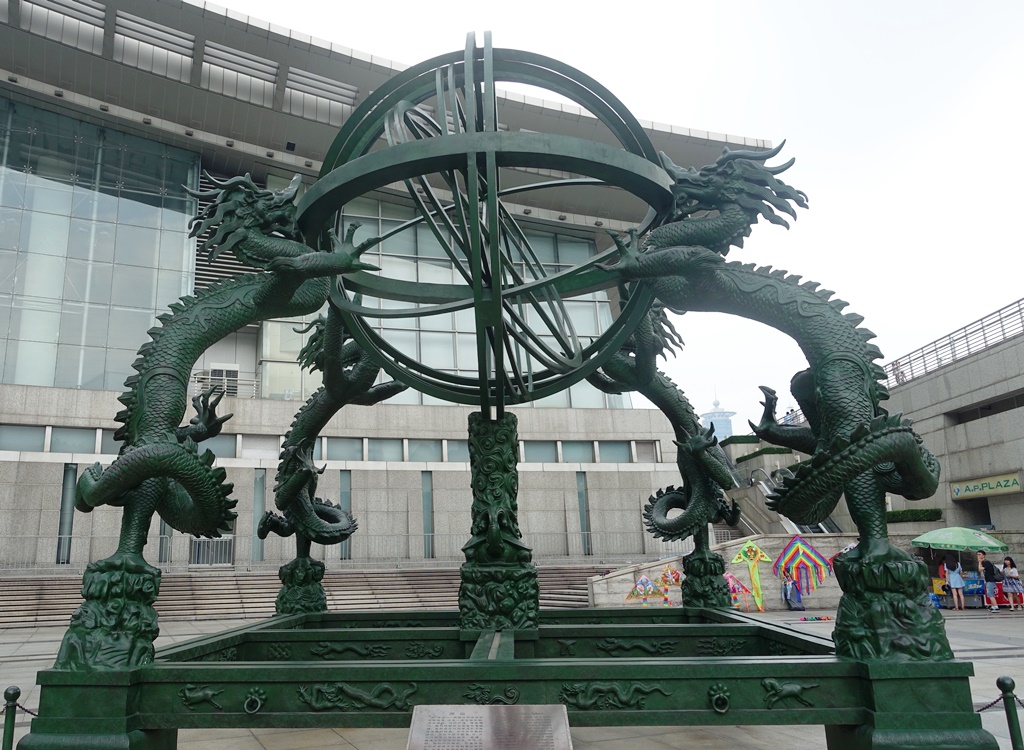
That's how I would describe the Shanghai Science and Technology Museum 上海科技馆, which my daughter and I visited today on a last sightseeing hurrah in Shànghăi 上海. The design of the building is striking, but for the most part the exhibits within are uninspiring. Lonely Planet's writers inexplicably describe them as "fascinating", but I'm assuming the authors of the Shanghai guidebook haven't visited too many museums elsewhere in the world. There were some interesting displays, such as the one on spiders (though it would've benefited from having actual arachnids to look at instead of mere mockups), while the 4D movie we watched (a Finding Nemo-inspired look at life under the sea in the Jurassic period) was entertaining. But the sheer number of people visiting today made getting around the vast interior a draining experience. Fortunately for Amber, she had been to the museum back in the 2nd grade while on a school field trip and had a much more productive visit then. But all things considered, this was a rather anticlimactic end to what has been a mostly enjoyable stay in China's biggest city; it certainly hasn't helped that our plan to go out for dinner this evening at a local Sichuan restaurant has literally been washed out by heavy rain. 


And so tomorrow two years and twenty-two days in Shanghai come to an end. In many respects, I'll be glad to move out and move on to new and (hopefully) better things. One thing I'm not going to miss is the pollution. While not as bad as in, say, Bĕijīng 北京 (though the two times when we went to China's capital the weather was almost perfect) or Chéngdū 成都, the air quality index can still get dangerously high at times, and long-term exposure is definitely something an expat should consider when deciding whether to relocate here (and pity the poor local who has to spend a lifetime in this kind of environment). The state of Chinese driving leaves a lot to be desired, though it isn't that much worse than in Taiwan, and so wasn't a major adjustment for my wife and I to make. And, of course, there's the censorship that comes with residing in a country governed under an authoritarian political system. The Chinese government's fear of its citizens communicating online with people in other parts of the world necessitates having to use a VPN in order to access sites like Facebook, YouTube and even this blog. Not content with just blocking "rumor-spreading" sites, the authorities are constantly attempting to block access by VPN's, making getting online to do routine tasks like checking up on social media a major headache at times. The heavy-handedness even spreads to more traditional media at times; during last year's Occupy Central demonstrations in Hong Kong, any time a story on BBC or CNN related to China was about to be aired, the TV screen would go black, and the picture would only return once the offending report was over, and a different story was being reported. And while Shanghai presents a prosperous face, there are pockets of poverty even in an upscale area like ours, with its large expat population, evidence that not all Chinese have benefited from "socialism with Chinese characteristics". 

On the other hand there have been a lot of positives. I was told when I first arrived here that I would be spoiled by having Shanghai as my first post, and that's proven itself to be the case. All of my colleagues during the two years I've been here, both American and Chinese, have been wonderful to work with, and morale in the office has been remarkably high. And Shanghai itself has been a great city to live in, with its numerous restaurants and shops complemented by a remarkably low crime rate for an urban area of 23 million people. Not once have I felt threatened here, even in the above-mentioned economically depressed neighborhoods. I'll be the first to admit that we've enjoyed life on an expat package, living in a house larger than most Chinese could enjoy, and with my daughter having the opportunity to attend a good international school that I wouldn't have been able to afford on my paycheck alone. I certainly wouldn't want to try to support a wife and child in Shanghai on an English teacher's salary, like I did in Taiwan, but it's easy to see why Shanghai is so attractive to the many single Westerners who come here to study or work.

In some respects, my worst fears about Shanghai have been realized, namely that it has most of the things that used to annoy me about living in Taiwan, only on a much larger scale. But Shanghai is without a doubt far more cosmopolitan than any Taiwanese metropolis (including even Taipei 台北), and I had far fewer encounters of the "Look! It's a foreigner!"-kind that are still sadly all too common in Taiwan. Probably the biggest effect Shanghai's had on me is in my perception of the Chinese as a people. Living in Taiwan, it's all too easy as a resident expat Westerner to think of Chinese as mindless automatons, marching in lockstep as they answer their government's call to realize the dream of "reunification" of Taiwan with the mainland. The deservedly poor reputation of some Chinese tourists overseas also makes it easy to assume that everyone in China is an extremely rude boor, pushing, spitting and urinating in public. In reality, most Chinese (at least those in Shanghai) seem to care little about Taiwan, the Senkakus, the South China Sea, the "revival of Japanese militarism" or any other hot button issue, preferring instead to get on with the mundane tasks of trying to make a better life for themselves and their families. And while examples of bad behavior are easy to find, for the most part my interactions with people outside of work were of the same normal variety that you would find elsewhere in the world (including acts of kindness). In short, the Chinese are no different than anyone else, and that shouldn't come as a surprise.

Even the government isn't as malevolent as I imagined it to be. Yes, there's the censorship, and rule of law is still lacking (as my visits to incarcerated Americans would at times attest). But the local media is far more open to critical reporting on political and social issues than I'd assumed (the government no doubt has learned it can be helpful to let people vent and to deflect attention away from other critical areas). And while the central government presents itself as omnipotent, it struggles to maintain control at the local level, where provincial interests (including the benefits accruing from corruption) can be much more important than the dictates coming out of Beijing. Like any vast bureaucracy (including the one I work for), there are competing interests and turf battles that make it hard to believe, for example, that every action taken by China vis-a-vis Taiwan is part of a grand conspiracy to draw the two countries closer together for eventual annexation "reunification". When it comes to dealing with Chinese officialdom, quite often their proverbial left hands have little clue what the proverbial other hands are doing, and quite often don't care to find out. That isn't to say I've turned into an apologist; far from it, as the U.S. is going to need to work even more closely with Japan and its other allies in the region to contain China (yes, I said it - see disclaimer at the bottom of this blog). But just as with the Soviet Union during the Cold War (those were the days!), we can't look at China while wearing a black-or-white, good vs. evil pair of spectacles. It's a complicated relationship that's going to have to be managed very carefully, and on numerous levels, by many rational, clear-thinking people.

I, for one, have little interest in being part of that management process, for in the end, I'm happy to get out and don't intend on coming back (though for obvious reasons Taiwan is a different matter). Having lived in Taiwan for too long, topped off with these past two years in China, I've had enough of life in the Mandarin-speaking world, and I'm looking forward to new and different challenges elsewhere, such as in Eastern Europe. I'm going to miss Asia, but mostly that relates to my relationship with Japan. However, I've enjoyed the time spent in Shanghai, and I wish the best to all my Chinese 同事们, past and present, at the consulate, as well as to my American colleagues. I may never return to China, but that doesn't mean I hope never to see them again.

Thanks for the memories, Shanghai, and 再见.