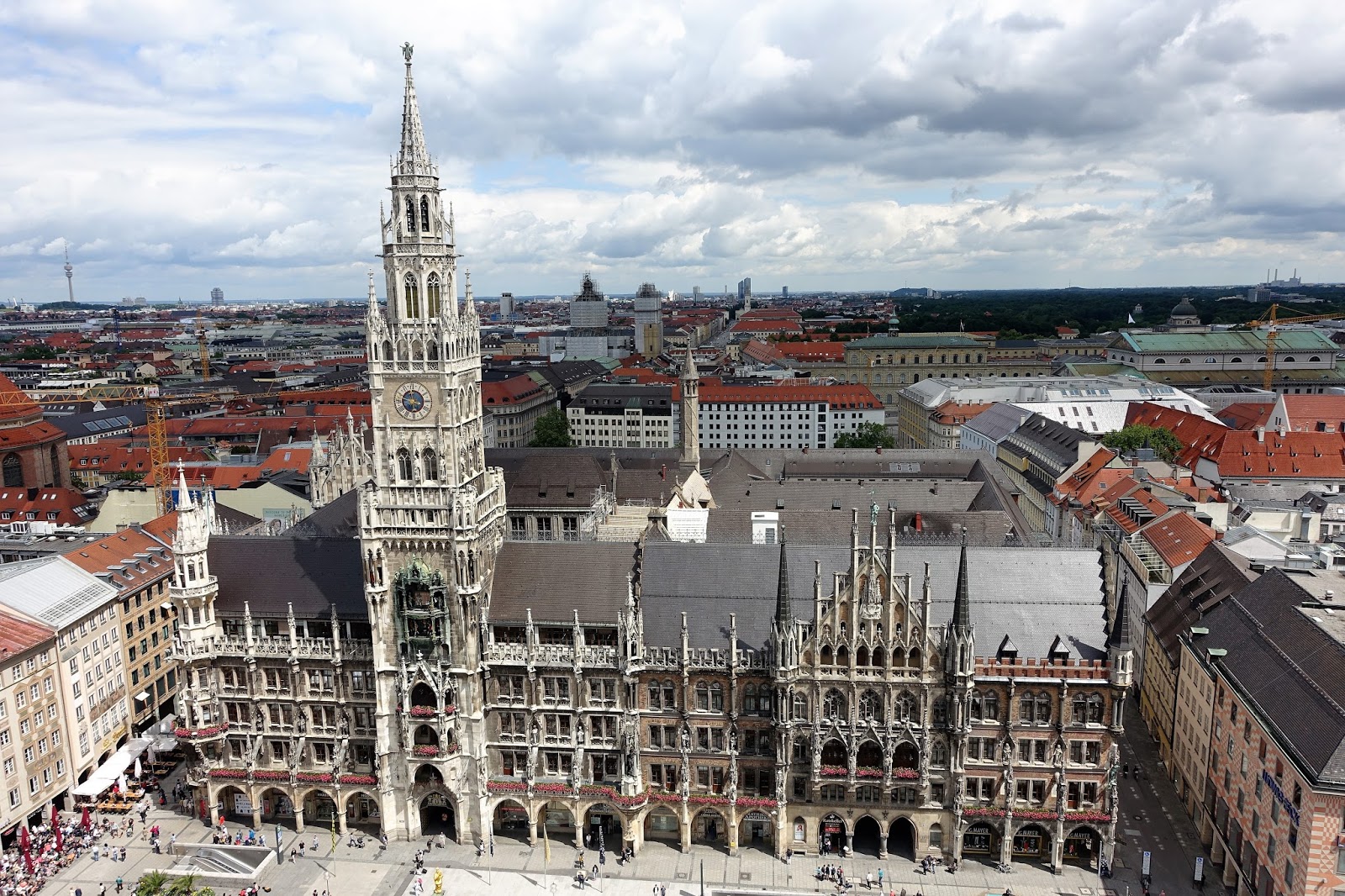
Munich from the tower of St. Peterskirche (Church of St. Peter)
One of the advantages of being posted to a European country, even one as small and relatively unknown as Lithuania, is the opportunity it provides to travel throughout the continent, especially within the Schengen Area (take that Brexit backers!). The lucky destination for our first family trip outside the Baltics was none other than Munich, the capital and largest city of the German state of Bavaria. It was my wife's suggestion to visit Germany first, and to take advantage of the break in the workweek created by both Independence Day (
aka the Fourth of July) and
Statehood Day (July 6;
aka Coronation of King Mindaugas Day), a public holiday in Lithuania, to expand our European horizons. And so the three of us arrived in Munich from Vilnius (via Riga) late last Saturday afternoon on an airBaltic Bombardier turboprop plane. Time wasn't wasted as we first dropped off our bags at our hotel, then proceeded on foot to the Augustiner Bräustuben beer hall, where I began my immersion into the best that German culture has to offer:


Many of the patrons were dressed in German national soccer team jerseys, as Germany would be playing Italy later that evening in the quarter-finals of Euro 2016 (and would eventually win 6-5 on penalty kicks after drawing 1-1; alas, they would lose 2-0 to France in the semi-finals). The women at the table near ours were already in a celebratory mood before the match even started:
Our home for the seven nights we were in Munich was the
Hotel Uhland, close to Theresienweise (locale for Munich's famed Oktoberfest) and one of the nicest mid-range hotels I've ever stayed in: the room was comfortable, the organic breakfasts delicious and the staff friendly:
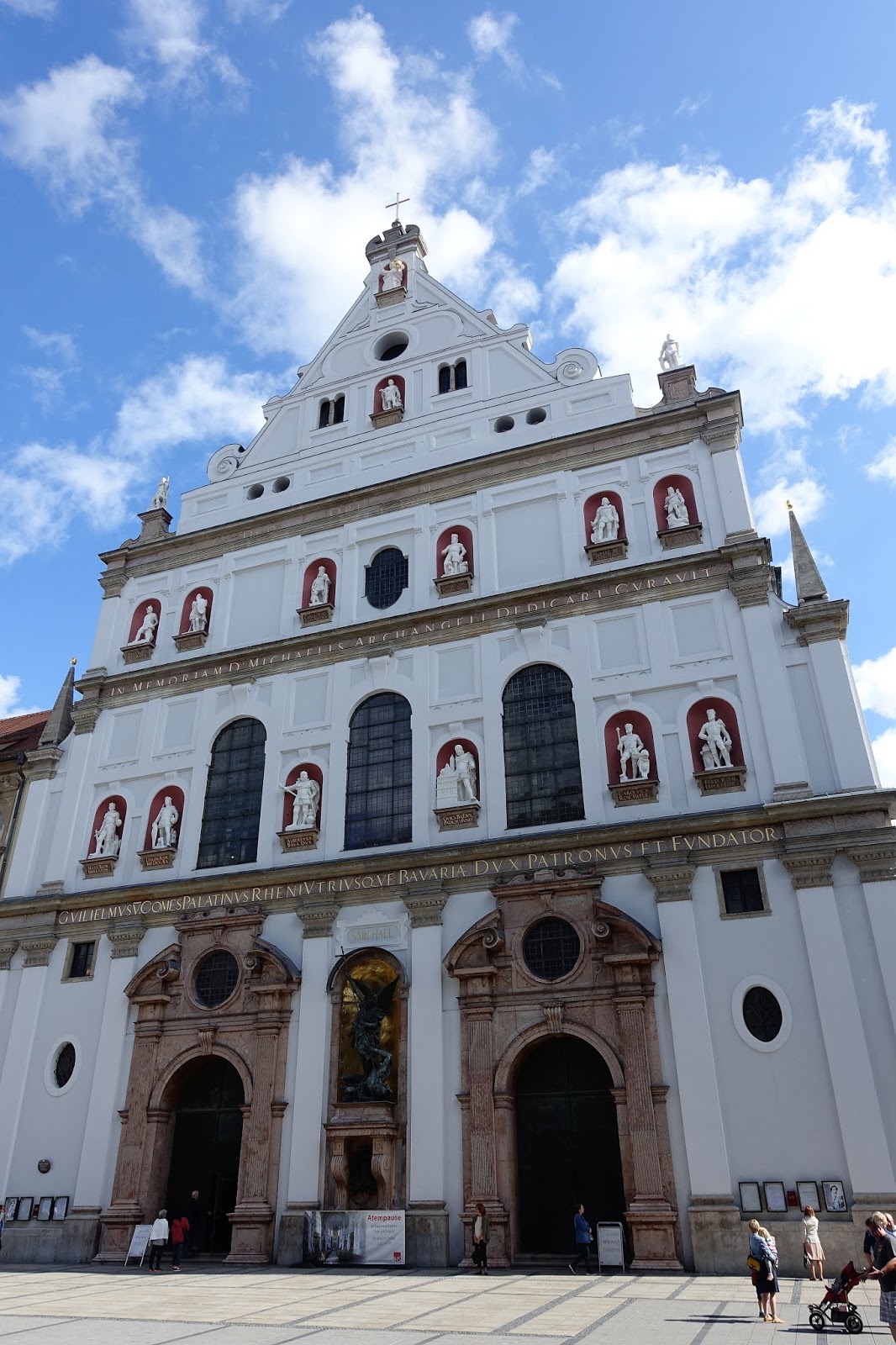
Our sightseeing began in earnest on Sunday with the short ride from Theresienweise to Karlsplatz on the Munich U-Bahn, and the start of an exploration of the Altstadt, the city's historic center. First stop was Michaelskirche (Church of St. Michael), completed in 1597, at which time it was the largest Renaissance church north of the Alps:
An archangel slays a dragon on the church's facade, symbolizing the triumph of Catholicism over Protestantism, at least in this part of Germany:
As it was a Sunday morning, a service had just gotten underway, meaning we wouldn't be able to visit the crypt, the final resting place of the Mad King, Ludwig II, who figures so prominently in Bavaria's history (especially when it comes to tourism):
Amber on Kaufingerstrasse, munching on a salted pretzel while standing in front of the FC Bayern Munich Fan Shop. It didn't get much more Munich than this:
The heart of the Altstadt is Marienplatz (Mary's Square), the center of which stands the Mariensäule (Mary's Column), built in 1638 to celebrate the defeat of Swedish forces during the Thirty Years' War. At the top of the column is a golden statue of the Virgin Mary standing atop a crescent moon:
The Mariensäule, in turn, stands in front of the Neues Rathaus (New Town Hall), a neo-Gothic historic building colored black by more than a century of coal smoke:
Gargoyles adorn the facade:
There are good views from the 85 meter (279 feet)-tall tower, including St. Peterskirche and the Altes Rathaus:
What draws the crowds to the Mariensäule are the twice-daily (three in summer) performances in the animated glockenspiel. The 43 bells and 32 figures perform two historic events, with the top part recreating a knights' tournament held in 1568 to celebrate the marriage of a local duke, while the bottom half portrays a rendition of the Schäfflertanz, a ritualistic dance of good fortune performed in real-life every seven years:
Taking a break by the blue-bottomed Fischbrunnen fountain:
Close to Marienplatz is Munich's oldest church, St. Peterskirche (Church of St. Peter), completed in 1150:
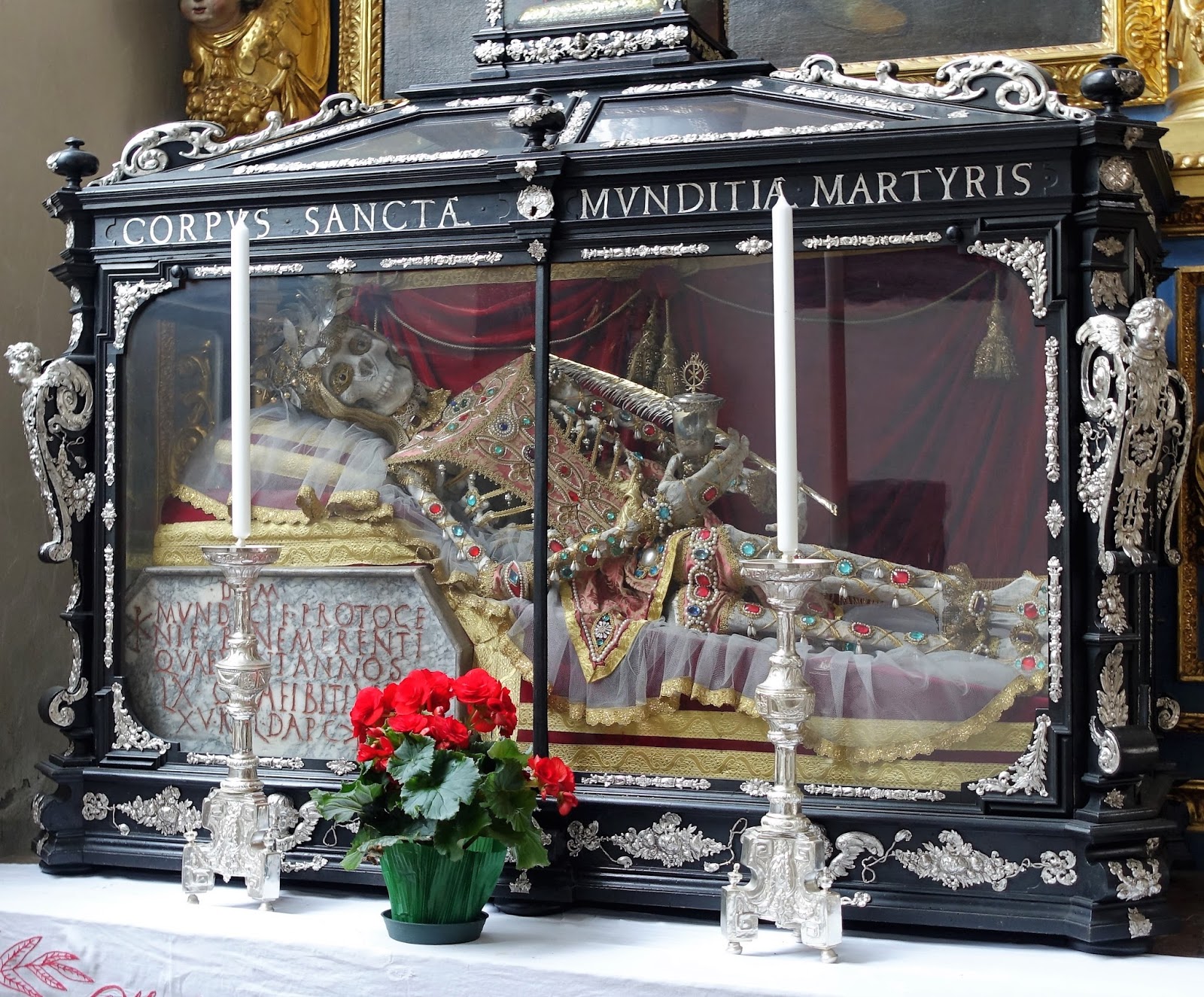
The interior includes the creepy relics of the martyred saint
Munditia:
More great views of Munich are had from the church's tower, standing tall at 92 meters (302 feet), reached by 306 stone steps (Amber counted them going up):
My daughter enjoys a post-lunch ice cream in front of the Altes Rathaus (Old Town Hall). The originals were destroyed by lightning (in 1460) and bombs (during World War II). Joseph Goebbels spoke here on November 9, 1938, launching what came to be known as
Kristallnacht:
Sinister has been replaced with cute, as the historic building is now home to the Spielzeugmuseum (Toy Museum), though the golem figure from 1580 could hardly be described as cuddly:
The Heiliggeistkirche as seen from the toy museum. The church, unfortunately, wasn't open on this day:
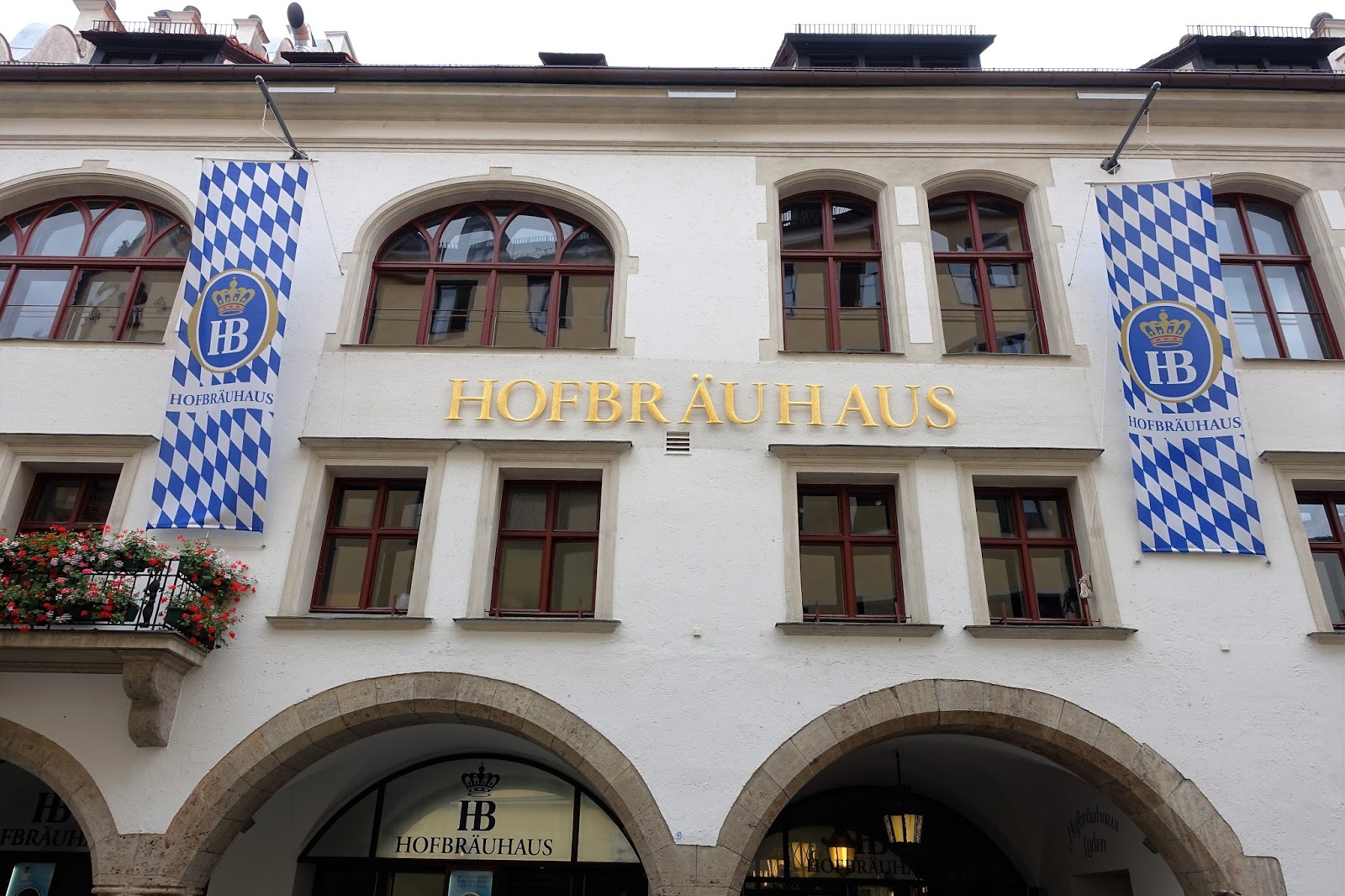
The
Hofbräuhaus is the world's most famous beer hall. We would eventually have lunch there, but not on this occasion, as the interior was crowded and stuffy (the weather in southern Germany was surprisingly warm during much of our stay). Instead we took a break at an outdoor cafe across the plaza:
The Alter Hof was once the home of the ruling Wittelsbach family but has been in private hands since the 15th century. This bay window on the southern facade of the central courtyard is called the Monkey Tower, from a story about an ape that rescued an infant from an angry pig:
"Money Rules" reads the words on the inscription, apropos for the former Münzhof (mint), which dates from 1567:
Max-Joseph-Platz, dominated by the Residenz (which we would visit on Friday) and the grand Nationaltheater (behind Amber in the photo below):
The Feldherrnhalle (Field Marshal's Hall) is aptly described by
Lonely Planet as "drip(ping) with testosterone", as it honors the Bavarian army. This was also the spot where Hitler's
Beer Hall Putsch was put down by the police:
Our final stop was the Theatinerkirche. The exterior is under wraps due to renovation work, and we arrived too late in the day to visit the royal crypt, but the interior of this church (built to honor the 1662 birth of Prince Max Emanuel) has to be one of the most impressive of any house of worship in Europe:
Our tour of the Altstadt finished, we took the U-Bahn from Odeonsplatz back to Theresienweise, where I ended the day with
schnitzel and beer, and a photobombing from my daughter: