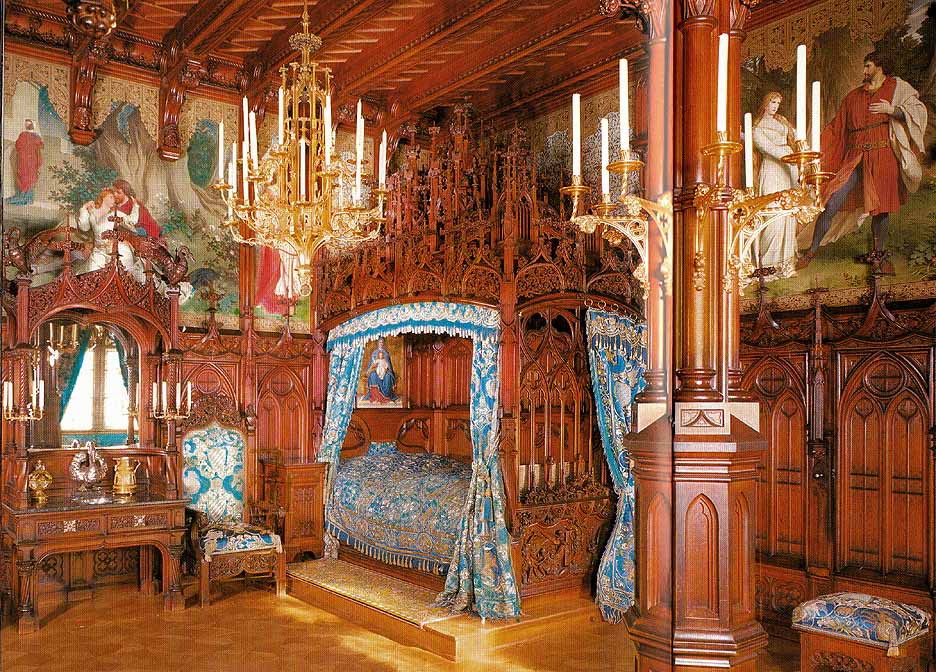
A little neo-Byzantine, anyone?
For our last full day in Munich (or Friday the 7th, to be more precise), we returned to the Alstadt, site of our first German explorations the previous Sunday. On this occasion, we took the U-Bahn to Odeonsplatz and made our way posthaste to the Residenz, the grand palace of the Wittelsbachs, the Bavarian ruling clan who lived there from 1385 to 1918. Munich's most popular attraction, in fact, is the Residenzmuseum, which would take up all of our morning. There are around 90 rooms that are open to the public at any one time, and seeing them is an exhausting but rewarding experience. Unlike the Ludwig II-related palaces Neuschwanstein and Herrenchiemsee, visitors to the Residenz aren't required to join a timed tour. Instead, you're allowed to move about at your own pace, armed with an audio guide providing an at times too-exhausting description of each room you step into. Best of all, non-flash photography is permitted inside the museum.
A fact which I took full advantage of.
The tour began with the Grottenhof (Grotto Court), home to a famed Perseus Fountain that we could only be glimpsed through the windows due to renovation work in the courtyard. The interior of the Grottenhof has a very-Indian feel to its design:

The Antiquarium is the first of the many jaw-dropping rooms encountered in the Residenz. It's a Renaissance-style barrel-vaulted hall lined with frescoes, and was built to showcase the ruling family's collection of antiques:


The rococo Ahnengallery (Ancestor's Gallery) is a long hall lined with 121 portraits of Bavarian rulers:

Rococo fans will also get a kick out of wandering through the six rooms that make up the Reiche Zimmer (Rich Rooms):


The Hofkirche was built in 1826. It was almost completely destroyed during World War II, with only the red-brick walls left standing (in fact, only 50 square meters/538 square feet of the Residenz' roof survived the war, and was painstakingly reconstructed in the years afterward). The room is now used for concerts:

My daughter checks out some paintings in a passageway:

The Kurfürstenzimmer (Elector's Rooms) hold a number of beautiful paintings, while a series of side rooms showcase the 18th-century passion for collecting ceramics and other pieces of art from China and Japan:


And then there is the Steinzimmer (Stone Room), the emperor's quarters:


Between the Residenz and Ludwig's castles, it's very easy to get palaced-out from the ostentatious displays of royal wealth (and at the same time perhaps gain an understanding why Marx believed that communism would take hold first in Germany). So for the rest of the day, we decided to take it easy (skipping the attached Schatzkammer der Residenz museum). Feeling hungry after touring the Residenzmuseum, we walked over to Munich's most famous beer house, the Hofbräuhaus. The place had been packed out the previous Sunday when we walked by, but on this Friday there were plenty of open tables (in the beginning, anyway). The site has a beer-drinking history dating back to 1644, and the first large-scale meeting of the National Socialist Party took place in its ballroom on February 20, 1920 (though the upstairs exhibition room was closed on our Friday there). While an oompah band played, Shu-E dined on her first German-style pork knuckle (Schweinshaxe), while Amber and I split an apple strudel for dessert:


From the Hofbräuhaus we walked back to, and then past, the Residenz, and entered the Hofgarten, a formal court garden behind the grand palace. A cellist was entertaining the lunch-break crowd under the octagon of the Dianatempel:


With the temperature hovering around 30°C (86°F), my wife decided she couldn't take the sunshine any longer (if she couldn't stand the "heat" in Munich, then I don't know what she's going to do when winter arrives in Vilnius) and elected to head back to the coolness of our hotel room. My daughter and I soldiered on however, first checking out the surfers riding the artificially created wave in the Eisbach:

After establishing that Munich was the German suburb of Surf City, the two of us entered one of Europe's biggest city parks, the Englischer Garten (according to Lonely Plant, the English Garden is bigger than London's Hyde Park or New York's Central Park), which stretches from north to south for a distance of about 5 kilometers (3.1 miles). The first thing we saw in the heart of Europe was the Japanisches Teehaus (Japanese Teahouse), which was built for the 1972 Olympics and is the site of occasional tea ceremonies held by a Japanese tea master:

Overlooking the sprawling lawn filled with Friday afternoon sun worshipers stands the 1838 Monopteros. The Greek temple was closed for renovations, but Amber and I clambered up the small hillside it stands upon to look at the Munich skyline:


I knew there was a Chinese pagoda in the garden, but the Chinesischer Turm is still a pleasantly jarring site. It was built in the 18th-century during a European-wide Asian craze and is the centerpiece of the city's oldest beer garden (1791). It also comes complete with an oompah band to entertain the drinkers:


Amber and I eventually returned to our hotel, where we retrieved Shu-E and went out for dinner at an Italian restaurant in Munich's Hauptbahnhof train station. The following morning, while the girls relaxed in the room, I took a walk around the Oktoberfest Grounds, the Therensienwiese (Theresa Meadow). At the western end of the expansive grounds is the Ruhmeshalle (Hall of Fame), lined with statues of Bavarian leaders...

...as well as the giant statue of Bavaria, which stands 18 meters (59 feet) high. For €3.50, it's possible to go inside the statue for a view overlooking Theresienwiese. While it might be an impressive site during Oktoberfest, all I would've seen on Saturday morning was a construction site, so I passed and continued my stroll around the meadow:


Before returning to the hotel, I stopped to have a look inside the modern Church of St. Paul. To my surprise there was an art installation inside called "Presence...!" What appeared to be seven photographs turned out to be seven videos playing on an endless loop:

All good things must come to an end, and so it was for the three of us in Munich. We packed up and checked out of the hotel, then took the U-Bahn to the Hauptbanhof, pausing long enough for me to buy a jersey from the FC Bayern München Fan Shop, before boarding the S-Bahn train to Munich's airport. Our airBaltic flight took us to Riga first (en route I tried my first Latvian beer), before the short, final hop to Vilnius and home:


There is a lot more to see in both Munich and Bavaria, of course, but a week was already a long time. Germany, or more specifically Bavaria, was great. It's a beautiful country, with a history both rich and tragic. The usual tourist boxes can be safely checked - friendly people, delicious food and drink, high level of safety - plus there's the freedom from speed limits on the Autobahn. If there are any drawbacks, it's that the cost of living is a lot higher than in Lithuania. Amber has already expressed a desire to visit Berlin (to see the zoo there), so there's a chance we might go back before our time in Europe is finished.
Auf Wiedersehen...for now.