
Wawel Cathedral and Wawel Castle
Enough carping about long drives, time to enjoy some of the sights of Kraków, Poland's former royal capital, with a history going back to the 7th century. The city served as the capital of the country from 1038 to 1596, when the seat of government was moved to Warsaw, though it remained the site of royal coronations and burials. Kraków avoided being the scene of any significant battles or bombings during the Second World War, making it the only large Polish city that was able to retain its pre-war architecture and appearance. In 1978 Kraków's Old Town became a UNESCO World Heritage Site; in that same year, Karol Wojtyła, the Archbishop of Kraków, became Pope John Paul II, a name you may have heard of.
We began our first full day in the city by walking over to Old Town, which has its origins in the rebuilding that took place following the sacking of Kraków by the Tartars in 1241. Rynek Główny is the largest medieval town square in Europe, measuring 200 meters by 200 meters. The layout was drawn up in 1257 (based on a Roman military camp) and has retained its form up to the present day. The square is dominated by the 108 meter-long 1555 Gothic Cloth Hall (the arcades were added in the late 19th century). In front stands a statue of Polish national poet Adam Mickiewicz:

Also dominating Rynek Główny is St. Mary's Church, which we would visit later the same day:

On the way to Wawel Hill, we passed by the Church of SS Peter & Paul, which I would visit the next morning:

Wawel Hill is the location of Kraków's top drawing attraction, Wawel Castle (Zamek Królewski na Wawelu), the political and cultural center of Poland until the end of the 16th century. The present Renaissance palace dates from the 16th century, though the original residence for King Boleslaw Chrobry was built in the 11th century:


The castle is now a museum with five separate sections (State Rooms, Royal Private Apartments, Crown Treasury & Armory, Oriental Art Exhibition and Lost Wawel), each requiring a different ticket valid for a specific time. To visit all five would take the better part of the day, so we opted for the State Rooms, securing a 10:30am ticket (The Royal Private Apartments would've also been interesting, but the only English-language tour of the day wasn't until 2pm, so we passed). The State Rooms consist of an impressively large chain of chambers and rooms restored to their original Renaissance and early Baroque styles and containing period furniture, paintings and tapestries. Photography inside isn't permitted, so the following images were gleaned from the Internet:
The ceiling of the Hall of Deputies has 30 individually carved and painted heads looking down at visitors, the only survivors from the original 194 heads carved in 1535 by Sebastian Tauerbach:
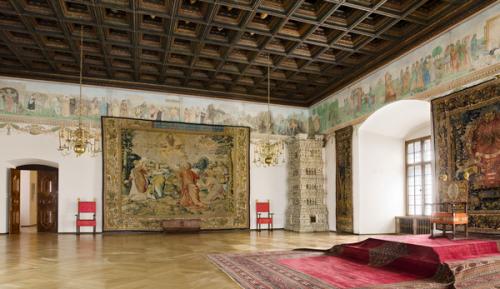

The Hall of Senators was originally used for balls, court ceremonies, senate sessions and theatrical performances. It now houses a rotating series of 16th-century tapestries, with the story of Noah being displayed at the time of our visit:


Adjacent to Wawel Castle is Wawel Cathedral (Katedra Wawelska). The present building (1364) is the third church on this spot. The cathedral has played host to most of Poland's coronations, entombments and funerals, most recently in 2010 with the internment of Lech Kaczyński, killed with 95 others in the 2010 Polish Air Force Tu-154 plane crash in Smolensk, Russia:

Huge prehistoric animal bones hang on a chain to the left of iron entrance door:

Just as in Wawel Castle, photography isn't allowed inside the cathedral, so the following images of highlights are courtesy of Google:
Holy Cross Chapel:

Sigismund Chapel:

Shrine of St. Stanislaus:

Royal Tombs. Home to many Polish monarchs and national heroes, for this American the most interesting resident was Tadeusz Kościuszko:


The one part of the cathedral where photography couldn't be stopped was in the tower housing the Sigismund Bell. Cast in 1520, it's the largest historic bell in Poland, at 2 meters high and 2.5 meters in diameter, and weighing 11 tons. It takes eight people to ring the clapper. The tower also provides good views of Old Town:


Our admission tickets to the royal tombs and bell tower also gained us entry to the Wawel Cathedral Museum, displaying church plates and royal funerary regalia, as well as items belonging to Pope John Paul II. Again, no picture-taking permitted. The cathedral as seen from the museum:

Looking out onto the Vistula River from Wawel Hill:

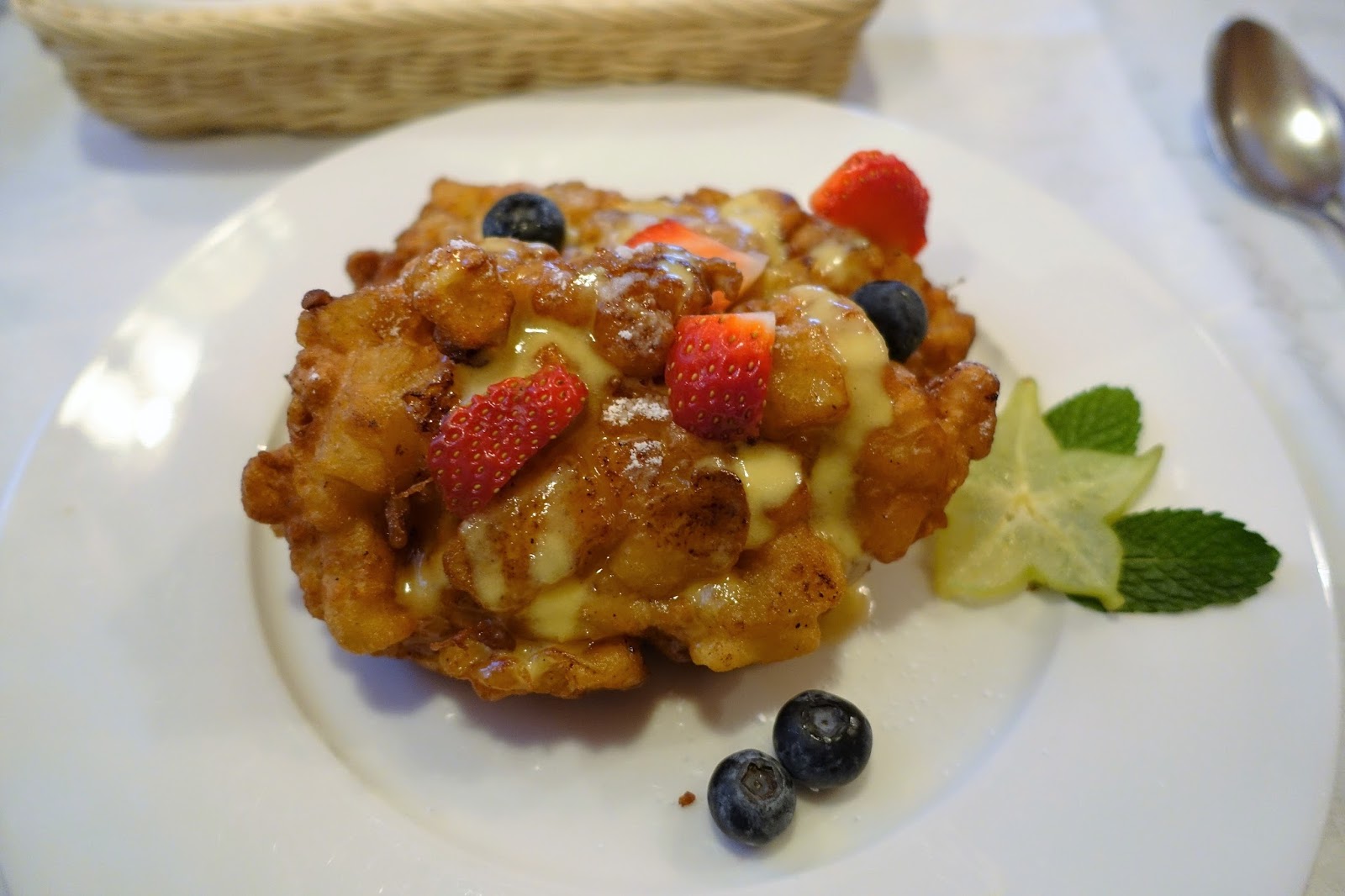
By this time we were feeling pretty famished, so we ventured back into Old Town for lunch. We settled on a Polish restaurant called Miód Malina ("Honey Raspberry"), where I started off with a bowl of chicken broth soup and a Tyskie beer, followed by venison as the main course (not pictured), and rounded out with an apple cobbler for dessert:


A quick trip back to the hotel so my wife could change her shoes. I used the opportunity to model the Polish national soccer team jersey replica I purchased just after lunch:

Returning to Rynek Główny as the square descended into darkness at around 3:30pm local time:

St. Mary's Church (Bazylika Wniebowzięcia Najświętszej Marii Panny) is a 14th-century brick Gothic beauty. The facade is dominated by two towers, one 69 meters in height and the other 81 meters high. From the latter the hejnal bugle call is sounded hourly; we heard it several times while we were in Old Town:

Here at last one could take photos to his or her heart's content...for an additional 5zł fee. The highlight here is the altarpiece, known as a pentaptych (an altarpiece consisting of a central panel and two side wings), carved in lime wood, then painted and gilded. The main scene represents the Assumption of the Virgin surrounded by the Apostles, while the side screens portray scenes from the life of Christ and the Virgin. The altarpiece by Veit Stoss stands 13 meters high and 11 meters wide and was consecrated in 1549:


The blue star vaulting in the nave is also impressive:


After visiting the church we ventured back out into the cold night air:

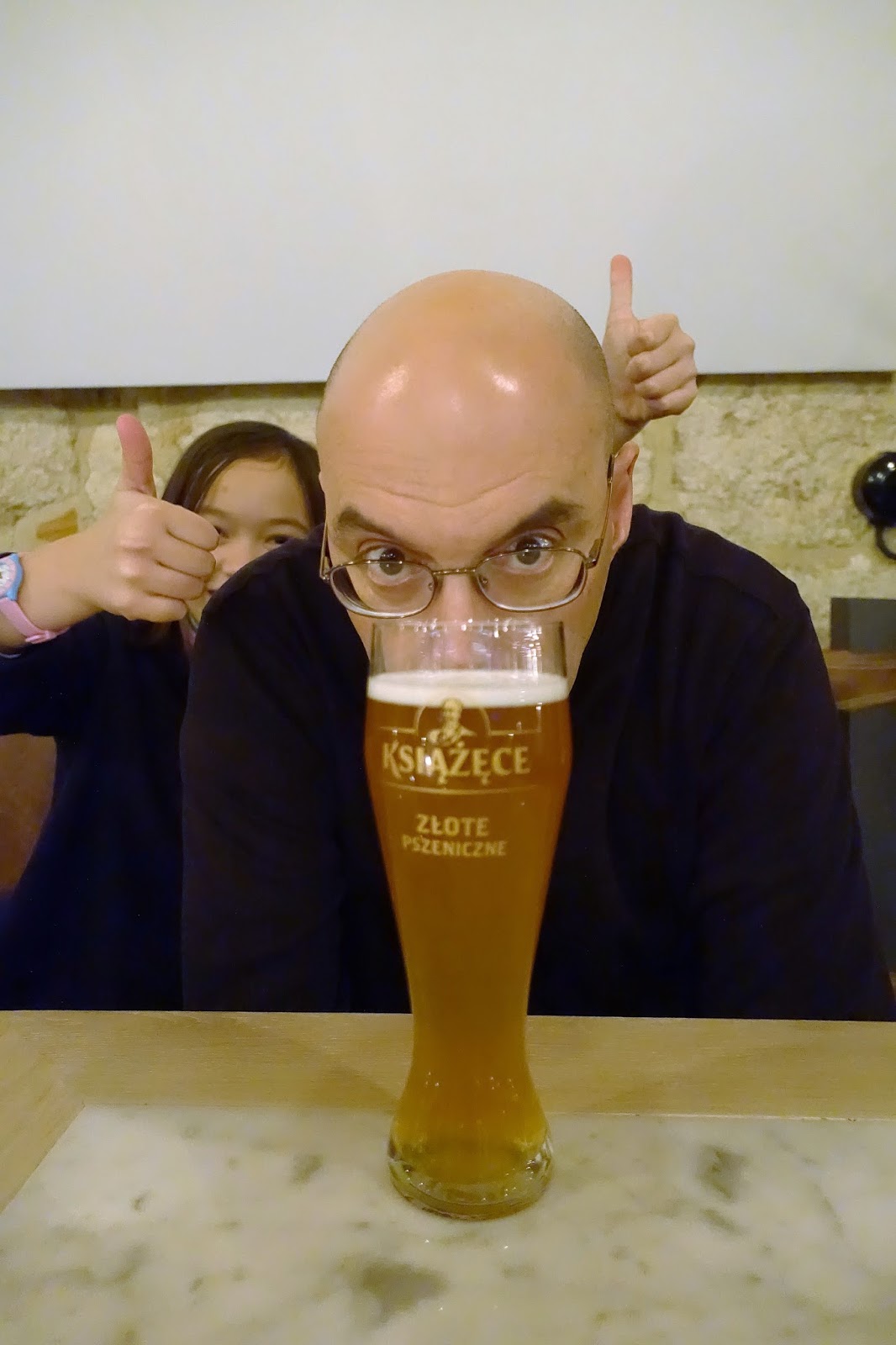
We had dinner at an Italian restaurant, because even Poles don't eat Polish food 24/7. You will note, however, that the beer was Polish:
The 70 meter-high Town Hall Tower (Wieża Ratuszowa), all that remains of the 15th-century town hall which was dismantled in the 1820's:

An active market goes on in front of the Cloth Hall, selling food, drinks, clothing and trinkets:

Amber enjoys a cup of hot chocolate. And when I say "hot chocolate", I mean it was a cup of heated, melted chocolate. Thick and sweet, and the perfect nightcap in the below-freezing temperature outdoors:


