Tuesday, January 3, 2017

Warsaw, Part 2: A jolt of Stalinism

Soviet-style Communism was ugly on so many levels

The drive from Kraków to Warsaw was a lot easier than the drive done in reverse three days previously. For one thing it took the four hours or so that Google Maps indicated it would, thanks to there being fewer cars on the road, which resulted in fewer traffic delays. It helped that we left Kraków at 8:30 on an ordinary Friday morning, so traffic was relatively light until we reached central Warsaw. We checked into the JM Hotel Warsaw Center, dropped off our bags in our room on the 22nd floor...:


...and headed downstairs to the hotel restaurant for a lunch of Polish dumplings and beer...:


...before hitting the streets of the Financial District:


Had we more time to spend in Poland's capital city, I would've used it to see the Warsaw Rising Museum, which is only a short walk from the hotel. But our time in Warsaw was limited, and the girls don't have much interest in World War II-related attractions, so there was only one obvious choice - the Palace of Culture and Science. The PKiN is a questionable "gift" from the Soviet Union to Poland, completed in 1955 and standing 231 meters high, still the tallest building in the country. And it's attractive in a hideous sense, in that special way that only the architects of Socialist realism could pull off successfully. These days the Palace of Culture & Science is hidden by the other tall buildings of the Financial District, but even after seeing countless photos of it, nothing could prepare for the shock as we turned a corner and came face-to-face with...this:


Once you've seen it in person, you have no choice but to take the elevator to the 30th floor and enjoy the views from 115 meters up. As the Poles supposedly say, the viewing terrace provides the best vista of Warsaw because it's the only one that doesn't include the PKiN itself!:


You could say it was a touch chilly up there on the terrace, a different kind of cold war being waged between the forces of nature and Socialist Classicism:


Back on terra firma, preparations were being made for a New Year's Eve concert and countdown to be held the following evening:


A conceit among some travelers is that you should only eat the local food, ignoring the fact that locals like to try new and different things in addition to the traditional staples. And so our last dinner in Poland was at a Lebanese restaurant, where I pondered life, the universe and the meaning of it all over a glass of Okocim:


It was a cold walk back to our hotel, in the below-freezing temperatures and chilling wind that made us miss the "warmth" of Vilnius:


A last look at the nightscape from our hotel room:


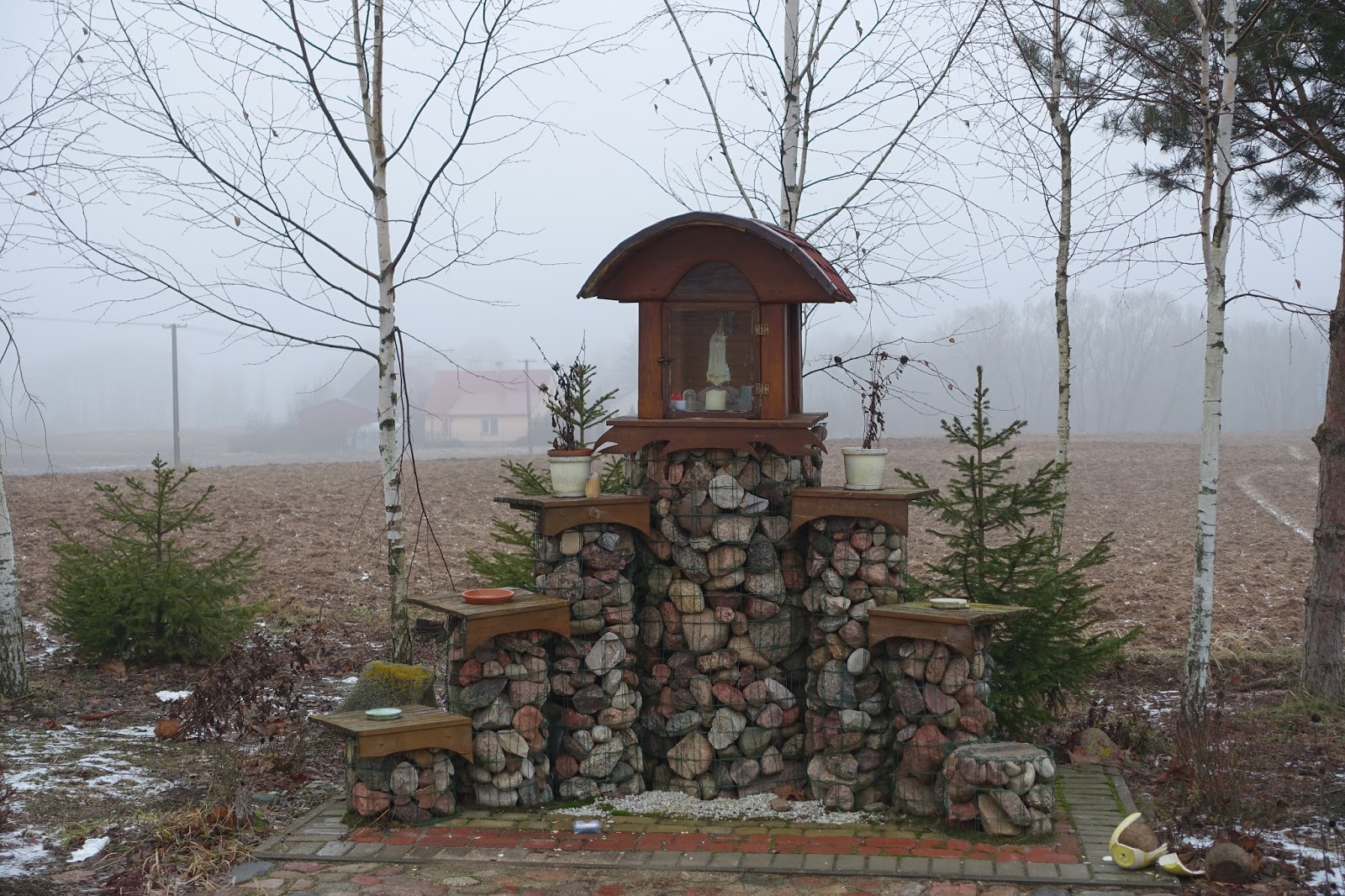
It was a long, tedious drive back to Vilnius on the last day of 2016, but it only took six hours this time (seven if you include the lunch break), thanks to an early start, the lack of traffic and the fact that I made sure to program the proper border-crossing first into the GPS to ensure no unnecessary detours into Belarus. The scenery was exactly as I used to imagine Eastern Europe to be - dull and relatively featureless (not too dissimilar to the American Midwest), and complemented by a heavy fog that reminded me of driving in California's Central Valley (there would be heavy snow on the ground soon after crossing into southern Lithuania, but it would all be gone by the time we rolled into Vilnius in the late afternoon). The only things missing were peasants on horse-drawn carts and German tanks coming over the hilltops:


Just before reaching the border, we stopped for one last meal in Poland, lunching on goulash and pork cutlets, while Shu-E at least got to enjoy a Łomża:


Dziękuję za wspomnienia Polska!...:


...but if there's going to be a next time, we'll fly or take the train...


Monday, January 2, 2017

Kraków, Part 2: Getting sentenced to the salt mines

Supplicating to the gods of salt

Our second full day in Kraków began with a solo exploration of Old Town while the girls stayed behind in our room at Wielopole, absorbed in their respective electronic devices (my only New Year's resolution is to wean my daughter off of things with screens - an impossible task to be sure):


The Church of SS Peter & Paul (Kościół Św Piotra i Pawła) was the first Baroque structure in Kraków, erected by the Jesuits in 1583. Outside stand the 12 Apostles on columns in front of the church:


Next door is the Church of St. Andrew (Kościół Św Andrzeja), in a building that has stood on the same spot since the late 11th century. On the outside all is austere...:


...but the inside is a completely different world, thanks to a radical 18th-century Baroque remodeling:


The Florian Gate (Brama Floriańska) is the only survivor of the eight entrance gates that once encircled Old Town. The lower portion of the gate dates from around 1300:


Briefly outside the confines of Old Town, looking toward a monument celebrating the Battle of Grunwald, with St. Florian's Church in the background:


The Barbican medieval fortification. Between the bastion and the Florian Gate were several tour groups, all gathered around guides giving explanations in English, French, Italian and Spanish (and identified by the flag they were carrying). I would later pass by a Croatian tour group on my back to Wielopole:


From in front of our hotel, Amber, Shu-E and I boarded a van to take us to the Wieliczka Salt Mine (Kopalina Soli). A UNESCO World Heritage Site since 1978, the ultra-deep salt mine has been in operation for over 700 years, with its deepest tunnel situated 327 meters underground. We were able to explore three levels of the mine between 64 and 135 meters below the ground as part of a mandatory English-language guided tour. Having our own vehicle, we should've been able to drive out to the mine ourselves, but the next available tour openings weren't until Friday, the following day when we were scheduled to return to Warsaw. So we joined an outing organized through our hotel, a more expensive option but still worth the expense as the mine is a definite must-see for visitors to Kraków:


Mannequins demonstrate various salt-excavating operations:


Spaghetti-like salt strings and accumulations of salt shaped like cauliflowers:


Salt was carved out of the rocks by hand and rolled into large blocks:


The undeniable highlight of a visit to the mine is the Chapel of St. Kinga (Kaplica Św Kingi), an actual underground church measuring 54 meters by 18 meters, and 12 meters in height. Everything from the altarpieces to the chandeliers is made of salt; it took more than thirty years to complete the chapel:


The Eram Barącz Chamber contains a man-made salt lake, with a density of 320 grams of salt per liter. Like the Dead Sea, you would float and not sink:


The final stop in the mine before taking the elevator back to the surface is the 36 meter-high Stanislaw Staszic Chamber:


Wooden boards in the mine were often painted white for greater visibility in the dark tunnels:


The mine logo on the floor of the gift shop as we headed back to the van. I thought it would look pretty cool on a soccer jersey:


The van dropped us back off at Wielopole, where we had lunch (vegetable curry for me) at the hotel's excellent vegetarian restaurant:


On our last evening in Kraków we entered the Rynek Underground exhibition, located beneath the market square in Old Town. It's a fascinating underground tour of medieval chambers and market stalls, enhanced by modern-day audio-visual wizardry:


The exhibits on medieval burials were appropriately eerie:


Back at ground level and checking out the stalls selling souvenirs inside the Cloth Hall:


Shu-E toasts the end of an interesting day at a German-style beer hall. The three nights we stayed in Kraków certainly weren't enough. With more time, I would've liked to explore more of Wawel Castle, as well as visiting Oskar Schindler's factory. Speaking of World War II, the notorious Auschwitz and Birkenau concentration camps are an easy day trip from the city, but I know my daughter would not have wanted to visit (having already been to Dachau). The communist-era architecture of Nowa Huta also sounds interesting, but at least I would get to see a stunning example of Socialist realism the following day in Warsaw: