Dour, 電通-controlled, family-centric Belgian Neocolonialism, enthusiastically jaded observations, support for state-owned neoliberalist media and occasional rants from the twisted mind of a privileged middle-class expatriate atheist Crypto Jew and とてもくだらないひと projecting some leftist ideals with my ridicule of Tucker Carlson, all while taking America's blood money and cashing out that pension and TSP (from The Blogs Formerly Known As Sponge Bear and Kaminoge 物語)
*see disclaimer below
There's a cold wind that's been blowing for the past several days, and it didn't originate in Siberia, as is usually the norm for Beijing at this time of the year. Instead, a flurry of executive orders has been coming in from distant easterly shores. While this development wasn't unexpected, the tone has been eye-opening. One of my colleagues (a person not of the Caucasian persuasion) only half-jokingly remarked that they had better stop talking about "black stuff" while in the office, or possibly face the consequences of snitching. Like any other large institution, my employer has its fair share of sycophants within its ranks (how else to get those plum assignments and increase chances for promotion?), and so as to not fall victim to the emerging neo-McCarthyism, no further words will by typed on this and other work-related matters, with the exception of topics like where I'll be going next.
And in response to that latter matter, I still don't know, but I'm 99.9% confident it won't be Beirut, despite what I accidently typed in my previous blog post!
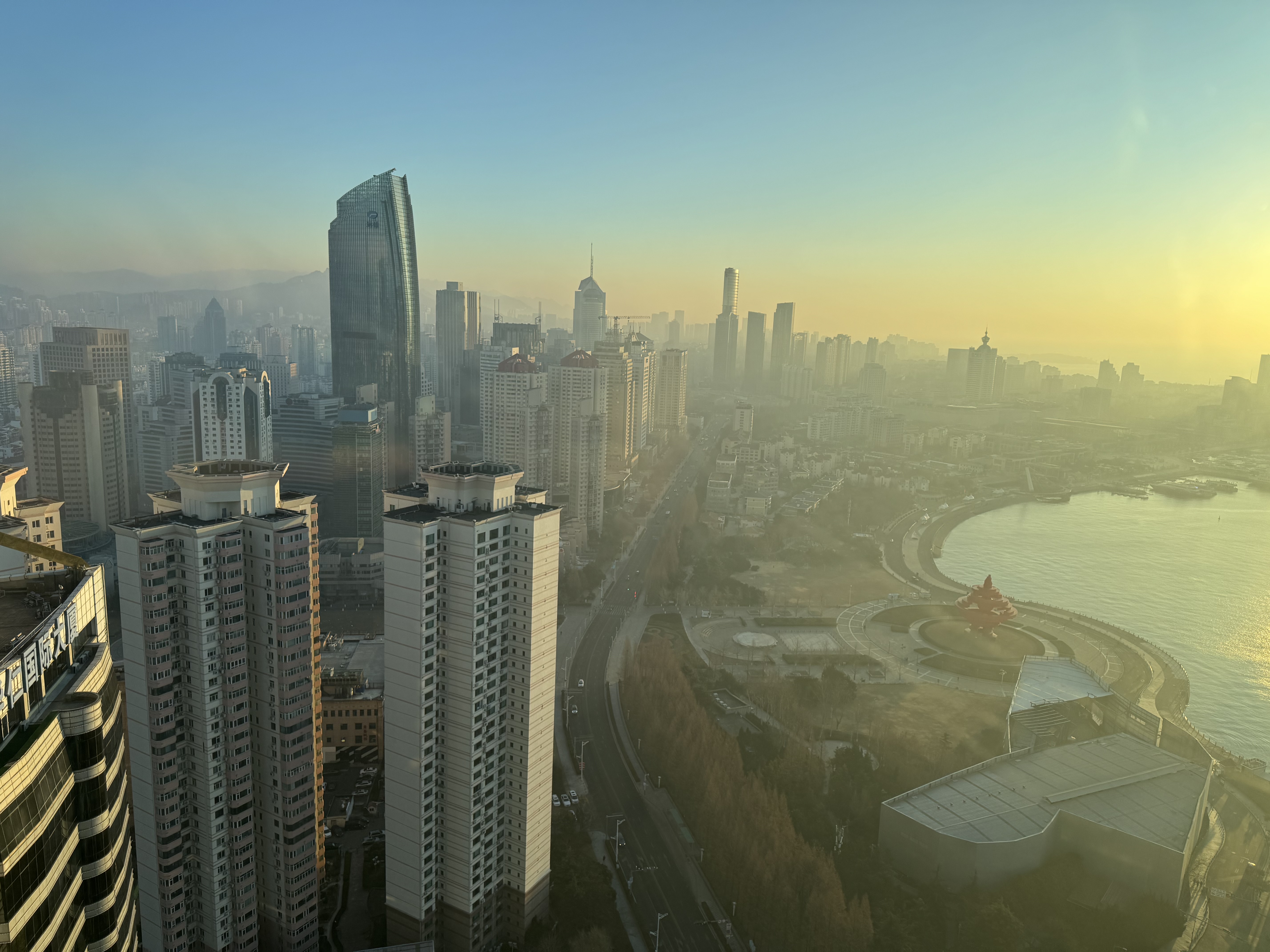
I do know where I've been recently, however, and that was to Qingdao 青岛, staying there with my wife for four days and three nights over the Martin Luther King, Jr. Birthday holiday weekend. Having already covered what we did in the city on Saturday (plus a little blurb on Friday night), it's time to move onto Sunday and Monday, beginning with the sunrise as seen from our hotel room on the morning of the 19th:
It would turn out to be another smoggy day in China:
Shu-E, who was in charge of our itinerary for the entirety of our stay in Qingdao, hired a car and driver for the day to take us to Lao Shan 崂山, a mountainous area 28 kilometers/17 miles to the east of the city (while still within the city limits). Our first stop was at the Yangkou Scenic Area. The driver points out something on the map to my wife:
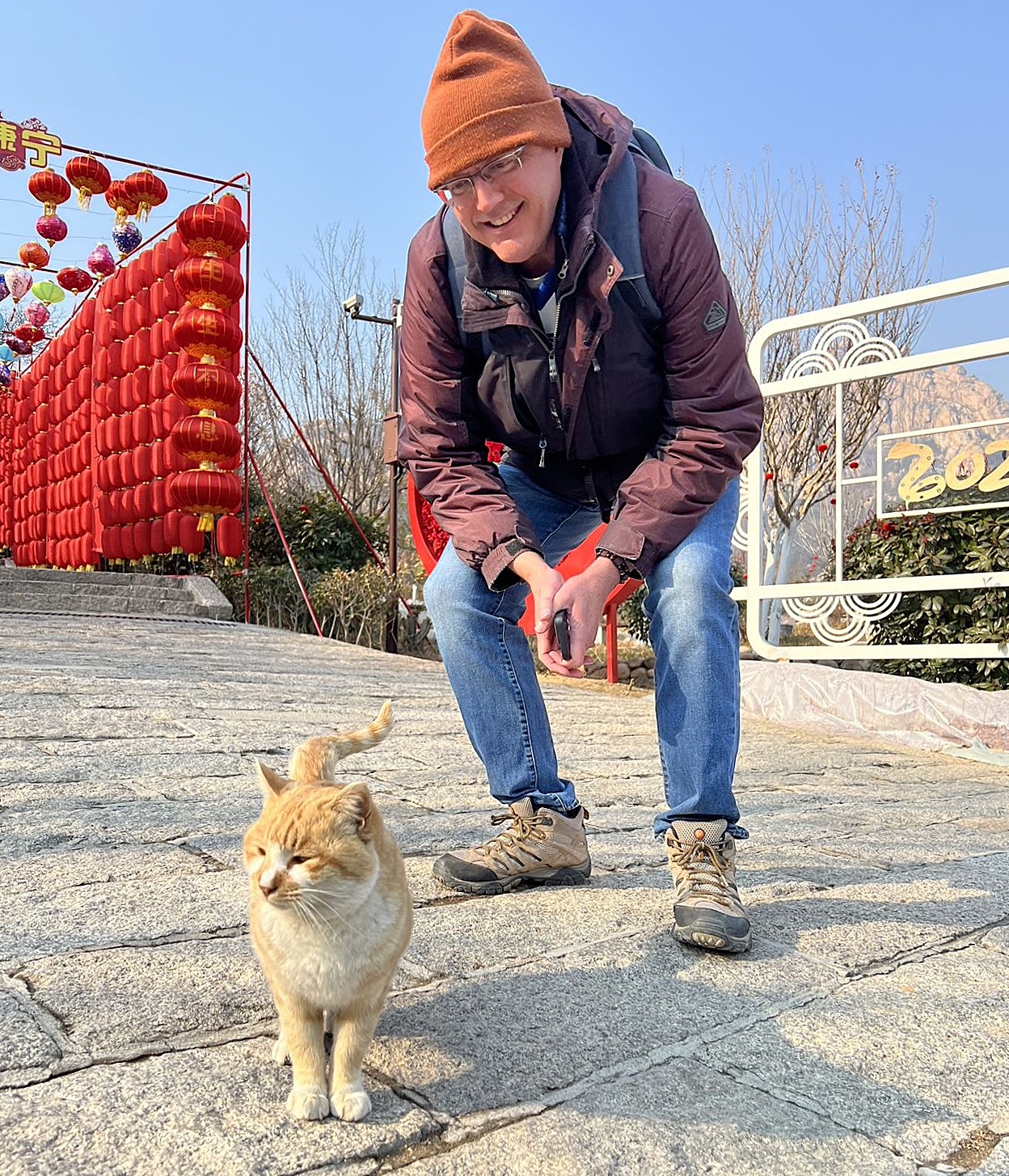
The area around the cable car was teeming with friendly felines. My cat, a Siamese who takes my attempts at petting him to be an excuse for launching an attack on my hand and fist, could learn something:
Getting ready to board the cable car:
Small shrines like this one are a common sight in Taiwan but aren't often seen in China. In Taiwan you could throw a rock in a random direction and stand a good chance of it landing in the grounds of a Taoist temple (or through the windows of a 7-Eleven). Here in northern China, however, only the larger, famous temples are found, and some of those appear only to function for sightseeing as opposed to spiritual purposes:
It wasn't until the two of us were ascending in the cable car 仰口景区索道 that I realized how close we were to the ocean (our driver waited for us in his car back at the entrance):
The Chinese penchant for marking rocks with characters and slogans was much in evidence as we neared the top:
I'd like to say I hiked several hours to the top of the mountain but these days a comparatively short number of steps is enough to get my heart racing and to leave me winded, such is the current state of my body:
The set of stairs above led to the entrance of the Looking for Heaven Cave 觅天洞. We decided not to go in as the descriptions indicated it was narrow with a low ceiling, and I'm getting too old for this shit:
So instead I purchased a Laoshan Cola 崂山可乐 from a vending machine close to the cave mouth. Shu-E would later buy a bottle of Laoshan-branded water:
The two of us aren't completely feeble yet, however, so we decided to descend on foot rather than take the cable car again. As I write this my wife is still complaining about all the walking she did last weekend, though at least this time it was her choice to do so, leaving me blameless...for once:
We walked by Shouzi Peak 寿字峰, the rocky outcrop we had passed earlier on our way up in the cable car. It was adorned with variations on the character shòu 寿, meaning "long life":
A detailed explanation was provided in English:
Further down the hill was Taiping Temple 太平宫, occupying a scenic location:
After reaching the bottom and getting back in the car we were driven down to sea level:
Our driver "recommended" a nearby seafood restaurant for lunch, no doubt because he would get a commission for bringing us there. But we had no issue with that as the place was probably no different from any of the other establishments in the area, the prices were reasonable and my seafood-obsessed spouse seemed satisfied with what we ended up ordering (which wasn't any of the items pictured below):
The driver suggested this spot as being ideal for a photo, with no obvious kickbacks that could be seen:
While driving along the coast Shu-E remarked that the scenery resembled that of Taiwan's Qingshui Cliff 清水斷崖. I don't know if I would go that far when it comes to spectacularism, but I could see where she was coming from. Unfortunately, the presence of heavy smog in the area meant it was pointless to take any photos.
We did come across an area where the atmospheric conditions were better, and so took a few snaps of the ocean, with tea farms in the foreground:
The final stop on our itinerary before heading back into the city was the Dahedong entrance to Lao Shan. As private vehicles weren't allowed past the entrance gate, we were deposited at the entrance, where it was a long walk (1080 meters/3543 feet) down many steps down to the Taiqing Palace 太清宫. The temple's origins go back to 960, though the grounds as they exist now are dominated by a giant statue of more recent vintage, depicting Laozi 老子, the possibly mythical (or at least semi-legendary) founder of Taoism.
Likely sensing our weariness, we were approached by a guide who offered to give us (well, my wife at least) a 50-minute guided tour of the temple PLUS a drive back uphill to the entrance gate, in an all-inclusive package costing RMB100 ($13.75). Naturally we took him up on the offer:
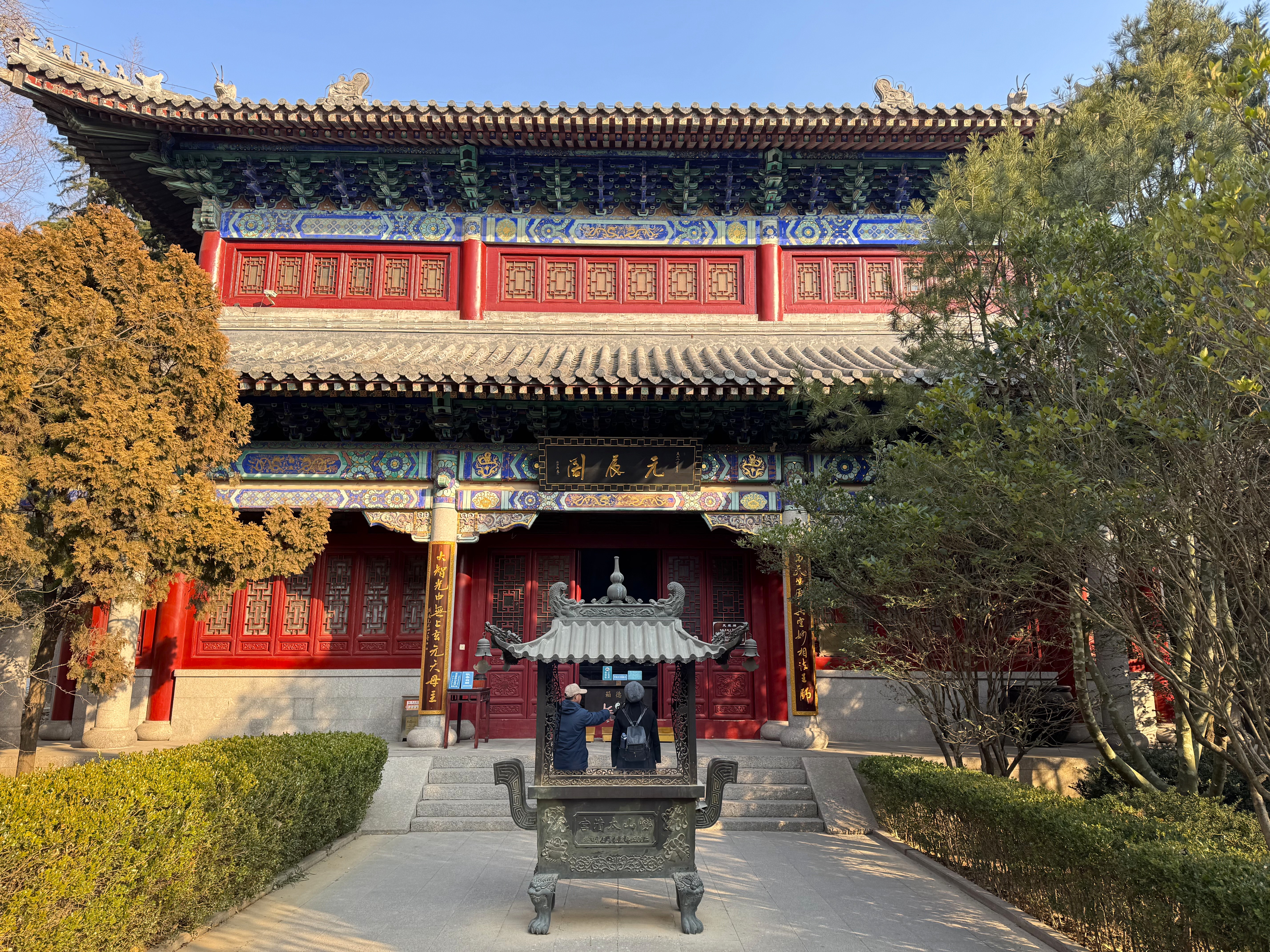
There were a number of attractive buildings to check out such as the Yuanchen Pavilion 元辰阁, though they all seemed to house a trio of deities (not the same ones) within:
Also dotting the temple grounds were a number of old trees, including cedar, cypress and ginkgo:
Behaving in a "civilized" manner seems to be of great importance in Chinese society. I've seen signs encouraging "civilized behavior" in restrooms:
Sanguan Hall:
Our guide points out a particularly notable tree to Shu-E:
I had to make do with the English explanation:
Sanqing Hall:
Having had my fill of halls and the trios of deities within them, I decided to venture up to the Laozi statue for a closer look. So while Shu-E continued her tour with the guide, I proceeded to climb up the steps to the statue in what turned out to be a serious miscalculation. Laozi's height of 36 meters/118 feet made him appear closer than he actually was, and I soon found myself struggling to make it up. What kept me from turning back was the sign indicating a toilet just before the statue. It turned out the bathroom was locked, but by then it was too late, so I continued the short walk from there to the statue's base:
The view from the top:
I soon headed back down, and met up with my wife and the guide. On our way out of the temple I glanced back for one final look at the great sage:
At the main entrance of the temple - we had approached on foot from the rear. Earlier in this post I made a remark on the relative lack of devotion seen in Chinese temples when compared to Taiwan. However, Taiqing Palace is one of the exceptions. As we made our way around the various halls, so did other visitors, many of whom were carrying incense sticks. Many people could be seen praying and prostrating themselves in front of the deity figures standing in the various halls:
Before going to the vehicle we had to stop in at a shop (on the guide's "advice") to sample tea and dried fish. Shu-E bought some of the latter, which she later shared with our cat Timi much to his excitement:
A final look before getting into our hired vehicle and returning to Qingdao. There was apparently a spectacular sunset on the drive back, but I was completely unaware, having fallen asleep in the back seat:
Back in the city and following a short rest in our hotel, we headed out again, this time by metro. Our destination was the Taidong neighborhood, popular for its night market and seafood. The name no doubt was meant to invoke Taiwan's Taitung 台東 (Shu-E also mentioned the existence of a Kaohsiung Road 高雄路 in Qingdao but we didn't go there):
Shu-E's first choice was to go to a beer house and eat seafood (of course), but despite it being a Sunday evening all the places we checked were full, with 20-30 minute-long wait times for tables:
So we (or my wife, to be more accurate) bought our own seafood from a wet market, and took our haul to a nearby restaurant to have it cooked:
We also ordered a pitcher of Tsingtao original draft to accompany the meal:
Peeling shrimp with an uncomfortable pair of latex gloves. I enjoy eating seafood, but I don't like the work involved with some dishes:
Such as crab. Tastes great but the reward often isn't equal to the labor involved in reaching the meat inside (the same goes for hot pot). Shu-E, on the other hand, has no problem, especially when it comes to crab. For her birthday one year when we were living in Shanghai 上海, we went out to a Japanese restaurant that offered a seven-course meal consisting entirely of crab dishes. I could have used some variety but she reached a culinary nirvana that evening:
We plunged back into the market after dinner, where I secured some much-needed red meat in the form of a Taiwanese-style sausage with garlic:
A Takoyaki たこ焼き vendor. Takoyaki is one of our daughter's favorite snacks. We didn't buy any, but Shu-E insisted I take a photo and send it to Amber via WeChat in order to torture her. My wife has a cruel sense of humor:
The Monday morning sunrise, courtesy of Shu-E, who always seems to be awake for these events. Except when she's at home:
It would be the clearest day of the three-day weekend, which figures. I once spent ten days one June in England, in which almost every day was overcast, and cool to the point I had to wear a windbreaker. It was only on the last day that the sun decided to make an appearance...when I was on the train heading toward Heathrow Airport:
Following breakfast and checkout, we took the metro to Qingdao railway station 青岛站. After finding a shop we were could stow our bags, we headed over to Silverfish Street 银鱼巷, one of those decaying downtown areas that has been revived with souvenir shops:
It was before 1100 on a chilly Monday morning so there weren't many people on the street yet, though things were starting to get busier:
Posing for my next profile pic:
Old meets new:
Are these bullet holes behind the glass? Unfortunately there were no plaques or signboards nearby to give any explanation. Qingdao was the scene of fighting on two modern-age occasions. The first was in 1914 when the Japanese bombed the city and seized control from the Germans. The other was in 1938, when the Japanese took over again in the early stages of the Second Sino-Japanese War. If I had to hazard a guess, I would say these holes date from the second conflict:
The most magnificent building in the area around the railway station is the Governor's House Museum 青岛德国总督楼旧址博物馆. The former German governor-general's residence was constructed in the German Renaissance style in 1904-5. It now serves as a municipal police office. The interior can be visited, but not on the morning when we were there:
With some time remaining to kill we returned to the No. 6 Bathing Beach for one last look:
Then it was back to the station area:
Waiting for boarding time. Railway stations in China are much like airports, with security checkpoints and that fact that passengers have to wait until boarding time before they can get onto the platforms and board their trains. National ID's are constantly being scanned so the authorities know where the citizens are traveling. These machines don't read passports so we have to locate a railway official to do it for us. For a country that is supposedly trying to attract foreign visitors, there is still much, much room for improvement:
High speed trains lined up. China's high speed rail system is very good and puts American trains to shame. But that doesn't justify the authoritarian political system, despite what some useful idiots on social media would have you believe:
The scenery between Qingdao and Beijing could hardly be described as attractive:
An Australian friend commented on Facebook that Qingdao was his favorite Chinese city, and I could see why. The city has preserved much of its architectural past while at the same time putting on an impressive modern face (as the nightly waterfront illumination illustrates). My wife seemed to enjoy our time there. For someone who professes to be very proud of her Chinese heritage, she seems drawn to those places famous for being Western concessions during China's so-called "Century of Humiliation".
The Lunar New Year and the Year of the Snake will be coming up soon, but while we have some plans to go out during that time, for the most part we'll be staying at home in Beijing. Though we remained in town during the 2023 LNY period, the country was just coming out of Covid restrictions so the situation could hardly be described as "normal"; last year we were in Yokohama 横浜, albeit staying very close to that city's Chinatown 中華街. While I imagine many Beijingers will be returning to their hometowns during the holiday, at the same time I'm expecting many visitors coming in to see the capital's major sites.
Dr. Martin Luther King Jr's Birthday or Inauguration Day. Call it what you will (and I prefer "MLK Day"), Monday the 20th of January allowed for a three-day Federal holiday weekend. One of the perks of working overseas for the State Department is being able to travel on the occasion of American public holidays, when the host country's denizens still have to go to school or work. And with the massive movement of people that will start this upcoming weekend with the onset of the Lunar New Year holiday period (officially commencing from January 28th but many will no doubt take advantage of the calendar this year for a longer break), the wife and I decided this past three-day weekend would be ideal for getting away from Beijing 北京.
Initially Shu-E wanted to use the long weekend to visit Harbin 哈尔滨, site of a famous ice festival. Unfortunately, millions of other people share the same desire, and the only sleeper train tickets she could have secured meant sharing a compartment with two strangers, something both of us wouldn't have been comfortable doing (we're old and set in our ways). Instead she suggested Qingdao 青岛, a nearly 3½-hour high speed rail trip away from China's capital, and so we found ourselves on Friday evening at Beijing South railway station 北京南站, hastily eating a bowl of lurou fan 滷肉飯(Taiwanese braised pork rice bowl) before getting ready to board:
Getting on the train in Beijing, where we departed at 1944 hours:
We arrived at Qingdao North railway station 青岛北站 at 2305 hours:
From there it was around a half-hour drive in a Didi (China's version of Uber) to our accommodations at the Haiyi International Apartment 海逸国际酒店公寓. We didn't get into bed until sometime after midnight:
If "Qingdao" doesn't seem familiar in this written form, think of "Tsingtao", the beer of choice at numerous Chinese restaurants across the world. At a time when China was being carved up by various colonial powers, the city's harbor and strategic location made it a natural target, with the Germans forcing a 99-year concession on the Qing government (and which explains the origins of the namesake brewery). Today's Qingdao is a blend of German architecture and modern developments. The sunrise as taken by Shu-E on Saturday morning from our room on the 36th floor:
This sight that greeted me from the bedroom window brought back memories of Shanghai's 上海 Oriental Pearl TV Tower:
The view from the 6th floor restaurant where we had breakfast each morning during our stay:
Following breakfast and a short metro ride, we found ourselves at the No. 6 Bathing Beach 第六海水浴场 (the city is a popular summer destination). There was a surprising number of people hanging out at the water's edge despite the cold temperatures, but my wife pointed out China is a vast country, with a huge interior and only a single coastline, and so many Chinese have never visited the seaside:
If the Huilan Pavilion 回阑阁, at the end of Zhan Bridge and jutting out into Qingdao Bay, looks vaguely familiar, it's probably because you've seen it on the Tsingtao Beer label:
We didn't walk out to see the pavilion because of all the seagulls flying about. Having been the victim of gull fecal attacks on a few occasions, I was worried about becoming a target yet again, a sense of dread shared by Shu-E. In many seaside locales visitors are discouraged from feeding these avian cockroaches, but in Qingdao old women were waiting to sell bags of bird food to tourists as they emerged from the metro station:
As you may recall from my last post refrigerator magnets are a popular souvenir these days in China, but my wife was less than impressed by what most gift shops were offering the punters:
Walking uphill from the beach we passed by Villa Anna 安娜别墅, now a popular locale for wedding photographs and other romantic pics:
St. Michael's Cathedral 天主教堂 is a Gothic- and Roman-style church completed in 1934, and which managed to survive the lunacy of the Cultural Revolution despite being badly damaged:
Down the hill from the cathedral is Zhongshan Road 中山路, which became a regional financial hub in the early years of the 20th century, home to many private banks, insurance companies and even pawn shops:
It was there that we had lunch, and the first of many Tsingtao's to be downed over the long weekend:
The restaurant's specialty was seafood dumplings:
I've never been a big imbiber of Tsingtaos other than when eating at Chinese eateries, so I was surprised to come across the many different varieties seemingly only available in Qingdao. We bought these six below from a beer shop on Zhongshan Road and had them shipped to our home in Beirut* Beijing. Look me up on Facebook to see in which order they get consumed:
Back on Zhongshan Road, and admiring the former site of the Qingdao branch of the Bank of Communications (1929-31) 交通银行青岛分行旧址:
Unlike in Taiwan, it isn't common to find Japanese on storefronts in China (for obvious historical reasons). The words inform passersby (presuming they can read 日本語) that stylishly new, high quality and reasonably-priced fashion suitable for all seasons can be found within. Or something along those lines:
A side street piqued our curiosity:
We came across a movie or TV drama being filmed there. A young Westerner dressed in 1940s/50s-style clothing was directed to look around frantically while extras filed by him. We saw at least two takes done before we moved on:
At the end of Zhongshan Road we hailed another Didi to take us to the next stop on Shu-E's itinerary, Signal Hill Park 青岛信号山公园, so-called because the tower on the top was used to signal incoming ships after the port of Qingdao was built. One of the many views while walking uphill:
Our entrance ticket included a voucher for a free ice cream bar:
Looking at Huilan Pavilion in the distance through the glare and the smog:
Where the signal tower once operated now stands a rotating sightseeing observatory:
The 1908 Protestant Church 基督教堂 (lower right below) was barely visible in the smog (the AQI was over 180 that day):
Yet another Didi then took us to Xiaomaidao Park 小麦到公园, located on a small circular island and now a romantic spot to gaze at the setting sun. This was the view looking toward a large Mazu statue, aka the Haishang Goddess Sculpture:
My wife the videographer:
Our fourth (and final) Didi ride of the day (they were all very cheap) took us back to our hotel. It was there, looking down at the May Fourth Square 五四广场, that a nightly illumination show (every evening except Mondays) takes place on the buildings around the bay, starting around 1840 and finishing at 2100. We had an excellent view from our room, the main reason Shu-E chose this particular hotel for us to stay:
We then ventured outside to have a closer look. Our hotel was one of the buildings lit up:
The "May Wind" 五月的风 sculpture:
At one point all the buildings became an immensely long advert for Coca-Cola, which must have cost the corporation a hefty sum:
The ghostly specters in the background were created by high-rises that weren't illuminated:
Our first full day in Qingdao ended at a hotpot restaurant across from our lodgings:
Yet another offering from the Tsingtao brewery:
The Wagyū 和牛 beef we enjoyed at dinner would prove to be a brief respite from the onslaught of seafood to come for the rest of this trip:
Moon over Qingdao:
What we did on Sunday and Monday is up next. To be continued at the same bat time, on the same bat channel...
*Kudos to the eagle-eyed reader who pointed out that I had originally written the name of the Lebanese capital instead of the Chinese one. As to why I did that, I can't really say. There was a position in Beirut on a recent bid list, but it had been removed before I ever gave serious consideration as to whether I should submit a bid.