Dour, 電通-controlled, family-centric Belgian Neocolonialism, enthusiastically jaded observations, support for state-owned neoliberalist media and occasional rants from the twisted mind of a privileged middle-class expatriate atheist Crypto Jew and とてもくだらないひと projecting some leftist ideals with my ridicule of Tucker Carlson, all while taking America's blood money and cashing out that pension and TSP (from The Blogs Formerly Known As Sponge Bear and Kaminoge 物語)
*see disclaimer below
Sunday the 16th of February was our first full day in Sapporo 札幌, the capital and largest city of Japan's second-biggest island, Hokkaidō 北海道. This is the less-than-spectacular view from our 10th-floor room in the Cross Hotel Sapporo. Despite this, the room was comfortable; the breakfast buffet was good; and best of all there were public baths on the 16th floor for the guests, including an outdoor one. Bathing in hot water (especially under the stars or in the snow) is one of the many pleasures of traveling in Japan, though my wife would beg to differ. Coming from Taiwan, where people wear bathing suits in hot springs, being nude among strangers is one Japanese custom she has never gotten accustomed to, and as a result Shu-E only showered in the bathrooms in the rooms where we stayed (though in Noboribetsu Onsen 登別温泉 she would have no choice but to use the public facility as our room wasn't en suite):
Having been to Sapporo a couple of times in the past (albeit with my most recent visit taking place nearly 30 years ago!) I left our itinerary to Shu-E. Her first choice of places to go after breakfast was Miyoshi Shrine 札幌三吉神社, a small jinja that looked very picturesque in the snow:
Satisfied with the photos taken at the shrine, my wife heads off to our next adventure:
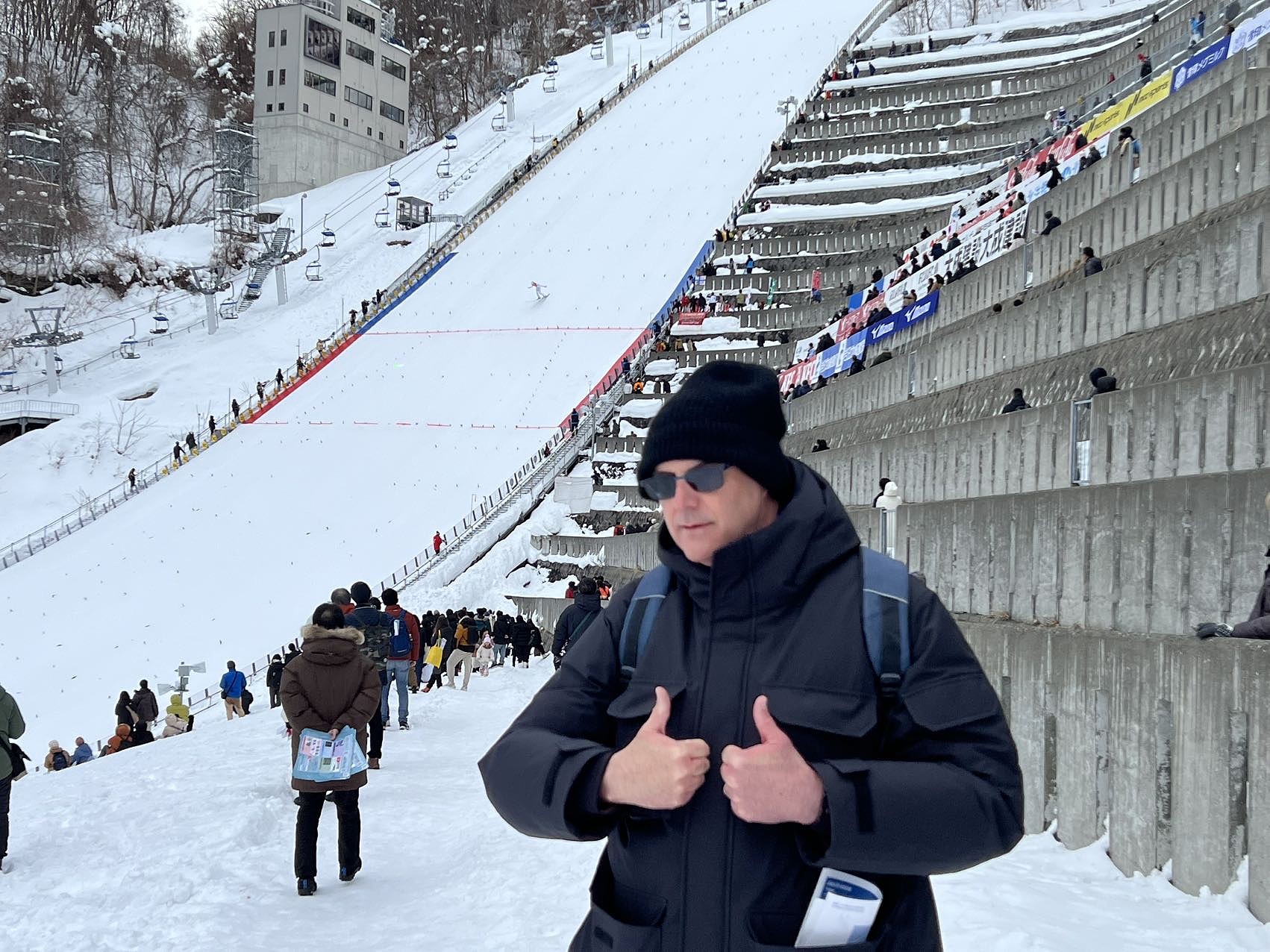
Actually, she left the choice of where to go next up to yours truly. One place I hadn't gone to on my previous two visits was the Sapporo Olympic Museum 札幌オリンピックミュージアム, located adjacent to the Ōkura-yama Ski Jump Stadium 大倉山ジャンプ競技場, the venue where the ski jumping competition was held during the 1972 Winter Olympics (during which Japanese jumpers swept all three medals in the normal hill event, sparking popularity of the sport in Japan). According to my guidebooks, it was possible to take a chair lift to the stop of the ski jump, and have the same view as the athletes before they plunged down the ramp toward the agony of defeat:
From Miyoshi-jinja we took the subway to Maruyama-Kōen Station 円山公園駅, from which we were directed to hop onto a crowded bus going to the ski jump stadium site, which should've been the first clue. The second hint came at the end of the ride, when the driver told me the trip was free (it should've been ¥250). It wasn't until we got off the bus that it became apparent this was no ordinary Sunday. Instead we had stumbled onto a FIS Ski Jumping World Cup event. Faced with the prospect of turning around and returning to the subway station, we instead went ahead and purchased tickets for the competition:
On TV it looks like ski jumpers are soaring dangerously high in the air, but in reality they appeared to be no more than ten feet/three meters or so off the ground:
That said, it's a risky sport and I lack the stupidity courage of an Eddie the Eagle:
Some foreign attendees being interviewed by local television, and being encouraged to say "Ganbatte" 頑張って ("Do your best!") for the camera:
The view of Sapporo from the ski jumping site. We only stayed to the end of the first round - the eventual winner was Japan's own Ryōyū Kobayashi 小林陵侑. As for the museum, it turned out entrance wasn't included in the ski jumping event ticket, and not feeling interested enough in shelling out for the separate fees, we got on the bus (still free, and still crowded) and returned to Maruyama-Koen Station:
Off in search of lunch and passing by a car that hadn't been driven since the last significant snowfall:
We had to wait for a table at Fuwatto Maruyama Kitchen フワットまるやまキッチン, but the beef stew rice omelet and beer made for a nice lunch break:
Shu-E took charge of things again following our meal. From the restaurant it was around a twenty-minute walk in the snow to the vast Maruyama Park 円山公園. Our intended destination there was Hokkaido Shrine 北海道神宮, the island's most famous, dating from 1871:
My wife couldn't pass up the opportunity to make a snow angel:
The shimenawa rope 注連縄 marking the entrance to the main shrine compound:
Hokkaido-Jingū is an example of what was originally a State Shintō 国家神道 site of worship. State Shinto was a nationalist usurpation of the historical native Japanese religion, intended to promote and reinforce the concept of the emperor as the head of the new state that emerged after the Meiji Restoration 明治維新. Though there are many justifiably famous former State Shinto shrines that are worth visiting (Meiji-jingū 明治神宮 in Tōkyō 東京 being one notable example), I'm much more interested in Shintō 神道 as it was practiced before 1868, especially the ways it was syncretized with Buddhism 神仏習合, a convergence that was forcibly separated by the new ruling authorities in the early years of the Meiji period 明治時代:
Ema絵馬 are small wooden plaques used to write wishes to the kami:
Several of the plaques had been left by Taiwanese visitors, including this one asking the 神 to help Zhang get into the psychology graduate school program of National Taiwan University 國立臺灣大學, the most prestigious institute of higher learning in the country. Hokkaido seems to hold a special attraction to Taiwanese, probably due to the snowy landscapes (snow only falls above the 3000 meter/10,000 feet altitude level in Taiwan, and only in small quantities). Everywhere we went during our trip Mandarin could be heard being spoken, and Shu-E identified much of that as being of the Taiwanese variety (as well as people speaking the Taiwanese dialect, a separate language from Mandarin; 台語 is also the language my wife speaks with her family):
The following day the shrine would be holding its annual festival, which I'm sure was a busy affair, but we would do other things that Monday (stay tuned kids for the next exciting blog post!):
There's something almost magical about seeing shrines and temples covered in snow. I remember my going outside to the local Buddhist temple to take some photos at night the first time snow fell when I was living in Tokyo:
My wife also couldn't resist snapping a few pics:
From the park we walked to a bus stop to catch a ride to our next spouse-designated destination. En route we passed by the small U.S. consulate, which I had no idea was hidden away on a quiet side street next to Maruyama Park, and not situated closer to central Sapporo, as I had assumed.
The bus dropped us off at the foot of Mount Moiwa 藻岩山, where we took the ropeway to the top, timing our arrival so that we would only have a short wait until sunset. I had been there way back in the summer of 1991:
Sunset transformed the view from the outdoor observation deck from this...:
...to this. Japan is no stranger to stunning night views (like Hakodate-yama 函館山 and Inasa-yama 稲佐山 in Nagasaki 長崎, both of which I saw in a different century), and the vista unfolding below Moiwa-yama was certainly impressive:
Having taken in the view, the two of us would descend from the mountain, and then take a bus and underground train back to central Sapporo. We would have dinner at a tonkatsu 豚カツ restaurant located on an upper floor of the Daimaru Department Store 大丸札幌店 in the Sapporo Station 札幌駅 complex:
On our way back to the hotel from the station in one of Sapporo's many underground passageways (a result of the sometimes harsh winter conditions) we passed by this large advert asking Japanese visitors to return the favor by going to Taiwan:
The opening to ABC's Wide World of Sports, a gateway to memories of Saturday afternoons long ago, and my initial introduction to the sport of competitive ski jumping:
It took some time and negotiations to decide where to go on the third and final R&R trip to which we were allowed to take during this tour in Beijing 北京. My initial suggestion was to escape the chill of China's capital and go somewhere warm, namely Thailand. My wife, however, maintained that destination would be too hot for her liking, and proposed that I could go there myself while she made yet another trip to see her family in Taiwan. And so I started planning a solo jaunt to Southeast Asia, with a stop in Kuala Lumpur to see friends on the way back to China. However, as the uncertainty that comes with still not knowing where we would be going next following Beijing slogged along with no end in sight, I feared that it might become more difficult to visit Japan in my final years before retirement, and so I switched destinations, working up an itinerary to travel around Kyūshū 九州 on my own for about 2½ weeks.
In the end, however, for reasons which I don't clearly recall, I pitched the idea to Shu-E of the two of us traveling together to Hokkaidō 北海道 and Taiwan. My wife being Taiwanese, the idea of experiencing snow proved too alluring, which is how the two of us found ourselves in mid-February sitting together on an Air China flight from Beijing Capital International Airport 北京首都国际机场, headed to New Chitose Airport 新千歳空港 and the island's largest city, Sapporo 札幌:
The view as our plane approached Hokkaido from the south:
Lunch at the airport after deplaning included curry rice カレーライス and what would be the first of many Sapporo Beers サッポロビール on this trip:
This would be my third sojourn to Japan's northernmost island, but my first in 30 years, and my first in the cold and snow of winter. On my first visit in the summer of 1991 I had traveled by train from Honshū 本州, passing under the Tsugaru Strait 津軽海峡 in the Seikan Tunnel 青函トンネル (the world's deepest and longest undersea tunnel) to Hakodate 函館, where I stayed a couple of nights. I would also spend time in Tōya-ko 洞爺湖, Sapporo and Sōunkyō Onsen 層雲峡温泉. I returned to Sapporo in the spring of 1995, having scored a free roundtrip air ticket from Tōkyō 東京. During that shorter visit I would make a day trip to Otaru 小樽, something my wife and I would do on our last full day in Japan before jetting off to Taiwan (stay tuned, folks!).
We ventured out after checking into our accommodations late on Saturday afternoon. Close to the Cross Hotel Sapporo クロスホテル札幌 stood the Sapporo Clock Tower 札幌市時計台, the city's oldest building (1878) and signature landmark. Visitors both Japanese and foreign stood on the sidewalk taking the required snapshots:
Another local landmark, the Sapporo TV Tower さっぽろテレビ塔, was visible between buildings. Like moths drawn to a flame, we found ourselves submitting to the tourist tractor beam:
In front of the entrance to the tower were groups of people dressed in what could best be described as anime-inspired furries. We would see these people around town over the next couple of days but never learned what the reason was behind it all:
The view from the observation deck 90.4 meters/296.5 feet above the streets:
From the observatory there was a spectacular view overlooking Ōdōri Park 大通公園, site of the annual Sapporo Snow Festival さっぽろ雪まつり, which this year had wrapped up just four days prior to our arrival. The sight is also an impressive one on a clear day but Shu-E wasn't interested in returning to the TV tower later to have a look in the daylight:
After the TV Tower we headed off in the direction of Susukino すすきの, Sapporo's semi-notorious nightlife district. Like other similar areas around the country (like Kabukichō 歌舞伎町 in Tokyo and Nakasu 中洲 in Fukuoka 福岡, to name just a couple), bars, clubs and restaurants are intermixed with less salubrious establishments. On this evening we only reached the intersection leading into Susukino. The Nikka whiskey billboard ニッカウヰスキー看板 on the far right is another local landmark, similar to the famous Glico Running Man in Ōsaka's 大阪 Dōtonbori 道頓堀 district:
Turning back we soon found ourselves in the Tanukikoji Shopping Street 狸小路商店街, in search of somewhere to have dinner:
It appears the trendy food item in Hokkaido these days is soup curry 札幌スープカレー, a dish I don't recall from my previous visits late in the 20th century. We passed by several soup curry establishments, all with long queues of hungry diners out front waiting to get in from the cold. Instead we settled on an izakaya 居酒屋 located across the road from one popular soup curry establishment:
Among the dishes we ordered in the lively establishment was zangi ザンギ, Hokkaido's take on the popular karaage から揚げ. Many a deep-fried chicken would be consumed on this trip:
Outside the izakaya following dinner. The dumber-than-usual expression on my face was the result of ultimately futile attempts at trying to capture my breath in the cold air on camera:
On our way back to the hotel. Apparently there had been heavy snow the week before our arrival, and there was still a lot of it on the ground (the weather would be generally cooperative throughout our trip). The sidewalks on the main streets were mostly cleared, and the sections where snow remained usually had rock salt sprinkled on them, but the threat of slipping remained, and the two of us would gingerly make our way on foot throughout our stay in Hokkaido. I would have one close call in Otaru, where my feet slipped out from under me but I was able to remain upright by holding on to Shu-E, but otherwise I managed to maintain my dignity and remain standing. My wife would suggest on multiple occasions buying a house in Hokkaido, but beautiful as the island is, the idea of falling and breaking brittle bones isn't an appealing one. Even in winter, however, Sapporo remains one of the most livable urban areas in Japan, with many sections of the central district located underground in response to the winter conditions (it was possible, for example, to make the ten-minute walk from Sapporo Station 札幌駅 to our hotel almost entirely below the surface):
Passing by the TV Tower again en route to our accommodations. While our room on the 10th floor didn't have much of a view to speak of, the tower was visible from the 16th floor lounge, adjacent to where the guests' baths were located:
We would spend this and the following two nights in Sapporo. Stay tuned as the adventure unfolds...