Saturday, August 17, 2013

The unbearable heaviness of shopping

My daughter inside Xujiahui Metro station  徐家汇站

Shopping observation #1: Shopping in China isn't a pleasurable experience

My wife's computer went kaput last week, so it's time to go shopping for a new one. This morning we got up relatively early and headed out to the Pacific Digital Plaza 太平洋数码广场, a large electronics mart similar to NOVA in Taichung 台中 and conveniently located just in front of the above-mentioned Xujiahui Metro station. We weren't there long: the sales clerks were extremely aggressive. If you so much as even glanced at a particular item, a salesperson would immediately be all over you, extolling the virtues of that particular product. One man even followed us up the escalator from the first to the second floor, haranguing Pamela despite her protests that she was only there to "look for somebody" (a feeble lie born out of desperation), and then turning his attention to me despite my insistence that I didn't need whatever brochures he was trying to give out. It's times like these I wish I weren't a diplomat.


Shopping observation #2: Shopping with my Significant Other isn't a pleasurable experience

Fleeing the Pacific Digital Plaza, the three of us escaped into the relative sanity of Metro City 美罗城, located next door (and pictured above).  This place was more akin to an American-style shopping mall, but it had one floor devoted to electronics, with much less aggressive staff than their pushy rivals next door. It was here that my normally level-headed Dr. Jekyll of a spouse underwent her shopping transformation into a fixated Ms. Hyde. For my beloved has a tendency at times to get attached to either an idea or a product, and no appeals to logic or reason can stop her from getting something once she decides that she needs (read wants) it. In this case, rather than walking around the floor of Metro City and checking out the various shops, she made a beeline for an outlet of a particular Taiwanese hardware manufacturer. Rather than having a look at all the models on display, she drew the salesperson's attention to just one. And rather than getting all the relevant information from the staff, and then going home and doing some research online to see if she could get the same model cheaper and with a more expansive warranty (as opposed to one covering only China), my Cosmic Soul Mate decided she couldn't wait any longer and that she had to get it now. Damn the torpedoes, full speed ahead.

So it looks like I'll need to cash another check this week in order to have enough money for incidentals like food. And my wife is still going to have to wait several days for the computer to be delivered to our home. 

Amber enjoys a custard taiyaki 鯛焼き at Metro City

Despite the tone of the preceding paragraphs, today was actually a pleasurable one for the most part. Amber and I went to a pool party in the afternoon at a nearby housing compound, and then the three of us had dinner at a seafood restaurant just around the corner from where we live. Afterward, we took a walk around the neighborhood and discovered a number of small eateries that look deserving of visits in the near future. 

And for once the temperature today didn't exceed 40°C (104°F). It was more like the usual 35°C (95°F). Shanghai 上海 has had 42 days (not including today) this summer where the temperature has been 35°C or higher, the majority of them coming after we arrived early last month. This evening felt relatively cooler, however, and the temperatures are forecast to drop below 35 beginning Monday. Now if only something could be done about the humidity...

A friendly feline at the local wet market 街市


Our dinner this evening. In case you're wondering, yes, that dish in the upper right of the photo is stinky tofu 臭豆腐. Pamela loves it, while Amber and I can't stand either the smell and the taste. Still, seeing as this was the first time to have it in China, and noticing that it differed somewhat in appearance from the stinky tofu usually found in Taiwan, I thought I'd be open-minded and give it a try.


The verdict


Sunday, August 11, 2013

Civic boosterism, Shanghai style

I have to say that things have been going pretty well recently (cue the sound of knocking on wood). Though I'm still slow compared to the veteran officers, and I persist in asking them a lot of annoying questions (which they're graceful enough to answer politely), I'm starting to get used to doing visa interviews, even if my Chinese interviewing continue to be sorely lacking. I'm enjoying the work so far, and every day is different enough that I don't see it becoming a routine, at least not yet. The heat wave is even showing signs of abating, though this means that temperatures are only likely to be around 35°C (95°F), instead of the 40°C-plus (104°F) weather we've been having the past couple of weeks. But the best news of all is that my wife and daughter have returned to Shanghai 上海 after having spent the past three weeks visiting family and friends in Taiwan, and I couldn't be more happier to see them again.

Today was the first time in more than a month that the three of us went out exploring in Shanghai. Our destination was the Shanghai Urban Planning Exhibition Hall 城市规划展示馆, conveniently accessed from the People's Square Metro station  人民广场站. The first order of business, however, was to find a place to have lunch and fast, as after just a few minutes of wandering around outside, the three of us were drenched in sweat from the humidity. Pamela soon spied a cheap noodle restaurant (which was air-conditioned, thank god), and I quickly wolfed down a bowl of something:


Suitably fortified, we ventured back outside (and underground)...


The Shanghai Urban Planning Exhibition Hall as seen on the opposite side of Xizang Zhong Road 西藏中路.


Amber poses in the "Old Shanghai" street located in the basement under the exhibition hall. Full of the kinds of food stands and shops that didn't exist in Shanghai in the 1930's, the only reason to linger there was to take advantage of the air conditioning.


The lobby of the Shanghai Urban Planning Exhibition Hall


The purpose of the exhibition hall is to impress upon the citizenry of Shanghai their leaders' grandiose plans to turn the city into a modern metropolis. But before being wowed by the future on the upper stories, the second floor had an impressive collection of photographs of the city as it once was.


The centerpiece of the exhibition hall was on the third floor - a huge model of what Shanghai is going (supposed) to look like by the year 2020, with day (top) and night (bottom) views. China may be pursuing capitalism for all intents and purposes, but its socialist characteristics were still apparent in this grand vision of the future. It'll be a city filled with utilitarian apartment blocks, devoid of anything old or traditional other than what will be preserved in designated, tourist-friendly zones. Diplomacy prevents me from commenting further.


Adjacent to the tennis court-sized floor plan was a small room giving a 360° virtual helicopter ride of this brave new world. I had to admit it was fun.


The rest of the exhibition hall was filled with uninteresting displays consisting of the usual propaganda of how the Chinese Communist Party has improved the lives of the people of Shanghai since Liberation, and will continue doing so into the foreseeable future. The top floor, at least, had good views of the Shanghai Museum 上海博物馆 (which I visited a couple of weeks ago) on one side, and of Renmin Park 人民公园 (which we'll visit at some point in the future) on the other. The entry price wasn't too bad (30 RMB/$4.90 for adults, 15 RMB/$2.45 for kids), especially considering we were able to escape the stifling heat and humidity for a couple of hours.


We could've continued exploring the area along Renmin Dadao 人民大道, but She Who Must Be Obeyed decreed that today merited a visit to Shanghai's main branch of IKEA, and so we went. It was that quintessential weekend Chinese shopping experience - meaning that only a fool who would do so on a Saturday, Sunday or a national holiday. Even my wife couldn't take the crowds, eventually conceding that she would be better off returning on a weekday, when she could take her time checking out the merchandise in an atmosphere of (relative) calm.


We rode the Metro back to our local station, but before returning home, we walked over to an area called Laowaijie 老外街 to search for a place to have dinner. Laowai means "foreigner", while jie refers to a "street" - Laowaijie is a pedestrian-only stretch of road filled with Western-style restaurants and bars, and is thus popular with the local expatriate population (of which there are many in our area). The food street's presence is denoted with one of those brown-colored tourism signs, which gives you an idea of how the Chinese view this place. We ended up eating at one of the few Chinese restaurants on Laowaijie, a place called Amy's Restaurant. It was here that I enjoyed one aspect of life in Shanghai that is much better than what I found in Taiwan - the availability of locally produced craft beer. The city has quite a number of brewpubs and microbreweries, and I enjoyed a couple of cans of the Made-in-Shanghai suds pictured above.


The "Shanghai Sichuan 四川" food at Amy's wasn't bad, either, including this dish of duck meant to be rolled in a tortilla-like flatbread . The bill came to 226 RMB ($37), including three beers - a little expensive by local standards, but cheaper than what you might pay at similar places back in the U.S. 


Amber poses on Laowaijie outside Amy's after dinner. I can't begin to tell you how happy I am that my little girl is back here with me, so I'll leave it at that now and bid you all 晚安.


Wednesday, July 31, 2013

The purity of tourism


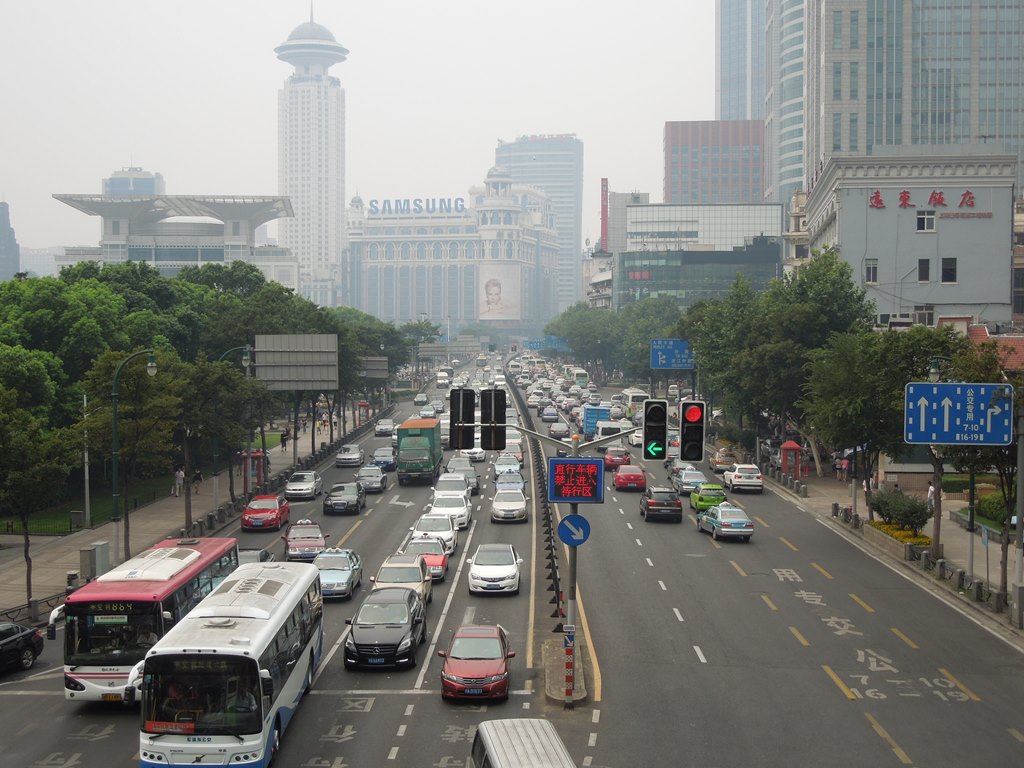
Look at the photo above, taken this afternoon on Shanghai's 上海 Nanjing Road 南京路, the street on which my workplace is located. You don't need to look too closely to see there are outlets for Gucci and Ralph Lauren, not to mention a Daliesque melting watch statue, all examples of pernicious foreign influences. In fact, the section of Nanjing Road where I work is lined with expensive boutiques selling name-brand Western consumer goods. Why do I consider these a threat, you may ask? I don't, actually. But apparently others do, judging by a recent exchange I've been a part of on Lonely Planet's Thorn Tree forum.

It all started with an innocent-enough post on the Taiwan branch posing the question "Why do backpackers rarely go to Taiwan?". Various suggestions were offered, with my own contribution noting that the majority of Western visitors I encountered while living in Taiwan were there because they had family or friends teaching English on the island, and suggesting that one reason for Taiwan being off the radar of so many backpackers (as well as more well-heeled travelers) might be because the tourism authorities haven't done a very good job promoting Formosa to the non-Chinese speaking world. A mild debate ensued, but in general the tone has been pretty low-key.

For me, however, one comment stood out that needed to be addressed. Let's call the person who made it "Julie_L", because that's the name she used. Julie wrote how she enjoyed visiting Taiwan, and is planning her second trip there, and concluded by noting:

What I do like is to visit countries that haven't been altered by tourism... We all admit that Taiwan does have an image problem. But so did Syria when I went there in 1998, Burma when I visited in 2008, and Ethiopia in 1997. So there is hope for Taiwan yet - things can change! But I will personally be happy if it doesn't change. They're wealthy enough without the extra $$$ that tourism brings, and better off without the countless problems it brings.  

A couple of problems were immediately apparent, like comparing Taiwan with the likes of Syria and Burma. I chose, however, to focus on the ignorance behind the observation that Taiwan has somehow not been altered by tourism. Ever since the government switched to a five-day workweek sometime around 2001/2002 (including the schools), with the private sector following suit, Taiwan's leisure industry has boomed. Deserted, forlorn places such as Sanyi's 三義 Shengxing Train Station 勝興車站 now groan every weekend and national holiday under the weight of the tour buses and the sightseers, and the souvenir stores and snack stands that have sprung up to serve their needs. Throw in the visitors from neighboring countries like Japan and the growing number of Chinese tourists, and relatively well-known sightseeing spots like the National Palace Museum 國立故宮博物院 and Taroko Gorge太鲁阁国家公园  have been, well...altered, as I pointed out in my reply to Julie_L:

Just because Taiwan doesn't attract large numbers of visitors from Western countries doesn't mean the country hasn't been altered by tourism. Taiwan has a thriving domestic tourism industry, in addition to the great number of tourists from other Asian countries, including Japan, South Korea and Singapore. And, of course, there is the growing number of Chinese traveling to Taiwan for sightseeing. Compared to how things were when I made my first visit there in 1999 (and later took up residence), Taiwan has, in fact, been greatly altered by tourism. 

There was another aspect to Julie_L's post that I chose not to comment on, but it's been a while since I've ranted about something on this blog, so here I go. There are two types of Western travelers that bother me. The first I've written about here before: the kind of person who appoints him or herself to be the sole interpreter of their chosen foreign locale to the outside (read Western) world. To do so, they have no choice but to reduce everything to an exotic cliche, because the family and friends back home don't want to hear how the locals in some far off foreign land are just like them. And they get upset when others have different interpretations of the same culture, because the country's only big enough for one interpreter. 

The other traveler I don't think I've mentioned before, but I'm sure you're familiar with the type - they're the ones who travel to less-developed lands and become upset when they discover the locals are driving cars, watching satellite TV and using air conditioners and refrigerators in their homes. Their once-idyllic, poverty-stricken lives have become more comfortable as their standards of living have increased, but this bothers certain travelers like our Australian friend Julie (as she identified herself on her profile), who seem to have been hoping to witness poverty and shortened lifespans. So they go on and on about how Western influences are "ruining" traditional societies, and look for poorer countries to get their voyeuristic thrills (and always with the comforting thought that home in their OECD country is just a plane ride away). Nonetheless, I chose not to address this in the reply I posted on Thorn Tree.

Julie's reply only seemed to confirm my initial thoughts:

...OK, how's this "What I do like is to visit countries that haven't been altered by 'Western' tourism."

To which I retorted:

...What difference does it make whether a place has been altered by tourists from Western countries or by tourists from non-Western countries? Isn't the fact that it has been altered in the first place enough?

At this point, someone else chimed in and observed that in Thailand, the influence of Western visitors was very apparent in the form of "beer bars,pizza places etc etc.", and noting that probably wouldn't be the case if the only tourists were those from China. I've yet to go to Thailand, but from what I've seen and heard, I can imagine all the negative effects from mass-market Western tourism have had on Thailand's popular tourist spots, and I can sympathize with the disappointment some travelers may feel. Still, as I pointed out in my reply:

It has only been in recent years that significant numbers of tourists from other Asian countries, in particular China, have been venturing into neighboring countries, so the effect isn't as obvious yet. Also, Northeast Asian visitors often travel in large groups and tend to stay together in certain hotels and resorts, and as a result have less interaction with local businesses compared to Western tourists. 

On the other hand, if you visit Hawaii, Guam or Saipan, the influence of Asian tourism (Japanese, Korean and Chinese) is probably very evident. 

At this point, our friend Julie_L decided to show her true colors, so to speak:

...you are very pedantic, and I can see that everything I say will be 'picked apart' by you. However, let me put this simply for you ...

I am a white person. I am not Asian. When I visit Asia, I like to visit Asia. I do not like to visit Pizza Hut and McDonald's or Disneyland. I cannot tell whether the people at attractions in Taiwan are from Taiwan or mainland China. All I know is that the people enjoying the attractions are from nearby geographically and are mostly ethnically Chinese. And they are enjoying the place just like I am. And they have not westernised it. They may have modernised it, but the influence is reasonably local.

OK, I admit I can be very pedantic at times, but Julie's words need to be "picked apart". In Julie's view, East is East and West is West...you know the rest. Basically, when Julie travels to Asia, she wants a culturally pure experience - no McDonalds or Disneyland etc - despite the fact these so-called symbols of "Westernization" have been accepted into the local cultures much in the same way that sushi restaurants and Chinatowns are part of the landscape in most Western cities. Julie can't distinguish one Asian from another, but that doesn't matter - as long as they aren't white or trying to "act white", Julie can enjoy her exotic Asian adventure.

I'm reminded of something I used to experience quite often while living in Japan and Taiwan - the "gaijin stare". I'm referring to those times when walking down a street, you encounter another Westerner approaching in the opposite direction. Some people would acknowledge your presence, while others would ignore you, but there was always a certain kind of person who would cast a cold, hard glance in your direction, a look that seemed to say "How dare you intrude upon my exotic, foreign experience!" Julie_L strikes me as one of those people. I was tempted to write back and ask her how she felt about Asians wearing blue jeans, or listening to Lady Gaga, or playing baseball or basketball, or if traveling in Australia she avoids sushi bars, but someone else replied to her last post very quickly. 

Actually, said person left two comments basically pointing out how ridiculous her observations were. To wit:

Cultures have always exchanged ideas and occasionally they keep one...

It seems kind of odd to declare that one set of cultural exchanges is "good" and the other set is "bad," based on whether they came from East or West. Perhaps Western countries should adopt a moratorium on adopting anything from the East. Of course then we'd be left without black pepper, paper money, fuel efficient vehicles etc. etc.. 

"Westernizing" the East does not ruin it, and neither does "Easternizing" the West. Most travelers enjoy cultural exchange...

By that logic when Asian people travel to the US their trip is partially ruined by the fact that we have adopted parts of Asian culture.

So unless Julie_L posts another comment directly addressed to something I've said, I'm basically done with this thread. 

If I were feeling pedantic, however, I might post something like this:

In the area where I work in Shanghai, there is an Isetan department store, a Family Mart convenience store, a Yoshinoya beef bowl restaurant, a Curry House Coco and a Uniqlo clothing outlet. All of these businesses are Japanese. I was wondering, Julie_L, what you would make of this situation. After all, they are hardly traditional parts of Chinese culture, yet they're not exactly "Western", either. Is the fact that these shops come from another Asian country and not from "the West" what you mean when you wrote earlier about "the local influence of modernization"?


Saturday, July 27, 2013

Art in the heat

Shanghai 上海 continues to be scorching. Yesterday (Friday) the mercury hit 40.6°C (105°F), and today the temperature felt very similar. Coming from the Sacramento valley, I'm used to 100-plus degree summers (it was around 105 when we were in Davis a few weeks ago), but that was a dry heat. Shanghai isn't dry; the humidity here is heavy, and after a just a few minutes walking outside, I find myself drenched in sweat. And, unfortunately, the spell of blue skies that greeted our arrival earlier this month has been replaced by what I expected the atmosphere to be like in China - the air quality index maintained by the US consulate here is now in the "unhealthy" category, and today was the first smoggy day since getting here 22 days ago. The worst is yet to come, of course, though people say Shanghai is nothing like Beijing 北京. Stay tuned...

So on days like this, when you don't want to stay home (especially when you're still by yourself) but you don't want to be out in the heat, humidity and pollution, indoor activities are the thing to do. And while you miss your little girl terribly and can't wait for her to come back from spending time with the Taiwanese side of the family, you know this is a rare chance to do something that would probably bore a seven year-old. And so I ventured out this morning, riding the Metro to People's Square station 人民广场站 (the busiest in all of China) so as to visit the Shanghai Museum 上海博物馆, the city's premier cultural attraction:


The design is supposedly based on a ding 鼎, a "an ancient Chinese vessel shape, a cauldron with legs, a lid and two facing handles", according to Wikipedia. The resemblance is there, but the impact of the building's design isn't enough to clearly mark it from all the other structures that dominate the Shanghai skyline. Still, the museum has five things going for it: 1.) admission is free; 2.) it's air-conditioned; 3.) non-flash photography is allowed; and 4.) most displays are captioned in English (rental audio guides are also available, though I preferred to discover things on my own). And 5.) the collection is interesting, and worth seeing. Following a long wait outside in the heat while the security check proceeded at its own leisurely pace, once indoors (and in the air-conditioning) I made my way to the first-floor gallery of bronzes. Many of the ornamental cooking and drinking implements, weapons and bells on display (none of them were meant for daily use, as far as my untrained eye could tell) were over 2000 years old. Though oxidization has deprived them of their original colors, they were still impressive. A few personal highlights:


An ox-shaped wine urn


Another drinking vessel, this one shaped like a dragon 


I'm not sure what this was, but it had tigers for handles and eight yaks on the lid. I remember it dated from the Han dynasty 汉朝.

From the bronze gallery, I walked to the other side of the floor to check out the sculpture gallery, consisting mainly of Buddhist religious figures, as well as this cute dog:


This was virtually the first time for me in Shanghai to see anything related to religion - unlike Taiwan, there are hardly any temples to be seen, at least in the areas of the city I've been to so far. Much of the statuary on display was similar in appearance, but a few stood out:


A couple of giant heads, dating from the Tang dynasty 唐朝


A pair of wooden figurines, looking almost coquettish

Next, I ventured to the second floor, pausing for an ice cream break in the cafe there. Suitably rested, it was time to see what the ceramics gallery had to offer the (un)discerning eye. Despite the chest-thumping about porcelain having been invented in China, this was one of the more interesting galleries. The tomb guardians were a popular sight...:


...though perhaps a little too popular:


In contrast to the multicolored creatures above, the Song 宋朝 and Ming 明朝 dynasty pots were much more restrained:


The highlight of the third floor for me was the painting gallery, especially as I decided to pass on the calligraphy and carved seal rooms:


Landscapes, unsurprisingly, made up the majority of the scroll paintings. It was hard to reconcile the idyllic natural scenes on display at the museum with the reality of modern-day China to be seen outside the museum.


Birds and Flowers in Spring  春禽花木图轴, by Bian Jingzhao 边景昭 (early 15th century)

How to view a vertical scroll painting (though a steadier gaze than what you see here is highly recommended). This one is called Sight-seeing of Autumn Mountain 秋山旅览图卷, done in the 16-century by Wen Boren 文伯仁 :


On to the fourth and top floor, and the gallery on China's minority peoples. There are 55 recognized minority groups in China, 54 on the mainland and "one" on Taiwan (more on that later). The wording on the introduction to the gallery might imply that they are all part of "China", but from the clothing, lacquerware and other items on display, it's clear that many of these peoples have cultures very distinct from the majority Han 汉族. It's also clear that at 93% of the population, the Han are obviously running the show, as the Tibetans and Uighurs could probably tell you. And considering the nature of my new line of work, this is probably all I should say on this matter. Enjoy some photos:


A suit made from salmon (as in the fish) made by the Hezhen people of northeast China


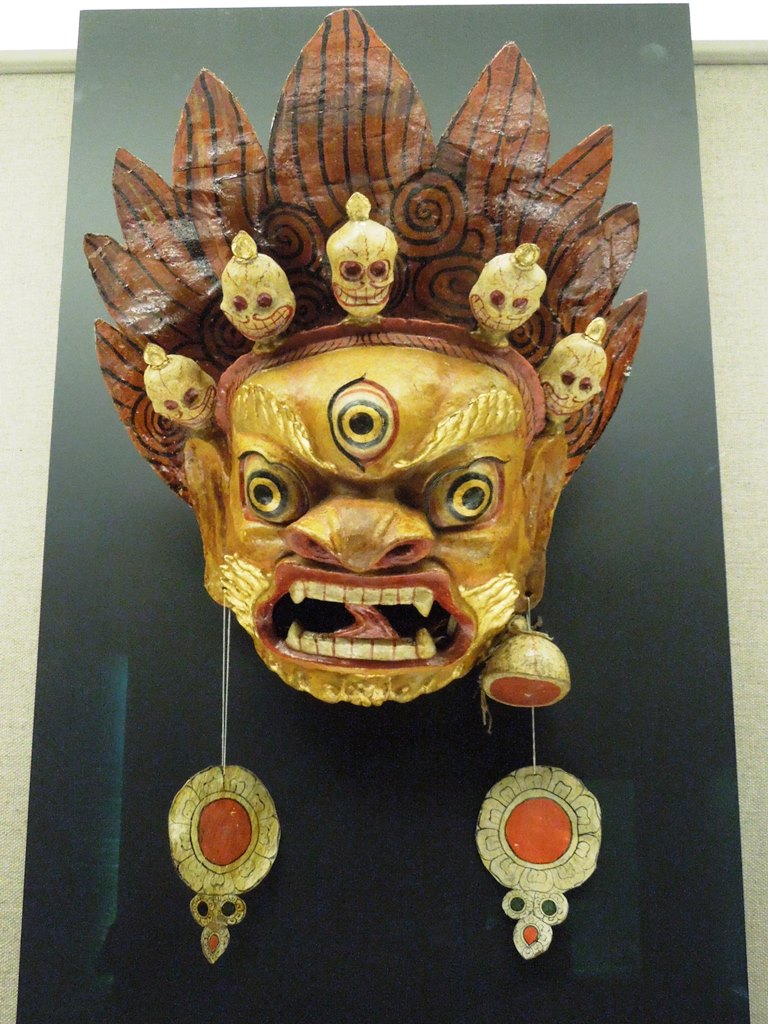
A rather intimidating mask from Tibet


Examples of lacquer 漆 made by the Yi (who also live in Vietnam and Thailand) on the top, and by the Dai below.


Anyone who has spent time on Taiwan might recognize these boats. Even if you haven't been to Lanyu (Orchid) Island 蘭嶼 (and I haven't), you've probably seen these traditional boats of the Tao people in tourist literature. Here's the interesting part: according to the caption at the Shanghai Museum, these fishing canoes were carved by the "Gaoshan" 高山族 people. Who are the Gaoshan? According to the Chinese government, the 14 aboriginal groups on Taiwan (as recognized by the Republic of China 中華民國 government) are all one minority grouping dubbed the "high mountain ethnic group". And, again, I probably should shut up at this point, and move on...

...to the furniture gallery, the last exhibition room I checked out the museum (I passed on the jade gallery, which is also on the top floor). I'm not the biggest fan of Chinese furniture, having always found it to be too heavy to move and uncomfortable to sit on, opinions formed from first-hand experience living in Taiwan. As works of fine craftsmanship, however, the Ming and Qing  清朝 pieces were things to be admired:


And that was it for my morning and afternoon at the Shanghai Museum. The obvious comparison is with Taipei's 台北 National Palace Museum 故宮博物院, but I find the two buildings difficult to compare, and not for diplomatic reasons. The last time I visited the Gù​gōng​ Bó​wù​yuàn was in 2001/2002, and the museum has undergone a major revamping since then. Also, to be honest, I don't really know enough about Chinese art to judge one collection over the other (I'm a greater admirer of Japanese art), except to say the museum in Taipei has a much larger and broader collection. Suffice it to say, if you have any interest in the traditional arts and crafts of China and you find yourself in Taipei, you should visit the National Palace Museum. The same goes if you come to Shanghai - make some time to see the Shanghai Museum. Just be sure to get there in the morning so that you don't have to wait too long outside to get through the security check.


Lunch in the restaurant on the ground floor of the Shanghai Museum. A plate of shrimp, egg and rice, plus a can of Tsingtao Beer  青岛啤酒 was only 48 yuan ($7.80). The beer itself was only 10 yuan ($1.60).


South Xizang Road 西藏南路 ("Xizang" is the Mandarin name for Tibet). Note the air quality.


Had I not eaten lunch inside the museum, I could've found something to eat on Yunnan Road Food Street.


Saturday, July 20, 2013

Self-Bunding

Two observations so far about life in Shanghai 上海:

1.) I'm lonely. Amber and Pamela are currently in Taiwan visiting the family there, and won't be back until the first week of August, shortly before my daughter starts her new school. I'm glad they're able to spend time with the folks on Formosa, but the house feels empty without them here. 

2.) I'm sweaty. We're in the midst of a heat wave, with the temperature today (according to the Shanghai Daily newspaper, which I've started a subscription to) reaching 35°C (95°F), though it felt much hotter this afternoon. And that's not to mention the humidity, which is seemingly as high as the temperature. Today was one of the sweatiest days ever for me, and that was without doing anything other than the simple act of walking around outdoors.

Despite the heat outside and our personal effects currently piled away in the living room and awaiting some kind of sorting and distribution throughout the house, I decided to check out more of Shanghai's Bund 外滩 area, the former International Settlement that is now the city's premier sightseeing spot and home to its finest (albeit Western-style) architecture. I actually began the day north of the Bund, getting out of the Tiantong Road Metro station 天潼路站 (and right into the heat) and making the short walk to the Main Post Office 国际邮局:


The building has been used as a post office ever since it was built in 1931. It's a striking structure, but that wasn't the reason for going there. On the second floor is the free-of-charge Post Museum 邮政博物馆. Actually, philately wasn't the reason, either - what drew me there was the prospect of getting a great view of the Bund from the rooftop garden. Alas, the roof area was under renovation and thus closed off, but the displays inside the museum were interesting. Best of all, it was air-conditioned.


A rare stamp issued (and then withdrawn) during the Cultural Revolution 文化大革命. On display in a special climate-controlled room were stamps put out between 1888 and 1978, with one glaring gap in the timeline - the 1960's.


The interior of the Post Museum. On the floor was an example of a mail train car, which had samples of letters being sent all over China...including Taiwan.

From the Post Museum, I crossed Suzhou Creek and entered the Bund (again; see last week). Following lunch in an air-conditioned Subway, I checked out the exterior of the former British Consulate (1873):


The old building is now some kind of private club and while the grounds are open to the public, white and black-shirted guards keep an eye on you as walk by the expensive luxury cars parked inside. The atmosphere was more than a little intimidating, while everything seemed a little, um, suspicious. The darker side of Shanghai appears to have taken over what the Brits left behind.


The former consul's residence (1884) was also well-guarded

Walking out of the consulate grounds, I came across a couple more examples of the bad old days (for the Chinese, of course):


The former Shanghai Rowing Club, built in 1905, used to have a swimming pool as well as docks for tying up the rowboats. Today it's a teahouse.


The former Union Church, dating from 1886

The street next to the church, Yuanmingyuan Road 圆明园路 was lined with both historic buildings and security guards. They didn't bother me while I was taking pictures (it is a public street, after all), but their presence was still a disturbing sign of the New China.


The China Baptist Publication Society building (1932) 


The Italian Renaissance-style Lyceum Building, finished in 1927


The Missions Building (1924)


The YWCA Building (1932)


The Yuanmingyuan Apartments, the date of which I forgot to note at the time, but thanks to Google, I now know is 1934.

Unfortunately, the 1933 Royal Asiatic Society Building was covered up in scaffolding. I couldn't find an entrance to check out the Rockbund Art Museum 外滩美术馆 housed inside, which I had wanted to visit today. Another time perhaps. 

There is a lot more to the Bund than what I've seen so far, but I decided to leave it for another day and walked over to Nanjing East Road 南京东路, stopping en route to practice my bad Mandarin with a couple from Shandong Province  山东省, who had asked me to take their picture. Instead of doing the sensible thing and heading home via the Metro, I made the stupid decision to see how far it was on foot from there to Nanjing West Road Station 南京西路站, the closest Metro stop to where I work. Dumb because I wasn't properly dressed for the weather (I was wearing a heavy pair of jeans as all my shorts and sandals are still waiting to be unpacked), and because it was damned hot and humid. This was the point where my shirt became drenched in sweat as I walked along the pedestrian walkway between Nanjing East Road 南京东路站 and People's Square 人民广场站 Metro stations.


I now know where single men can easily find female company. Walking along Nanjing Road, I was constantly being approached by people asking me if I wanted a "massage", with a couple of them also mentioning "girls". One, er, "recruiter" even tried to give me his card in case I changed my mind, though when I told him my wife wouldn't like that, he seemed to accept that as a reasonable excuse. Though I didn't get any massages or girls, I did discover the not-so-imaginatively named Foreign Language Bookstore 上海外文书店 (Communists were never known for their clever marketing strategies) a few blocks away on Fuzhou Road 福州路. Four floors of English-language titles (plus a Japanese section), including a ground-floor section devoted to books on China, mean I'll probably be back several times during the next couple of years.


The end (or beginning, depending on your perspective) of Nanjing Road's pedestrian-only zone, as seen from the entrance to the People's Square Metro station. From here, I continued to plod on, stopping to have a Tiger Beer at a bar called Windows Garage, a happy-hour bargain at only 15 RMB ($2.40). As wasn't the case with the Post Museum rooftop garden and the Rockbund Art Museum, this time my timing was good.


The interior of the Westgate Mall. The visa section where I now work is located in the same complex. The shopping center is full of high-end designer-brand outlets, but were empty despite the number of shoppers inside (most of them checking out Isetan 伊勢丹 Department Store, which anchors the mall). As a colleague explained it to me earlier, building owners make their money from apartments and condos, with store rents being surprisingly reasonable. As a result, foreign designers open up shops in these complexes knowing they aren't going to sell anything, looking at these outlets as a way of getting themselves noticed in China. Chinese consumers prefer to go overseas to buy their 名牌产品, the cost being cheaper than back home thanks to China's high tariffs. No wonder we're so eager to issue visas to Chinese tourists.

Next weekend I hope to do some more exploring. I also hope to be better prepared for the heat.