Wednesday, May 28, 2014

Memorializing Beijing, Part 1


Our bed at the Bamboo Garden 竹园宾馆

This past Memorial Day weekend saw us in Bĕījing 北京, China’s capital, for the second time since we arrived in this country last summer. Unlike our first visit, this time we flew there from Shànghăi 上海, landing on Friday night at the city’s lesser-used Nányuàn Airport 南苑机场, where our hotel was a long taxi ride through crowded streets away. Saturday morning brought rain and chillier-than-expected temperatures, but the weather didn’t hamper our enthusiasm as we took the Metro to one of Beijing’s more popular sightseeing attractions, the Summer Palace 颐和园.

Formerly the hot weather respite locale for Chinese emperors, the Summer Palace was a royal garden that took on its more lavish form during the reign of Emperor Qianlong 乾隆帝in the 18th century. The palace was pretty much razed to the ground by British and French troops during the Second Opium War in 1860, as virtually every signboard in the park reminded visitors in Chinese, English and Japanese. The notorious Empress Dowager Cíxĭ 慈禧太后 used money earmarked to modernize China’s navy to instead rebuild her summer playground. Today, the bridges, corridors, lakes, pavilions and temples bring in the sightseers by the busloads. We entered the palace through the relatively quiet North Palace Gate, crossing over an area known as Sūzhōu Street 苏州街, to which we would return later on our way out:


Cixi’s marble boat 清晏船, an amazing F-you gesture to those desperate to bring China’s navy up to then-modern standards. Spectacular it may be, but it didn’t do much to stave off China’s defeat at the hands of the Japanese during the First Sino-Japanese War in 1894-5:

 
Amber dresses up as a Manchu ᠮᠠᠨᠵᡠ princess:


The Long Corridor 长廊, decorated with colorful paintings:


Behind the Long Corridor sits Longevity Hill 万寿山, home to the Cloud Dispelling Hall 排云殿, which obviously was failing to do its job on the day we visited:
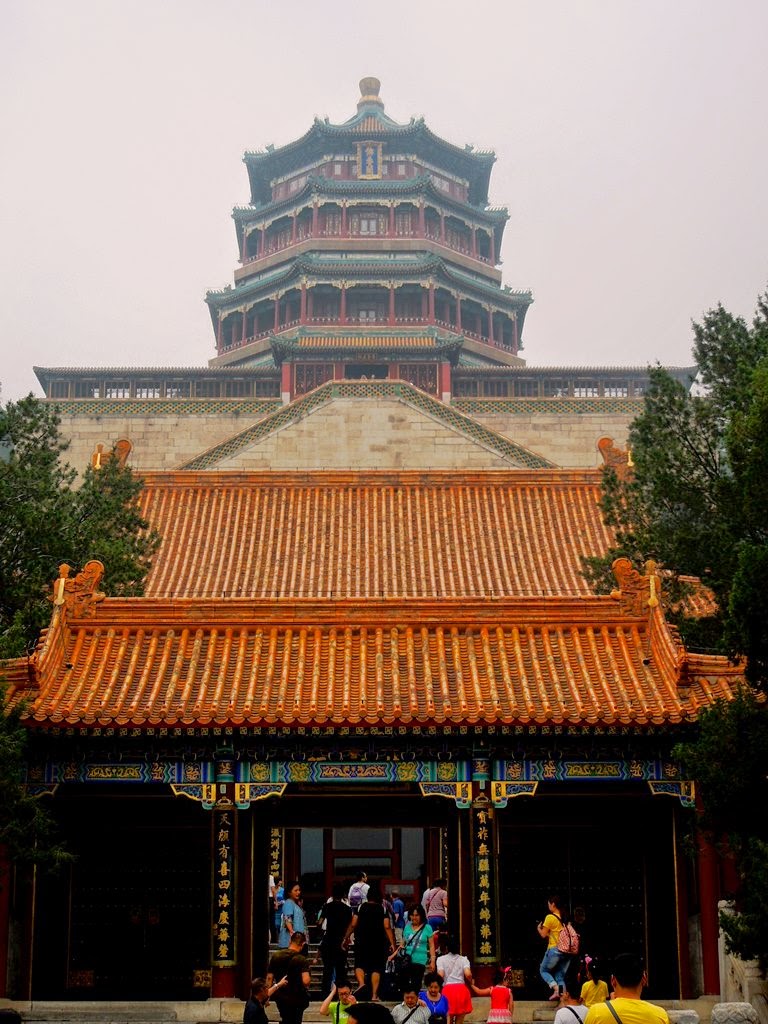


Here, Cixi sat and admired her birthday presents from Chinese nobles and foreign dignitaries:


Amber during a rare break from the crowds:


A corridor connects the Cloud Dispelling Hall with the Buddhist Fragrance Pavilion 佛香阁: 


At the top of Longevity Hill sits the Buddhist Temple of the Sea of Wisdom 智慧海. The view from there takes in Kūnmíng Lake 昆明湖, including South Lake Island南湖岛 and its 17-arch bridge龙王桥:


Leaving the temple, we made our way along the top of Longevity Hill toward the Summer Palace’s most popular building, the Hall of Benevolence and Longevity 仁寿殿, conveniently located near to where the tour buses pull up to disgorge their loads. Cixi took a load off there, making her hardwood throne a must-photograph item with the Chinese visitors:


Another must is the griffin statue:


Nearby sits the Palace of Virtue and Harmony, featuring a three-story theater. Various performances were being held on the stage:


The three of us later took a stroll along the lake, crossing the aforementioned 17-arch bridge over to the also-aforementioned South Lake Island, whose Dragon King Temple龙王庙 was unfortunately closed for renovations:


We then took a boat back across the water to Longevity Hill:


On our way out of the Summer Palace, we walked down the steps to Suzhou Street, a riverside area filled with souvenir shops:


It was a nice spot to take a break and enjoy an Arctic Ocean orange soda:


Like so many other places in China, the Summer Palace occupies a huge area, far too big to explore in one day. Size matters in this country. Still, what we were able to see was worthwhile, despite the crowds. Less worthy was the area around Qiánhăi Lake, filled with bars, restaurants, souvenir shops…and people:


Dinner ended up being at an overpriced Vietnamese restaurant:


All in all, however, it was a successful first day in Beijing. Tomorrow would bring about the Wall…


Sunday, May 18, 2014

Kongzi say...

Love him or hate him, for better and/or for worse, there's no escaping the influence the philosopher Confucius 孔子 has had on Chinese society (and in Korea and Japan, as well). For around a thousand years, knowledge of the works attributed to him were a requirement to pass the rigorous imperial civil service exam in China. In theory, at least, subjects bowed to their rulers, wives dutifully obeyed their husbands and children had to demonstrate filial piety. Students were force fed his teachings in class. Chinese society rarely, if ever, lived up to its Confucian ideals, but that never stopped the Neo-Confucianists from using the philosophies derived from the great sage's lectures to limit progress and bring society to a standstill. And though the Communists tried their best to eradicate Confucius from Chinese life during the early years of the People's Republic, modern-day authoritarians desperate to hold on to power have re-discovered the value of promoting the ideas of the great philosopher. 

And so, if you haven't already guessed, there is a connection between our family, this weekend and Confucius. Like many cities in China and Taiwan, Shànghǎi 上海 has a Confucian Temple 文庙, located in the Old City 老成. Shanghai's Confucian outpost is noted for its secondhand book market held every Sunday; however, today's was canceled due to security measures in place for the upcoming Conference on Interaction and Confidence-Building Measures in Asia, to be held May 20-21 in Shanghai. The temple was established during the Yuán dynasty  元朝, but was heavily damaged during the Taiping Rebellion, and was largely rebuilt in 1855.

One of the most noteworthy buildings in the complex is the Kuíxīng Pavilion 魁星阁, dedicated to the Taoist god of fate and literature:


My daughter poses by a tree (the type of which I do not know) which is over 300 years of age:


The study hall had an exhibition of teapots, all showing a high degree of craftsmanship and skill, such as this meter-high monster which had images of swimming carp on the other side (but which couldn't photograph clearly due to the reflection off the glass)...:


...and this one of a scholar chanting a Buddhist sutra:


Students visit the Confucian temple to pray for success on the much-too-important high school and college entrance exams, and their red ribbons expressing their wishes were tied to posts and trees outside the main hall:


In Confucian Temples in Taiwan, it's uncommon to find statues or other representations of the great philosopher, but Shanghai's house of worship had not one, but two. The first stood in front of the Dàchéng Hall...:


...and the other inside the building:


In Shanghai, the future (here in the form of the yet-to-be-completed Shanghai Tower 上海中心大厦) is never far away. According to a program recently aired on Discovery, the Shanghai Tower is a remarkable new lifestyle concept that will cure the ills of modern-day Shanghai (traffic congestion, overcrowding, pollution etc.). In reality, it will be nothing more than just another skyscraper to add to the city's growing collection:


After our visit to the Confucian Temple, we made our way over to Dōngtái Road 东台路, a long street of old houses that have so far escaped the attention of the developers and city planners. Here, virtually every shop was devoted to selling antiques and other curios, ranging from kitschy Chairman Mao nicknacks to reproductions of terracotta warriors:


Local kids play behind the stalls:


Of course, we couldn't leave without purchasing something. This reproduction of an old poster advertising a brand of Japanese sake called Hakutsuru 白鶴 fit the bill nicely:


Cats on a warm tin roof:


Saturday, May 17, 2014

Albion, China

The period running from the conclusion of the First Opium War in 1842 up to the end of the Second World War in 1945 is considered in China to be a century of national humiliation, and the population is constantly reminded of this by their unelected representatives (while the government conveniently ignores the many other centuries where neighboring countries and peoples were brought to heel in the name of Chinese cultural superiority). It was a time when European imperial powers such as Britain, France, Germany and Russia, not to mention the United States and, later, Japan, established settlements in many Chinese cities and administered them under the principle of "extraterritoriality", the idea that foreigners were not subject to local laws, only to those of their home countries. It was during this period that Shànghǎi 上海, with its International Settlement and French Concession, prospered and the legacy of that time lives on in the city's architectural heritage.

The section of the city where we live, Hóngqiáo 红桥, is considered to be in the suburbs, and is noted for its large expat population (like us). Prior to World War II, many wealthy Westerners maintained villas in this area. Although this Saturday was yet another wet and overcast weekend day, I was determined to get out on my new Trek mountain bike and do some exploring. After riding around some back streets for a while (and coming across a small area that surprisingly evoked the swamps of the American South), I found myself on Hongqiao Road 红桥路. Passing by the Cypress Hotel 龙柏饭店, I recalled that this place had a connection to Victor Sassoon, the hotelier and tycoon whose architectural legacy lives on in today's Shanghai (as this CNN article illustrates). Sassoon had a mansion here that he used as a weekend retreat, a building that supposedly looked like this:


I say "supposedly", because I didn't exactly see any buildings that looked like the one in the above photo. What I did find, however, was this small cottage-like structure standing in what looked like an English garden (albeit an English garden with a pond stocked full of hungry Asian carp):


Next door was a fine example of period architecture, the Times' Villa. It was built in "Spanish style" (according to the plaque on the outside wall) sometime in the 1930's for the American-Oriental Banking Corporation:


My trusty new steed, parked in a garden in Shanghai, or possibly Colchester...:


Further along Hongqiao Road is another former home of Victor Sassoon's. This house is currently owned by the local government, which appears to have not yet made up its mind about what to do with the property:


Sassoon wasn't the only man of means to enjoy life in relatively tranquil Hongqiao before the war. H. H. Kung 孔祥熙, a wealthy banker and Kuomintang 中国国民党 politician, also maintained a pair of residences that are still in use today. The first is now a teppanyaki restaurant:


...while the other (built in 1934) has been converted into a medical clinic:


It's easy to understand why many Chinese are resentful of the way Westerners and wealthy Chinese cavorted in Shanghai during the prewar period. But despite the perceived humiliation, credit is due those who have had the foresight to maintain so much of the architectural heritage left behind by the "barbarians" who came to Shanghai through the "open door" to make (and lose) fortunes here. It's what makes exploring this city so enjoyable, and why I'm looking forward to longer and more interesting bike rides as the weather warms up.