Thursday, February 26, 2015

Lunar New Year: Sakurajima

Sakurajima 桜島

As an admitted Japanophile, last year was a difficult time in that it was the first year since 1988 that I never stepped foot on Japanese soil for any purpose whatsoever - not for travel, not in transit and certainly not to return to a home and a job. Thanks to my better half, however, all is right with the world again early in 2015 as it was her suggestion we visit Japan during the Lunar New Year holiday. Pamela initially wanted to travel to the northernmost island of Hokkaidō 北海道 to experience some snow, but the thought of being surrounded by thousands of Chinese tourists led us instead in the opposite direction, to the city of Kagoshima 鹿児島, on the southern island of Kyūshū 九州. There were still plenty of Mandarin-speaking visitors there, but many of them were from Taiwan, and in any event we were fortunate not to run into any large tour groups. 

We left Shànghăi 上海 last Thursday afternoon, and arrived at Fukuoka Airport 福岡空港 almost at the scheduled time of 5:15. The airport there is one of my favorites, mainly due to the fact it's only two stops on the subway to Hakata Station 博多駅, a claim to convenience that few major urban airports can make. By 7:00 in the evening local time the three of us were seated on the Kyūshū Shinkansen 九州新幹線 for the 138-minute bullet train ride to Kagoshima-Chūō Station 鹿児島中央駅:


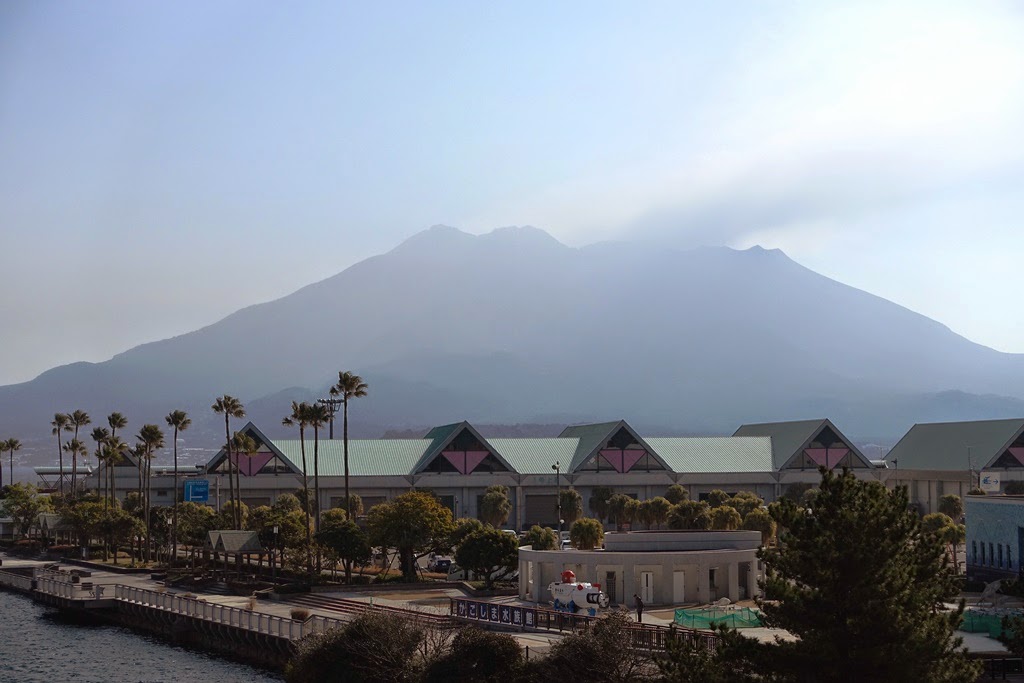
Kagoshima's most famous attraction is an impressive one. Not many cities in the world are situated just 4 kilometers from an active volcano. Sakurajima is only a 15-minute ferry ride across Kagoshima Bay, and on Friday morning we took a tram from Kagoshima-Chuo to the port:


As we approached the west coast of Sakurajima, the volcano was smoking away:


A single, 40-kilometer road makes a circuit around the former island, and we rented a car from a small shop across the road from the ferry terminal. First stop was the visitor's center, where there were displays on the volcano, including photographs from a massive eruption in 1914, the lava flows of which connected the southeastern half of Sakurajima to the mainland, thus ending its status as an island:


In the rear of the center was a long foot bath 足の湯, comfortably warming in the chilly winter air:


Our road tour really began with the drive up to the Yunohira Lookout 湯之平展望台, 373 meters above sea level and providing views of the Kita-dake 北岳 and Naka-dake 中岳 peaks. Smoke could be seen rising from the still-active Minami-dake peak 南岳 in the background:


The view toward Kagoshima city was also pretty impressive on this clear day. Much of the land visible in the photo below was the result of lava flows from the 1914 eruption:


From the lookout, we continued on our circuitous route, enjoying the views out to sea on our left:


Looking to the right, we were greeted by a sight none of us had ever seen in person: a volcano in the throes of an eruption. Knowing that this happens numerous times on a daily basis on Sakurajima was little comfort as the ash cloud seemingly made its way toward us:


The scale of the 1914 eruption is best realized by the sight of this Shintō 神道 shrine gate. This torii 鳥居 once stood three meters high, until it was covered in ash:


Almost as astounding as the ongoing eruptions is the fact that people live at the foot of the volcano. The buried torii lies in front of a school, and we had lunch at a cafe across the road. Afterward, we stopped off at a small store, where Sakurajima's famous giant daikon 大根 radishes were growing in the plot in the back (in contrast the local mandarin oranges, mikan みかん, are tiny, a result of the same rich volcanic soil).


The best place to see Minami-dake in action is the Arimura 有村 Lava Observatory. Below, Amber checks out one of the many shelters located around Sakurajima, a sobering reminder that another major eruption likes the ones in 1914 and 1946 could happen at any time:


And as I was pondering the necessity of the shelters, Minami-dake erupted yet again:


By this point on our journey, our clothes were covered in a light coating of ash and dust:


In the southern part of Sakurajima is the Karasujima 烏島 Observation Point, built over the same 1914 lava flows that engulfed a small island that used to be located 500 meters offshore:


After dropping off the car, it was time for a selfie before getting back on the ferry for the ride back to Kagoshima:


Amber became quite attached to the mikan plush toy that she bought at the visitors center. It would be her constant companion on our trip:


Back in the city, we took a tram to the Tenmonkan shopping arcade 天文館本通アーケード:


Images of local hero Saigō Takamori 西郷隆盛 can be seen all around Kagoshima. Saigo was one of leaders of the Meiji Restoration 明治維新 that ended centuries of feudal rule and started Japan on its drive toward modernization, only to become a tragic hero when he rebelled against the new government after fearing that the reformers were moving ahead too quickly. The Satsuma Rebellion ended in failure and Saigo's death, but his ultimately futile resistance is still admired in modern-day Japan (and served as the inspiration for that ridiculous Tom Cruise vehicle The Last Samurai):


Dinner in Tenmonkan was okonomiyaki お好み焼き, a dish often described as a "Japanese pancake", though it bares little resemblance to what that word conjures up in North America. Mine was a seafood mix garnished with seaweed and bonito fish flakes. Japan is a land of many attractions, and sampling some of the cuisine is (or ought to be) one of the definitive highlights of any visit:


Following dinner, we walked back to the Kagoshima-Chuo Station area. While Pamela retired to our hotel, my daughter and I decided to try out the Ferris Wheel located atop the Amyu Plaza アミュプラザ shopping center next to the station building. Amber elected to ride in the "skeleton" car - the one with the transparent floor and sides. A little unnerving, but a fun way to end the day:


Monday, February 16, 2015

Mission possible in Xitang

Taiwan has its "old towns" - usually a block or two (sometimes more) lined with buildings the facades of which date from the time when the Japanese administered the island. Saved from destruction by the tourist trade, they form simultaneously interesting and depressing glimpses into Taiwan's past and present: elegant structures whose survival now depends on selling the same snack foods and souvenir knick knacks that can be found all over Taiwan to the weekend and holiday hordes. They may have been saved from destruction, but it's hard to distinguish one "old town" from another.

In Shànghăi's 上海 case, it's the "water towns", centuries-old burgs which developed along the network of canals, lakes and rivers that populate the plains surrounding the city, that owe their survival to late 20th-century economic reforms and the early 21st-century tourist boom that has followed in their wake. Canal towns such as Zhōuzhuāng 周庄, Tónglĭ 同里 and Wūzhèn 乌镇 offer evocative glimpses of a China gone by, but at the same time it's hard to distinguish one from the other, each one offering similar foods, gift items, restaurants and even bars and dance clubs. Survival comes with a price, and Xītáng 西塘, only an hour's drive from Shanghai and where we spent last night, was no exception.

The Lunar New Year may be almost upon us, but the reason we had time to visit a canal town this weekend was due to Presidents Day, which this year happens to fall three days before the start of the Year of the Sheep. We'll be spending the Lunar New Year break in Kagoshima 鹿児島 in Japan, but for the time being please enjoy a few photos from our overnight visit to Xitang:


We stayed Sunday night at the Time Walk Theme Inn, one of many homes converted into Chinese-style B&B's (only minus the breakfast, at least in our case). Ours was situated along a quiet (though filthy) canal and had a loft that my daughter quickly declared to be hers for the night. 


The weather had been rainy starting in the morning and throughout the drive from Shanghai, but by the time we arrived at Xitang, the skies had cleared and there were some nice views of the waterways. I was surprised by the lack of traffic on the expressways, as well as by the relatively few numbers of visitors in the town yesterday.


When in Xitang, do as the...For Amber, that meant frozen yogurt; for my wife, stinky tofu. 


Boats were on hand to take visitors up and down the canals. They weren't very busy in the daytime, but the situation changed once night fell.


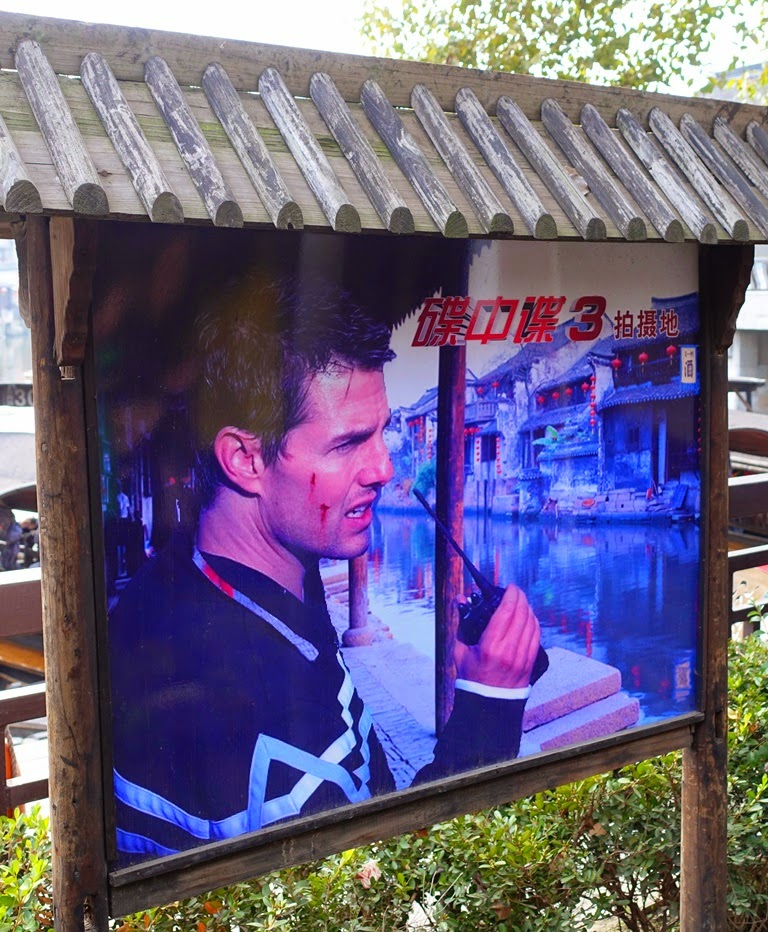
I've seen Mission: Impossible III, but I don't remember the scenes filmed in Xitang. There were billboards, however, to help me jog my memory.


When the rain started coming down again, I was grateful the town's residents had the foresight to build roofs over many of the walkways. One section, in particular, was covered for about a kilometer.


While many of the same snack foods could be found all over Xitang, I only saw one establishment catering to those visitors hankering for a scorpion or a centipede.


Little did I know Xitang is also a fashion mecca. My wife had to have this outfit.


For some reason, all the locally-brewed beer I've had so far in China has been extremely weak, the opposite of what you find in the United States. Xitang Beer weighed in at a puny 2.8% alcohol content.


They may be tourist traps at times, but the canal towns do look lovely at night. In Xitang the thing to do is to launch a paper holder shaped to look like a lotus leaf, and with a burning candle in the center, into one of the canals. We were going to to the same until the rain started coming down hard.


Xitang, unfortunately, had a bar street that was unsurprisingly garish and noisy. Dance clubs alternated with bars where the entertainment at the latter seemed exclusively the realm of Chinese guitar-pickin' singer-songwriters, baring their souls at full amplification. 

The three of us went for a boat ride after dinner. It was hard to take photographs due to our position in the middle of the craft, but the lights along the canals were pretty nice. 


I'm not sure why I woke up at 6:20 this morning. It was either the alarm on my wife's smartphone that she forgot to turn off before going to bed last night, or the fireworks going off at that early hour of the morning (and continuing until lunchtime), or a combination of both. Across the canal from our room was a temple.


The canals were quiet in the early morning hours. Surprisingly, however, Xitang would soon get busier on this Monday than it was yesterday. Some people, apparently, were getting a head start on their Lunar New Year holiday.

It took some walking around, but we eventually found a place to have breakfast. My daughter enjoyed some dòhuā 豆花, while I had some steamed dumplings 小笼包, accompanied by a bowl of warm soya milk. 


The sky was an ugly gray which later revealed itself to be heavy smog as we drove back to Shanghai.


Xitang does not have any "must see" sights, but there are some attractions that are included in the 100 RMB ($16) admission ticket to the canal town (our tickets were only half that, and Amber was admitted free of charge, due to the fact that we stayed overnight in the town). My daughter and I checked out an old mansion while Pamela took in a traditional Chinese garden.


A purchase for the home: it's the character fú 福, meaning "good fortune", "happiness" or "luck". The characters in the red area of the wall hanging are stylized renderings of that one character. 


Some final views of the canal and the town before the short drive back to Shanghai. The expressways were again relatively empty, a great relief considering the nightmarish traffic jams that can happen in China (and Taiwan) during the Lunar New Year holiday period.


No visit to a canal town is complete without purchasing some locally-made alcohol. No doubt because I was the designated driver, my wife sampled just about every variety there was at the shop before deciding on a couple of bottles.