Dour, 電通-controlled, family-centric Belgian Neocolonialism, enthusiastically jaded observations, support for state-owned neoliberalist media and occasional rants from the twisted mind of a privileged middle-class expatriate atheist Crypto Jew and とてもくだらないひと projecting some leftist ideals with my ridicule of Tucker Carlson, all while taking America's blood money and cashing out that pension and TSP (from The Blogs Formerly Known As Sponge Bear and Kaminoge 物語)
*see disclaimer below
A 15th-century depiction from central Tibet of Amitābha
Winter came early this year to the District of Columbia and its environs, but it didn't stay around long. This was the scene from our balcony as I awoke on Thursday morning:
Snow continued to fall throughout the morning and into the early afternoon:
What it looked like at work:
By mid-afternoon the snow had turned into rain and the ground began to get slushy. Come Friday morning the sun was out, and while the temperatures were low, they stayed above freezing, with much of the snow being gone by the time I woke up. If the day wasn't sunny enough already, I had the pleasure of an unexpected break from classes, as our instructors were busy doing "professional development", or something along those lines. My wife, as usual, elected to stay home, so I headed off by myself to see what was going on at my favorite pair of galleries in the District, the Freer Gallery of Art, and it's companion, the Arthur M. Sackler Gallery. Together they form the Smithsonian Institute's collection of Asian art, "where Asia meets America" (hence the title of this post). As always, I started with the Freer and its current Japanese exhibits. Painting the Classics: Japanese Screens features folding screens depicting scenes from The Tale of Genji 源氏物語, arguably the world's first novel. This Edo-period 江戸時代 pair dates from the 17th century:
In another room, Imperfectly Beautiful: Inventing Japanese Ceramic Style featured examples of pottery used in the tea ceremony 茶の湯, focusing on how Japanese potters broke away from continental influences to create items that emphasized the personal, such as this Azuchi-Momoyama period 安土桃山時代 vase from the Iga region 伊賀焼:
It wasn't all folding screens and tea ceremony utensils. There were examples of hanging scrolls like this early 19th-century Edo-period depiction of the 11th-century warrior Minamoto no Yoshiie 源義家 returning to Kyōto 京都 after fighting in the north:
And in a precursor of things to come, there was this magnificent depiction of Amida 阿弥陀如来 from the early 14th-century, which came with a surprise from the 8th century inside! I'll let the caption tell the story:
The guardians of the Four Directions (from left to right: east, south, north and west):
One of the Freer's ongoing exhibitions is the magnificent Peacock Room, which I've seen on my previous visits (see here and here):
Although the Freer is noted for its large Japanese collection, it also has extensive displays of Chinese arts and crafts...:
...as well as examples from the Korean peninsula:
A rarity indeed: this flower-shaped bowl stand from the Northern Song Dynasty 北宋 is an example of Ru ware 汝窯, the rarest of all Chinese ceramics:
From the Freer it was downstairs to the Sackler, where the utterly fascinating Encountering the Buddha: Art and Practice across Asia is running until November 2020. Pride of place (for me, at least) goes to this Heian-period 平安時代 (late 12th-century) statue of a bosatsu 菩薩, made of wood with gold leaf:
A pair of bodhisattva. The one on the left is from northeastern Thailand and dates back to the 7th century (!); the one on the right is only eight or nine hundred years old and is either Cambodian or Thai in origin:
The highlight of the exhibit is without a doubt the stunning Tibetan Buddhist Shrine Room, containing over two hundred objects of Tibetan Buddhist art from the Alice S. Kandell collection. The effect of the lighting and recorded chanting of monks creates an atmosphere that is absolutely mesmerizing. Unfortunately, I will probably never have the opportunity to visit Tibet due to the nature of my employment. Then again, even if I were able to go, I would be afraid to see what has happened to the culture as a result of Chinese government policies promoting Han migration into the region:
In the gift shop later, it took all my willpower to stop myself from shelling out $60 for a book detailing all the objects in the Tibetan Shrine Room (though I did buy some prayer beads that had been blessed by Tibetan nuns, with the money hopefully going to a good cause. I also purchased a book on Buddhist art at the Freer/Sackler). Desire is the cause of suffering, I had to remind myself. I also searched in vain for a CD of Tibetan throat singing similar to what was being played in the shrine room; here's a video shared from YouTube instead:
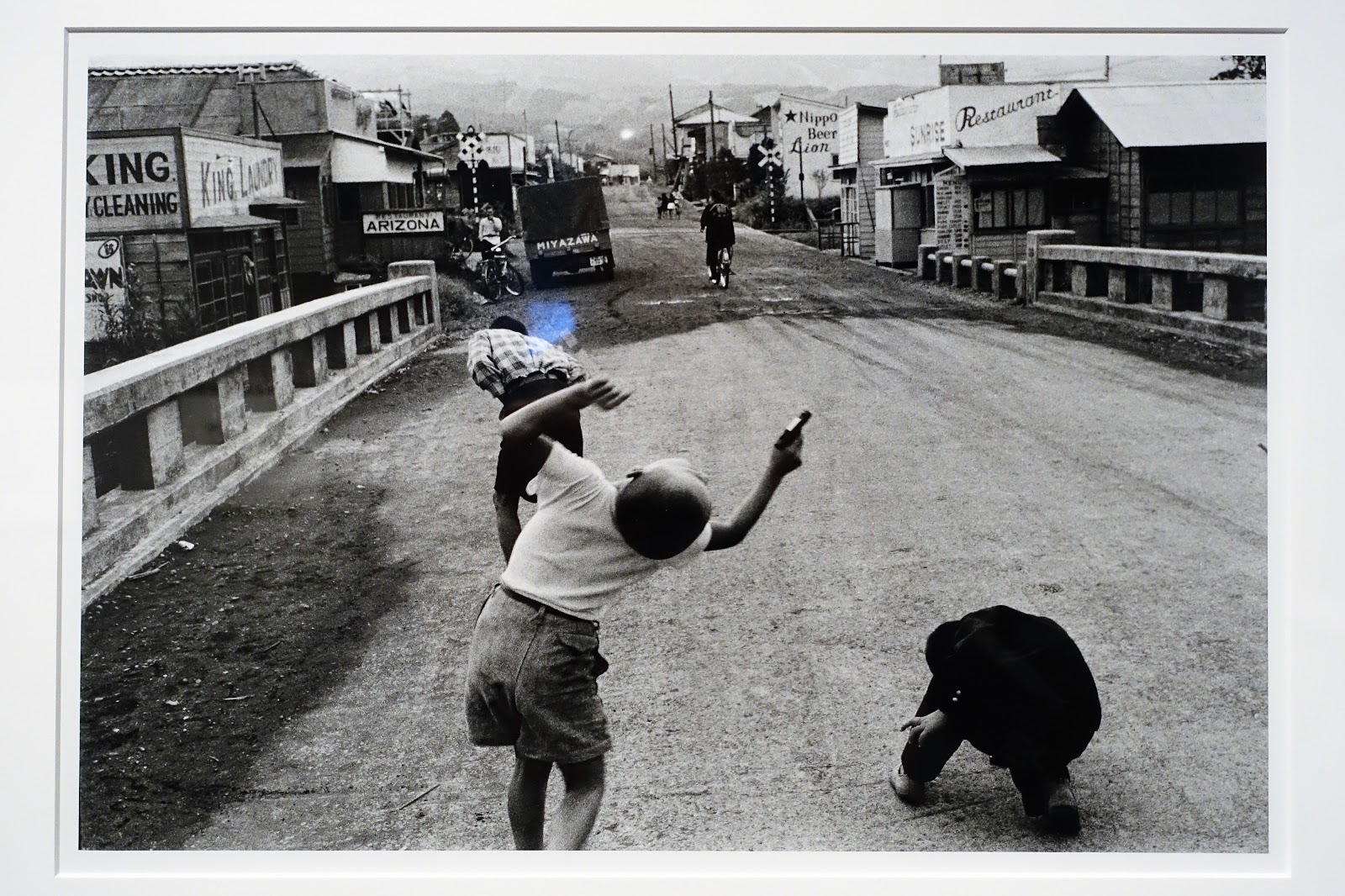
Another fascinating exhibition currently at the Sackler is Japan Modern: Photography from the Gloria Katz and Willard Huyck Collection, which features a selection of works from 20th-century Japanese photographers. My favorite was Town near U.S. Base, Gotemba, Shizuoka, taken in 1957 by Shigeichi Nagano 長野重一. It shows a group of children in postwar Japan playing near an American military facility that was located in the shadow of Mt. Fuji 富士山:
Anyone who has ever lived in Tōkyō 東京 will surely appreciate this amazing diorama map of Japan's capital:
Resound: Ancient Bells of China showcases the development of bells in China, such as this bird-and-dragon motif example from circa 500-450 BCE (!). This exhibit also provides a rare hands-on opportunity, as visitors can sample the tones produced by replicas of the bells, using computer images to see the variations in sound wavelengths:
Returning to Nippon, Japan Modern: Prints in the Age of Photographs showcases how traditional woodblock printmakers tried to adapt in the age of photography, with some surprisingly artistic results. Shin-Ōhashi (1926), from the series Twenty Views of Tokyo by Hasui Kawase 川瀬巴水:
Another of Kawase's works - Dusk at Kiba (1920). I had to stand some distance away so as not to have my image reflected in the glare of the glass frame. Were I to be a performance artist, I would purposefully put my prints in highly reflective frames so that the viewer becomes part of the image, along the lines of John Cage and 4'33":
Of course images of Fuji-san were popular. Mt. Fuji from Hakone Observatory (1938), by Shinsui Itō 伊藤深水:
Autumn in Okutama (1927), by Un'ichi Hatsukawa 平塚運一, struck a chord as the area in question was one of my favorite weekend escapes from the urban expanse that is Tokyo (while still being a part of the Tokyo Metropolis 東京都):
River Scene (1920), by Kazuma Oda, shows the jarring juxtaposition of a traditional Japanese bridge with the polluting smokestacks of a Japan that rapidly industrialized after the Meiji Restoration 明治維新:
Sanjō Bridge (1954), by Tomikichirō Tokuriki:
The Freer/Sackler isn't only just East Asia. There is an extensive collection of objet d'art from Iran and India, for example, as well as this "South Arabian Mona Lisa" from Yemen. But it's the Japanese art (as well as the pieces from China and Southeast Asia) that keeps me returning to the galleries time and time again when I'm in this area:
The newest attraction on the National Mall is the National Museum of African American History and Culture, which opened in September 2016 while we were in Vilnius. Unfortunately, the required timed tickets for weekend visits are almost impossible to get, and we may have to wait until the next time we're in Washington to go, when some of the hoopla should have hopefully died down:
Passing by a couple of South American heroes on my way to the Metro station:
With my first Amharic evaluation to take place before Thanksgiving (and which I'll probably do horribly on), the visit to the Freer and Sackler galleries provided a brief though welcome break and an opportunity to experience something of Asia again, if only for a few hours on a weekday morning/afternoon. I'll finish this post with one nagging question, however, from these and other galleries/museums I've visited over the years in the West: was there nothing worthwhile in Taiwan to be stolen collected?
Perhaps that question is better left as a kōan 公案...
Yesterday (Monday) was Veterans Day, better known in other countries which also participated in the War that unfortunately did not End All Wars as Armistice Day or Remembrance Day (actually the holiday was on Sunday, but observed on Monday so as to create a three-day weekend). Veterans Day commemorates those who have served in the U.S. military and shouldn't be confused with Memorial Day (observed on the last Monday in May), which honors those who died fighting in this country's many conflicts. We take the military very seriously in the U.S., with the post-9/11 media constantly thanking our "heroes" for serving their country in the defense of my freedom, though it's never been made clear how that was threatened in the first place by the people of Vietnam, Grenada, Panama, Iraq, Afghanistan etc. Calls for universal health care or free university tuition are always answered with questions over how such "socialist largesse" can be paid for, yet few seem to ask where the money will come from to pay for the newest aircraft carrier or next-generation fighter plane. The Pentagon receives over $700 billion a year, to cover the costs of 2.8 million employees and a network of almost 800 overseas military bases in more than 70 countries and territories. Direct American involvement in the war in Afghanistan has been going on for 17 years, with more than 2400 U.S. dead and no end in sight, and yet was barely mentioned as an issue in the recent midterm elections. And speaking of our "heroes", not enough attention is being paid to the trauma suffered by some as a result of their military service - the latest white terrorist was an ex-Marine who served in Afghanistan (and I don't even want to get started on the gun sickness in American society, another issue with no end in sight amid an unwillingness among many in our political elite to do anything meaningful about it, except for useless "thoughts and prayers").
It can all be a bit much at times, what with endless wars, senseless shootings, political acrimony and my own personal family and health issues. Fortunately, there are days like this past Saturday. Despite a high of only 45°F (7°C), it was beautifully sunny. Having rented a car for the weekend, I drove to Fort Hunt Park in Alexandria, Virginia. I loosened up by walking along the paved path that circles the park, passing by the horse stables for the U.S. Park Police:
Fort Hunt Park gets its name from the military installation that used to watch over the Potomac. Remnants of some of the fort's batteries have been preserved:
My name is Kaminoge and I approve this park
The circuit completed, it was time for the real walk to begin, as I crossed under the George Washington Memorial Parkway to join up with the Mount Vernon Trail already in progress. My goal was to finish the final 3.4 miles (5.5 kilometers) to, you guessed it, Mount Vernon. It was an easy, straightforward walk, beginning with views of Fort Washington on the other side of the Potomac River in Maryland. Originally built in 1809, it complemented the later Fort Hunt (1893) in defending Washington, D.C. from an invasion from the sea:
Ladies and gentlemen, I give you...the Potomac!:
The trail made its way over boardwalks built over swampland...:
...and past some stately homes on the other side of the Memorial Parkway:
The Cedar Knoll restaurant, "Mediterranean fare with a river view". I made do with apple slices and matcha-flavoredPocky ポキー sticks:
A little bit of history en route to Mount Vernon. I tried but failed to get the hawk flying in the background into the shot:
Crossing the stone bridge over the above-mentioned Little Hunting Creek:
My hiking book warned me the trail was "steep" as it approached Mount Vernon but it was anything but:
The Mount Vernon Trail is no doubt usually busy with anglers, cyclists, joggers, picnickers et al, but the chill probably kept most of them away on this particular Saturday. The same couldn't be said of Mount Vernon itself - cars were slowly searching in vain for spots as I passed by the parking lots:
Having been to Mount Vernon previously, I contented myself with the food court and gift shops (and restrooms) outside the entrance. The reward for my walk was a high cholesterol level-be-damned bacon cheeseburger, eaten al fresco on the patio as all the indoor tables were taken - the sweat from the effort to get to Mount Vernon kept me warm during lunch. Afterward, it was back the way I came as I returned to Fort Hunt. In all, the walk took a shade under four hours (lunch break included), and covered a distance of 8 or so miles (around 13 kilometers):
While Saturday was a fairly successful day, Sunday could be best summed up as a case of the blahs, with one notable exception. I'd planned to go for a bike ride, buy a new pair of shoes and study some Amharic, but in the end I did none of those things, the result of an ennui I seem to be feeling a lot of lately. Fortunately, the day was saved when my family and I joined up with some friends of ours for dinner at the Vienna branch of Sakura, one of those "Japanese-style" steakhouses you don't find in Japan. It was my first time to sample a Koshihikari Echigo Beer こしひかり越後ビール, a tasty rice lager:
The preparation of the entree was a performance, of course, though my daughter doesn't look too impressed in the photo below. However, Amber really showed off her talents when she successfully caught in her mouth all four pieces of shrimp the cook tossed her way with a flick of his spatula:
I was hoping to do something with my daughter on Monday, but as she had had a couple of days off from school the previous week due to "professional development" for the teachers, she had to go to school as usual on the Veterans Day holiday. With Shu-E preferring to stay home, I found myself riding the Metro solo into the District to check out the Newseum, an interactive museum designed to promote awareness of the First Amendment, as well as trace the historical development of modern journalism. Leaving the Federal Triangle Metro station and making my way along Pennsylvania Avenue, I passed by what used to be the Old Post Office, but which has been transformed into a Trump International Hotel. No conflicts of interest here, folks, move along:
I also passed by a couple of monuments that seemed to epitomize the holiday:
The Newseum. Admission is on the hefty side, but it turned out to be worth it:
I began my exploration in the below-street level first floor, watching part of a documentary on sports journalism. I came in as Bobby Thomson hit his Shot Heard 'Round the World, then watched Jackie Robinson, Muhammad Ali and Wide World of Sports ("the thrill of victory and the agony of defeat"), before being reminded of the Munich massacre, one of my earliest memories of how cruel the world could be:
There is also an exhibit on the Berlin Wall...:
...that includes an actual section of the Wall, as well as one of the guard towers that stood watch over the "death strip". The first of many sobering exhibits to come:
Next, I took the elevator up to the top (sixth) floor and started to make my down to ground level. First, however, I stepped out onto the terrace for the view down Pennsylvania Avenue, taking in the U.S. Capitol...:
...and the National Gallery of Art:
Each day, the Newseum posts that day's front pages of a sampling of newspapers from all fifty states. The state where I grew up was represented by the Los Angeles Times...:
...while news from my current state of record was presented by The Seattle Times:
The most gripping exhibits were those showcasing Pulitzer Prize-winning photographs (WARNING: some of the following pics may be disturbing), like this award-winning shot from the Ferguson unrest of 2014 that shows that police officers aren't always "heroes":
Malcolm Browne's famous picture of Thích Quảng Đức calmly burning to death on a street in Saigon in 1963 in an act of self-immolation:
Even the photos that have been seen numerous times still retain the power to shock:
Making my way down. A collection of press ID badges:
One of the most fascinating sections of the Newseum is its collection of original newspapers and pamphlets going back several centuries and reporting the major stories of the day. The lighting was too dim to photograph many of them, but images could be called up on computer screens:
I was able to get shots of a couple of front pages:
This is the headline held up by Harry Truman in a famous photograph following the 1948 U.S. presidential election:
As the Newseum is financed by a private foundation, it is free to bring attention to the current atmosphere faced by journalists in this country:
It seems that in some respects not much has changed:
The 9/11 Gallery includes the ruins of the antenna that stood on the roof of the North Tower of the World Trade Center. In the background are copies of headlines from newspapers around the world reporting the attacks:
This connection between the 1968 Olympics Black Power salute and the more recent brouhaha over NFL players taking a knee in protest against unarmed African-American men being gunned down by police serves as a sad reminder that too many white folks in this country still get upset when black people seek to bring attention to the injustices they face:
In case you're wondering, the best country for press freedom is Norway, according to Freedom House:
How Freedom House ranks the world, with green being "free", yellow "partly free" and red "not free":
My next destination doesn't rate too highly:
A wall lined with photographs of some of the many journalists around the world who have been killed in the line of work:
Edward R. Murrow, part of an exhibition on radio and television:
Though it isn't easy to see through the glare, this is the room where the museum receives digital submissions from all over the world:
Visiting students having the chance to be TV reporters. It was too bad Amber couldn't have come with me:
I remember seeing this photograph in Newsweek, to which my father subscribed. It shows the body of a Thai university student who had been lynched by a pro-government mob in the 1976 Thammasat University massacre in Bangkok:
I'm also old enough to remember this photo, having seen it in a newspaper (most likely the Orange County Register):
The last exhibit I checked out focuses on the FBI's work fighting terrorism and cybercrime, as well as the pursuit of notorious most-wanted criminals like Bradford Bishop, a Foreign Service officer who brutally murdered his wife, mother and three children in 1976 after being passed over for promotion. He has yet to be caught (assuming he's still alive at 81 years of age):
Engine parts and landing gear (among other artifacts) found in the rubble of the World Trade Center:
The Newseum is a fascinating museum that is well-worth the high admission price, and the message it promotes has never been more relevant than now in this era of so-called "fake news" and the current administration's hostility toward the role played by a free press.
Passing by some doorways on the way back to Federal Triangle station:
Federal Trade Commission
Department of Justice
The Brutalism that is the FBI Building proves that not all of Washington's architecture is grand:
And now as this Veterans Day has come to a close, let's continue to honor those who serve in the military. My grandfather, father and brother-in-law are or were veterans, and both my uncles on my mother's side fought for their king and country during the Second World War. At one time I even seriously considered enlisting in the Coast Guard. But just like wishing "thoughts and prayers" after a shooting tragedy without demanding something concrete be done to address the underlying causes, repeating "thank you for your service" without thinking about why this country continually puts its servicemen and women in harm's way in foreign lands is the very definition of disrespect. It's a sad commentary on modern American life when a late night TV comedian is held to a higher standard than the highest elected official in the land ("I like people who weren't captured").
It's also pretty sad when it takes The Onionto point out the inadequate care traumatized veterans receive in return for their service. As someone else once said, the best way to honor veterans is to stop creating them. Or even better yet, for those who served and suffered in the line of duty, to create a society that truly lives up to the lofty ideals those veterans have been told they were protecting.