Wednesday, December 26, 2018

Joyous Holidays to Ye All*

*How William Shakespeare might wish everyone "Happy Holidays". However, the few Christmas-related quotes from the Bard sound anything but joyous (Easter being the main Christian festival in Elizabethan England) - even "Twelfth Night" has little to do with the holiday. See below...

If there is one lesson I've learned during this holiday season, it's that I'm not essential. Thanks to the federal government shutdown, I've been furloughed until funding for the State Department is restored. I was overseas during previous shutdowns and still reported to work, as the duties carried out by Consular officers are considered vital, and Consular Affairs is basically self-funded through fees received from visa applications, passport renewals, notaries and other services. Being a language student during the latest closure is a different matter, however, meaning there is no reason to for me to report for work. Not that there is much to do at the moment, anyway - there's a weeklong break in classes, and students were given the opportunity to take paid leave, do independent study at home or (as in my case) a combination of both. Christmas Day is already a federal holiday, and this year the president issued an executive order giving federal employees a day off this Christmas Eve as well - that is, until the money run out at midnight last Friday. So now I'm on an unpaid break until fiscal sanity is restored in Washington. On the bright side, while a long period of budget acrimony might wreak havoc on the family finances, I'll have a good excuse for when I fail my Amharic exam next summer - "everything was going well until my studies were forcibly interrupted around Christmas!"

"So this is Christmas, and what have you done? Another year over, a new one just begun". So John Lennon famously sang. As you can see below, my daughter appeared pretty content with this year's haul of goodies, especially the Switch that was at the top of her wish list:


I did pretty well also, having received a much-needed case for my iPhone, along with a pair of wireless headphones. Even my wife, who tends to exhibit Scrooge-like symptoms around this time of year, seemed pleased with her Macys gift card.

For Christmas dinner, thanks to a minor comedy of errors sequence, we ended up having Taiwanese food at the Jumbo Jumbo Cafe in Rockville, a city in Maryland known as "Little Taipei" thanks to its large Taiwanese expat population:


Munching on sausage fried rice and Taiwanese fried chicken on the 25th was fine as we had enjoyed a much better feast the previous evening at the Arlington home of some friends of ours, who graciously invited us to dine with them on Christmas Eve:


"At Christmas I no more desire a rose
Than wish a snow in May's new-fangled mirth"
Love's Labour's Lost (Act 1, Scene 1)

So wroteth (?) the Bard of Avon back in the mid-1590's, but it's likely he would be more enthusiastic about the end of the year holiday season were he to be around today. In any event, Amber and I visited the Folger Shakespeare Library, an independent research library on Capitol Hill (and thus not subjected to any government shutdowns, unlike the National Christmas Tree), and home to the largest collection of Shakespeare's printed works in the world. Regular readers of this blog may remember that we stayed a night in Stratford-upon-Avon in July of last year, so a trip to the library seemed like an apt though belated coda:


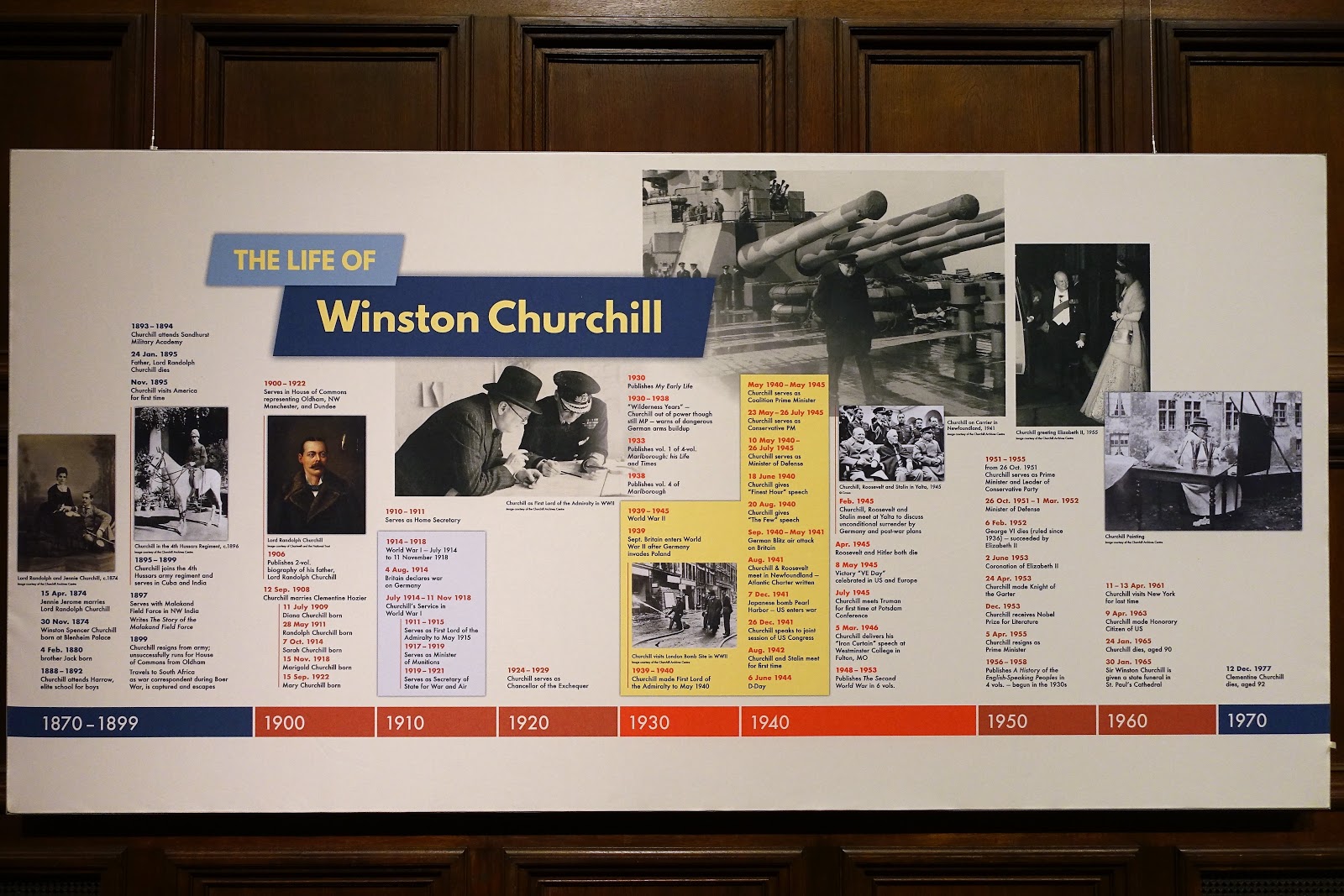
The current exhibition at the library is "Churchill's Shakespeare", focusing on the relationship between the Bard and Britain's wartime prime minister:



Churchill typed many of his greatest speeches, but my daughter struggled putting her thoughts on paper thanks to the limitations of 20th-century technology:


A photograph of Churchill's mother posing as Olivia from Twelfth Night, taken when she attended a Shakespearean Ball in 1911:


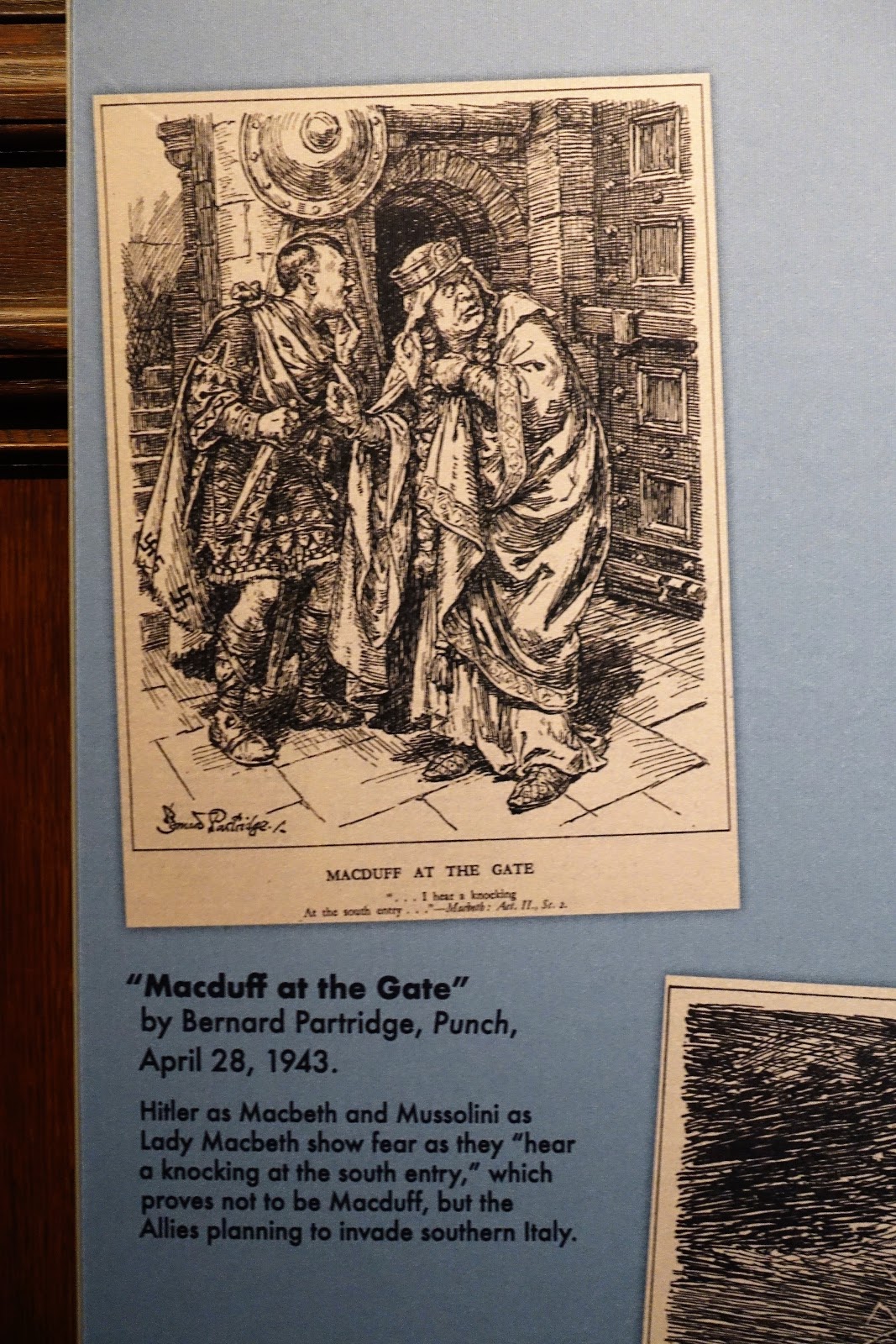
Shakespearean imagery played a role in British propaganda efforts during the Second World War:


Churchill, of course, consciously evoked Shakespeare when giving his famous wartime speeches. These are his typewritten notes for his "This was their finest hour" speech which he gave in the House of Commons on June 18, 1940:


And here is yours truly being inspired by Sir Winston giving said speech:


A commemorative plate issued at the time of Churchill's death in 1965:


In addition to being a library, the Folger is also a performance space. While we were visiting, a concert of English seasonal music was being staged in the theater. At least we could watch some of it on the closed-circuit TV outside:


We weren't able to go inside the Reading Room, but the curtains had been opened by a tour guide, so we did get a look:


While the Elizabethan Garden was closed due to renovation (which meant the exterior of the building was covered in scaffolding), it was a still an interesting visit, helped in great part by the lack of an entry charge, and a pleasant way to spend an afternoon after a morning of last-minute Christmas shopping.

Speaking of the run-up to Christmas, having rented a vehicle for the holiday period, on Christmas Eve I drove out into the Virginia countryside for the purpose of reconnecting with nature. Virtually all of my hikes in this area have been loops, but one trip in my AMC's Best Day Hikes Near Washington, D.C. guide requires a car shuttle between two points - Bull Run Regional Park in Centreville and Hemlock Overlook Regional Park in Clifton. Seeing as I only occasionally have one car, the plan on Monday was to start the hike at Bull Run, walk for exactly two hours (as the total length of the hike given in the book is four hours), and then return to the car, leaving the rest of the hike to be completed beginning at the other end for another time. The waving bear (there for a seasonal night light show) which greeted me as I set off on foot at Bull Run was a promising omen...:


...but the closed-off boardwalk was another matter. Seeing as the only way to continue was to wade through muddy water, I returned to the car and drove a half-hour through some pretty countryside to the end point (and now new start point) of the hike at Hemlock Overlook:


The first part of the hike was an easy walk along Bull Run. The temperature was on the chilly side (45°F/7°C), but at least it was sunny:


The remains of the first hydroelectric plant in Virginia, built in 1925:


A bend in the river:


A tricky set of stone pillars, the only way to cross Pope's Head Creek:


A railroad bridge of the Norfolk Southern Railroad, also used by Amtrak and Virginia Railway Express trains:


Beneath the trestle was a rather touching memorial:


Looking up as I passed under the bridge, it wasn't the two pairs of shoes that caught my eye. Rather, it was the rustiness of the trestle that had me wondering how much longer it could bear the weight of the passing trains:


Eventually the trail left the riverside and made its way up and down the hills:


At the two-hour point into the hike, I turned around and retraced by steps back to the car. On the way back I passed a toy of some kind that somebody had left on a log by the path:


All in all, it was a pleasant if somewhat muddy walk through the woods (there had been a brief but heavy downpour the previous evening). The only sounds of civilization were the planes flying overhead as the Bull Run-Occoquan Trail is close to Dulles Airport:


Back at the ruins of the power plant. This is Cody, who apparently is cooped up at home much of the time, for he was racing at top speed along the trail, so excited to be outside (and much to the consternation of his owner, whose exasperated calling after of his dog reminded me of Fenton, except that there were no deer involved):


And so another Christmas is almost in the books as I get ready to post this entry. Here's hoping yours was merry!


A few other moments in the run-up to Christmas:


Amber started playing the flute this year at school. She had her first band concert earlier this month, and even sat in with the intermediate band for a few numbers


A post-concert meal at Sweet Rice


On the last day of class before the break, we went for lunch at Meaza, where I had my first Ethiopian beer. It won't be my last...


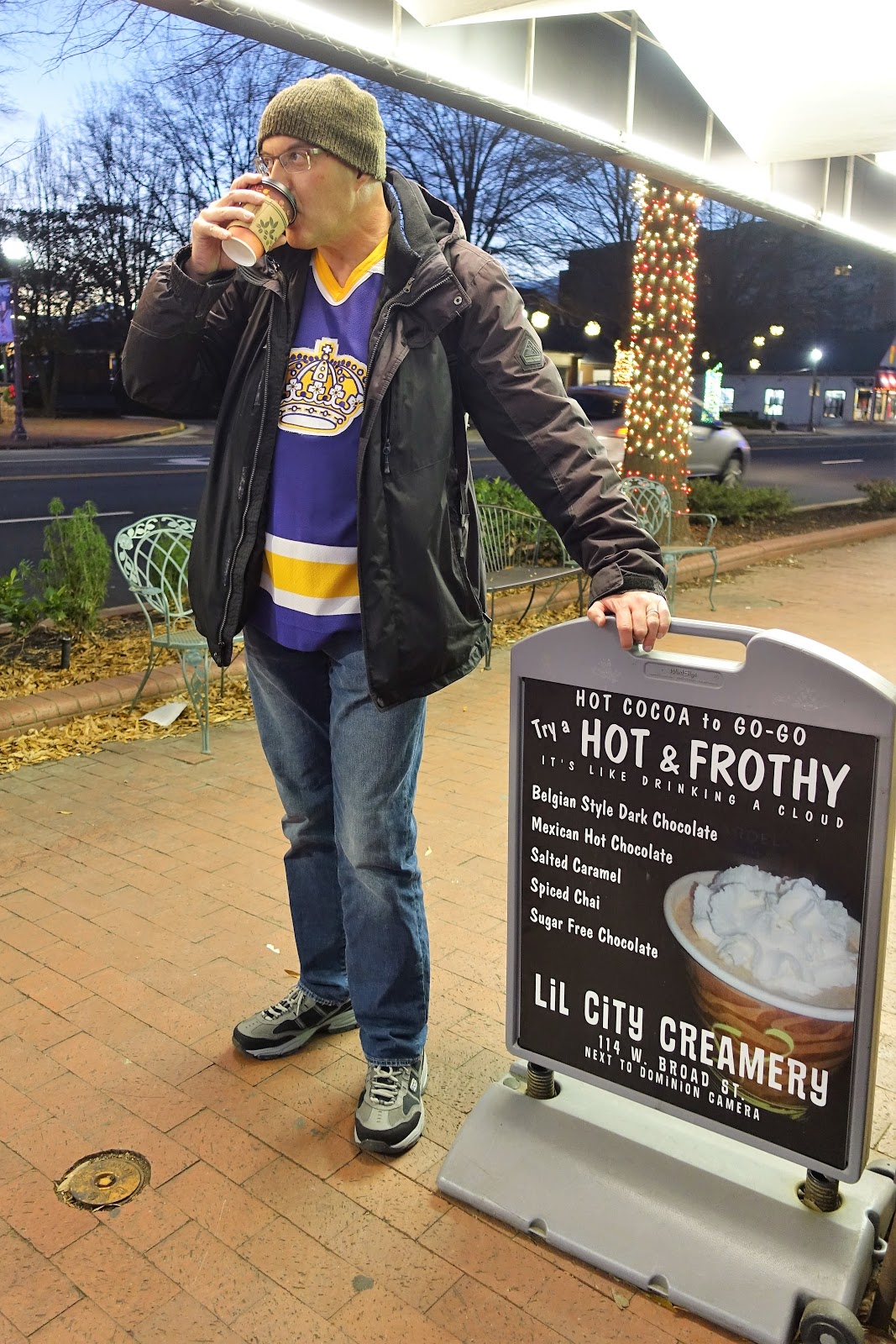
Enjoying the cocoa and admiring the owner's collectables at Lil City Creamery

Just as with Halloween, Christmas light displays are serious business in this part of the country

Enjoying crispy chicken on a bed of white rice at Pho 88

A bit of public art on the streets of Falls Church


Monday, December 10, 2018

Tragically Hip Travel


Artwork on the walls at the National Go Center in Washington, D.C. My daughter took part in the Winter Warmer Tournament held there on Saturday (yesterday). 

Regular readers of this blog (all two or three of you) will know that I occasionally post rants trenchant observations related to Taiwan (or to be more specific, a certain type of Western expat living there). On the other hand, as an admitted Japanophile, I don't usually carp on matters related to Nippon. However, this time I will. I often peruse the Japan (and Taiwan) threads on Lonely Planet's Thorn Tree forum, dishing out unsolicited advice as needed culled from decades of experience and wisdom. In recent months I've noticed more and more commenters using the pejorative adjective "touristy", without ever defining what the word means. The city of Takayama 高山, in particular, seems to have been singled out with this dreaded hipster condemnation. Granted, it's been a while since I've been there (circa winter 2004), but I don't recall anything out of the ordinary from any other locale in Japan that is popular with sightseers. But on Thorn Tree it isn't uncommon to read of complaints that tourists outnumber visitors there, for example, even though I'm hard pressed to think of any well-known city, town or village in Japan where that isn't the case - Kyōto 京都 gets a whopping 50 million visitors a year, yet posters on Thorn Tree are never advised to give the city a miss because, you know, it's too "touristy". But maybe Japan's imperial capital is the exception.


The Cherry Hill Farmhouse, which I checked out six years ago

To me, the word "touristy" conjures up an image of a place or attraction created solely for the purposes of attracting tourist cash. Takayama, for example, has a long history as a castle town, with one section of the city containing a number of well-preserved old buildings. In addition, the city is also host to a couple of famous annual festivals. So it's understandable why many people want to visit there. On the other hand, there is Mojikō Retro 門司港レトロ in Kitakyūshū 北九州. While there are some historic buildings from the Meiji 明治時代 and Taishō 大正時代 periods, it only became a tourist destination from the mid-1990's, when the waterfront was redeveloped to include a hotel (where we stayed last December), a cute drawbridge and lots of shops. That isn't to say you shouldn't visit Mojiko Retro (we liked it), but it isn't as authentically historic as, say, poor old Takayama. Hearing "touristy" used so derisively also suggests a place where people go mainly to eat, shop or buy souvenirs, with some artificial "sights" created to give them something to see while spending their hard-earned yen, dollars, euros, NT etc. Again, Takayama doesn't really fit that definition.

Halloween casualties

But after reading a lot of these comments on the Thorn Tree pages (with Nikkō 日光, Nara 奈良 and other well-known spots being similarly labeled), it became clear that "touristy" really means "too many tourists from Western countries". Many people don't seem to mind if a spot is crowded with locals - "Ise's 伊勢 very touristy, but mostly with Japanese tourists, giving it a different feel from somewhere like (you guessed it) Takayama" was one comment that stood out for its honesty. The corollary is "off the beaten path", as in "very few visitors from Western countries", even though places such as Hagi 萩 or Matsue 松江, to give but two examples, are hardly unknown to Japanese vacationers (or your humble scribe - see my blog entries from January of this year and June 2008, respectively, for example).

The Gage House, built in 1909

So would-be travelers to Japan from Western countries seek advice on avoiding places in Japan where they might see too many people like themselves, and hope to visit areas where there aren't many people who look like them. But what should they expect? Tourism to Japan has boomed in recent years (almost 27 million visitors in 2017), meaning these folks are just wanting to jump on a bandwagon that shows no signs of slowing down anytime soon. They want to go to Japan, too, but at the same time avoid places where too many Western-looking faces will interfere with their Instagram photo ops of the fantasy Japanese world that they've conjured up from too many anime アニメ episodes, coffee table books, tourist brochures and YouTube videos. Never mind the fact that, depending on where they go, many of the Asian tourists they will see there are likely not to be Japanese - after all, Japan is also very popular with visitors from China, South Korea, Taiwan and southeast Asia. But, hey, as long as they're not white, so what, right? We live in the era of the hipster, where every experience has to be an "authentic" one.

A creepy bit of local history I was unaware of until I walked by this afternoon

Now if anyone has a right to complain about sites being too "touristy", and to yearn to get "off the beaten path", it's me. After all, I have nearly 30 years of living, visiting and/or working in Japan under my belt, along with a solid background in Japanese art, culture and history appreciation, plus a working proficiency in the language (I'm also humble, modest and unassuming). There are certainly a lot more gaijin 外人 (Asian, Australian, European and North American) in the country than there used to be, especially in those areas that are "off the beaten path" (though there were still times in recent years when I would go days without seeing another Westerner), so it would be understandable for an old geezer like myself to gripe about the "foreigners" overrunning the sights I want to have to myself see. But I don't mind. In the same way that a Japanese tourist can put the blinders on and ignore the factory smokestack just to the side of the historic pagoda, I can overlook the excitable American or Chinese tourist who can't get enough of the temples or old wooden houses. They have just as much right to travel to Japan and spend their tourist yen as I have. And as long as people are courteous and respectful (no pulling flowers in full bloom off of cherry trees or harassing the geisha 芸者 in Kyoto's Pontochō 先斗町 district, for example), what is the problem?


Felt kinda Okinawan for dinner on Sunday evening - Okinawa Soba and Orion Beer オリオンビール at Maneki Neko 

So my advice to the posters on Thorn Tree is simple - do some research, decide on places that look interesting to you, and then go. Don't worry about things being "touristy" or whether or not you are on or off "the beaten path". After all, Japan was "discovered" a long time ago, long before there were maid cafes in Akihabara 秋葉原. Even way back in January 1989, when I first arrived in Japan (three weeks after the death of Emperor Hirohito 昭和天皇), I was considered a later arrival to the party. So remember this before you go: should you succeed in getting "off the beaten path", the locals aren't likely to get too excited about your presence there because there's a good chance that a lot of foreigners (including myself!) were there well before you (perhaps before you were even born). Have a good trip!


Broad Street getting into the festive seasonal mood