Showing posts with label Addis Ababa. Show all posts

Monday, July 5, 2021

Goodbye Ethiopia, We Hardly Knew Ye

Looking west from Meskel Square

Assuming there haven't been any hiccups, by the time some of you read this we should be on a plane flying high in the night sky over the Atlantic Ocean en route to Washington, D.C. We're due to arrive at Dulles on a Tuesday morning, from where we'll drive to Falls Church and move into what will be our next new home (in by now very familiar surroundings) for the next year or so. General Services training will start (online) on Thursday, and will last until Labor Day, after which I'll be plunged in Mandarin training (again). 

In case you haven't figured it out, the above paragraph means our tour in Addis Ababa አዲስ አበባ, Ethiopia ኢትዮጵያ has come to an end. After enjoyable postings in Shanghai, China and Vilnius, Lithuania, the past two years in the Horn of Africa (minus the six-plus months lost to Authorized Departure in Ballston, Virginia) were difficult and disappointing ones. Things started well, with family trips to Cape Town, Egypt and the Seychelles, plus a weekend visit by my daughter and me to Axum አክሱም (now in the midst of the war zone that the Tigray region has become). But we wanted to see and do so much more in Africa in general, and in Ethiopia in particular. We had a trip planned to the country's most famous sight, Lalibela ላሊበላ, in late February of last year. But while Shu-E and Amber were able to see the UNESCO World Heritage rock-hewn churches, I had to go back to the U.S. after my father died on the 26th of that month. And it was while I was in Washington state that the COVID-19 pandemic broke in the United States as part of its swathe of infection and death around the world.

Ethiopia held out against the coronavirus until mid-March of 2020 (during the time we were in the Seychelles, our last vacation as a family as of the present), but then things went rapidly from bad to no one knowing what was the full extent of the spread of the virus. In short order we had to cancel planned visits to Gondar ጎንደር and the Simien Mountains ሰሜን ተራራ, as well as to the walled city of Harar ሐረር; instead, we ended up caving in to pressure from upstairs and found ourselves cooped up in a small apartment from early April to late September/early October, doing almost nothing while the Trump administration spectacularly mishandled the COVID-19 crisis, and American streets erupted in protests over the death of George Floyd. The pandemic would erase our planned family summer R&R trips to Taiwan and Japan, as well as an excursion to South Korea over the Christmas/New Year holidays upon which we were also hoping to embark.

The girls, of course, would eventually make it to Taiwan in the fall, while I returned to work in Addis. And whereas my wife and daughter were able to enjoy a semblance of pre-COVID life in Taichung 台中 and Xiluo 西螺, I and my colleagues at work had to deal with the events going on in Tigray, beginning in late November 2020. As if the coronavirus wasn't bad enough, the deteriorating security situation throughout almost all of Ethiopia meant I (and later Shu-E and Amber, after they returned from Taiwan on Christmas Day) would spend the remainder of our tour confined to the capital city. 

I did manage to get out of the country once, for a period of one week in late March/early April, but only because of a previously undiagnosed heart condition that necessitated a medical evacuation to South Africa. So thanks to a combination of a death in the family, a worldwide pandemic, war and ethnic conflict in Ethiopia, and an atrial fibrillation, it's with some sense of relief that we're finally leaving, all of us now fully vaccinated, and returning to a hopefully different America than the one we left last fall.

And yet, in some respects, I'm sorry to go. Sorry I wasn't able to see more of what is a beautiful and historic country. Sorry to leave my coworkers, American and Ethiopian. And sorry that we couldn't make more of what was still an amazing African experience, regardless of all the fears and frustrations.

Despite the poverty, pollution, power outages and Internet disruptions (not to mention the pickpockets and scam artists), I leave Ethiopia and Addis Ababa with more positive memories than negative recollections, especially when it came to our interactions with the locals. I wish this country and its people nothing but the very best, and I sincerely hope they can overcome the daunting challenges that threaten the fraying ties that bind this multi-ethnic country together. So long Ethiopia, I wish I'd had the chance to get to know you even better.

And so another chapter is finished, and the time to turn the next page is upon us... 

We had most of our things boxed up and taken away a couple of weeks ago, leaving us to live out of our suitcases until we can be reunited with some of our possessions (mainly clothing and kitchen items) sometime in the next 6-8 weeks. The majority of our stuff won't be seen again until after we arrive in Beijing next summer. Truth be told, this lifestyle of constant moves and packing/unpacking has lost almost all of its luster, especially when considering the toll it's taken on my family. Were I younger I would pack it all in (pun intended), but I'm at that point now in life where it's better to just 我慢 and see it through until when I age out:


This past Friday there was a farewell party for myself and two others who are moving on. No event in Ethiopia would be complete without a woman preparing coffee and popcorn:


Amber and I pose with Getachew and Merid, two of the people I supervised and who were a pleasure to work with:


Saying farewell to a great group of colleagues:


Our last family meal at a local restaurant happened the previous weekend at Arirang, my wife's favorite go-to Asian eatery in Addis. Shu-E is looking forward to returning to Falls Church as we'll be close to Annandale, home to several Korean restaurants that she's a fan of:


I'm a fan of Ethiopian beer:


I went with the bibimbap, a tried-and-true favorite. There was a group of Chinese diners in the next room while we were at Arirang, but none of them appeared to notice my 我是台湾人 T-shirt; my job is prevent international incidents, not provoke them:


We're now in the rainy season here in Addis, meaning daily downpours, complete with lightning and thunder. Fortunately, the rainfall, while heavy at times, is brief. One thing I'll miss is the view of the Entoto Mountains from the embassy grounds, even on those days when you can see the clouds coming in:


What the rainy season looks like from our residence:


On this particular night the power went out in most of the neighborhood (we have a generator that kicks in during moments like these):


Street scenes. It isn't uncommon to see beasts of burden on the roads:


A cat chills in front of a cafe:


Crossing over Addis Ababa's light rail tracks. We've never ridden the train, as we're not allowed to do so due to security concerns, but also because the two lines don't go anywhere of interest to us, and we have (had) a car:


Che Guevara and Charlie Chaplin:


Buses, minibuses and taxis often sport religious imagery:


In case you're wondering, the name in Amharic is also "No Name", with the English rendered phonetically into the local script:


"The Ohio State University":


Banana sellers are a common sight on city streets:


Foosball is very popular in this soccer-crazy country. These people were playing outside the Addis Ababa International Stadium (1940); a newer stadium sits out in the eastern part of the city:


Approaching the recently renovated Meskel Square መስቀል አደባባይ:


St. Stephens Church:


Passing by Meskel Square:


A walk through the shopping street near our residence. I really should've done this on a weekday, when the street is a lot more active than on the Sunday afternoon when I filmed this. My apologies for the handheld swaying camera work; I don't have a gimbal:


Next stop: Beijing, by way of Falls Church...


Saturday, June 19, 2021

Last Minute Sightseeing, Part Hulet (ሁለት)


The lions of Judah?

17 days to go until we say farewell to Ethiopia. The next two weeks plus are going to be busy times, and the majority of our possessions will be packed up next week, not to be seen again until next year in Beijing (hopefully). It's a tiring aspect of this diplomatic lifestyle, the constant uprooting and moving around, and to be honest I'm close to burning out. It's also taken it's toll on my wife, who is looking forward to the quasi-familiar surroundings of China after having a rough go of it here in Addis Ababa. My daughter seems more resilient, but I wouldn't be surprised if she finds one place in which to settle after finishing college, and then never move again. I would certainly understand if that were to be the case.

Earlier in the week saw a final spurt of sightseeing activity, at least for Amber and I. On Sunday we visited Friendship Square, while on Tuesday we had a look at Unity Park. Opened to the public in October 2019, it's located on the site of the Grand Palace, the home of emperors, presidents and prime ministers of Ethiopia. The ticket pricing is (as with Friendship Square), um, discriminatory. The cost for Ethiopians to get in is ETB300 (almost USD $7); for non-Ethiopians it's $20, payable only in US dollars! But that's only for the Regular ticket. For the Special (aka VIP) ticket, the prices are ETB1100 ($25.40) and $50! The Special ticket covers a guided tour of palace buildings that proles with regular tickets are not able to access, so I took the plunge on two of the upgraded ducats (no discounts for children). My weak justification for spending a hundred bucks was that it was a birthday present for myself, which is simultaneously plausible and pathetic:


With our guide leading the way, we entered the park. Our first stop was to see a pair of Ethiopia's rare Black-Maned lions. The lions have a 175-meter-long (574 feet) enclosure in which to wander, but they were fast asleep and difficult to spot while we were there:

 
Next, we walked through a section of indigenous plants:


On the wall are the prior residents of the Grand Palace. From left to right are Haile Selassie; Mengistu Haile Mariam (the brutal leader of the brutal Derg regime); Meles Zenawi; and the current prime minister, Abiy Ahmed:


Preceding the four above are Menelik II; Lij Iyasu; and Zewditu:


We soon reached the historical buildings that are only open to those who paid for Special tickets. In the former office of the Minister of War are examples of the kinds of guns used by Ethiopian soldiers when they defeated the Italians at the Battle of Adwa in 1896:


Inside Menelik II's reception room:


Though the buildings underwent extensive renovation in preparation for the complex's repurposing as Unity Park, at least some of the doorways are originals:


The affectionately-named "Egg House" served as Menelik II's office:


The 1892 banquet room was where Haile Selassie was imprisoned after being overthrown in 1974. During Menelik II's time, beer was served in pitchers like this one:


One of Haile Selassie's chairs:


Original artwork on the ceiling:


Speaking of ceilings, this is what the one in the Egg Room looks like:


The blue roof in the background is that of a church. It was once part of the palace complex but the Derg built a wall which still stands, literally to separate church and state:


The fireplaces were a nod to Western influences as Menelik II made tentative steps to modernize his nation following his victory over the Italians. Ethiopians are naturally proud that their country was one of only two in Africa (the other being Liberia) not to be colonized by the European powers (though Mussolini exacted his revenge in 1935):


In several places throughout the palace complex parts of the original walls can be seen, protected in glass casings:


Examples of medals given by Haile Selassie to Ethiopian troops who fought in the Korean War or who served in U.N. peacekeeping missions:


The Grand Palace was established in 1887. The view from the buildings there indicates why the location was chosen:


A car that belonged to Haile Selassie. It was Italian but I couldn't catch the make or model. According to the guide it still runs. The guide also told us there are plans to eventually put on display what remains of the last emperor's vast private auto collection:


The next stop on the tour was the Throne House, complete with a depiction of Haile Selassie seated on his:


One of the crowns worn by Emperor Menelik II:


The cloak and hat worn by Haile Selassie when he gave his famous speech to the League of Nations in May 1936, condemning Italian aggression against Ethiopia. Although considered one of the greatest speeches of the 20th century, it failed to persuade the League to act against Italy (the Italians were eventually driven out by British and Ethiopian troops in 1941):


Bob Marley later used the words of the speech in his song "War:


Side rooms in the Throne House include images of religious items and videos of Ethiopia's natural beauty:


There are also displays on the previous occupants:


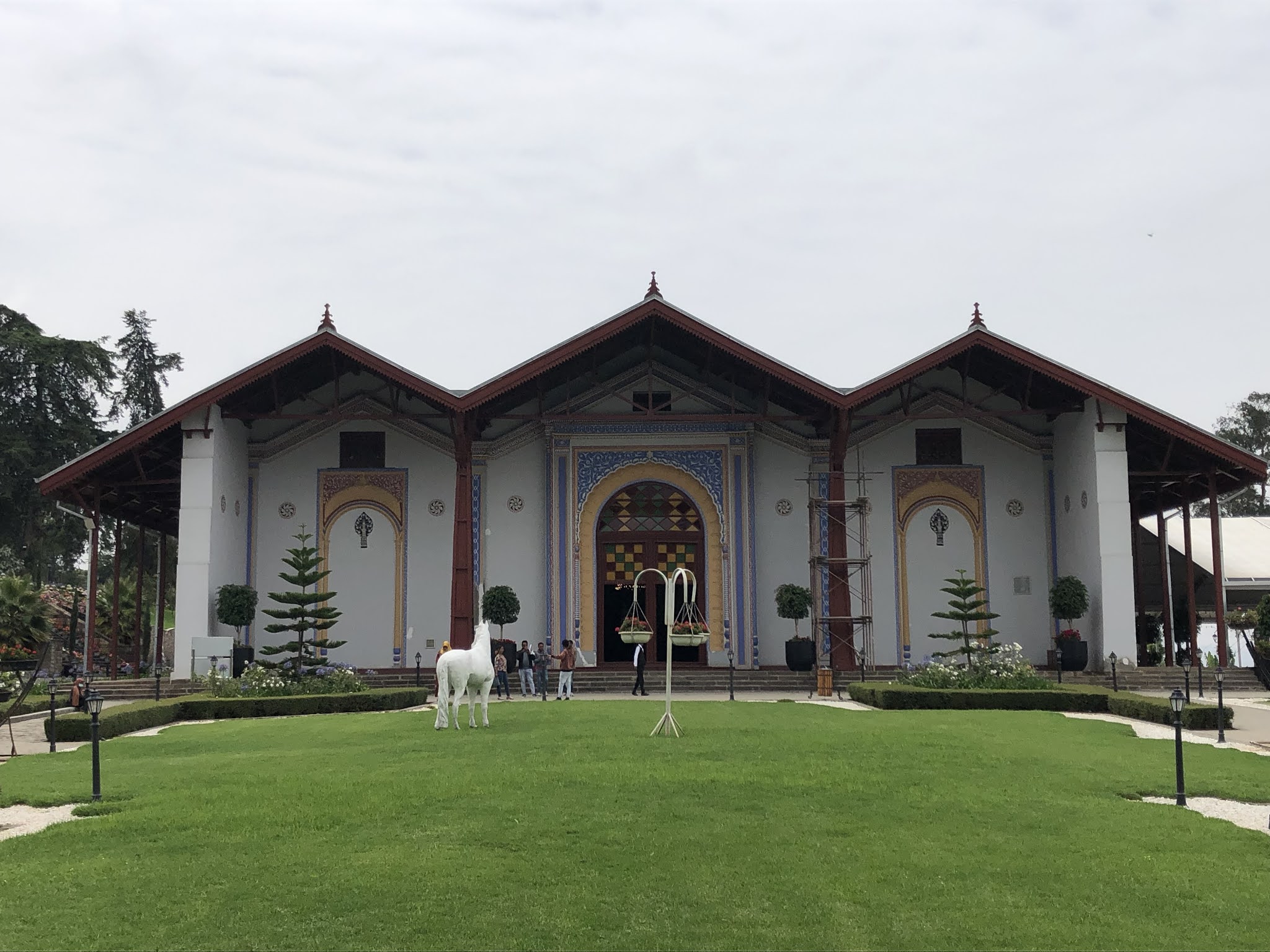
The exterior of the Throne House:


Following the overthrow of the monarchy in 1974, the Derg used the upper room as a meeting hall. The basement (a wine cellar in imperial times) became prison cells and torture chambers for senior officials of Haile Selassie's government. One of the bloodiest actions during that time was the executions of more than 60 of these unfortunate individuals on a single day in November 1974:


According to the guide, these poles were used to string up prisoners while torturing them:


It was with some relief that we moved next to the Banquet Hall, finished in 1899:


I didn't realize how huge the room was until we stepped inside:


Menelik II would sit on his throne and literally look down upon the several thousand people sitting on the floor while eating in front of him:


From the Banquet Hall we moved on to Unity Zoo, which was the highlight of the park for Amber. She was especially taken with the meerkats:


A diver was cleaning one of the displays as we made our way through the small aquarium. A larger one is still under construction:


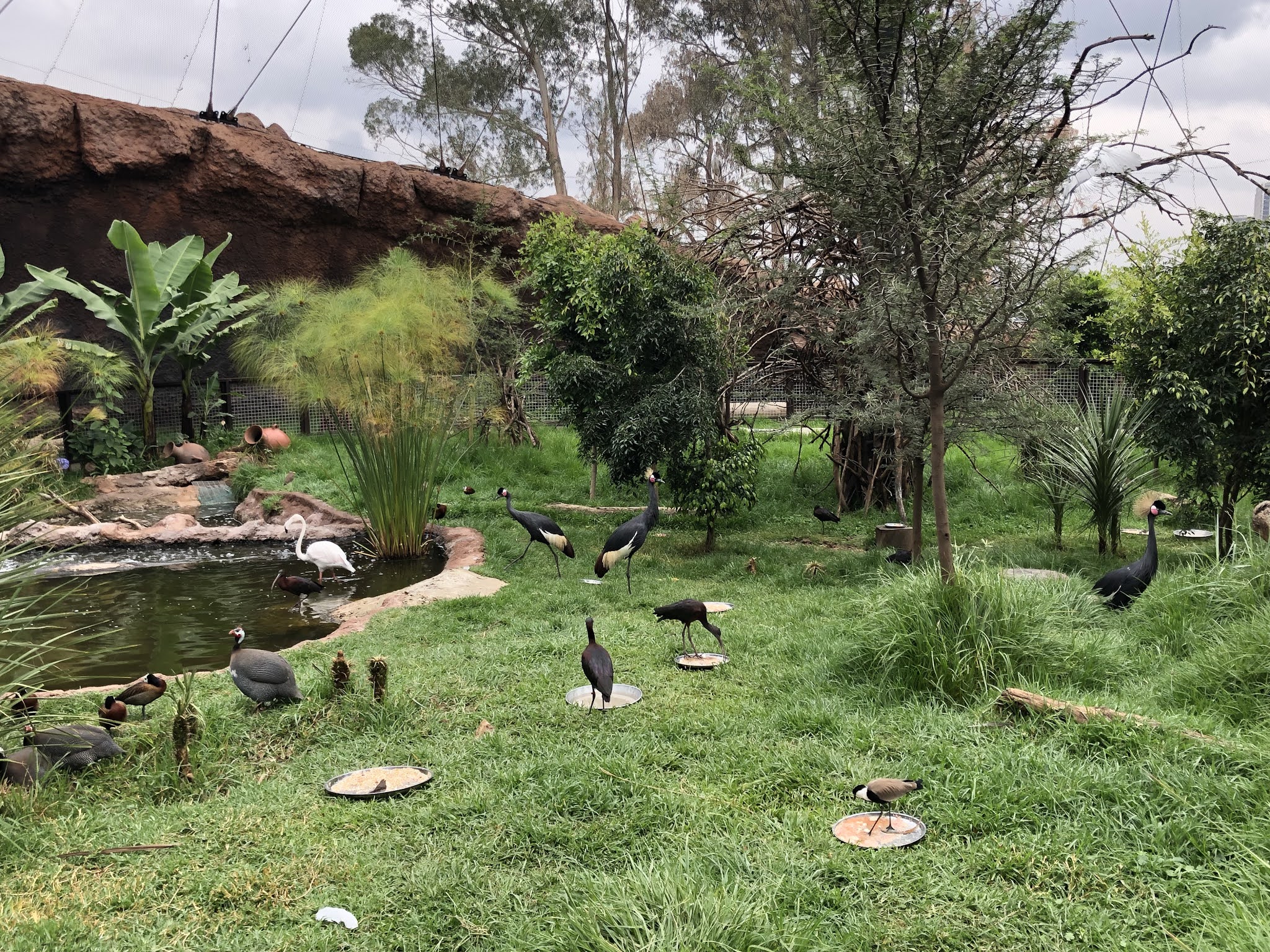
A peacock struts his stuff:


Cheetahs and wild dogs taking it easy. What else are they going to do?:


Same with the white lions, brought over from South Africa:


A Gelada baboon, which we were fortunate to see in the wild early in our tour before things started taking a turn for the worse:


The enclosure containing the giraffes provided a different perspective from other zoos and animal parks I've visited. Sad to say, with our safari plans having been canceled due to COVID-19 Unity Zoo would be the closest Amber and I would get to seeing some of Africa's magnificent wildlife:


For me, the least interesting section of Unity Park was the Pavilions of the Regions, designed to introduce the cultural, historical and natural attractions of the different regions of Ethiopia. The name "Unity Park" is part of the prime minister's vision to forge a common Ethiopian identity among the 80 some ethnic groups that comprise the country, but this particular part of the park seemed underwhelming. Or perhaps it was a sad reminder that thanks to both the coronavirus and the unstable security situation in many parts of Ethiopia, my plans to see much of this country haven't been realized, and time has now run out:


A replica of "Lucy":


Posing with our guide at the end of the tour:


Left to our own devices, my daughter and I headed back towards the zoo, where there's a row of cafes and restaurants. On the way we passed by the Banquet Room:


I ordered a tea and milk, thinking it would be a milk tea. It turned out to be a glass of tea and a cup of milk, with me unsure how to drink it. In the end Amber and I reasoned the best approach was to pour the tea into the milk, and add sugar as needed:


Shiro with butter was part of our lunch, along with tibs:


Back to the zoo and the adorable meerkats:


Friendship Square is on the other side of Niger Street:


Taking a selfie with the white lions:


Going back to the Great Palace complex:


The Black-Mane lions were a little more visible as we made our way toward the exit:


Unity Park is a popular place for wedding photos. We saw at least five couples having their portraits taken:

And so our sightseeing in Ethiopia came to an end on an overcast Tuesday afternoon in mid-June. Was Unity Park worth the $50 "wealthy" foreigners are gouged to pay? No, but the tour was interesting, and with so few options in the last year for getting out and doing things in Addis Ababa, I have no regrets for crossing the park off our list of places to visit before we depart.

Thoughts on our time in Africa in general, and Ethiopia in particular, to follow in the next post. Until next time...