Showing posts with label Cairo. Show all posts

Saturday, January 25, 2020

Ninth and Tenth Days in Egypt: Last hours in Cairo

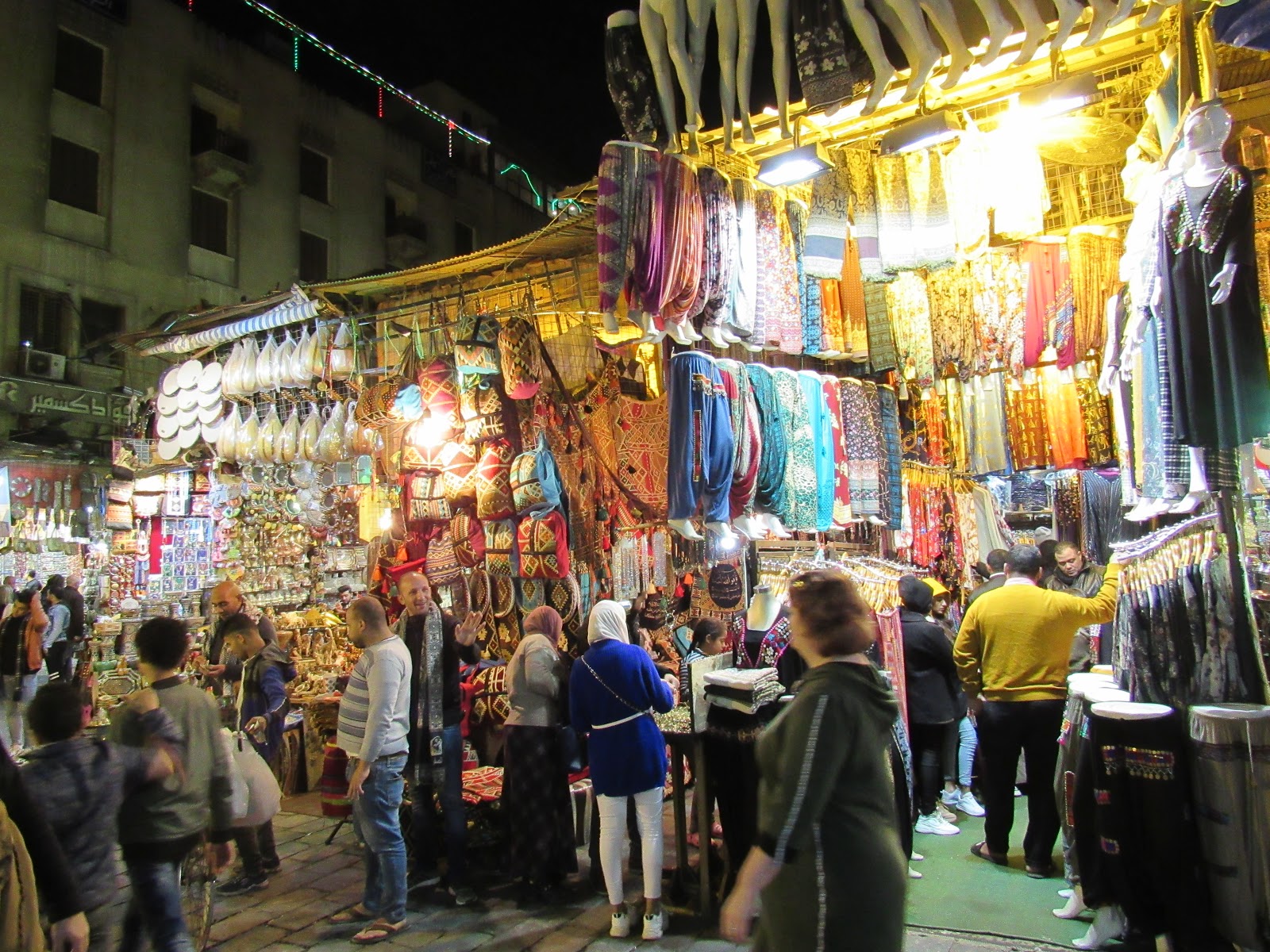
Khan Al Khalili market

On our last full day in Egypt (a Saturday) we flew from Luxor back to Cairo:


Thank you, but by that point we'd already been in the country for nine days:


Passing by a mosque...:


...and a church on the drive into town from the airport:


We also drove by Ramses Train Station (1892), which we'd used to travel to and from Alexandria:


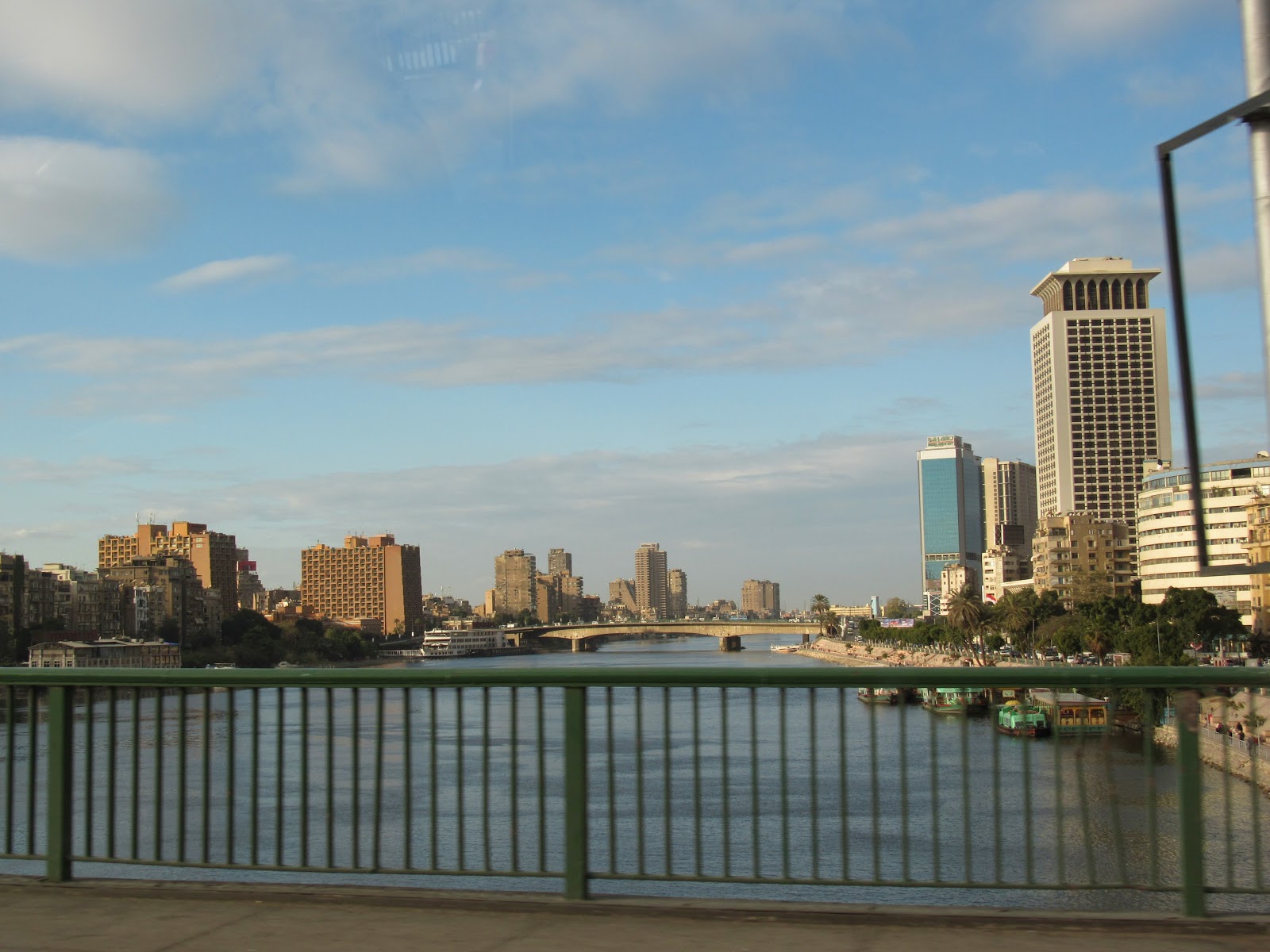
Crossing the Nile into Zamalek:

We met up with our friend Doering, and the four of us traveled by Uber to Cairo's massive Khan Al Khalili market, described by Lonely Planet as "basically a medieval-style mall":


Market activities have been taking place here since the 14th century and many Cairenes shop in the khan for daily sundries. However, the market also attracts a great many foreign visitors, and stalls selling the usual tourist tat are abundant:
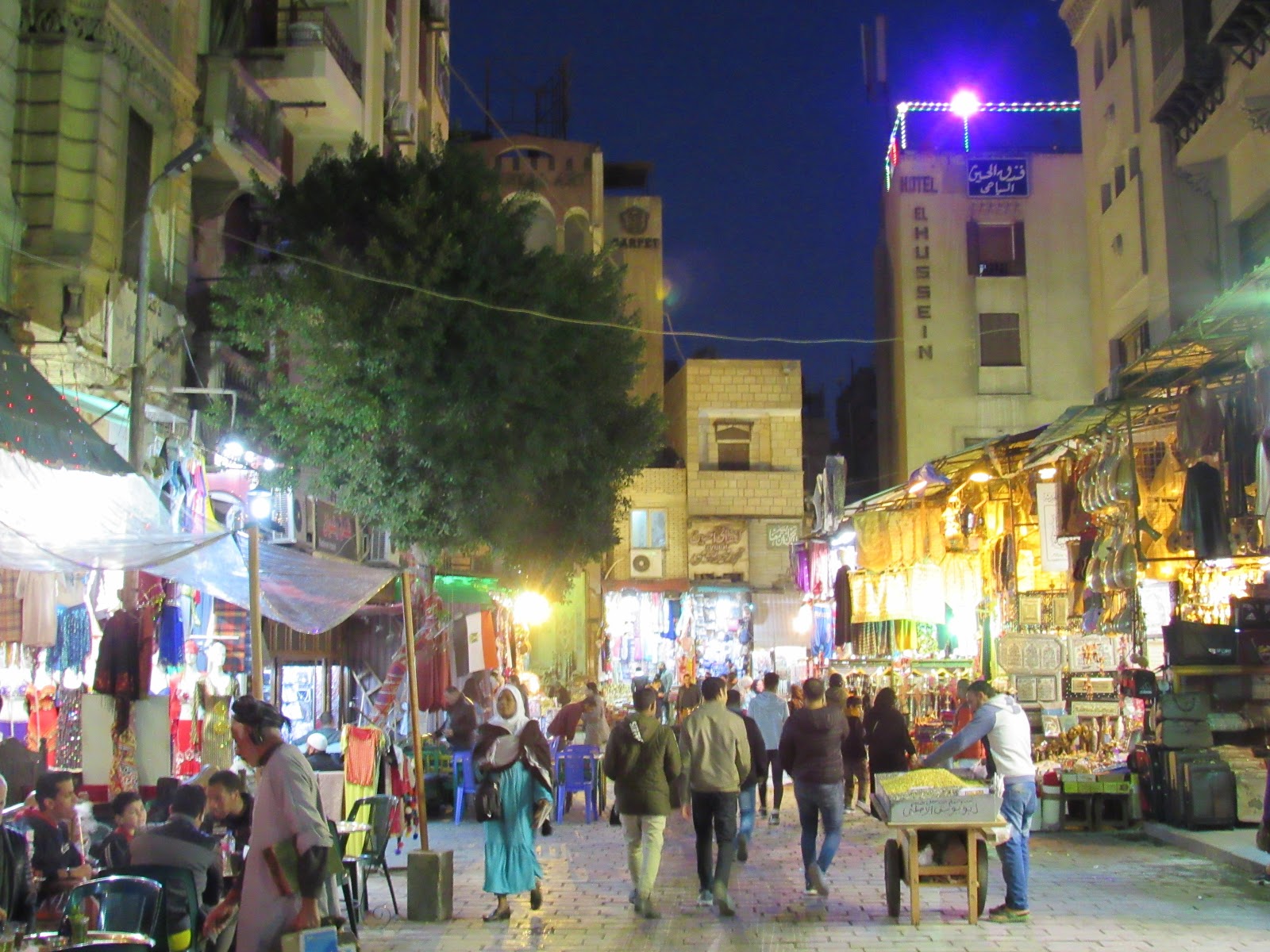


So much for the stereotype of a strictly conservative Islamic society:


For dinner, we tried to bribe our away into Mahfouz in order to avoid the two-hour wait, but our efforts were unsuccessful. However, the nearby place selling feteers proved to be a delicious alternative:


Shu-E with Doering:


Doering was a most gracious hostess, putting us up at her place for our last night in town. Her three cats were pleased with the extra attention:


The Nile on a Saturday night...:


...and on a Sunday morning:


Google Maps said there was a Dunkin Donuts nearby, so Amber and I went out on Sunday morning in search of it. En route we passed by this less-than-politically correct Chinese place. Wok like an Egyptian?:


Where Dunkin Donuts should've been, there was only a wall. However, there turned out to be a McDonald's further along, so the two of us indulged in those morning treats that can't be enjoyed in Addis Ababa. More scenery along the way:


Sunday morning was spent in a fruitless search for a shop selling an official Egyptian national soccer team jersey (or even that of one of Cairo's major Egyptian Premier League clubs), but at least we did get to see some more of the city (and my wife satisfied her craving for fried chicken, going so far as to pick up some extra pieces from a KFC to bring back with her to Ethiopia!):


In the early afternoon, I walked over to the Cairo Marriott Hotel, which was once a palace for Empress Eugenie built by Khedive Ismail when the former visited for the opening of the Suez Canal in 1869:


While the interior is worth having a look around, the real reason for going there was to meet up with an A-100 classmate, Chandni, who by coincidence also happened to be in Cairo at the same time as us. One of the perks of this line of work is getting to see familiar faces in different parts of the world:


I walked around the neighborhood for a few more photo ops before our early evening ride to the airport, followed by our late night flight back to Addis Ababa. It would around 0400 hours local time on a Monday morning when we arrived home. Fortunately, I had arranged to take Monday off from work, and as Tuesday was the Orthodox Christmas Day, I was able to return to the office on Wednesday fairly well-rested:


And that was the end of our ten-day, nine-night sojourn to Egypt. Although it seemed like a long trip, we only just scratched the surface of what this fantastic country has to offer. Had I more time, I would've liked to taken a cruise along the Nile between Aswan and Luxor, for example. Cairo, too, has much more to experience than just the pyramids or the Egyptian Museum - I wish I could've visited the Citadel, or experienced more of Islamic Cairo by visiting some mosques. Still, we saw a lot while we were there, and had a most enjoyable time, thanks both to the country as a whole, and our friend Doering in particular.

Of course there were downsides. The hard sell from touts and vendors got tiring very quickly, and the traffic in Cairo (and Alexandria) at normal times is even worse than during peak hours here in Addis. And there are a lot of security restrictions that come with living and working in Cairo that I was able to avoid as a visitor. But the history of the country (and the sights that are a result) are incomparable and definitely worth seeing, and the people in general are welcoming to visitors from abroad. Tourism has been down since the 2011 revolution (and also due to some terrorist-related incidents in subsequent years), but we certainly didn't have any trouble on our trip. Go, I say!

Just be sure to have a lot of small bills handy for all the baksheesh you'll be distributing while you're there...


Wednesday, January 15, 2020

Sixth Day in Egypt: He gave his life for tourism

Egyptian Museum

My family and I welcomed in the New Year at the Steigenberger Hotel El Tahrir:


The Egyptian Museum was only a short walk from the hotel, though getting across a traffic-clogged street bereft of crosswalks was a bit of a challenge:


Until it's replaced by the Grand Egyptian Museum at Giza (supposedly) later this year, the Egyptian Museum remains the most important collection of ancient Egyptian artifacts in the world. Opened in 1902, it seems as if the museum hasn't changed much since then - there are no interactive touchscreen displays, for example, just objects displayed in glass cases, often with typed display cards. To walk inside the Egyptian Museum is like taking a step back in time in more ways than one:


Upon entering we made our upstairs to the Tutankhamun Galleries to see some of the treasures of the young pharaoh, whose untouched tomb was discovered by Howard Carter in 1922. While photography is permitted in most parts of the museum, it's forbidden in the room displaying the boy king's death mask:


Other items, fortunately, can be photographed, such as the gilded wooden shrines:


There are so many items in the museum that it's difficult to take it all in (not to mention the details all down):


Statue of King Tutankhamun:


Graeco-Roman mummy portraits, placed over the faces of the embalmed dead:


Animal mummies:


The Royal Mummies Halls require a separate admission ticket, and photography is also not allowed in this section. Lying in individual glass cases in two separate rooms, the mummies are a reminder that these were human beings, and small ones at that. Among the preserved rulers are Ramses II...:


and Queen Tiye, with her long, flowing hair:


The Middle Kingdom Models provide glimpses into daily life in ancient Egypt 4000 years ago:


After the Tutankhanum Galleries and the Royal Mummies Halls, the Old Kingdom Room on the first floor is probably of greatest interest. The black statue of Khafre:


Seated Scribe, made of limestone:


The only surviving representation of Khufu, the builder of the Great Pyramid of Giza, stands a tiny 8 centimeters (3.1 inches) tall:


Seneb, a high-ranking court official, his wife Senetites and their two children. The kids were placed in front of Seneb to cover their father's short legs (he was a dwarf):


The panel of Meidum geese was covered in plastic due to painting going on in the room:


The statues of Rahotep and Nofret, in remarkable condition for being 4600 years old:


The colossal statues of Amenhotep II and Queen Tiye:


The last room we visited before leaving the museum was the Amarna Room, featuring artworks commissioned by Akhenaten for the capital he had constructed at Tell Al Amarna:


The most impressive piece is the unfinished head of Nefertiti:


One could easily spend the whole day inside the Egyptian Museum, though you would have to be seriously interested in Egyptology to do so. A full morning was sufficient for us. We returned to our hotel for lunch, where I looked through the pair of books I picked up in the museum gift shop:


After lunch, we were driven to the airport for our domestic flight to Luxor, though our departure would be delayed by over an hour:


We arrived in Luxor, checked into our hotel and had a late dinner in the first-floor restaurant:


Much of what we had seen on the first day of 2020 in the Egyptian Museum would come to life (sort of) during the next couple of days in Luxor...