
Size does matter
Our friends Barbara and Jeff seemed to have enjoyed themselves while they were here, but China is still China, after all, and there's only so much a sane-minded individual can put up during a visit. When I proposed during our four-day, three-night excursion to Chéngdū 成都 that the five of us make a day trip to Lèshān 乐山 to see the world's tallest Buddha statue, they blanched at the idea of riding two hours or more on a typical Chinese bus (as opposed to hiring a van and driver for the day) and decided instead to stay in town. And so it was that my wife, my daughter and I set out on our own to experience one of the country's better-known sights.

What does it say about our hotel room when the best view was to be had from the bathroom?
We actually arrived in Leshan in less than two hours' time from Chengdu's gritty Xīnnánmén 新南门 tourist bus terminal, then took a taxi to where the Grand Buddha 大佛 has been sitting for the past 1200 years or so. The driver didn't drop us off at the main entrance, but took us to another gate further down the road. However, upon discovering that at this window we could only buy the more expensive admission tickets that included entry to something called the "Oriental Buddhist Theme Park" (which we had no interest in seeing), we had the cab take us back to the main gate, where my wife was able to battle the scrum (with her husband acting as her bodyguard) to secure the more reasonably-priced admission tickets to the Grand Buddha (and a couple of other minor sights). Perhaps our friends had made the right decision to stay in Chengdu.
Once inside, we made our up the steps to where the Grand Buddha was carved into a cliff face overlooking the spot where two rivers, the Dàdù 大渡河 and the Mín, meet. Below us, sightseeing boats were doing a busy trade:

We approached the Grand Buddha from the top, beginning with an up-close-and-personal look at his massive head:


A staircase leading down to the base of the statue was already choked with traffic, even on a late Friday morning. One can only imagine what the place is like on weekends and national holidays:

It wasn't a pleasant experience making our down the steps (again, I was thankful it was only a weekday), but the views of the Buddha compensated:


There were smaller carvings in the cliff side, as well, to give yourself
something to look at when the Grand Buddha was temporarily out of sight:

At last, we reached the bottom, where we could take in the statue in all its glory. It was finished around the year 803, and upon its completion, the swift river waters became calm and boatmen could proceed with their work in safety. It was truly a blessing that was achieved by dumping massive amounts of rock into the river during the carving process. The statue is 71 meters (233 feet) high; the ears stretch for 7 meters (23 feet); the shoulder span is 28 meters (92) feet in length; and each of the Buddha's big toes is 8.5 (28 feet) long. In short, the Grand Buddha is an impressive sight, an amazing feat of engineering and well worth the effort to get to Leshan:


The girls were impressed:

Amber provides a frame of reference:

With more time, it would probably have been interesting to have taken of one of the numerous sightseeing boats to get another perspective on the Great Buddha (for one thing, there are two guardians in the cliff side that are only visible from the tour boats). But with our time limited, and having had our fill, we kept walking along the steps away from the giant statue until we emerged onto this classically Chinese scene:

Before reaching the bridge, we ducked into the Máhàoyá Tombs Museum 麻浩崖博物馆 to examine a collection of tombs dating from the Eastern Han dynasty (AD 25-220):


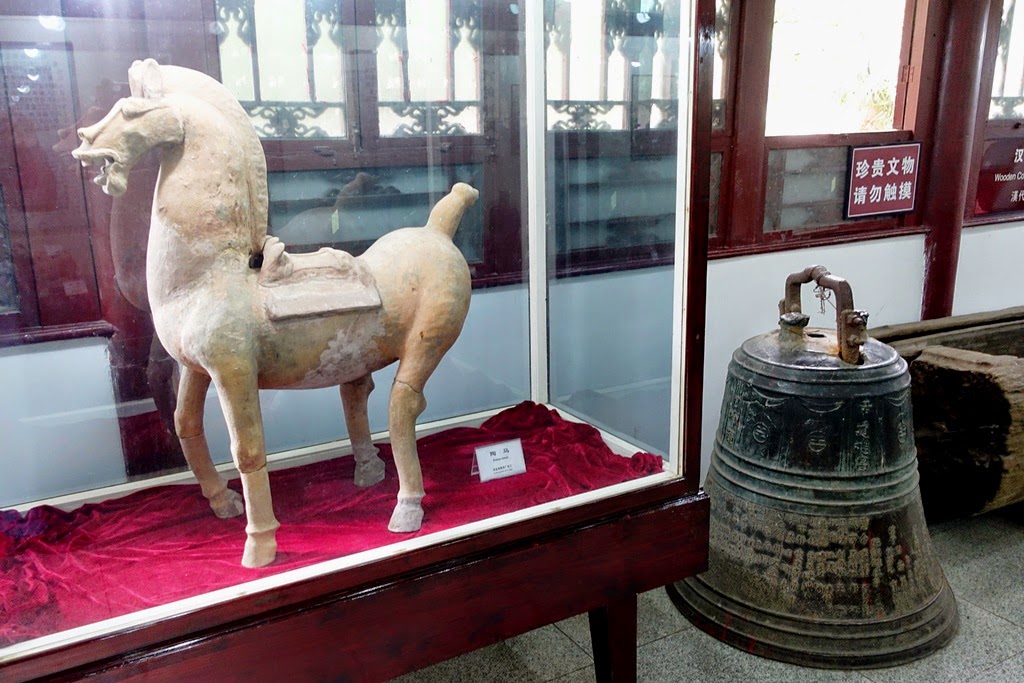
The small museum contained artifacts excavated from the tombs:

From the museum we crossed the arched bridge, and walked up and over the hill to Wūyóu Temple 乌尤寺, which was established during the Tang dynasty (the same era as the Grand Buddha), but later underwent significant renovations during the Ming and Qing dynasties. The main hall fronts the Dadu River:


Away from the main hall is the Luóhàn Hall, which houses around a thousand terracotta arhat figures (those who have reached nirvana), with no two being alike, as well as a statue of the Goddess of Mercy (Avalokiteshvara in Sanskrit; Guanyin in Chinese):


At this point it was 3 o'clock, and we had tickets for the 3:30 bus to Chengdu, but the timing didn't look too good. Amazingly, however, we made it...just. First, by hopping on a bus going back to the main entrance to the Grand Buddha, the place where we had first bought our tickets. Across the street, a taxi had just dislodged its fare and was pulling away, with Pamela in hot pursuit. Apparently, the driver saw her in his rear-view mirror, frantically waving her arms, and stopped. We made it to the bus station with about five minutes to spare; as the three of us were the last ones on the bus, the driver took off then and there. A typical lane-weaving, horn-leaning Chinese bus driver, he had us making good time back to Chengdu, until we hit the late afternoon rush hour:

From the bus station, we walked along the Wangjiang River, which would've been a pleasant stroll had not the Chengdu city planners decided the sidewalk would also be suitable as a dedicated lane for speeding, horn-blaring motorbikes:

Before reconnecting with Barbara and Jeff, the three of us had dinner at a chuànchuàn xiāng restaurant, a type of spicy hotpot using meat and vegetables on skewers (you pay by the skewer) that is a local specialty. Things don't get more authentic than this, right down to the greasy residue left behind when we finished. Our friends from overseas, being vegetarians, probably wouldn't have enjoyed the meal; they most definitely would not have liked the nearby public toilet used by restaurant patrons and everyone else in the vicinity:


We eventually made it back to the hotel just in time meet up with Barbara and Jeff, and catch a taxi to the Jĭnjiāng Theater 锦江剧场 for an evening of Sìchuān opera, a Chengdu musical tradition with a history going back some 250 years. Well, what we actually saw were snippets of traditional opera, along with lasers, special effects and civic boosterism, and all of it set to a techno soundtrack. The show was clearly aimed at tourists, especially non-Chinese ones, but it was thoroughly entertaining, with the highlight of the evening being the "face-changing" 变脸, in which the performers change the masks they're wearing with such speed that it feels more like a magic show than an opera performance (I didn't make any videos, but you can see an example here). The best part was seeing the puppet that not only could change its face like the human actors, but was also able to spit fire:


The next morning, I took a walk around the streets near our hotel, catching a glimpse of the elusive Chengdu Giant Panda as it was scaling the Uniqlo building:

The Giant Panda Breeding Research Base 大熊猫繁育基地 and the Great Buddha at Leshan made our visit to Chengdu a worthwhile excursion (with more time, I would've loved to gone hiking at Éméi Shān 峨眉山), but I don't think I would've liked living and working there. I'm sure there are a lot of great restaurants, as well as things to do at night, but the air quality is poor and the city is just, well, too Chinese at times. And as to what that means exactly will be left to your interpretation...:


