Showing posts with label Huangshan. Show all posts

Sunday, October 19, 2014

Huangshan - the Descent


Walking down a mountain is easier than walking up a mountain, right?

The fog was thick and heavy on Monday morning (Columbus Day) on the summit of Huángshān 黄山, one of the most famous mountains in China. The atmospheric conditions had already put paid to my wife's idea of waking up before dawn in order to see the sunrise (a blessing in disguise, allowing me to get some much-needed sleep), and we wondered if it would still be a good idea to go ahead with our plan of descending from the mountain via the long and laborious western route. The staff at the hotel where we'd spent the night were telling people that it would take 6-7 hours to walk down and that trail conditions were "dangerous". Pamela suggested we walk the first few kilometers to test things out for ourselves; if it was as bad as advertised, we could always descend via the cable car, which was operating despite the heavy fog. Suitably attired, we set out from the hotel and into the mist:


You have to go up before you can go down. My wife huffs and puffs her way upstairs through the fog:


The first landmark we reached was the Flying Rock 飞来石, looking suitably eerie in the morning mist:


Bright Summit Peak (1841 meters/6040 feet) was anything but. However, while the fog was thick, it wasn't raining and the ground didn't seem particularly slippery, so we decided to go ahead with our planned descent on foot. But not before stocking up on hard-boiled eggs first:


There wasn't much to see as we began making our way down, but everyone was in a good mood:


Finally, in an area known as Áoyú Peak (1780 meters/5840 feet), we broke through the cloud cover, and the magnificence of the scenery on Huangshan began to appear before us:


The staircase clung to the side of the mountain as it snaked its way downhill, with the wind whipping up at times. Looking back, we were amazed both at how far we'd come and where exactly we'd been walking:


Things were beginning to warm up as the sun started to break through the clouds:


Unlike the eastern route, which is under a forest canopy for the most part, the western steps are exposed, providing the views that have served as inspiration for generations of Chinese artists and poets:


Occasionally the clouds would roll back in, but not for very long:
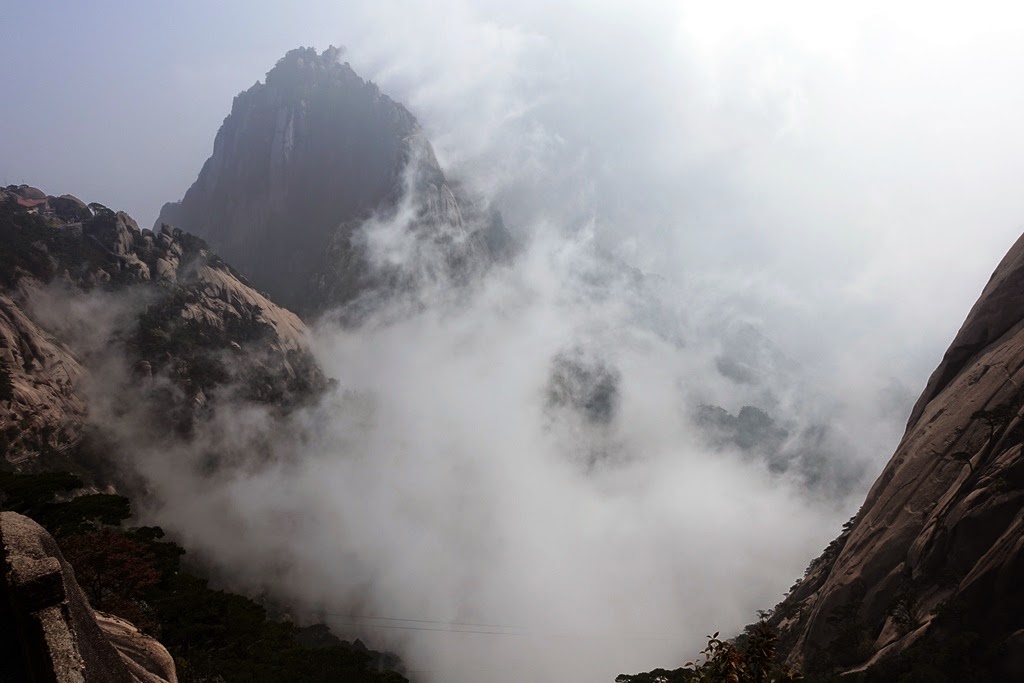


Every turn revealed a new postcard-worthy view:


For me, Elephant Trunk Rock conjured up images of something else:


Graffiti, Huangshan-style:


Ansel Adams would've loved it here: 


If you look closely at the photograph below, you will see a steep stone staircase making its way up the granite peak. This is the famed Heavenly Capital Peak 天都峰 (1810 meters/5938 feet), the most celebrated stretch of trail on Huangshan, providing its most staggeringly beautiful views. However, with an eight year-old in tow and with no idea how long it was going to take us to reach the bottom, we skipped this detour:


Pine trees cling precariously to outcroppings everywhere on the mountain:


Taking a snack break. The girls were still in good spirits at this point:


Chinese ink paintings frequently came to life as we continued on:


Eventually, the stone steps carved out of the side of the mountains turned into the Never Ending Staircase. Legs became wobbly as continued the descent, but Amber soldiered on, often leading the way:


For those whose knees and legs couldn't take the steps any longer, sedan chairs were available (at a hefty cost). Little did I realize...:


Pamela was starting to lag behind us. True to form, she stubbornly insisted we go on ahead and not wait up for her, which me did, admiring the views along the way:


Looking back up at the mountain. My wife was nowhere in sight:


Five hours and ten minutes after leaving our hotel, we reached the end of the western steps! I couldn't have been more prouder of my daughter - for 15 kilometers (9.3 miles), she made her way downhill unaided, and at the end was still as cheerful and energetic as ever, betraying no hint of fatigue or muscle ache. Ah, youth...:
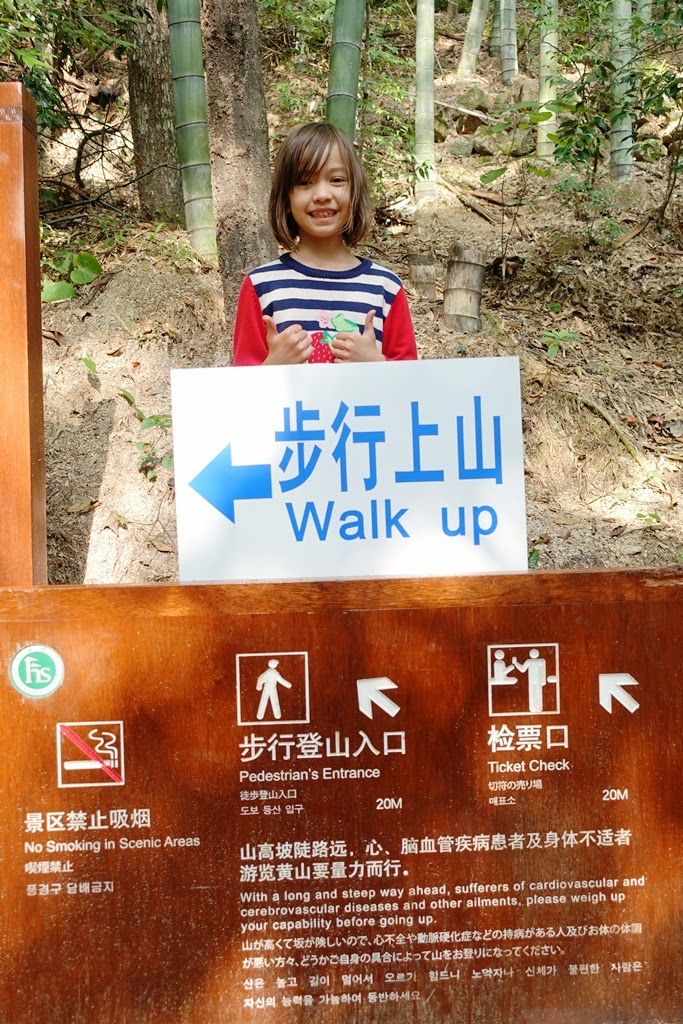

The same could not be said for poor Pamela, however, who made her way down about 20 minutes later. It turned out that she'd ended up employing the services of the sedan chair bearers as her legs wouldn't let her go any further down those damned stone steps. I have a strong feeling that this will be the last time my wife will join me and Amber on a hike:


The western steps route ends at the photogenic Mercy Light Temple 慈光阁. From there, we caught a minibus back to Tāngkŏu 汤口, where we'd left our car while we ascended the mountain the day before:


My daughter back in Tangkou, beaming from having hiked down from Huangshan:


From Tangkou we drove to the old trading town of Túnxī 屯溪. After checking into our hotel, we went out for dinner, where we celebrated (or in Pamela's case, tried to recover from) our successful descent from one of China's most beautiful mountains with a local beer:


Thursday, October 16, 2014

Huangshan - the Ascent


Finally. After more than a year here in China, I was at last able to climb a mountain. There's a lot to like about living in Shànghăi 上海, but the city is virtually as flat as the proverbial pancake, with the highest "mountain" being a hill barely a hundred meters in height (and dwarfed by the city's skyscrapers). China is a very mountainous country, to say the least, but getting to them from Shanghai can be time-consuming: it took us 5½ hours to drive to Tāngkŏu 汤口, the nondescript town situated at the foot of Húangshān 黄山, one of China's most famous mountains. Arriving on a Saturday evening at the start of the Columbus Day holiday weekend, we quickly found something to eat after checking in at our hotel. The local Huangshan Beer helped somewhat to mask the sewage-smelling fish that we'd ordered for dinner (apparently a local delicacy):


The next morning we took a shuttle bus to Yúngŭ Sì 云谷寺, aka Cloud Valley Temple (890 meters/2920 feet) and the start of the eastern route up the mountain. The eastern steps are by far the easier of the two hiking paths to the top of the mountain, but when my wife was told it would take four hours on foot to reach first the summit, and then the hotel where we would be staying that night, she opted (along with my daughter) to take the cable car up instead. Figuring that they would reach the top long before me, we made plans to meet at the hotel at 1 o'clock. It was just before nine in the morning when I set off by myself up the eastern steps:


It was a grind walking up and I felt woefully out of shape, stopping every few feet to catch my breath. The porters who make this trip each day, carrying food, drinks and construction materials, certainly helped to put things in proper perspective, however, as I trudged along:


The route up was almost entirely shaded by trees, though spectacular views popped through the canopy every now and then:


Food and drinks were available on the way up:


Atmospheric conditions were constantly changing, as clouds made their way in and out:


The leaves were just beginning to show their autumn colors:


The landscape of Huangshan is dotted with lonely pine trees clinging to rocky outcroppings, many of which have been given fanciful names. Fortunately, I can't remember what this particular pine is called:


Finally, I reached the summit area at Bái'é Fēng 白鹅峰,  aka White Goose Ridge, 1770 meters (5807 feet) above sea level. To my surprise, it'd only taken me two hours and ten minutes (and 7.5 kilometers/4.7 miles) to reach the top:


With almost two hours to kill until I was supposed to meet Pamela and Amber at the hotel, and being unable to reach my wife by phone to let her know that I was at the top, I decided to take a look around at the sights on the summit, beginning with the "umbrella pine":


The Refreshing Terrace 清凉台 is noted for its sunrise views (and the noontime scenery was pretty cool, too):


Flower Blooming on a Brush 梦笔生花:


After about 40 minutes walking around, and with the roof of the Xīhăi Hotel 西海饭店 in sight, my wife called to say that she and my daughter had only just at that moment arrived at the summit. Seems they had to wait more than 2½ hours to board one of the cable cars! Never had a hike felt so good as at that moment:


Having another Huangshan Beer in the hotel bar and watching the porters go by while waiting for the girls to show up:


At last, Amber and Pamela arrived. It took a few moments for my laughter to die down. We checked in and then checked out the view from our room's balcony:


Following a pricey lunch (from food to lodging, everything is expensive at the top of Huangshan), we set out to explore more of the summit:


Purple Cloud Peak 丹霞峰:


Young lovers show their undying affection for one another by leaving padlocks to rust in the harsh mountain climate:


The cloud cover added to Huangshan's mysterious aura:


Passing by our hotel again. Our room was on the second floor, the second window from the right in the photo below:


Huangshan's fame and popularity ensures that it attracts a lot of tourists, many of whom travel in large groups, following a megaphone-toting (and using) guide around the various official lookout points and sightseeing spots. Listening to the din, it's hard to believe that these people could truly appreciate why Huangshan has been an inspiration to Chinese artists and poets over the centuries:


A lonely sentinel maintains its vigil in the woods:


Back at Qīngliáng Tái, aka Refreshing Terrace:


Couple Pine, so called because "its two trunks stand(ing) abreast out of one root like a couple leaning close to each other." Note all the padlocks by the bridge:


 The Sea Exploring Pine:


The vista that awed me the most was the one at Beginning to Believe Peak 始信峰, at 1683 meters (5522 feet) above sea level. It made a believer out of me:


As we made our way back to the Xihai Hotel for dinner and to settle in for the evening, the cloud cover quickly fell upon us, making it difficult to see the path:


The thick fog meant it would be pointless to wake up before dawn in order to see the sunrise (though that didn't appear to stop some people from trying early the next morning), but it also ensured we would get enough rest before the daunting descent that lay ahead of us the following day: