Blackheads House and St. Roland Statue, Old Riga
Whereas Friday in Rīga was rainy, Saturday was clear and sunny (for the most part; there were a few drops of rain around lunchtime). We left our hotel after breakfast and headed over to the nearest tram stop, passing by some fine examples of Rīga's noted art nouveau buildings:
We began our explorations of the city by taking the convenient tram to Maskavas Forštate in central Rīga (
Centrs):
Rīga's "Moscow Suburb" is one of the city's oldest central districts; it was also the site of the Jewish ghetto during the Second World War. But despite the dark past, it's the home of my wife's favorite Rīga attraction, the Rīga Central Market (
Rīgas Centrāltirgus). The market has been in operation since 1570, though it's only been in its current location since 1930. Housed in a series of gigantic World War I Zeppelin hangars, the Central Market is home to a vast number of fruit, vegetable, dairy, fish and meat vendors, though apparently the number of traders is decreasing as many Latvians now prefer to shop in suburban shopping malls:
11 a.m. wasn't too early to sample the wares of one local craft beer seller. Nothing like a Double IPA to cap off the morning:
From the Central Market, we walked into Old Rīga (
Vecrīga), easily identified by its centerpiece, the towering spire of St. Peter's Church:
In the Rătslaukums stands the historic Blackheads House (
Melngalvju nams), built in 1344 as a residence for the Blackheads, a guild of unmarried German merchants. The original house was heavily damaged in 1941 before being razed by the Soviets in 1948, but an exact replica was completed in 2001, in time to celebrate Rīga's 800th birthday. Until recently the building was serving as the temporary home of Latvia's president, and even now remains closed as it prepares to reopen as...what, I don't know:
For lunch, we went just behind the House of the Blackheads to
Salve, a restaurant serving Lithuanian cuisine, where I had the "homemade sausage with beef & pork with stewed sour cabbage and baked potatoes", and washed down with a Užavas beer:
Next up was the short walk over to Doma Laukums and Rīga Cathedral (
Rīgas Doms), the largest medieval church in the Baltics. Built in 1211 as a Catholic house of worship (it's now Evangelical Lutheran), the cathedral is an amalgamation of styles ranging from Romanesque to baroque to Gothic, and from the 13th to the 18th centuries. During Soviet times, worship was suppressed and the cathedral became a classical-music venue (and still is, though Latvian-language services have since been resumed). The huge 6768-pipe organ (1884) is currently undergoing restoration, but the cloister was open for exploration:
Rīga's Old Town is a lot smaller in size compared to Tallinn's and Vilnius', but it has its charms. And the city makes up for it in other ways, as you will find out near the end of this post (or which you already know, had you read the
preceding entry):
The beautifully-restored stock-exchange building is now home to the
Art Museum Riga Bourse (
Mākslas muzejs Rīgas Birža). There was a special exhibition featuring a dozen paintings from the Prado Museum in Spain, as well as a series of graphics by the Spanish artist Goya. However, the permanent collection, while interesting, wasn't as impressive as some of the others we've seen in Europe in recent years, and the Oriental collection was disappointingly closed on the day we visited. The building itself, however, is a work of art and there are great views of the town square from the upper floors:
Dona Tadea Arias De Enriquez (1793) by Francisco Goya
Amalia of Solms-Braunfels (1631-2) by Anthony Van Dyck
Ceres and Two Nymphs (1615-7) by Pieter Paul Rubens and Frans Snyders
If you don't recognize this by now, there's no hope for you...
The combination of a nasty cold and a lack of interest in non-Chinese art had by this time taken its toll on Shu-E, so after a coffee break in the museum's cafe, my wife decided to head back to the hotel to get some much-needed rest. Amber still had a lot of energy, however, so I took her to have a look at the Cat House (
Kaķu māja) historic building in Livu Laukums. No, not
that kind of a cathouse; this is a 1909 art nouveau building with an interesting legend behind it. The story goes that the owner's application for membership in the Great Guild located across the street was rejected, so he turned around the black cats mounted on his building's turrets so that their butts were pointing toward the guild hall. This outraged the guild members, but after a lengthy court battle the Cat House owner was admitted into the club provided he turned the cats in the opposite direction. Which he did:
In Livu laukums (Livu Square):
The Freedom Monument (
Brīvības bulvaris) stands between Old and Central Rīga. Paid for by public donations, it was erected in 1935 where a statue of Peter the Great once stood (Latvia had been independent from the Russian Empire since 1918). The inscription at the base of the monument reads "For Fatherland and Freedom", while a copper Liberty stands on top, holding three gold stars (symbolizing the three original cultural regions of Latvia) in her hands. Among the figures carved around the monument's base is the cultural hero
Lāčplēsis. The Freedom Monument wasn't destroyed during the Soviet period, but anyone caught placing flowers at its base would be persecuted:
My daughter and I then took a 50-minute boat ride along the Pilsētas Kanāls (City Canal), passing by some by-now-familiar sights, then venturing out into the wide Daugava River before returning to our starting point near the Freedom Monument:
Central Market Zeppelin hanger
The view from the eastern and western ends, respectively, of Bastion Hill (
Bastejkalns), overlooking the canal:
By this time it was already half-past six, so Amber and I headed back to our
hotel, fifteen minutes away on foot in the Quiet Center. My wife still wasn't feeling very well, so my daughter and I had dinner down the street at a small Indian restaurant:
After dinner, Amber went back to our room to unwind with her Nintendo DS player, but I wasn't quite ready to call it a day just yet. Old Rīga may be beautiful, but the city's pride and glory is its
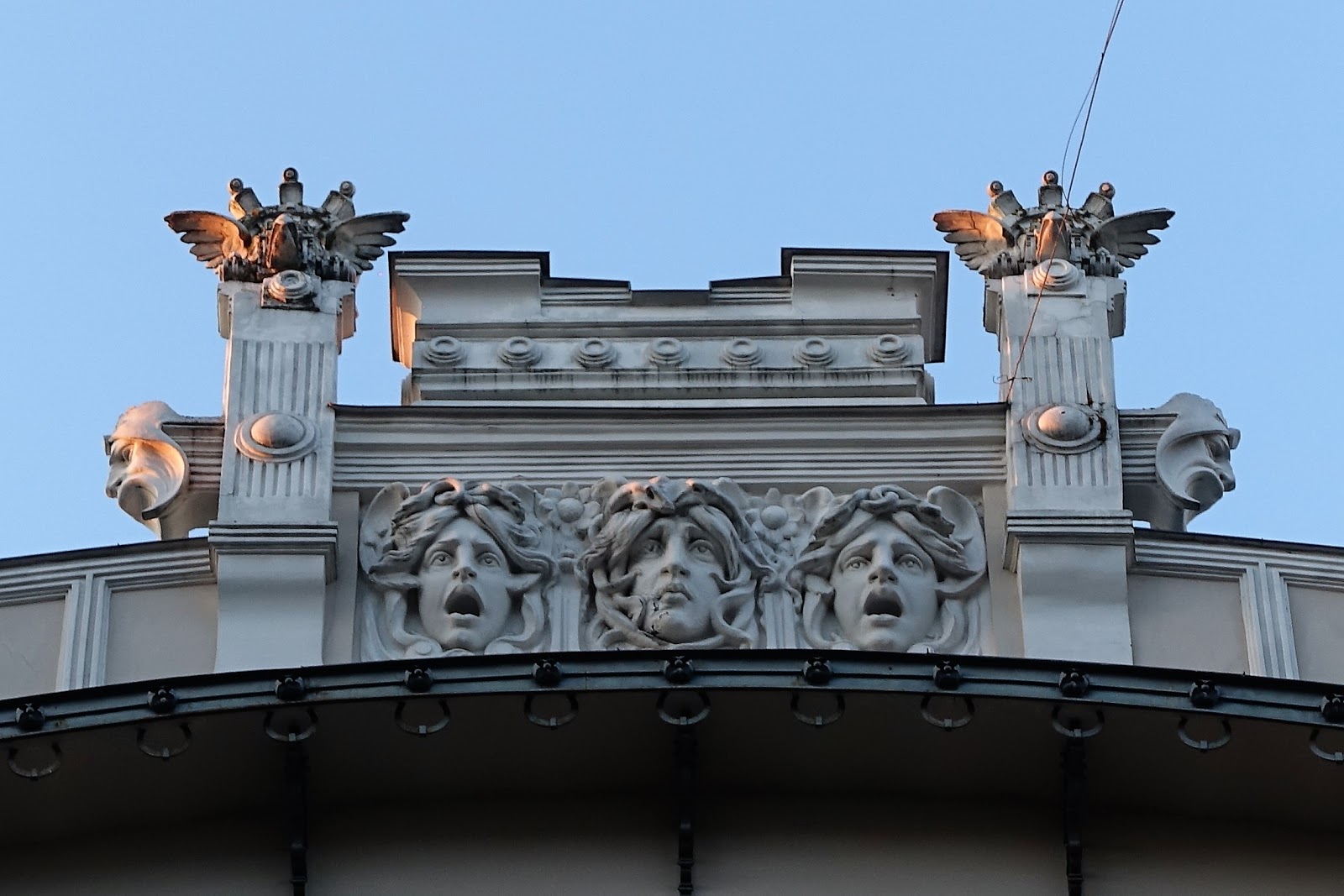
art nouveau district, centered around Alberta iela. On this one street is an incredible collection of residential houses, restaurants and shops in the art nouveau style. Walking along the street is an amazing experience as you take in the intriguing details of the various facades. A camera or a phone is a must to record it all:
This building houses the
Riga Art Nouveau Museum, which Amber and I had
visited the previous day
What a way to end the day! There was nothing more to do after that except buy a beer from the local Maxima and enjoy a nightcap back in our hotel room: