Showing posts with label Russian. Show all posts

Monday, April 25, 2016

Это правда?


I speak Russian.

At least that was the determination of the examiners at my end-of-training Russian exam last Thursday. While I didn't feel that I did all that badly during the two hour-long test (thanks to the extra coaching I'd been receiving during the week leading up to the exam), at the same time I was sure that I hadn't reached the required threshold for passing, especially in the reading portion. So it came as quite a surprise to learn late Thursday evening that I had, in fact, been given the 2/2 score (on a scale from one to five) in speaking and reading, respectively, that was specified as a passing grade for a beginning student in Russian. There are only two possible conclusions to be drawn from the unexpected result:

1.) The criteria for receiving a 2/2 was much lower than I'd thought, or
2.) The Russian department at the Foreign Service Institute wanted to get rid of me as quickly as possible.

I'm leaning toward the latter interpretation.
 
So now thirty-two weeks of Russian language training is over, and we are due to leave Falls Church, Virginia for Vilnius, Lithuania is less than a fortnight. There's a lot to do in the limited time we have left here, and, frankly speaking, my passing the language test has caught me off guard. After a disastrous progress evaluation back in late February, my training time was actually extended by an additional eight weeks, as the powers-that-be determined at that time that I wasn't going to pass the final exam penciled in for April 21. I wasn't upset by the extension that would've kept us in the D.C. area until the middle of June, because it would've meant my daughter could've finished the school year here. However, the original test date wasn't rescheduled, and now I'm officially supposedly proficient enough at Russian to do my job when I get to Vilnius.


I'm not so sure about that. Despite more than seven months of intensive study in speaking Russian and reading Cyrillic, I'm actually very weak at the language skills that I'll need to use when I'm on the job in Vilnius, namely interviewing applicants from Belarus and Russia seeking visas to travel to the United States (by contrast, most Lithuanian citizens are eligible to participate in the Visa Waiver Program). It's highly unlikely that I'll ever be called upon to give a presentation in Russian to an audience in Lithuania on education or health care in the U.S., yet this "skill" is an important component of language training at FSI. The fault lies not with the instructors, who are very good at their jobs, but with the content of the curricula and the structure of the all-important end-of-training exam. Giving vent to my frustrations and criticisms with the way languages are taught in the State Department would require a long and separate blog post (in probable conjunction with a letter of resignation), so I'll leave all that for the feedback I'm expected to provide now that my training is finished. In the meantime, I feel spectacularly unprepared for the real world that awaits me when we arrive in Vilnius early next month.

Russian misgivings aside, I'm looking forward to Lithuania. Everything I've heard about both the country and the embassy there has been nothing but positive, and I've been getting good vibrations from the various emails between myself and some of the people I'm going to be working with. My wife is also excited about the move (although not knowing the situation regarding the existence of Asian grocery stores in Vilnius is making it difficult for her to determine what comfort foods need to be shipped from Falls Church). Even my daughter doesn't seem to mind having to finish the fourth grade at a new school in a new country. The next week-and-a-half will be busy for us, but we're eager to get a start on our second posting.

The paucity of blog posts during the last three weeks has been mainly due to my having to prepare for the final language exam, but we did do a few things aside from the usual routines (Pamela and Amber take zither and Mandarin lessons, respectively, every weekend at a Chinese school in Falls Church). My daughter, for example, was one of the winners in her division at the Cherry Blossom Go Tournament, held at George Mason University earlier this month:


We also took advantage of the warming spring weather one weekend to visit the historic mill town of Occoquan, in Virginia's Prince William County:  


The compact downtown district has around sixty residential buildings and non-residential structures that have been preserved for visitors:


These days in America you can find any number of "historic towns", just as you would come across an ever-increasing number of "old streets" in Taiwan. But while the latter mostly consist of food stands and the resulting hordes of snacking visitors (at least on weekends and national holidays), the preservation of the former has taken the form of antique shops, art galleries and restaurants offering al fresco dining. And, of course, shops selling fudge and ice cream:


Our time here is winding down, and there's a lot to do in preparation for the move. If I can find the time, I'd like to do a hike before we go, and perhaps see an Orioles game at Camden Yards (though the weather forecast for next weekend doesn't look promising). Despite the stress that comes with having to learn first Mandarin, and then Russian, the FSI way, we like living in Falls Church - it's a nice area, the schools are good and Washington, D.C. isn't far away. Hopefully we'll be back in a couple of years.

Springtime in the local cemetery

Full moon over Falls Church. Unfortunately, my tripod is in storage somewhere in Europe, otherwise this would've been a pretty atmospheric photo...right? 
 
Amber going solo with crab legs for the first time...sort of. Mom still had to crack open some of the legs for her.
 
Sunset over Leesburg Pike. It looked more impressive in real life. For some strange reason, shooting through the front windshield didn't yield the desired result. Go figure...


Saturday, November 21, 2015

From Russia With Eggs

The events of last Friday in Paris have dominated the headlines for the past week, and like many users on Facebook, I changed my profile photo to show the French tricolor. I noticed that this action on our parts triggered a certain reaction from some Facebook users, who posted links to articles that criticized the showing of solidarity with the people of France while simultaneously ignoring the equally horrific bombings that took place in Beirut the day before what occurred in Paris (as well as other atrocities that have taken place in Nigeria, Pakistan and other locales outside of the developed world). While valid points about selective outrage were made, I couldn't help but notice from looking at their previous feeds from before Friday the 13th that none of these holier-than-thou types had expressed any outrage over the Beirut bombings at the time they happened. They waited instead until well after the expressions of sympathy and solidarity started showing up across Facebook following the terrible events in Paris to get up on their virtual soapboxes. When tragedy strikes, some people can't resist the opportunity to show their moral superiority.

Unfortunately, an even nastier trend also emerged on Facebook: the cries of those opposed to President Obama's plan to allow 10,000 Syrian refugees into this country. Most of these people have put up, or linked to, posts proclaiming that we should take care of our hungry veterans, or the homeless on the streets, before opening up our borders to more people in need. The problems with that line of reasoning are legion. To begin with, like the smug "What about Beirut?" posters described above, very few of these folks suddenly concerned about those who have fallen through the social safety net have in the past publicly proclaimed on the pages of Facebook their concern with America's homeless population. The United States has the resources to take care of all those in need in our country, as well as continue to live up to the ideals spelled out on the Statue of Liberty (a gift from France, it shouldn't be forgotten); what it lacks is the will to do so. The American suburbs are populated by many of who are afraid of the outside world, and of the people who inhabit it. It's the same old sad and ironic paradox being played out yet again, that of a so-called nation of immigrants that suffers from xenophobia. And never mind that virtually all of our newfound fans of the homeless are themselves descended from immigrants. For every proverbial two steps forward this country takes, it continues to fall back one step each time. On the other hand, I've seen a lot of positive posts on my Facebook thread, so perhaps hope will eventually triumph over dismay. 

Meanwhile, life goes on here in northern Virginia, as I continue to do daily battle with the complex rules of Russian grammar (which must have been hammered out by Russian grammarians over all-night vodka drinking sessions). Today my class had its first field trip, an excursion to the Hillwood Museum and Gardens in the Rock Creek Park area of Washington, D.C. The museum is housed in a 1923 neo-Georgian manor that was owned by Marjorie Merriwether Post, heir to the cereal-company fortune:


One of the wealthiest women in the U.S., Post purchased the estate in 1955. She began collecting French decorative arts in 1919, and her tapestries, furnishings and other objects are on display in the French Drawing Room. This room, with its painted and gilt wood paneling and mantel from Parisian homes dating to the time of King Louis XVI (1774-92), was the first stop on our guided tour with our Russian-speaking guide:


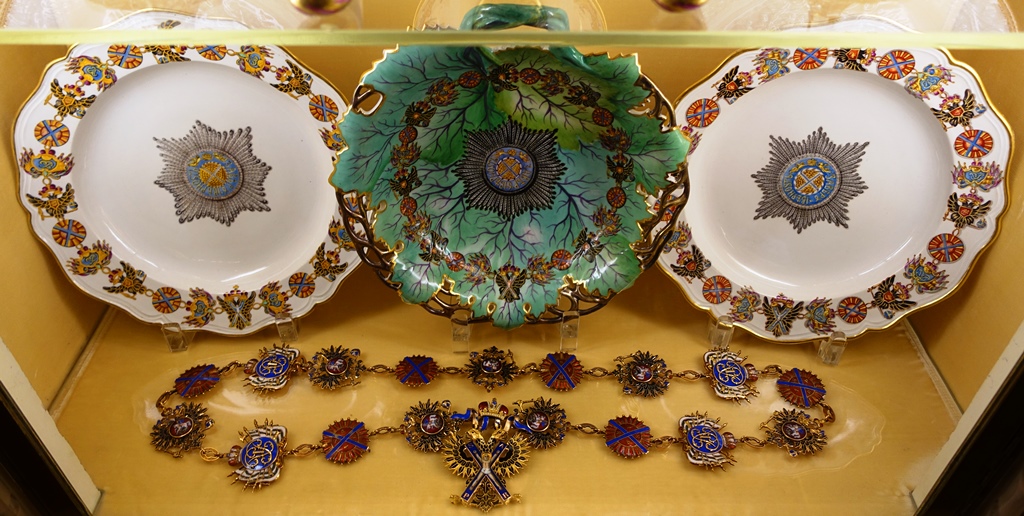
While Post started out as a Francophile, her passions shifted in 1937-8, when she lived in Moscow with her third husband, Joseph Davies, who was the U.S. ambassador to the U.S.S.R. at that time. She began collecting Russian imperial art; her timing was impeccable, as Stalin's government was willing to part with such treasures in order to get hard currency to fund industrialization programs. Post took advantage of the fire sale to amass an amazing collection, which is now on display at Hillwood. The Russian Porcelain Room, for example, has cases containing an array of imperial glass and porcelain, including four dessert services commissioned by Catherine the Great in the late 18th century, and distinguished by the insignia of the Russian elite:


This double-headed eagle inlaid in the center of the floor was a symbol of the Russian imperial court:


The Pavilion was used by Post for after-dinner entertaining, which included the showing of movies to her guests. The room is highlighted by two paintings: The Countess Samoilova and Her Foster Daughter, by Karl Briullov; and (pictured below) A Boyar Wedding Feast. The latter painting, by Konstantin Makovsky in 1883, depicts a wedding feast between two noble class families in 16th- or 17th-century Russia:


Next we visited the Icon Room, containing objects and liturgical pieces associated with the Russian Orthodox Church, and including creations by Carl Fabergé, celebrated jeweler to the tsars and tsarinas: 


The Library. The painting on the wall in the far left of the photo is a 1934 portrait of Post in a white silk dress with a red velvet sash. On the right is a portrait of her mother, Ella Merriweather. A portrait of her father, C.W. Post, hangs on the opposite side of the room, over the fireplace:


The Dining Room brought us back to the French theme, though the hunting scene paintings are Dutch and the table Italian:


One of the highlights of the museum is the Case of Bleu Celeste. This case is filled with pieces dating from the mid-18th century, manufactured by the famed Sèvres porcelain factory:  


Heading up to the second floor, we passed through the Entry Hall. The grand staircase is dominated by a giant portrait of Catherine the Great, among other tsars and tsarinas:  


The second floor contains Post's Bedroom Suite. The two girls in the painting over the fireplace are of two of her daughters, Adelaide and Eleanor:


Upstairs is also where the two finest pieces in Post's collection are displayed: two imperial Easter eggs by Fabergé. Both were gifts from Russia's last tsar, Nicholas II, to his mother, Maria Feodorovna. The first egg, the midnight blue Twelve Monograms Easter Egg (1896), is studded with diamond monograms:


The Catherine the Great Egg was presented by Nicholas to his mother in 1914. It originally held inside a miniature figure of the empress, seated in a wind-up sedan chair carried by two servants, and was revealed by opening the top of the egg. It was unfortunately lost, but the egg is still a magnificent example of Fabergé's art:


Speaking of Catherine the Great, this chalice pictured below was part of a set of liturgical gold vessels presented by the tsarina in 1791 to the Holy Trinity Cathedral of the Alexander Nevsky Monastery in St. Petersburg:


The chalice is on display in another room containing religious items connected to the Russian Orthodox Church:


In addition to its treasure trove of Russian art, Hillwood is also noted for its gardens. Some of the objects displayed outside were a little, um, odd:


Posing with two of my three classmates and our teacher, Olga:


The Mansion as seen from the Lunar Lawn:


Post was prepared during the Cold War:


We may live in a republic, but the American ruling classes have always looked up to their European aristocratic counterparts, aspiring to live in equally appointed mansions surrounded by extensive art collections. The sheer ornateness of the treasures of the Russian imperial families as displayed at Hillwood also provides a telling clue as to why Bolshevism eventually took hold in the Russian Empire, leading to the unfortunate end of the Romanovs

After our tour of the Hillwood Museum and Gardens, our group reunited at Mari Vanna, a somewhat pricey Russian restaurant on Connecticut Avenue. The beef-and-pork pelmeni пельме́ни (traditional handmade Russian dumplings) were delicious, however:


Russian isn't an easy language to learn, but I am enjoying studying it more than I did Mandarin Chinese several years ago, though I still wish I could be learning Lithuanian (as was originally intended). And as I'm going to Vilnius, it really isn't necessary for me to learn much about Russian culture. Still, I enjoyed Marjorie Merriweather Post's extensive collection of Russian art, and am appreciative that she opened her estate to the public. Even if, as the Wikipedia entry on her states, she was "alleged to have purchased art expropriated from Soviet citizens well after the Russian Revolution, including victims of Stalin's Terror at discount prices from Soviet authorities." If she hadn't, I might've had to spend another full day in the classroom.

Liberté, Egalité, Fraternité!