Showing posts with label work.. Show all posts

Wednesday, March 11, 2015

Early morning Bunding

 
Because of a visiting delegation in town from Washington, D.C., my services were not required in the office this morning; instead, I was summoned to spend that time at an undisclosed location down near the Bund 外滩, that most iconic of Shànghăi 上海 landmarks. I've been to the Bund a number of times, but never early in the morning, so I arrived about an hour beforehand to have a look around. Without the usual crowds of sightseers, and with the sky clear, it made for a pleasant walk before my shift began. What follows are some pictures I took between 7:45 and 8:30 this morning as I strolled the riverside promenade:


From left to right: the Wàibáidù Bridge  外白渡桥, Broadway Mansions 上海大厦, the Russian Consulate 俄罗斯领事馆 and the Astor House Hotel 浦江饭店 (partially visible behind the consulate).


The Monument to the People's Heroes is a socialist anachronism in Huángpŭ Park 黄浦公园, totally out of character with the rest of the Bund. The park, incidentally, was China's first, laid out in 1886.


Walking south along the promenade


Pŭdōng 浦东 (of course)


The Former Palace Hotel (1909) on the left (now known as the Swatch Art Peace Hotel), with its larger neighbor the Fairmont Peace Hotel (1929). The crowd-control barrier in the foreground is the city government's response to the stampede that occurred at that spot on New Year's Eve, killing 36 people and injuring 49.


The same hotels from another angle. In its heyday, the Fairmont (then known as the Cathay) was one of the finest hotels in Asia, along with the Peninsula in Hong Kong and Singapore's Raffles.


Custom House (1927). The bell tower was called "Big Ching" and was the largest of its kind in Asia. It still chimes every quarter of an hour, just like a certain clock in London.


The Hongkong & Shanghai Bank Building (1923)


Continuing south along the Bund...


Because you can never have enough photos of the Pudong skyline...


As my shift was getting ready to start, it was time to turn around and start heading north...


The Bund at street level


Inside a certain iconic Shanghai hotel, a certain English playwright wrote a certain play while he holed up in his room with a bad case of the flu.


The view from where I was working this morning


The Oriental Pearl TV Tower 东方明珠广播电视塔. One of my Chinese colleagues, a Shanghai native, described it as being "hideous". Good call. 


The Huángpŭ River 黄浦江 sees a lot of ship traffic

I returned to my office in the afternoon, walking as usual through the Bubbling Well Road Apartments 静安别墅, a traditional Shanghai housing complex concentrated around a long lane and known as a lĭlòng 里弄. These three-story red-brick houses were put up between 1928 and 1932:


And, as usual, I passed through a section of the French Concession 法租界 on my to the subway station after work was over for the day. Only this time I had a camera with me:


The rather obvious standout in this tableaux is the Shanghai Exhibition Center 上海展览中心, the former Palace of Sino-Soviet Friendship and one of the few remaining examples of Stalinist architecture to be found in Shanghai.


I go by the Moller House 马勒别墅 almost every weekday evening and never tire of seeing it. The story goes it was designed by the 12 year-old daughter of its Swedish owner.


Wednesday, December 17, 2014

常来常熟!

Periodically, I'm asked to go on what are known as "outreach" visits to cities located in the provinces closest to Shànghăi 上海 - Ānhuī 安徽省, Jiāngsū 江苏省 and Zhèjiāng 浙江省. The idea is to establish a presence in localities that would normally be overlooked in the usual government-to-government exchanges and frequently involve visa presentations to business and/or student groups, courtesy calls with local officials and visits to American companies or Chinese firms with strong business ties to the United States. I've been on a couple of these trips already, and have just come back from my third such outing, an overnight visit to the city of Chángshú 常熟 in Jiangsu Province. It was a typical outreach foray in that I met with officials from the local Foreign Affairs Office, gave a presentation to a business group in one of the city's two development zones and was taken on a tour of two companies doing business in Changhsu. Hopefully, the trip was a success. With one exception, the photos below were taken during my free time there.

This is the exception. It's me looking as if I'm elaborating on the finer points of American foreign policy, in particular the strategic implications of the "pivot to Asia" as it pertains to China with a local official. In reality, we were just exchanging the usual pleasantries. The officials I met on this visit were all very friendly; in many of these outlying cities, they seem appreciative that someone from the U.S. mission, even a peon as lowly as me, has taken the time and effort to reach out to them. Many thanks go out to my coworker Charlie (on the left), who did so much to make this trip happen.


Changshu is considered a "small" city. It's an indication of just how big China is when an urban area with a population of one million registered residents (and another million or so unregistered denizens), and comprised of a dozen towns as well as two economic and technological development zones, is thought of as being in the minor leagues. Traditionally, textiles and garment-making were its largest industries, but in recent decades the automotive manufacturing sector has become dominant. Compared with many Chinese cities of similar size, Changshu seemed somewhat clean and well-organized, at least in the newer part of the city where I stayed. This was the view from my hotel room:


And this was the view from one of the corridors inside. The large apartment blocks in the background are gradually replacing the older housing seen in the front. The numerous condo complexes visible as I was driven around Changshu gave the city a Pyongyang-like appearance at times.


Dusk...


...and dawn:


After breakfast and with some spare time before the first item on the day's agenda, I took a walk in the park located across the street from the hotel. It was below-freezing, but the sky was clear, which doesn't happen all that often in China.


Close-up views of the above scenes:


Examples of older houses:


Locals:


Like public parks the world over, ghastly art set the scene in Changshu:


Outside the hotel...


...and in the lobby:


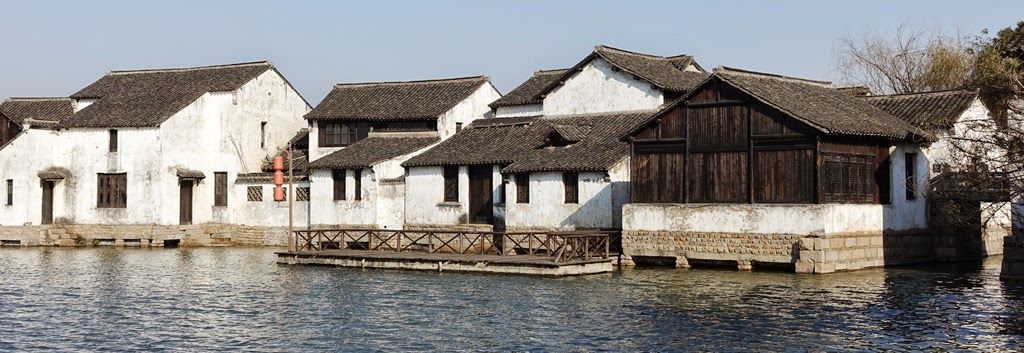
Following a visit to an American company and lunch with officials from one of the development ones, Charlie and I had some time to kill before the drive back to Sūzhōu 苏州 and the train ride back to Shangahi. We were taken to see one of the local sightseeing spots, Shājiābāng 沙家浜. It's an odd tourist village, being one part propaganda, one part historic lakeside town and one part protected wetland. The propaganda element concerns a battle in the reeds there that apparently took place during the Japanese invasion of China. The battle has been celebrated in a revolutionary opera and was the subject of a popular TV series in the 1960's and '70's. Performances of "Let the Bullets Fly" are held regularly in the village:


In many tourist spots around China, signs are written in Mandarin, English and Japanese. In Shajiabang, however, Japanese has been replaced by Korean:


For some reason, we weren't taken to see the military museum:


On this very chilly Wednesday afternoon, only a few tourists were out braving the cold:


Among the things we did on our brief sojourn to Shajiabang was to visit the home of a wealthy family that once lived in the area and to take a boat ride along some of the waterways.


The local firewater, Osmanthus wine 桂花酒, has an alcohol content of 78%. I was able to finish the small cupful I had by taking small sips. The woman who served it to me finished hers in one gulp. Sorry, America.


At Suzhou Railway Station 苏州站, en route to Shanghai: