Friday, June 24, 2011

Welcome to Fantasyland: the Commonwealth of Taiwan - The People and the Land

A brief mention of Taiwan’s native peoples and its land (their land?) as our exercise continues…

Taiwan 台湾 is unique when compared to Japan in its relative ethnic diversity. Whereas there are only a small number of native Ainu アイヌ peoples remaining in Hokkaidō 北海道, and the presence of roughly a million resident Koreans 在日韓国・朝鮮人, in Japan, the commonwealth is home to 14 aboriginal tribes that have received official recognition by the government in Taihoku: the Ami アミ, Atayal タイヤル, Bunun ブヌン, Kavalan クバラン, Paiwan パイワン, Puyuma プユマ, Rukai ルカイ, Saisiyat サイシャット, Tao タオ, Thao サオ, Tsou ツォウ, Truku タロコ, Sakizaya サキザヤ and Sediq セデック. Recognition as an indigenous community gives a tribe title to ownership of certain land tracts, as well as the right to use their native names on official documents, such as family registries 戸籍 and passports. The latter caused much friction with Japanese authorities, who insisted that as Japanese citizens, Taiwan’s aborigines must use kanji 漢字 in writing their surnames and given names. Eventually, the Japanese government acceded to repeated requests by aboriginal activists and Taiwanese authorities, and now allows native people to use kana 仮名 for purposes of transliteration.

Despite much progress in recent decades, the aboriginal peoples of Taiwan are still economically disadvantaged in comparison to other commonwealth ethnic groups. Entertainment, military service and sports continue to provide popular routes for aboriginals seeking to improve their economic status.

There are four areas designated as “state parks”, and administered by the commonwealth’s interior ministry. Three were established during the pre-war period – Daiton 大屯, Shintaka Arisan 新高阿里山 and Tsugitaka Taroko 次高タロコ – while the other one (Kontei 墾丁) was set up by the commonwealth authorities. These areas are not considered part of the Japanese national park system 国立公園. In addition, the commonwealth’s tourism bureau has designated twelve areas throughout the island as “scenic areas”.

As an external territory of Japan, Taiwan is responsible for its own environment, and thus administers a separate set of environment regulations from those in Japan. This has provoked a great deal of controversy among the Taiwanese public, especially in recent years, as many people feel the commonwealth government has not been stringent enough in its efforts to maintain a clean and healthy natural environment for its residents.

Wednesday, June 22, 2011

Welcome to Fantasyland: the Commonwealth of Taiwan - Legal Matters

From the wall of a Japanese restaurant, something about an old tree with its roots firmly attached to the ground, and its leaves to the branches, and still growing.

We now return to our regularly scheduled fantasy...


While Taiwan's 台湾 criminal justice system is organized along Japanese lines, its institutions enjoy a great deal of autonomy. Law enforcement is provided by a commonwealth police force under the oversight of a police agency headquartered in Taihoku 台北. The force is staffed almost entirely from top to bottom with Taiwanese, and operates independently from the National Police Agency 警察庁 in Japan. Operations are centralized, and police officers can, and often are, assigned to different areas of Taiwan during their careers.

The judicial system also operates separately from that in Japan. As with the police force, the number of Japanese officials has been reduced over the decades to the point where virtually all prosecutors, judges and corrections officers are Taiwanese. Taiwan has its own law schools which train students to become lawyers, and its own bar association, which administers qualifying exams for those wishing to practice law, as well as being responsible for seeing that its members adhere to its ethical standards. While the commonwealth government does recognize legal degrees and qualifications obtained in Japan, it still requires the holders of such to pass a modified bar exam if they wish to set up practice in Taiwan (the reverse holds true for Taiwanese aspiring to do the same in Japan).

The basic court system is divided into three tiers, with trial courts at the lowest level; district courts, which handle appeals of trial court decisions, as well as cases involving more technical matters; and a high court, which sits in Taihoku. In theory, Taiwanese are entitled to appeal high court decisions to the Supreme Court of Japan 最高裁判所 in Tōkyō 東京. In practice, however, such requests are usually rejected by the Japanese high bench, unless there are constitutional issues involved (see below). As is the case with all other official matters of business in Taiwan, Japanese is the language employed in the practice of law on the island.

Taiwanese courts have yet to follow the lead of courts in Japan and establish a lay judge system 裁判員制度, but the issue is currently being discussed in Taiwan's legislature.

Despite the autonomy enjoyed by the legal/criminal justice systems on Taiwan, there are a couple of important restrictions that must be noted. The first is that any act passed by the National Diet 国会 in Tōkyō can supersede any legislation enacted by the commonwealth's legislative assembly in Taihoku. Secondly, all laws promulgated in Taiwan must be in accordance with the Constitution of Japan 日本国憲法.

Monday, June 20, 2011

Dad's Day 父親節

The third Sunday in June is Father's Day in many countries, including the U.S.A. and Japan 父の日, but not here in T'ái​wān 台灣, due to some annoying cultural reasons, the day is always observed on August 8. Fortunately for this dad, our household follows the American calendar in these matters, and so the three of us celebrated, um, me at a beer restaurant in T'ái​chūng 臺中. Located on the 10th floor of the MODE Mall (just a short walk from the South Exit of T'ái​chūng Station 臺中車站, though today we took the car, and had a hell of a time finding a place to park), Bravo Beer is a T'ái​pěi 臺北-based (the best always are in this country) bar/restaurant that specializes in beers from Heaven...I mean Belgium. Needless to say, the couple of brews I had this afternoon were divine, and the food wasn't bad, either - the Scotland Boneless Chicken Thigh I ordered was pretty tasty. Surprisingly, although the restaurant was busy, it appeared only a handful of diners other than ourselves were drinking beer with their meals. Perhaps this isn't surprising after all - taking into consideration both the dominance of the locally-produced, mass-market (and tasteless) T'ái​wān Beer 台灣啤酒, and the miniscule number of microbreweries on this island, the vast majority of Taiwanese are not all that familiar with the taste of good quality beer.

As for all you Westerners out there who claim to enjoy Taiwan Beer, you're just hopeless...wait, what I mean is you should know better. Shame on you all (but Happy Father's Day if it was applicable).

Here's what I had this afternoon. My wife made do with a large draft Hoegaarden (sorry Barbara!):

First up was a Westmalle Tripel, one of the best-known brews outside of Belgium. The 9% alcohol content did a lot to alleviate my sore throat.

I had hoped to try a De Koninck ale, but it wasn't in stock at Bravo. They did have Karmeliet, however, which my daughter insisted I order after I told her it was an amber ale. I'm glad I took her advice.

Sunday, June 19, 2011

Family fun at the love hotel!

My daughter on occasion does some modeling work for a children's clothing wholesaler (this is what happens when your Asian wife is convinced that your Amerasian child needs to be shared with the entire world). Today was one of those days, only with a difference. Usually the photo sessions take place on a Saturday morning at the company's office, but on this Saturday, the time was changed to the early afternoon, and the location was at one of T'ái​chūng's 臺中 infamous boutique hotels, the Mùlán Motel 沐蘭旅館.

For those who are unfamiliar with the concept of boutique hotels, they are basically overdecorated, overpriced...sorry, "upmarket" versions of what the Japanese introduced to the world in the postwar period as "love hotels" ラブホテル. For NT10,000, you and your loved one (or whomever you just happened to have picked up that evening) can spend the night getting horizontal (or vertical, if the case may be) in a "high-class" room complete with a home entertainment system, jacuzzi, a themed bedroom and, for some strange reason, a toilet sans door (how that might excite one's erogenous zones is beyond my comprehension). Yes, that's $350 (or ¥28,000) for a night of sin in a room the aesthetics of which can best be described as appealing to a poor, barely educated farmer who suddenly struck it rich in the lottery. It's lust the nouveau riche way!

What I can't understand is why the company chose a love motel as the setting for photos of children wearing the latest summer fashions. While standing around outside waiting while the room was being readied, there was a busy stream of couples driving in and out of the motel, including a foursome in one car (cue the imagination to get a workout). I don't know what the visitors were making of the sight of seven adults, four kids and several bags of clothing and equipment, but hopefully their thoughts were of the clean and wholesome variety, even if their nights (and afternoons, in some cases) probably weren't.

The bedroom. The kids made a beeline for the bed and started bouncing up and down on it. Fortunately, none of them noticed the dish of condoms on the chest of drawers next to the bed, and so no awkward questions had to be answered.

The bathtub area, complete with tastefully arranged faux palm trees.

Amber strikes a pose. Yeah, baby!

For Amber and the other kids, the highlight of the afternoon came, no doubt, at the end, when they all got to play in the tub.

Saturday, June 18, 2011

Sunset...日没...日落

The sunset this evening in Fēng​yuán 豐原, following a brief but heavy late-afternoon downpour.

Friday, June 17, 2011

Welcome to Fantasyland: the Commonwealth of Taiwan - Security

Kaminoge's summer fantasy rolls on...

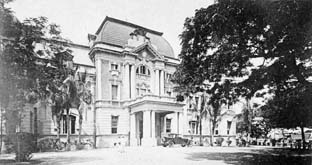
Taiwan Grand Shrine 台湾神宮, a Shintō shrine 神社 constructed in Taihoku 台北 in 1901

In addition to managing Taiwan’s 台湾 foreign relations, the central government in Japan is also responsible for the defense of the island. In order to avoid upsetting Chinese sensitivities, the Japanese Self-Defense Forces 自衛隊 keep a low profile on Taiwan, and the primary responsibility for the commonwealth’s security falls on Japan’s Coast Guard 海上保安庁. In particular, the JCG maintains a visible presence in the waters around the Hōko Archipelago 澎湖諸島, ensuring that Chinese and other foreign fishing vessels stay out of Taiwan’s exclusive economic zone.

Owing to its status as an external territory of Japan, Taiwan’s security is covered under the terms of the Treaty of Mutual Cooperation and Security between the United States and Japan 日本国とアメリカ合衆国との間の相互協力及び安全保障条約. As part of efforts to demonstrate American resolve regarding the defense of Japan, the U.S. military holds annual exercises on Taiwan in conjunction with the SDF.

Taiwan does not maintain a territorial army or an American-style national guard. Being Japanese citizens, Taiwanese are permitted to enlist in the Self-Defense Forces. In fact, a relatively high percentage of SDF members from Taiwan are made up of members from Formosa’s aboriginal tribes 台湾原住民, with military service having long been considered one of the most effective routes for Taiwan’s native peoples to escape from discrimination and economic inequality.

Thursday, June 16, 2011

Welcome to Fantasyland: the Commonwealth of Taiwan - Finances

Still dreaming…

Being a commonwealth, and therefore without elected representatives sitting in the Diet 国会, Taiwan 台湾 does not receive any grants, subsidies or transfers of funds from the central government in Tōkyō 東京. Rather, the island’s government generates revenue from its own tax collections. Residents and businesses in Taiwan pay income tax to the commonwealth government, which in turn distributes money back to the various cities, towns and villages. The Taiwanese finance ministry also receives income in the form of a local value-added tax on all consumer goods, as well as taxes on such things as cigarettes, alcohol and gasoline. Under the terms of the free association agreement with Japan, the government has the authority to issue bonds, when necessary, in order to help meet its financial obligations.

Despite being fiscally independent from Tōkyō, the Japanese yen 円 remains the unit of currency in Taiwan, and all bills and coins in circulation are printed by the Japanese Ministry of Finance 財務省. Also, a system of mutual recognition is in place when it comes to tax payments. People who maintain family registries 戸籍 in Japan, but are living and working in Taiwan, make their income and residential tax payments to the authorities in Taiwan. These contributions are recognized by the central and local governments in Japan, and taxpayers are thus considered to have met their financial obligations in Japan proper. The same holds true for registered Taiwanese residents who are living and working in Japan – the Taiwanese government accepts and credits all tax payments made outside of Taiwan. The system is designed to protect taxpayers from double taxation and the roughly equal income and residential tax rates in both Japan and Taiwan serve to minimize incidents of tax evasion.