My daughter stands in front of Goose Pond, part of the Patuxent Research Refuge in Laurel, Maryland. Amber was fascinated by the fact that part of the pond was iced over, and enjoyed skipping rocks across the icy surface. OK, I admit it, so was I.
It's been nearly eight months since leaving Taiwan, and to be honest, I haven't given the place much thought during that time. A couple of items that I came across recently online, however, have given me reason to think back to life on the Beautiful Isle, and to wonder if I did the right thing by coming here. Introspection and retrospection were brief, though, and the answer pretty obvious.
Amber demonstrates
Amy Chavez is a columnist for the
Japan Times ジャパンタイムズ , with her "Japan Lite" having appeared in the paper every Saturday for years. Chavez is an inoffensive and sometimes humorous writer, but "lite" is the operative word here, and her observations can be best summed up as "I'm so fortunate to be living this life on a small island in the Inland Sea 瀬戸内海." Chavez apparently spent some time in Taiwan recently, and produced
this story for her column, which appeared in the December 29 issue. The headline "
How can Japan help save the world? Be more Taiwanese" was certainly an attention-grabber, but the content sadly revealed that all-too-often occurrence of Westerners coming to Taiwan for a short period of time (about a month in Chavez' case), spending most if not all of that period in the capital Taipei 台北 and assuming that what they witnessed there must be true for the entire island. Unfortunately, they feel the need to share these insights with the rest of us.

My daughter the bird-watcher
And just what lessons can we learn from the Taiwanese? According to Chavez, Taiwan is a green paradise because 1.) Taiwan's MRT subway uses plastic electronic tokens as well as the more modern smart cards and In addition, all of Taiwan's restaurants use reusable lightweight metal
or plastic chopsticks — no more disposable chopsticks to burn or end up
in landfills! Likewise, if you want a plastic bag for your purchase at the convenience
store, you have to pay for the bag. More than anything, it forces
people to make a decision as to whether they really want a bag or not,
rather than just accepting it; 2.) ...although Taiwan may still be relatively new to international tourism,
this has not stopped this island of 23 million Chinese speakers from
attacking the language barrier (I'm not sure how this helps the planet); 3.) Despite seats being marked "priority seats" on Taiwan's trains and
subways, in practice all seats are priority seats. Young people wouldn't
dare sit down unless the train car is empty; 4.) Due to their Taosit/Buddhist background, many Taiwanese eat vegetarian
at least once a week. As a result, vegetarian restaurants are plentiful.
And the food is great — full of spices and flavors not usually
associated with non-mooing, non-squawking cuisine. And why do we have
this idea that to eat vegetarian, you have to be vegetarian? The
Taiwanese have even come up with "fake" beef and fish flavors so that
people can eat vegetarian but still have the animalistic taste; and 5.) Taiwan, like Japan, already has a bicycle culture. But the latter now
has a cycling culture as well — where people can go long distances on
two wheels rather than just to the office or shopping and back. In just a
decade, cycling has been embraced by every age bracket and income
level, making Taiwan one of the leading cycling countries in the world.

Cash Lake, part of the Patuxent Research Refuge
There exist two Taiwans - the one centered around the modern, progressive metropolis of Taipei, and the one that is characterized by polluting factories, ugly architecture, gangster-dominated local politics and occasionally reactionary denizens. The latter is the one where I lived, and so let me comment briefly on each of Chavez' observations:
1.) It's great that the MRT reuses plastic tokens. However, when it comes to reusable chopsticks, I dined at plenty of restaurants that only provided the disposable kind. Likewise, with plastic bags, things weren't quite as rosy as Chavez imagines things to be. Sure, the large supermarket and convenience store chains charged shoppers for using plastic. But plenty of small shops ignored the law, and gave out plastic bags free of charge. I was in Taiwan when the rules on plastic were first put in force, and I would posit that they haven't had anywhere near the intended benefit. Plastic is still supreme in the Taiwanese heartland.
2.) Though some cities such as Taipei (of course!) and Tainan 台南 have made it easy for non-Mandarin speaking visitors to get around, the same can't be said of other localities. Chavez would do well to consider the plethora of tourist information offices to be found in Japan, often conveniently located in train stations. Even when these offices don't employ English-speaking staff, they often have useful foreign-language brochures and maps, as do many individual sightseeing attractions. Taiwan has some lessons to learn in this area.
3.) The "kindness on the trains" observation is just plain laughable. Perhaps Chavez rode the MRT on a good day, but I've read a lot of blog and Facebook postings complaining about young Taiwanese not giving up their seats to those in need of them. And it's obvious she's never ridden on a regular TRA train in the hinterlands, with people putting their shoes up on the seats, speaking loudly into their cell phones and trying to snag reserved seats for themselves, thereby forcing the rightful ticket-holder to have to ask them to get up.
4.) I know the type of vegetarian restaurant Chavez dined at, and the way the food is presented is impressive. However, vegetarian cuisine in Taiwan usually means eating at small cafeterias offering food drowning in oil just like their carnivore-catering neighbors provide. Unlike in the West, people go veg for religious reasons (and not as healthy or environmentally-friendly lifestyle choices), and the veggie food to be found isn't any better for you than the standard cafeteria fare.
5.) It's great to see Taiwanese out and about on their bicycles, but for the vast majority bikes are for weekend recreational purposes only. In Yokkaichi 四日市, an industrial city in central Japan where I once lived, many people used their bicycles to go shopping at local supermarkets. In Fengyuan 豐原, the former city in central Taiwan where I lived until moving to Washington, D.C. last May, most shoppers relied on their exhaust-spewing scooters for their local shopping excursions. And many young Taiwanese still prefer to spend their free time in indoor venues, for fear of being exposed to the sun and having their skin get dark (Gasp! The horror!).
These ducks may look like they are standing on the shore, but in fact they're taking advantage of the ice cover in the middle of Cash Lake
Chavez' Taipei-centric article can be excused - she was just a visitor, after all, though I would ask her if she would consider Tōkyō 東京 to be representative of Japan as a whole (and I'm pretty confident what her reply would be). Those resident foreigners who live in Taipei should know better, but many don't seem to (an edited version of Chavez' piece in the Huffington Post elicited "I'm proud to say that Taiwan is my home" from a Canadian who posted a link to it on Facebook earlier today). Which brings me to the second item that got me thinking this week. This one was a blog post put up a couple of days ago, seeking to explain why the blogger suffered reverse cultural shock on his/her recent trip back to the U.S., and why he/she much prefers life in Taipei...I mean Taiwan...well, Taipei, though the writer thinks they mean Taiwan. After some internal debate over whether to provide a link to the blog, I've decided not to so as to not seem too mean-spirited (an exercise in futility, I know). If you're dying to know, here's a hint: think elderly quaffers of a certain aromatic beverage using the cured leaves of a certain plant.

Amber in the woods
Now in all fairness to the blogger, whom I shall refer to as "X", I do agree with a couple of their observations, and I'm assuming that some of their other ones were meant in jest. Health care in this country is a disgrace. Not in terms of quality, which is top-notch, but in terms of the lack of a national health insurance system, making the U.S. a sad exception among the developed nations. Even with Obamacare on the way, and even with a decent private health insurance plan, I dread what might happen to us financially should anyone in this family develop a serious health condition. And even if we remain in sound condition physically, there's the bewildering morass of co-payments, deductibles, what is covered vs. what isn't and so on. The other thing I agree with X concerns attitudes toward religious views - the U.S. is far less secular than many of our friends and allies, which might explain why we are so backward on so many social issues by comparison.

The best shot I could get of a warbler making its way around a tree
Now for the fun stuff. At least I hope these weren't meant to be taken as a serious endorsement of life in Taiwan. Take exhibits A and B, for example: apparently it's a bad thing that Americans say "bless you" after someone sneezes (Taiwanese don't), and while in the States, X experienced a chronically dry nose and throat, to the point that I frequently wake up with nosebleeds. In my case, I got tired of being asked in Taiwan extremely personal questions about my marital status and income (and if it's superstitions that are turning X's knickers into knots, they should just pay a visit to their neighborhood Taoist temple). As for central heating, I'm loving the fact that even though the temperature is a lot colder here in Washington that it ever was in Taiwan, the indoors is far more comfortable. And thanks to insulation, we don't even have to use the heater that often.
Exhibit C: Ridiculous morning shows. This one is a real head-scratcher. Granted, I don't watch GMA or any of those other shows in the morning, but with the number of channels available on American cable/digital TV, and in comparison with the utter vapidity of so much that is broadcast on Taiwanese television, I just can't see what it is that's bothering X so much here. X, obviously, has never had to endure the Japanese morning "wide shows" ワイドショー.
Exhibit D: X is frustrated in America because the public transportation is poor in many places: Let's say you want to go out for a few drinks. Unless you live in a
reasonably rural area, you can't go alone. Buses are rare if they exist,
taxis cost a mint, and if you drink and can't drive home, and do take a
taxi or get a ride, how do you get your car the next day? I don't get
at all how this would work. I actually would agree with X here except that it's apparent that they're comparing Taipei with much smaller American cities. Certainly Bostonians, New Yorkers and Washingtonians don't face these dilemmas. And here's where the Taipei-blinkers become noticeable. Many of the questions X raises about the lack of public transport apply to virtually everywhere in Taiwan outside of Taipei and, to a lesser extent, Kaohsiung 高雄. It would've been extremely inconvenient living in Fengyuan without having access to a scooter or a car in order to get around, and those who went into Taichung 台中 for a night of wine, women and song faced an expensive taxi ride home (relatively speaking) back to the burbs.
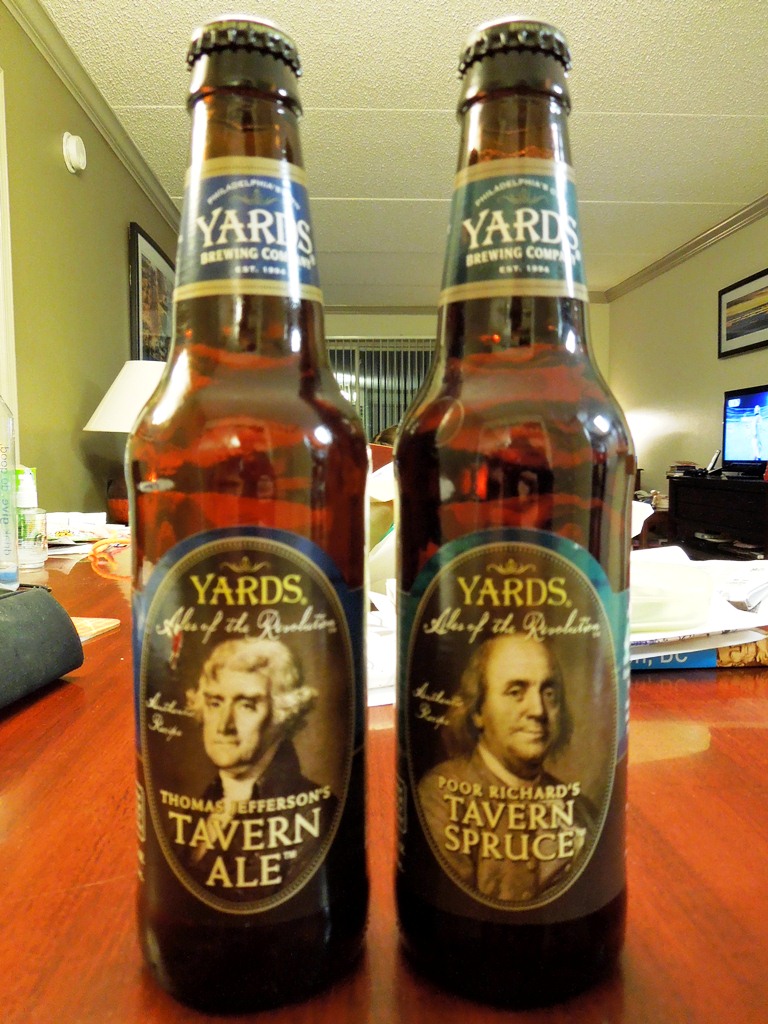
Exhibit E: Being unable to find what you want in a sea of options. As in going to a Walmart (of all places) and not being able to find a Super Ball (of all things). If this wasn't meant to be funny, then it's sadly just plain stupid. I wouldn't judge a country by its supply of readily available synthetic rubber toys. No, I would make my decisions about permanent residency based on the supply of craft beer. And in this regard, all I can say is god bless the U.S.A.
And it isn't just beer - I've developed a taste for locally-brewed sodas since arriving in Virginia. Give me Birch Beer (or Cheerwine) or give me death! Seriously, though, the quantity and quality of fine foods and drinks is far better here than in Taiwan. I would much rather shop in the
Local Market than fight the flies and crowds, not to mention risking the stomach ailments, that come from buying daily provisions in Taiwan's traditional markets.
Exhibit F: People around me actually understanding what I'm saying. I know, it's tough not being able to make fun of people who are in close proximity to you. It must be a constant source of frustration.
Display at the National Wildlife Visitor Center
Reverse culture shock is a legitimate feeling. I've been through it before, having once moved from Tōkyō to Bremerton, Washington, and getting extremely agitated by not being able to walk to anywhere when I needed something like I could do back in Setagaya-ku 世田谷区. And having been away from the States for so long, there are times when I find myself feeling like an outsider in this country. However, in X's case, and in those of many other expats, it goes much deeper. In Taiwan (or Japan, or any other East Asian country) a Westerner like X (and yours truly) stands out. We are showered with attention, much of it not unpleasant, excused for our indiscretions (an advantage some of us put to great use) and made to feel very special, all the while in a place that seemingly holds unlimited interest. Why, even a walk down to the neighborhood ATM can at times be an exciting adventure in an exotic land. The United States (or Canada, or Australia, or the UK, or any other land the passport of which you hold) seems so bland, so ordinary by comparison. And once back home, even if it's only for a short visit, you've gone back to being a nobody, just another face in the crowd. Given such a choice, some opt to put on the rose-tinted glasses and proclaim to the world their love of Taiwan.

Amber and friends at the Visitor Center
So what about me, you may (or may not) be wondering? Is there anything I miss about Taiwan? Well, yes, there is one thing - mountains. Northern Virginia is hilly, but compared to central Taiwan, it's relatively flat. I've done a number of refreshing walks through some scenic countryside here, but I wish I could do more hiking of the vertical variety as opposed to the horizontal.
And what do I like about being back in the States? A couple of things stand out. One is the sheer variety of people around us. In Taiwan, I stood out because I was a white Westerner in a densely-populated Asian country. In the Washington, D.C. area, there is a refreshing mix of ethnicities and races, reflected in the faces you see, the languages you hear spoken, and the shops and restaurants you pass by (and patronize) as you go about town. Diversity is especially welcome when you have a biracial and bicultural child, as I do.
And the other? People here are nicer. Really. That's not to say I didn't meet a number of friendly folks or be the recipient of many acts of kindness while in Taiwan - I did and I was. But quite often it was the type of kindness given to a guest or a visitor, a constant and not always-so-subtle reminder that, no matter how long you had been living in Taiwan, even if you were showing signs of taking up roots there (such as by marrying a local and having children), you were always going to be an outsider, a foreigner, a 外国人, a barbarian. Here in the U.S., people are nice to me because they are nice to everyone. It doesn't matter that you're not a member of their family, nor a part of their social circle, that you're not a classmate or co-worker - many folks here are unthinkingly courteous and pleasant to those around them. No one makes a big deal over the fact that I'm in their vicinity, but at the same time very few act is if I'm completely invisible.
And so, despite having to readjust to life in a land I left back when George H.W. Bush had just moved into the White House, and despite having to struggle over raising my pathetically poor Mandarin reading and speaking levels (oh the irony!), so far I have no regrets over having left Taiwan. And I certainly won't later this evening when I open up another microbrew.