Sunday, January 19, 2014

Get we to a nunnery


The Year of the Horse is almost upon us as we prepare to spend our first Lunar New Year 春节 here in Shànghăi 上海. It's a festive time of the year that I've never looked forward to celebrating, because while it's of great importance for Chinese reuniting with their families, it's also likely to be (based on past Taiwan experience) a cacophonous din of exploding firecrackers, not to mention densely packed roads, trains and subways, sightseeing spots overrun with pushing, shoving hordes and price-gouging on the part of hotels and restaurants. The hotel part I can only assume because we have no choice this year but to stay within in the city as I will have the "pleasure" of being the duty officer during the Spring Festival - if you know of any American citizen friends, relatives or acquaintances living within the greater Shanghai metropolitan area, please be sure to remind them that this will be a great time of year to leave the city (the further away from Shanghai, the better!).


Here at our home, we're trying to get into the spirit of things. The Christmas tree has been taken down, and in its place stands a wintersweet, known in Chinese as a làméi 腊梅, which blooms at this time of year and therefore holds some sort of significance the meaning of which my spouse is utterly unable to get across to her barbarian husband (because she herself doesn't know the reason why). The lunar new year's eve falls on January 30 this year, and our holiday break will stretch from the 31st to February 4.


Speaking of holidays, tomorrow is Martin Luther King, Jr. Day, which means I get the day off from work (though my daughter still has to go to school). Today, the three of us stepped out into the cold to do some sightseeing, an activity we haven't done as a family unit in quite some time (though Pamela has been busy the past few weeks entertaining visitors from Taiwan). We headed this afternoon to the Old City 老成 area, always busy on the weekends but especially so at this time of year, with the Lantern Festival 元宵节 as well as the new year fast approaching. Lunch was had in a small hole-in-the-wall restaurant located down a short, narrow alley and consisted of beef noodles, green vegetables and the above-pictured niángāo 年糕, aka "New Year cake". Made of steamed glutinous rice, it had a texture similar to that of mochi 餅.


Amber poses with a giant gourd outside the restaurant. We were in the vicinity of Yù Garden 豫园, one of Shanghai's most popular tourist attractions (especially the surrounding bazaar), but today our destination was somewhere a little different. 


A short walk to the west of the gardens lies the Chénxiānggé Nunnery 沉香阁. Temples are plentiful in Taiwan, but houses of worship are comparatively fewer and far between in Shanghai. 


Photography wasn't allowed inside the buildings, but we did visit the Hall of Heavenly Kings 天王殿, the Great Treasure Hall (pictured above) 大雄宝殿 and the Guānyīn Tower, which contained an androgynous image of the Buddhist Goddess of Mercy (and where one of the resident nuns gave my daughter an apple). 


Among the items for sale on the street outside the nunnery, you could purchase a small figurine of Máo Zédōng 毛泽东, in which the Great Helmsman comes off looking more like the Great Gardener.
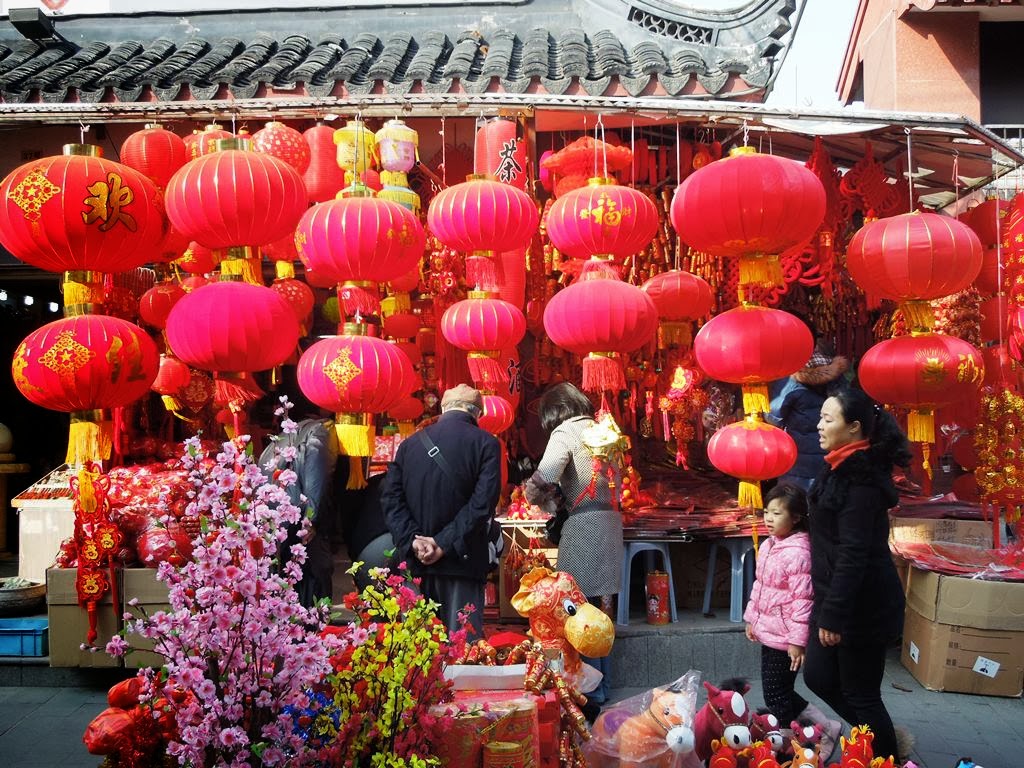

A shop stocked with items related to the Lunar New Year


An establishment selling kites and various other bric-à-brac


My wife insisted on us plunging into the chaos of the Yùyuán Bazaar, a maze of narrow lanes cluttered with souvenir shops and food stands (including such traditional Chinese fare as KFC and DQ). Pamela was in search of stinky tofu 臭豆腐, which she unfortunately found.


Spring festival decorations were in abundance. The bazaar will no doubt be even more of a zoo come the holiday period.
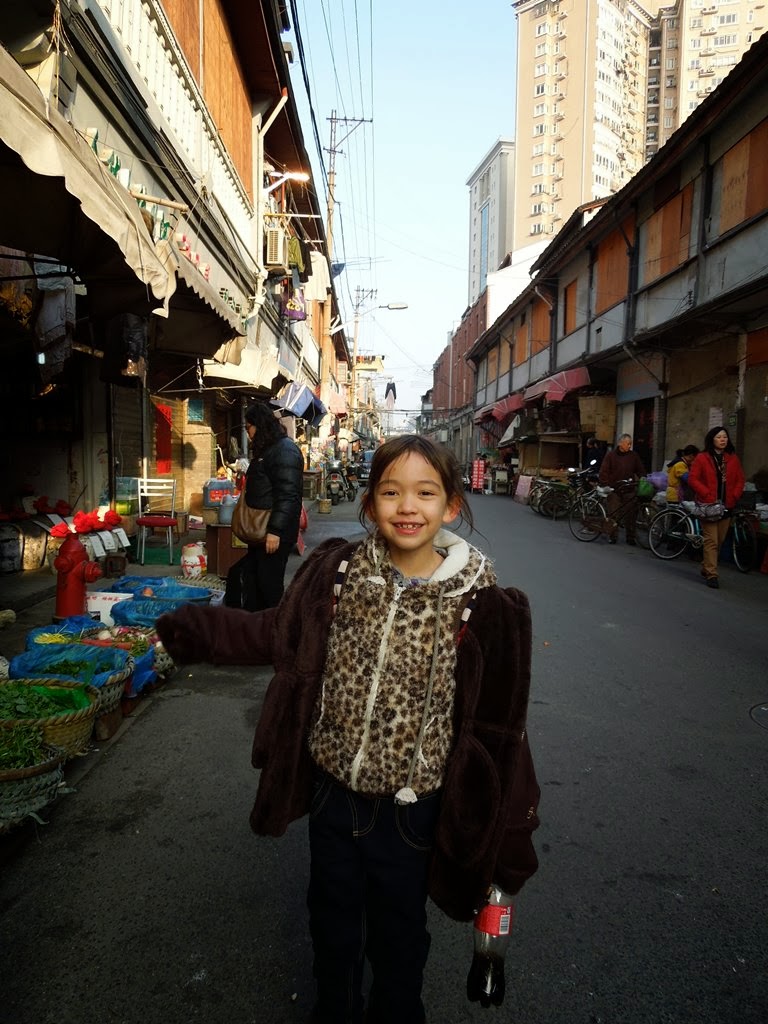

Leaving the Yu Gardens behind, we walked over to Dàjìng Lù 大镜路, one of those odoriferous, jumbled little streets that were no doubt ubiquitous in Shanghai not all that long ago. My wife hates walking down streets like this one, because it forces her to come face-to-face with a China she knows is still quite common, but which she would prefer to ignore, especially in a city like Shanghai, where China's new-found prosperity is so much in evidence.


Pamela did take an interest in the jars filled with traditional alcohol, but she chose to ignore all that laundry hanging overhead. 
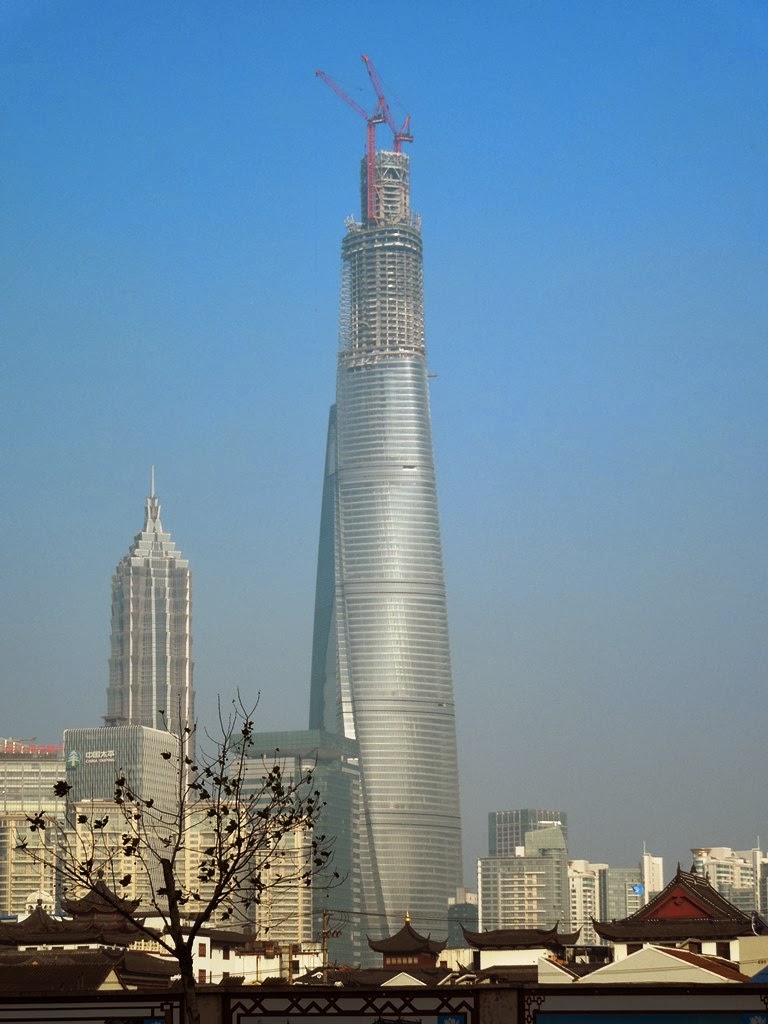

Time is running out for streets like Dajing Lu. Looming in the distance is the Shanghai Tower 上海中心大厦, due to be finished sometime this year, when it will stand 632 meters (2073 feet) high. The residents don't need to look so far, however - at the opposite end of the street, construction is nearing completion on what appears to be another high-priced condo complex.


Past the condos stands Báiyúnguān Temple 白云观


Unlike the nunnery, this Taoist temple was very active, with worshipers burning incense and colorfully-clad Taoist priests holding a noisy ceremony in the main hall while we were there.


"I see ya, you camera-toting foreign devil"


Bowing before a large statue of the Jade Emperor in the main hall


Big ass joss sticks


Like most old Chinese cities, Shanghai was once surrounded by a wall, one that stretched for five kilometers (3.1 miles) in length. Torn down in 1912, the only surviving section of the wall (erected in 1553) is found in the Dàjìng Pavilion 大镜阁, which dates from 1815. It sits next door to the Baiyunguan Temple. 


This dog taking a nap on Dajing Lu probably had no idea that just around the corner and a few hundred meters down the road, this sight (though, hopefully, not fate) would await him...


There, hanging among the sausage, the fish and other meats was hanging what the Taiwanese used to refer to as xiāngròu 香肉 "fragrant meat", a euphemism for when dining on man's best friend. Bon appétit!



Sunday, December 22, 2013

Soon it will be Christmas day...

My badge showing my affiliation with the Chinese Communist Party 中国共产党. I found it on the ground when we were at the Temple of Heaven Park 天坛公园 in Běi​jīng 北京 last week, and it's proudly adorned my backpack ever since.

Ring-a-ling and hear them sing, soon we'll be spending our first Christmas in Shàng​hǎi 上海. While there are some decorations to be seen about town (lights, trees etc.), it still takes some effort to get into the proper spirit of things. At least this Wednesday will be a day off from the consulate. Combined with my daughter being on winter vacation from school, the three of us will be together as a family all day long on the 25th. There will be presents under the tree come Wednesday morning as Santa will surely find a way to get in despite the lack of a chimney. Our friends at the public security bureau 公安局 can no doubt show St. Nick how it's done.


Amber in front of the Shanghai Grand Theater 上海大剧院. After several more smoggy days recently, we were blessed today with relatively clear skies. Behind the theater you can get a glimpse of Tomorrow Square 明天广场, which looms over the entire People's Square 人民广场 area. 


The Shanghai Art Museum  上海美术馆 is (was) located inside the clubhouse building of the former Shanghai racecourse, a venue for horse races built by the British in 1862. The racecourse was razed after the Second World War, and much of the former racetrack is now People's Park 人民公园. The clubhouse dates from 1933, and features a clock tower that was once nicknamed "Little Ben". It's another magnificent example of Shanghai's unique architectural heritage, but unfortunately the museum was closed this afternoon. Apparently, it's in the process of being moved to a new location. The old clubhouse still hosts an expensive restaurant on its top floor, so hopefully it will stick around.


People's Park is home to the Shanghai Museum of Contemporary Art  上海当代艺术馆 (currently hosting an exhibition of works by Japanese artist Yayoi Kusama 草間彌生. The long line of people waiting to get in was the main reason we gave it a pass today) and an Arabic-looking bar fronting a lotus pond. On weekends, the park is filled with parents and grandparents (and professional matchmakers) looking for spouses for their children and grandchildren (and clients). Printouts are displayed with all the important statistics - age, height and monthly income. Curiously, only a few have photos of the person. It's an interesting, sometimes amusing, scene from a sociocultural standpoint, but on a personal level it's somewhat disheartening to see so many souls seeking partners, and one wishes them all the best of luck in their searches.


The aforementioned Tomorrow Square. At any moment, I expected the top to open up and a rocket to blast off, like in a scene out of You Only Live Twice. 


Tomorrow Square is home to some very expensive apartments, as well as the five-star JW Marriott Hotel Shanghai at Tomorrow Square, the lobby of which is on the 38th floor.


From the lobby can be seen great views of People's Park down below


Looking down on the Shanghai Museum  上海博物馆


I'm sure it looks even better at night, but the hotel employees probably wouldn't take kindly to gawking tourists, unless the latter were willing to spring for overpriced cocktails.


Beside Tomorrow Square is a street called Jiāng​yīn Lù 江阴路, consisting of run-down buildings that have managed to resist the developers (so far). A number of pet shops line the road, dealing in critters ranging from rabbits and turtles to newts and salamanders.


When in Rome, buy a cricket and put it in a small cage


It's only a matter of time before our caged prisoner makes music...or else


Tuesday, December 17, 2013

#humblebrag in Beijing, Part 2: Going to heaven


Continued from yesterday's post...

Sunday was another cold but sunny day in Bĕjīng 北京. Having already visited the Forbidden City 紫禁城 and Tiān'ānmén Square 天安门广场 (and with my loved ones earlier having taken advantage of my needing to work by going to see the Great Wall 长城 without me), and with our time limited (we had an afternoon high-speed train bound for Shànghăi 上海 to catch), we (OK, I) made the decision to spend the morning in the Temple of Heaven Park 天坛公园, "(a) tranquil oasis of peace and methodical Confucian design in one of China's busiest urban landscapes", according to Lonely Planet's Discover China guide.


Like virtually all open urban spaces in China, the Temple of Heaven Park was full of people exercising, dancing and playing games (though the folks in the photo above were atypical in that whatever it was they were doing, it wasn't being done in unison). Still, the crowds were nothing like the hordes of the day before at the Forbidden City, with the result being that we had some relative elbow room while visiting some of the sites within the park.


The Round Altar 圜丘 was first constructed in 1530 and rebuilt two hundred years later. Made out of white marble and arranged in three tiers, the structure is dominated by the number nine, which is explained in detail in the link above. Suffice it to say, it all adds up if you're superstitious and Chinese. Being an altar, it was used for religious rites, especially for rain-making ceremonies conducted by the emperor in times of drought. 


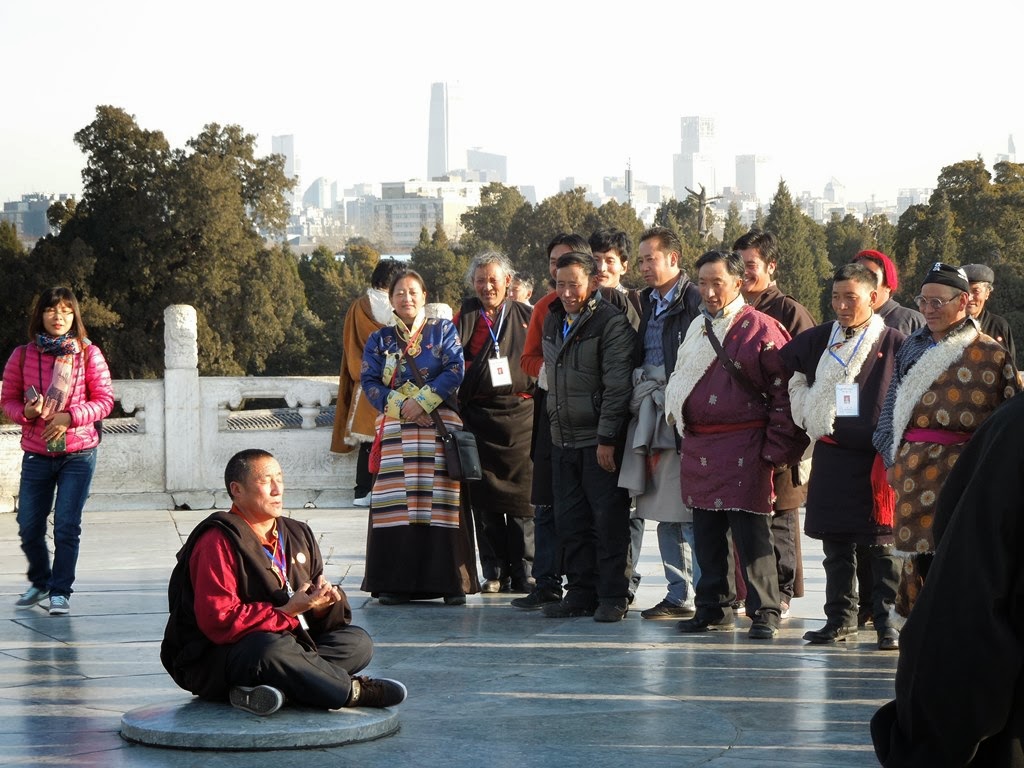
We were joined at the Round Altar by a tour group consisting of members of one of China's 54 officially recognized minority groups. The colorful native dress would no doubt have pleased the government, at least judging from this recent BBC article.


The presence of the tour group, however, made it very difficult to experience the altar's acoustic properties. One's voice supposedly is amplified when standing on the circular stone in the middle.


Behind the Round Altar was the Imperial Vault of Heaven 皇穹宇, the next place we visited (included on the through admission tickets we had purchased before entering the park).


This hall was built at the same time as the Round Altar. It's surrounded by the Echo Wall 回音臂, which is said to be able to carry a whisper from one person to another. 


The interior was used for winter solstice ceremonies. It contains tablets of imperial ancestors.


The approach to the third and final site we saw at the park, the Hall of Prayer for Good Harvests 祈年殿.


If the hall seems vaguely familiar, it's probably because you've seen pictures of it in guidebooks. Built in 1420 (and rebuilt in 1889 after burning down following a lightning strike), it's one of Beijing's most iconic structures.


"Look, Ma, I'm in China!"


The interior consists of wooden pillars supporting the ceiling without benefit of any nails. Speaking of the ceiling, it has a carving of a dragon, the imperial symbol.


A couple of small on-site museums explained the hall's purpose as a site for ritual sacrificial offerings and on the architectural features of the building.


And that was how we spent our last morning in Beijing. We rode the metro back to our hotel, retrieved our belongings, and then took a taxi to Beijing South Railway Station 北京南站. On the way, we passed by the China Central Television Headquarters, aka "Big Boxer Shorts" 大裤衩. 


The scenery from the train window was just as dreary going back to Shanghai as it was traveling up to Beijing, with some horrible smog partway through the trip. Fortunately for us, Beijing's notorious pollution wasn't much in evidence while we were there. A day-and-a-half for sightseeing (three-and-a-half for Amber and Pamela) wasn't enough to do the city justice, so I hope to have a chance to return before our time is over in China.