Sunday, January 26, 2014

Here Comes Dr. Sun


It's supposed to be the world's largest annual migration: the hundreds of millions of Chinese migrant workers who return to their hometowns before the onset of the Lunar New Year, aka the Spring Festival 春节, which this year begins on January 31. Things are supposedly peaking right about this time, but you wouldn't have known it judging the relative lack of crowds this Sunday afternoon at Shànghăi's 上海 main railway station  上海火车站.


I went there hoping to see and photograph the immense numbers of people I was expecting to find lined up outside the station. Instead, the expansive plazas (Chinese city planners love huge, open spaces) on both the northern and southern sides of the train station were relatively empty. Even the lines at the ticket window were not very long. Sure, there were plenty of people pushing themselves and their belongings through the ticket gates, but the scene wasn't even remotely like the news images I had seen in recent years of the sea of humanity attempting to return home in what for many is the only chance they'll have all year to see the families and hometowns. Either I was too early or too late, or the authorities have gotten better about scheduling additional trains to handle the passenger loads.


From the Shanghai Railway Station, I made my way (alone, as my daughter was at home recovering from a cold and my wife wanted to rest) via the Metro to the French Concession area 法租界, one of Shanghai's nicer districts. From the Xīntiāndì Metro station 新天地站, it was a ten-minute walk to Fùxīng Park 复兴公园. Laid out by the French in 1909, it's one of the city's more pleasant green spaces.


Throughout the park, groups of old men could be seen playing card and board games...


...while a handful of elderly people were still doing tai chi exercises 太極拳, even in the middle of the afternoon.


The Chinese parasol trees 梧桐 were looking barren in the winter air, but in the heat of a sweltering Shanghai summer, they're no doubt a welcome sight.


Today was an ideal day for kite-flying, a popular activity in China


Nobody was paying any attention to the fathers of Communism


I'd assumed these groups of men were intent on watching some sort of Chinese version of chess, but in fact they were engaged in discussion amongst each other. A bystander told me they were "complaining about the Communist Party."


Reading newspapers posted on reading boards, in a scene that probably was a lot more common in the past than in this day and age of the Internet (even one that is heavily censored behind the Great Chinese Firewall).


The 1933 St. Nicholas Church 圣尼古拉斯教堂 is a short walk from the west gate of Fuxing Park. It started out as a Russian Orthodox house of worship, before morphing into a washing machine factory and then a French restaurant. It now houses Kinloch, a "Scottish cafe". 


Also close to Fuxing Park is the Former Residence of Sun Yatsen 孙中山故居, consisting of the Shanghai home of the "Father of the Country" and "forerunner of democratic revolution" (top) and a museum dedicated to the time he spent in the city and as the president of the Republic of China 中华民国 (bottom).


Dr. Sun Yat-sen 孙中山. Considered a great hero in both China and Taiwan, he was the first president and founding father of the R.O.C., and author of The Three Principles of the People 民族主义, a work of political philosophy as much fun to read as Das Kapital. Truth be told, although he had long worked toward the overthrow of China's imperial system, the 1911 Wŭchāng Uprising 武昌起义 caught him unprepared. His tenure as the country's first republican president was less-than-successful, as he was soon pushed aside by Yuán Shìkăi 袁世凱, who briefly made himself emperor before dying in 1916. Even with Yuan out of the way, Sun was never able to see his vision of a modern Chinese state realized, due to in large part to opposition from warlords. Following his death in 1925, Sun's Kuomintang party 国民党 was taken over by Chiang Kai-shek 将中正, who led it down an increasingly authoritarian, corrupt path that resulted in defeat at the hands of the Chinese Communist Party 中国共产党 forces and a hasty retreat to Taiwan.


Photography wasn't allowed in this national shrine. Sun's home, especially, is considered sacred ground where plastic covers have to be placed over your shoes before you're allowed to venture inside and have a look at what is a fine example of an affluent family's house in Shanghai in the early years of the 20th century. The museum next-door has some interesting displays, including Sun's uniform as well as a mini-revolver that he carried on his person. The English captions, however, assume that Western visitors are already familiar with this period in Chinese history and that there's no need to go into any background or give the items and photographs any sort of context.


From the Nationalists to the Communists: down Sīnán Road 思南路 from the Sun residence is a house that was briefly occupied back in 1946 by none other than Zhōu Ēnlái. Photography isn't allowed inside here, either, though the bare room decorations ensure that you aren't missing much by not being able to do so. The house has a terrace in the back with rattan chairs that gives it some colonial atmosphere, somewhat ironic considering the former occupant.


Next door, there's a small but pleasant garden, and an adjoining building that manages to overcome the dull (Communist) party-themed displays on the ground floor.


Zhou is still looked upon favorably by many Chinese, as he was seen as being more moderate and pragmatic than Máo Zédōng 毛泽东. That being the case, you don't survive as long as Zhou did in the eat-your-young world of internal CCP political machinations without making a number of morally questionable compromises, and Zhou shares at least some of the blame for the tens of millions of Chinese who perished under the idiocies that were the Great Leap Forward 大跃进 and the Cultural Revolution 文化大革命.


The neighborhood where Sun and Zhou lived is still filled with Western-style buildings from that era, including the house across the street from Zhou's that was used as a KMT outpost to spy on him. It's great to see the houses being lived in, though at least one had poles sticking out from the side with laundry hanging from it. This being Shanghai, there has to be at least one horribly-pretentious commercial/residential district, patronized by the city's nouveau riche and homesick expats. In this case, it's called Sinan Mansions, located halfway between the Nationalists (the Sun residence) and the Communists (the Zhou residence). Much like modern-day China, you might say...








Sunday, January 19, 2014

Get we to a nunnery


The Year of the Horse is almost upon us as we prepare to spend our first Lunar New Year 春节 here in Shànghăi 上海. It's a festive time of the year that I've never looked forward to celebrating, because while it's of great importance for Chinese reuniting with their families, it's also likely to be (based on past Taiwan experience) a cacophonous din of exploding firecrackers, not to mention densely packed roads, trains and subways, sightseeing spots overrun with pushing, shoving hordes and price-gouging on the part of hotels and restaurants. The hotel part I can only assume because we have no choice this year but to stay within in the city as I will have the "pleasure" of being the duty officer during the Spring Festival - if you know of any American citizen friends, relatives or acquaintances living within the greater Shanghai metropolitan area, please be sure to remind them that this will be a great time of year to leave the city (the further away from Shanghai, the better!).


Here at our home, we're trying to get into the spirit of things. The Christmas tree has been taken down, and in its place stands a wintersweet, known in Chinese as a làméi 腊梅, which blooms at this time of year and therefore holds some sort of significance the meaning of which my spouse is utterly unable to get across to her barbarian husband (because she herself doesn't know the reason why). The lunar new year's eve falls on January 30 this year, and our holiday break will stretch from the 31st to February 4.


Speaking of holidays, tomorrow is Martin Luther King, Jr. Day, which means I get the day off from work (though my daughter still has to go to school). Today, the three of us stepped out into the cold to do some sightseeing, an activity we haven't done as a family unit in quite some time (though Pamela has been busy the past few weeks entertaining visitors from Taiwan). We headed this afternoon to the Old City 老成 area, always busy on the weekends but especially so at this time of year, with the Lantern Festival 元宵节 as well as the new year fast approaching. Lunch was had in a small hole-in-the-wall restaurant located down a short, narrow alley and consisted of beef noodles, green vegetables and the above-pictured niángāo 年糕, aka "New Year cake". Made of steamed glutinous rice, it had a texture similar to that of mochi 餅.


Amber poses with a giant gourd outside the restaurant. We were in the vicinity of Yù Garden 豫园, one of Shanghai's most popular tourist attractions (especially the surrounding bazaar), but today our destination was somewhere a little different. 


A short walk to the west of the gardens lies the Chénxiānggé Nunnery 沉香阁. Temples are plentiful in Taiwan, but houses of worship are comparatively fewer and far between in Shanghai. 


Photography wasn't allowed inside the buildings, but we did visit the Hall of Heavenly Kings 天王殿, the Great Treasure Hall (pictured above) 大雄宝殿 and the Guānyīn Tower, which contained an androgynous image of the Buddhist Goddess of Mercy (and where one of the resident nuns gave my daughter an apple). 


Among the items for sale on the street outside the nunnery, you could purchase a small figurine of Máo Zédōng 毛泽东, in which the Great Helmsman comes off looking more like the Great Gardener.


A shop stocked with items related to the Lunar New Year


An establishment selling kites and various other bric-à-brac


My wife insisted on us plunging into the chaos of the Yùyuán Bazaar, a maze of narrow lanes cluttered with souvenir shops and food stands (including such traditional Chinese fare as KFC and DQ). Pamela was in search of stinky tofu 臭豆腐, which she unfortunately found.


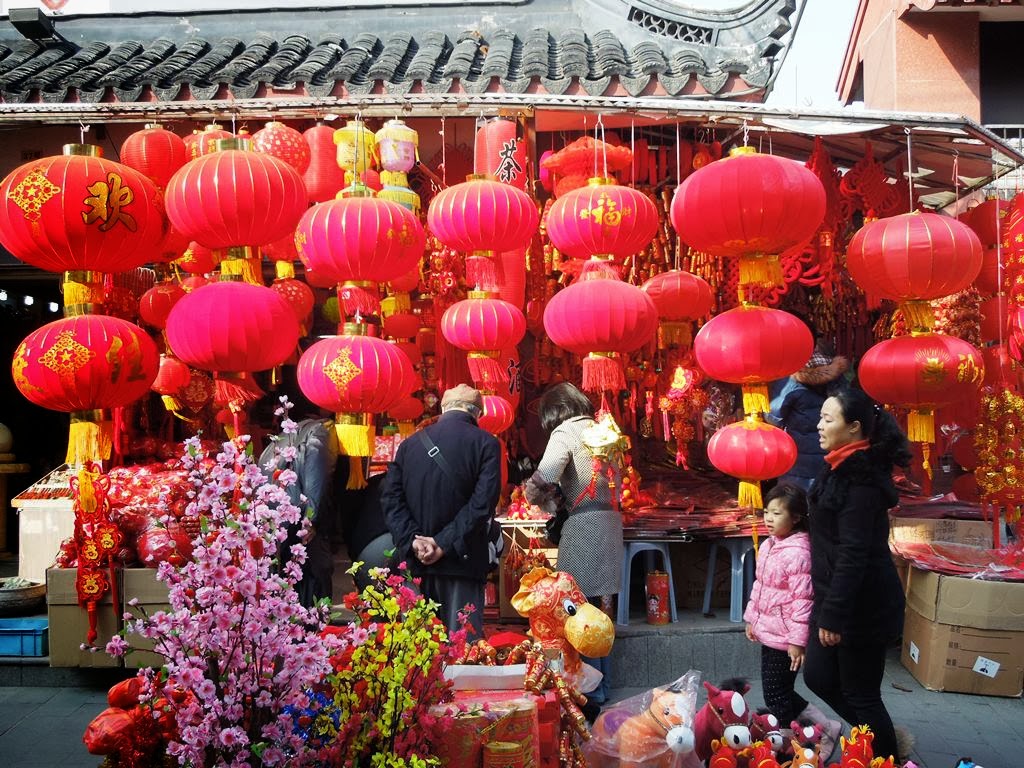
Spring festival decorations were in abundance. The bazaar will no doubt be even more of a zoo come the holiday period.


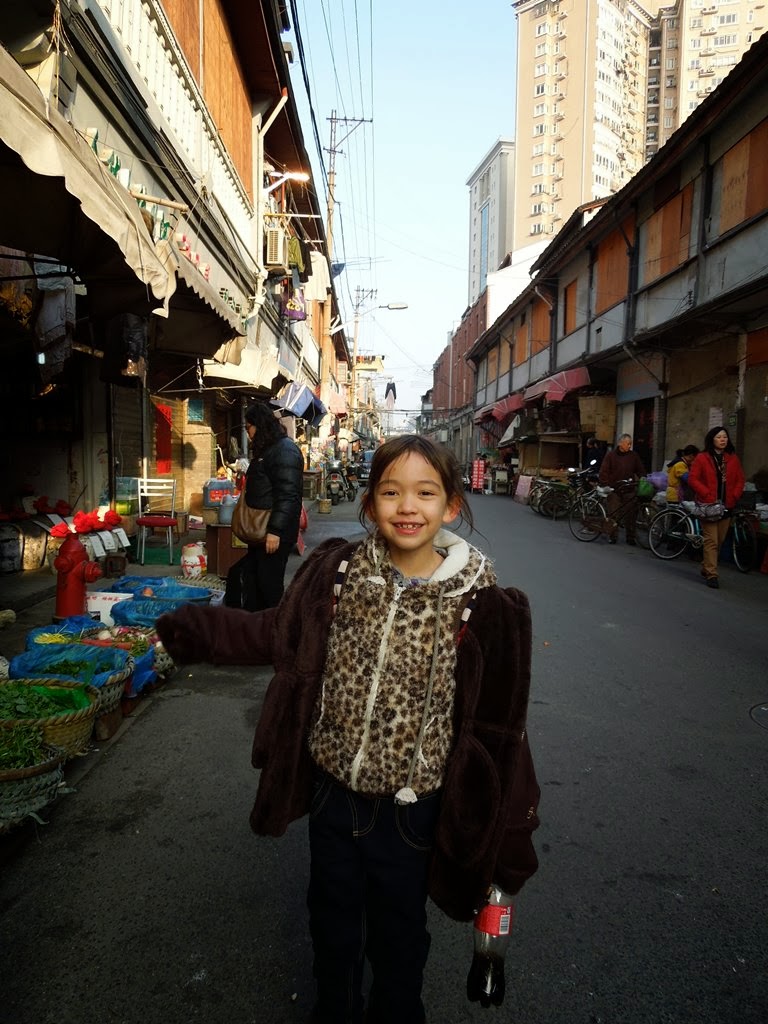
Leaving the Yu Gardens behind, we walked over to Dàjìng Lù 大镜路, one of those odoriferous, jumbled little streets that were no doubt ubiquitous in Shanghai not all that long ago. My wife hates walking down streets like this one, because it forces her to come face-to-face with a China she knows is still quite common, but which she would prefer to ignore, especially in a city like Shanghai, where China's new-found prosperity is so much in evidence.


Pamela did take an interest in the jars filled with traditional alcohol, but she chose to ignore all that laundry hanging overhead. 


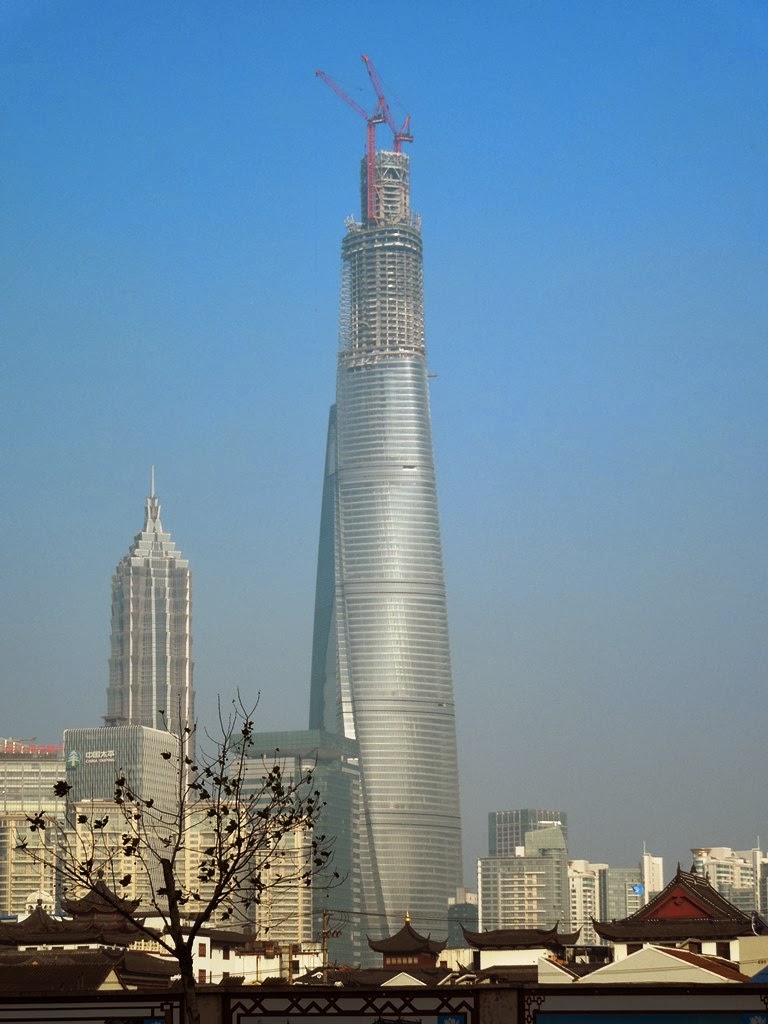
Time is running out for streets like Dajing Lu. Looming in the distance is the Shanghai Tower 上海中心大厦, due to be finished sometime this year, when it will stand 632 meters (2073 feet) high. The residents don't need to look so far, however - at the opposite end of the street, construction is nearing completion on what appears to be another high-priced condo complex.


Past the condos stands Báiyúnguān Temple 白云观


Unlike the nunnery, this Taoist temple was very active, with worshipers burning incense and colorfully-clad Taoist priests holding a noisy ceremony in the main hall while we were there.


"I see ya, you camera-toting foreign devil"


Bowing before a large statue of the Jade Emperor in the main hall


Big ass joss sticks


Like most old Chinese cities, Shanghai was once surrounded by a wall, one that stretched for five kilometers (3.1 miles) in length. Torn down in 1912, the only surviving section of the wall (erected in 1553) is found in the Dàjìng Pavilion 大镜阁, which dates from 1815. It sits next door to the Baiyunguan Temple. 


This dog taking a nap on Dajing Lu probably had no idea that just around the corner and a few hundred meters down the road, this sight (though, hopefully, not fate) would await him...


There, hanging among the sausage, the fish and other meats was hanging what the Taiwanese used to refer to as xiāngròu 香肉 "fragrant meat", a euphemism for when dining on man's best friend. Bon appétit!


Sunday, December 22, 2013

Soon it will be Christmas day...

My badge showing my affiliation with the Chinese Communist Party 中国共产党. I found it on the ground when we were at the Temple of Heaven Park 天坛公园 in Běi​jīng 北京 last week, and it's proudly adorned my backpack ever since.

Ring-a-ling and hear them sing, soon we'll be spending our first Christmas in Shàng​hǎi 上海. While there are some decorations to be seen about town (lights, trees etc.), it still takes some effort to get into the proper spirit of things. At least this Wednesday will be a day off from the consulate. Combined with my daughter being on winter vacation from school, the three of us will be together as a family all day long on the 25th. There will be presents under the tree come Wednesday morning as Santa will surely find a way to get in despite the lack of a chimney. Our friends at the public security bureau 公安局 can no doubt show St. Nick how it's done.


Amber in front of the Shanghai Grand Theater 上海大剧院. After several more smoggy days recently, we were blessed today with relatively clear skies. Behind the theater you can get a glimpse of Tomorrow Square 明天广场, which looms over the entire People's Square 人民广场 area. 


The Shanghai Art Museum  上海美术馆 is (was) located inside the clubhouse building of the former Shanghai racecourse, a venue for horse races built by the British in 1862. The racecourse was razed after the Second World War, and much of the former racetrack is now People's Park 人民公园. The clubhouse dates from 1933, and features a clock tower that was once nicknamed "Little Ben". It's another magnificent example of Shanghai's unique architectural heritage, but unfortunately the museum was closed this afternoon. Apparently, it's in the process of being moved to a new location. The old clubhouse still hosts an expensive restaurant on its top floor, so hopefully it will stick around.


People's Park is home to the Shanghai Museum of Contemporary Art  上海当代艺术馆 (currently hosting an exhibition of works by Japanese artist Yayoi Kusama 草間彌生. The long line of people waiting to get in was the main reason we gave it a pass today) and an Arabic-looking bar fronting a lotus pond. On weekends, the park is filled with parents and grandparents (and professional matchmakers) looking for spouses for their children and grandchildren (and clients). Printouts are displayed with all the important statistics - age, height and monthly income. Curiously, only a few have photos of the person. It's an interesting, sometimes amusing, scene from a sociocultural standpoint, but on a personal level it's somewhat disheartening to see so many souls seeking partners, and one wishes them all the best of luck in their searches.


The aforementioned Tomorrow Square. At any moment, I expected the top to open up and a rocket to blast off, like in a scene out of You Only Live Twice. 


Tomorrow Square is home to some very expensive apartments, as well as the five-star JW Marriott Hotel Shanghai at Tomorrow Square, the lobby of which is on the 38th floor.


From the lobby can be seen great views of People's Park down below


Looking down on the Shanghai Museum  上海博物馆


I'm sure it looks even better at night, but the hotel employees probably wouldn't take kindly to gawking tourists, unless the latter were willing to spring for overpriced cocktails.


Beside Tomorrow Square is a street called Jiāng​yīn Lù 江阴路, consisting of run-down buildings that have managed to resist the developers (so far). A number of pet shops line the road, dealing in critters ranging from rabbits and turtles to newts and salamanders.


When in Rome, buy a cricket and put it in a small cage


It's only a matter of time before our caged prisoner makes music...or else