Saturday, April 5, 2014

Guilin and Yangshuo: Day 1

I've never been bitten by the China bug, but one place in this vast country that has always interested me has been the scroll painting-like mountain scenery of Guìlín 桂林. Even if the name isn't familiar, you've no doubt seen the pictures of mountainous spires jutting straight up out of a landscape dotted with rice paddies. And for the next few blog entries, that is exactly what you're going to see here as well, for the Kaminoge family took advantage of our daughter's spring break from school this past week to fly from Shànghăi  上海 to Guilin in the southwestern province of Guăngxī 广西 in order to soak up some atmosphere and do some serious sightseeing.

Guilin is just over two hours by air from Shanghai. Things got off to a rocky start, however, while we sat in the plane on the tarmac for over an hour, waiting for clearance for take-off. Such delays are common in China, as the country's paranoid military authorities severely restrict the airspace available for civil aviation purposes, with the result being that civilian flights start getting backed up as the day progresses. Once in the air, our flight was rocked by turbulence almost the entire way to Guilin. Then, back again on solid ground, our taxi driver pulled away from the curb before I'd gotten into the cab, with the right rear tire actually running over part of my foot. Fortunately, nothing was damaged, but it was a scare. We eventually arrived at our accommodation, the Guilin Riverside Hostel 九龙商务旅游酒店, in one piece. The Riverside Hostel was our home for the first three nights of our trip. With a nice location next to the Táohuā River 桃花江, English-speaking staff, tour-booking services, Western-style breakfasts and a small but comfortable, wood-floored room, this inn is justifiably popular with foreign travelers. So naturally my wife, who prefers staying in the kind of concrete and linoleum hotels popular with Chinese tour groups, was a little disappointed with our lodgings. 


Once checked in, we set out to explore the city. Guilin has a population of 4.7 million, but its downtown area, though lively, is somewhat small. Walking along the main drag, Zhōngshān Middle Road 中山中路, the atmosphere was not unlike that found in southern Taiwan, with the street scene evoking images of Kaohsiung 高雄 or Kenting 墾丁 (minus the latter's proximity to the ocean, of course). Pamela, getting hungry, stopped to buy some kebabs from a street stall:


The pedestrian-only Zhèngyáng Lù 正阳路 was where we eventually found a restaurant to sample some local dishes. First up was Guilin rice noodles 桂林米粉, which I found to be lacking in flavor, and which Amber was shocked to learn contained horse meat (specifically, the bowl on the right. We could've ordered some with more standard fare like beef or pork, but I want my daughter to experience new things, even if we didn't tell her it was horse until after she had eaten some. Dog meat is also widely available in this part of China, and Amber was constantly worried that my wife and I were going to spring a canine surprise on her at meal times. Don't worry - we didn't):


Another local specialty we sampled was Guilin snails 桂林田螺, which were quite tasty. My daughter wouldn't eat these, but did enjoy using a toothpick to pry the meat from the shells:


Guilin would prove to be a typically dirty and dusty Chinese city in the daytime, but at night parts of it are very attractive, such as the Sun and Moon Twin Pagodas 日月双塔 located on Shān Lake 杉湖:


As we made our way back to the Riverside Hostel, sightseeing boats plied the waterways around central Guilin:


The first day might've been brief, but we were to keep ourselves pleasantly busy in the days to come...


Saturday, March 15, 2014

Crowd control

Spring is on its way...

When you live in a city that has an official population of 23,710,000, you're going to have put up with crowds every now and then. Like this afternoon, for example, when the family and I took the Metro to People's Square 人民广场 for the purpose of visiting the Shànghăi Museum of Contemporary Art 上海当代艺术馆.


Getting through People's Park 人民公园 proved to be the first of several obstacle courses we would encounter today. In this case, it was the Shanghai marriage market - every weekend, parents and grandparents converge on the public space to list marriage advertisements extolling the attributes (height, education, income etc.) of their children and grandchildren in hopes of finding suitable partners.The only information missing from most of the posters was photographs of the potential cosmic soul mates.


The point of our going to MOCA Shanghai was to see the current exhibition there, A dream I dreamed, an exhibit of some of the works of the Japanese artist and writer Yayoi Kusama 草間弥生. I figured my daughter would enjoy the pop art aspects of Kusama's work, but upon arrival we were faced with a long line of people standing outside, waiting to get in. I had hoped that with this current retrospective coming to an end in two weeks' time after a 3½-month run, and with a major Monet show having just rolled into town, it would've been easy to get into MOCA. Guess I'd figured wrong.


Seeing as we didn't have tickets for the MOCA exhibition and being unable to locate any box offices, we decided not to wait around but to try our luck somewhere else. That somewhere else turned out to be the Pŭdōng 浦东 area, where a short taxi ride from People's Park had us soon lined up, waiting to get to the top of Shanghai's fascinatingly hideous icon, the Oriental Pearl TV Tower 东方明珠广播电视塔. Did I say "wait"? It took us roughly 90 minutes from the time we purchased our exorbitantly-priced tickets to when we finally reached the highest of the three observatories inside the 468 meter (1535 feet)-high tower. 


The "Space Capsule" sightseeing floor at 351 meters (1152 feet) was a classic tourist trap. The location of the afternoon sun prevented any decent photos of Shanghai's iconic Bund 外滩 waterfront from being taken, but the views were pretty impressive despite the haze, especially of the other buildings making up the Pudong skyline. In the photo above, you can see the Shanghai World Financial Center 上海环球金融中心, looking like a giant bottle opener; the Chrysler Building-resembling Jīnmào Tower  金茂大厦; and the soon-to-be-completed Shanghai Tower  上海大厦中心, which was recently scaled by a Russian and a Ukrainian, who naturally posted their bowel-cleansing video onto YouTube.


Far down below on the Huángpŭ River 黄浦江, two tugboats made quick work of getting a large passenger liner turned around and pointed in the direction of the ocean. 


Considering the cost and the long wait it took to get to the top, I was thinking it had been a mistake to have paid to have gone to the highest observatory (the Oriental Pearl TV Tower has a byzantine ticket-pricing system based on which of the three observation floors you choose to visit, along with incidentals like a revolving restaurant), but when we ventured down the to the sightseeing floor at 263 meters (863 feet), I felt a little exonerated. True, the Bund was easier to make out at this lower height...


...and the views in the other directions weren't bad, either...


...but as the look on Amber's face attests, there were a lot more people to deal with on the lower and cheaper level. Tired families sitting down in front of the windows meant it was difficult in places to get a good look at the world on the other side of the glass.


I was leery and my daughter was afraid, but my wife at least enjoyed the Transparent Observatory, looking down from 259 meters (850 feet) above the ground.


Our admission tickets also included entry to the excellent Shanghai History Museum  上海城市历史发展陈列馆, located at ground level. I had visited on Labor Day last year, but this was the first time for Amber and Pamela. Among the many things we learned was that Communists weren't capable of turning out anything but ugly passenger cars, as the 1950's-era Shanghai and Fénghuáng (Phoenix) 风凰 Sedans pictured above so painfully make clear.


An example of a palanquin used in traditional wedding ceremonies. The most interesting exhibits, of course, were those related to Shanghai's period as a treaty port controlled by foreign powers. The captions accompanying some of the displays referred to the sense of national humiliation and semi-colonization that China underwent following its defeat at the hands of the British during the first Opium War of 1840-1842, feelings that are constantly being reinforced through officially-approved popular media (along with rabid anti-Japanese sentiment, of course). Still, while I can understand how the Chinese might feel about this period in their history, it's hard to feel sympathy for a Han Chinese-dominated empire that was created over the centuries by subjugating and dominating their neighbors in ways similar to how the Western imperialist powers imposed themselves in places like Shanghai up until the end of the Second World War. 


Official narratives aside, the Shanghai History Museum does a very good job at presenting tableaux giving an idea of what life in the city was like in the time before the city's "liberation"...


...including opium dens and houses of prostitution. 


Back at ground level, the lights of the city were starting to come on as dusk fell. 


Dinner at Yoshinoya 吉野家, located on the 8th floor of the huge Superbrand Mall. My daughter shows off a box of chocolates we purchased on our way of out of the Oriental Pearl TV Tower. We had been successful in running the gauntlet of souvenir shops as you make your way out of the tower after having visited the observatories, but our willpower had been seriously weakened by the time we reached the chocolate stand, the last shop encountered before returning to the outside world. Resistance proved to be futile.


The Oriental Pearl TV Tower - overpriced, crowded, touristy and just plain ridiculous to look at, but if you're going to be spending any time at all in Shanghai, it's hard to avoid its siren call. 


Sunday, March 9, 2014

Red, I'm seeing red

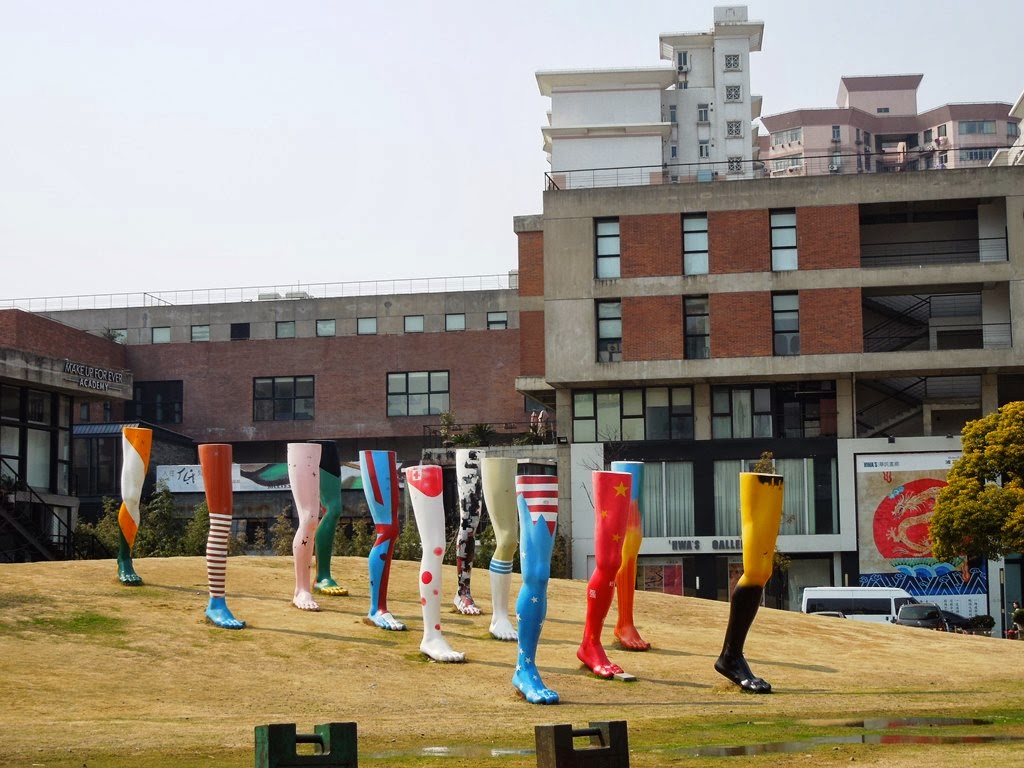
My daughter frolics among some sculptures just outside the No. 4 exit from Hóngqiáo Road Station 虹桥路站. 


Red Town 红坊国际文化艺术社区 is one of those art spaces converted from former industrial sites that you can find in urban areas throughout North America, Europe and the rest of the developed world as their economies struggle to cope with the transition into a post-manufacturing era. That process is apparently underway as well in China's wealthier metropolises such as Shànghăi 上海, as the city's factories relocate to the suburbs and beyond in order to make way for condos, shopping malls and all the other trappings of affluence. Red Town is a short hop on the Metro from where we live, and the relatively clear skies made it a fun afternoon for us (and Amber, in particular) to check out the outdoor sculptures:


Catching up on the news in the Shanghai Daily with the architect of China's Reform and Opening. Ladies and gentlemen, boys and girls, give it up for Mr. Dèng Xiăopíng  邓小平!:


The former Shanghai No. 10 Steel factory which used to operate on this site is now home to a sculpture gallery containing several interesting pieces. There's also an onsite bookstore where I ended up purchasing a book on Chinese propaganda posters, which includes such timeless classics as Long live the revolutionary and comradely friendship between the Parties and peoples of China and Albania! and Learn from Comrade Lei Feng:


The Shanghai Sculpture Space 上海城市雕塑艺术中心 is free, as are the various other galleries located in Red Town. Enclaves such as these are welcome additions to China's vast concrete conurbations, but after getting home later this afternoon, I went out for a walk and a dose of reality. Just a few blocks from the gated expatriate oases that populate our area are neighborhoods that have somehow missed out on the opening up of the Chinese economy. Housing stock there is crumbling, while laundry poles and lines protrude from and between buildings. Hand-pulled carts and electrified bikes outnumber automobiles. Businesses and people spill out onto the broken sidewalks. Piles of debris are everywhere, signs that the developers are beginning to move into these areas as well, and it's only a matter of time before the residents are bought out and sent off to the suburbs (or back to their home provinces). Some of the knocked-down homes still show signs of being occupied, and in a couple of them, people are still doing business. The class struggle is over, but the results are not what the artists and slogan writers behind the propaganda posters expected back in the 1950's and 1960's.