Wednesday, December 2, 2015

The Big Gotham


It had been a long time since my last trip to New York. How long had it been? The last time I was there (coincidentally my first visit as well), I stayed with a friend at his apartment on Atlantic Avenue in Brooklyn. One of the nights I was there, he and I, plus his Japanese girlfriend, were among the 76 million people watching the final episode of Seinfeld. That's how long it had been (and my friend, sadly, is no longer with us), and another trip was long overdue. 

With the Thanksgiving holiday providing for a four-day weekend (not to mention a badly-needed break from the ordeal of learning Russian grammar rules), the time seemed right for a second visit to America's biggest city, this time with my wife and daughter in tow. So on the morning of Thanksgiving Day, the three of us took the Amtrak Northeast Regional train from Alexandria, headed toward Penn Station:


It was the first time for me to ride on a passenger train in the U.S. since I was about my daughter's age. Though the lack of assigned seats was a potential source of anxiety (though we were able to find some upon boarding), and despite the sometimes-grim scenery as the train made its way through some depressed areas around Baltimore and Philadelphia, it was an enjoyable way to travel. We reached Penn Station roughly on time, and took the subway to 79th Street, the closest stop to our hotel. After checking in, we searched for an open restaurant in order to have dinner. Most places were closed for the holiday, while many of the others were packed with diners, but we did find an open table at a bar and grill on Amsterdam Avenue and West 76th Street. Happy Thanksgiving:


We stayed three nights at the Lucerne Hotel on West 79th Street:


The sightseeing began in earnest on Friday, as the three of us took the subway to South Ferry, then caught the, um, ferry to Liberty Island. The iconic Manhattan skyline as seen from the boat:


The first time I was in New York, I rode the Staten Island Ferry for the free view of the Statue of Liberty as the boat passed by. This time Amber, Pamela and I got off the ferry at Liberty Island and walked toward the statue:


Like so many things in New York, the Statue of Liberty is instantly familiar, yet still nonetheless impressive as we walked around the colossal sculpture:


Seeing Liberty Enlightening the World in the flesh (so to speak) was a poignant reminder of the ideals this nation supposedly stands for, a message particularly relevant in the current political climate of Donald Trump, Ted Cruz and other anti-immigrant demagogues:


Perhaps our friends on the rabid right should pay a visit to Ellis Island, for a refresher course on American civics and a reminder of who actually built this country (after it had been seized from its original inhabitants, of course):


12 million immigrants passed through Ellis Island between 1892 and 1954, lured by the promise of starting new lives in a new land. The Immigration Museum, housed in the Main Building, does an excellent job of explaining the history of immigration to the United States, as well as on the particulars of the immigrant experience at Ellis Island. To its credit, the displays do not shy away from the darker side of that experience and history:


Immigrants were processed in the Great Hall, though to the best of my knowledge none of my ancestors passed through here (though my father says his grandmother immigrated from Ireland to New York in the 1880's). It's possible that someone on my paternal grandmother's side of the family lived in North Carolina before the American Revolution (moving to Canada afterward, which strongly suggests they were Loyalists); my grandfather's American lineage isn't clear at all:


Having seen the Statue of Liberty and Ellis Island, we returned by ferry to Battery Park, then walked up Broadway toward the Financial District. On the way we passed by the famous Charging Bull bronze sculpture, surrounded by a throng of tourists waiting to have their pictures taken with it:


Trinity Church stands near the intersection of Wall Street and Broadway. According to Wikipedia: During the September 11, 2001 attacks, as the 1st Tower collapsed, people took refuge from the massive debris cloud inside the church. Falling wreckage from the collapsing tower knocked over a giant sycamore tree that had stood for nearly a century in the churchyard of St. Paul's Chapel, which is part of Trinity Church's parish and is located several blocks north of Trinity Church. Sculptor Steve Tobin used its roots as the base for a bronze sculpture that stands next to the church today:


The burial grounds of the church are home to the remains of luminaries such as Robert Fulton and Alexander Hamilton:


There was a heavy police presence in New York in the aftermath of the Paris attacks. Wall Street was one of those places with especially stringent security, preventing people from walking up to the entrance of the New York Stock Exchange. On the other hand, with so many police officers around, getting directions was an easy matter:


Across from the Stock Exchange stands Federal Hall. Again, quoting Wikipedia: 

Federal Hall, built in 1700 as New York's City Hall, later served as the first capitol building of the United States of America under the Constitution, as well as the site of George Washington's inauguration as the first President of the United States. It was also where the United States Bill of Rights was introduced in the First Congress. The building was demolished in 1812.  Federal Hall National Memorial was built in 1842 as the United States Custom House, on the site of the old Federal Hall on Wall Street, and later served as a sub-Treasury building. It is now operated by the National Park Service as a national memorial commemorating the historic events that occurred there.

Inside the memorial are exhibits, including the Bible used by Washington to swear his oath of office:


The Father of His Country stands in bronze outside the memorial:


Back on the subway, going from Wall Street to 34th Street-Penn Station. Much has been written as to how New York's subway trains are a microcosm of the city's diversified population. Cliched, perhaps, but also true:


Macy's Herald Square, the flagship store of the Macy's chain. The famous Thanksgiving Day Parade took place the previous day, but was over by the time we arrived in the city:


Amber gives a hint as to our final destination on this Friday:


The Empire State Building, the world's tallest building from 1931 to 1970 and arguably still the most famous skyscraper in the world, reaching a height of 1454 feet (443 meters). I visited the site of King Kong's last stand in the morning during my first trip to New York in 1998. This time the family and I took the elevator up to the 86th floor observatory as the sun began to set:


The view of the night lights of New York was stunning from the 102nd floor:


We finished our day with dinner at the Heartland Brewery at Fifth Avenue and 34th Street, where the Voyage Sampler of eight 5-ounce house brews proved to be the perfect way to cap off the evening:


Cheers! (To be continued...)


Monday, November 23, 2015

Trouble in paradise: "I'm shocked, shocked to find that gambling is going on in here!"


It's already old news, but for a while in the Taiwan-centric blogosphere, the viral video of a Taiwanese lout verbally harassing a British man and his Taiwanese girlfriend on the Taipei metro, was the only news that mattered, getting posted and re-posted, and commented upon, to the point where I didn't even need to sit through the entire 14-minute video to know what was going on. The incident didn't surprise me in the least, as I've always been aware that racism is deeply embedded in Taiwanese society. Taiwan is a multi-ethnic society in which the "ethnic card" gets frequently played in local politics. Many times in my classes when I was teaching there I would have adults make statements about members of the Hakka community or aboriginal groups in terms that would definitely be considered politically incorrect in the West. The flipside of the obsession with having pale, white skin (as reflected in the numerous TV ads for skin-whitening products) is a denigrating attitude towards those Taiwanese with darker complexions, many of whom live in the southern part of the island. And, of course, there is a deep-rooted xenophobia, as referred to in the BBC article which I've linked above.


For me, Taiwan was a place where people were constantly remarking on my very existence in their presences, and often not in a complimentary manner. I don't know how many times I would hear the expression "big nose" in the Taiwanese dialect, which people would often use knowing that very few foreigners could understand the local language. The supposed "kindness" shown toward big noses that so many Western residents seem to revel in for me smacked of a not-too-subtle reminder that I was always going to be on the outside, no matter how long I'd been living there or the fact that I had married a local woman and had a bi-cultural child. And speaking of my daughter, despite the fact she is an R.O.C. citizen and fluent Mandarin speaker, she was often referred to as being "foreign" (even by her own grandmother, though not meant in an insulting manner) - fortunately, she was too young at that time to understand what people were really saying.


Reading the BBC article, I was particularly bemused by the Taiwanese woman referring to so-called "white privilege". While I wish women had been flocking to me (they weren't), all that "power" I supposedly had didn't stop people from laughing about me while I was standing in front of them, let alone the woman who tried to sue me by making false hit-and-run accusations (thank god for CCTV cameras at traffic intersections!). Then there is the common knee-jerk reaction to accusations of discrimination and racism in Taiwan by pointing out examples of such against Taiwanese in Western countries. A comparison I find humorous, for not only is it a weak attempt to deflect attention away from the real issue(s), it also ends up being an unintentional admission that Taiwan is a society where xenophobia quite often rears its ugly head.


While the hoopla over the MRT video was being played out on social media, I was wondering how those Westerners who seem to feel that Taiwan is nothing short of an earthly paradise were reacting to the news. These are the folks who time and time again, when someone puts up a post on Facebook extolling the honesty or kindness or some other wondrous virtue of the people of Taiwan (usually through a personal experience such as having a wallet returned), fill the comments with replies such as "That's why I love Taiwan!" or "Taiwan is the best!" or some such nauseatingly naive observation, as if the act of being a Good Samaritan was the exclusive domain of the Taiwanese. Has the video served as a wake-up call, a realization that behind the smiling faces lie thoughts of an insulting, demeaning nature? Or will they find a why to dismiss, excuse or rationalize the behavior of Mr. Liao, the ogre on the subway, as an exception to the otherwise beautiful lives they have carved out for themselves on the Beautiful Isle? I suspect most of them will do the latter, preferring the blinders over seeing the bigger picture.


And perhaps there is some truth to being white and privileged. Just ask the factory worker from Thailand or the Filipina caregiver about how much their hearts have been touched by Taiwan.


Meanwhile, in this country, which of course has its own problems, Amber and I took a drive yesterday into Maryland horse country, stopping at the Woodstock Equestrian Park in rural Beallsville. Our purpose wasn't to go to riding, but to take an easy hike along an appropriately-named Field's Edge Loop trail. The path did just that, making a long loop around rolling farmland under a bright blue sky. It was far from a "hike", actually, being more of a leisurely walk up and down gentle slopes, but it felt great to be outdoors, chasing the few remaining butterflies and grasshoppers as winter prepares to set in, and watching V-shaped formations of geese flying overhead. We even got to see a few horses on a jumping course as we were leaving. On an afternoon such as yesterday's, all was briefly right with the world.


Saturday, November 21, 2015

From Russia With Eggs

The events of last Friday in Paris have dominated the headlines for the past week, and like many users on Facebook, I changed my profile photo to show the French tricolor. I noticed that this action on our parts triggered a certain reaction from some Facebook users, who posted links to articles that criticized the showing of solidarity with the people of France while simultaneously ignoring the equally horrific bombings that took place in Beirut the day before what occurred in Paris (as well as other atrocities that have taken place in Nigeria, Pakistan and other locales outside of the developed world). While valid points about selective outrage were made, I couldn't help but notice from looking at their previous feeds from before Friday the 13th that none of these holier-than-thou types had expressed any outrage over the Beirut bombings at the time they happened. They waited instead until well after the expressions of sympathy and solidarity started showing up across Facebook following the terrible events in Paris to get up on their virtual soapboxes. When tragedy strikes, some people can't resist the opportunity to show their moral superiority.

Unfortunately, an even nastier trend also emerged on Facebook: the cries of those opposed to President Obama's plan to allow 10,000 Syrian refugees into this country. Most of these people have put up, or linked to, posts proclaiming that we should take care of our hungry veterans, or the homeless on the streets, before opening up our borders to more people in need. The problems with that line of reasoning are legion. To begin with, like the smug "What about Beirut?" posters described above, very few of these folks suddenly concerned about those who have fallen through the social safety net have in the past publicly proclaimed on the pages of Facebook their concern with America's homeless population. The United States has the resources to take care of all those in need in our country, as well as continue to live up to the ideals spelled out on the Statue of Liberty (a gift from France, it shouldn't be forgotten); what it lacks is the will to do so. The American suburbs are populated by many of who are afraid of the outside world, and of the people who inhabit it. It's the same old sad and ironic paradox being played out yet again, that of a so-called nation of immigrants that suffers from xenophobia. And never mind that virtually all of our newfound fans of the homeless are themselves descended from immigrants. For every proverbial two steps forward this country takes, it continues to fall back one step each time. On the other hand, I've seen a lot of positive posts on my Facebook thread, so perhaps hope will eventually triumph over dismay. 

Meanwhile, life goes on here in northern Virginia, as I continue to do daily battle with the complex rules of Russian grammar (which must have been hammered out by Russian grammarians over all-night vodka drinking sessions). Today my class had its first field trip, an excursion to the Hillwood Museum and Gardens in the Rock Creek Park area of Washington, D.C. The museum is housed in a 1923 neo-Georgian manor that was owned by Marjorie Merriwether Post, heir to the cereal-company fortune:


One of the wealthiest women in the U.S., Post purchased the estate in 1955. She began collecting French decorative arts in 1919, and her tapestries, furnishings and other objects are on display in the French Drawing Room. This room, with its painted and gilt wood paneling and mantel from Parisian homes dating to the time of King Louis XVI (1774-92), was the first stop on our guided tour with our Russian-speaking guide:


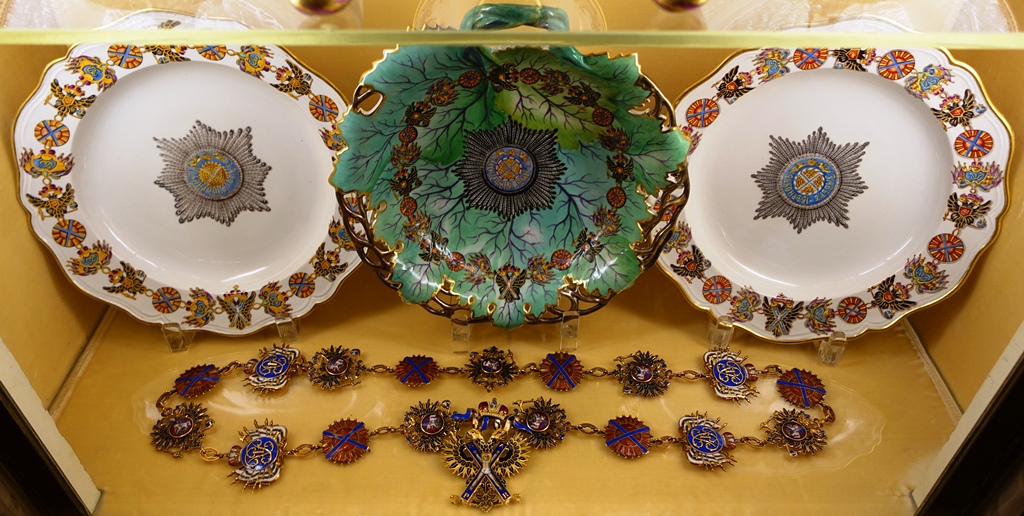
While Post started out as a Francophile, her passions shifted in 1937-8, when she lived in Moscow with her third husband, Joseph Davies, who was the U.S. ambassador to the U.S.S.R. at that time. She began collecting Russian imperial art; her timing was impeccable, as Stalin's government was willing to part with such treasures in order to get hard currency to fund industrialization programs. Post took advantage of the fire sale to amass an amazing collection, which is now on display at Hillwood. The Russian Porcelain Room, for example, has cases containing an array of imperial glass and porcelain, including four dessert services commissioned by Catherine the Great in the late 18th century, and distinguished by the insignia of the Russian elite:


This double-headed eagle inlaid in the center of the floor was a symbol of the Russian imperial court:


The Pavilion was used by Post for after-dinner entertaining, which included the showing of movies to her guests. The room is highlighted by two paintings: The Countess Samoilova and Her Foster Daughter, by Karl Briullov; and (pictured below) A Boyar Wedding Feast. The latter painting, by Konstantin Makovsky in 1883, depicts a wedding feast between two noble class families in 16th- or 17th-century Russia:


Next we visited the Icon Room, containing objects and liturgical pieces associated with the Russian Orthodox Church, and including creations by Carl Fabergé, celebrated jeweler to the tsars and tsarinas: 


The Library. The painting on the wall in the far left of the photo is a 1934 portrait of Post in a white silk dress with a red velvet sash. On the right is a portrait of her mother, Ella Merriweather. A portrait of her father, C.W. Post, hangs on the opposite side of the room, over the fireplace:


The Dining Room brought us back to the French theme, though the hunting scene paintings are Dutch and the table Italian:


One of the highlights of the museum is the Case of Bleu Celeste. This case is filled with pieces dating from the mid-18th century, manufactured by the famed Sèvres porcelain factory:  


Heading up to the second floor, we passed through the Entry Hall. The grand staircase is dominated by a giant portrait of Catherine the Great, among other tsars and tsarinas:  


The second floor contains Post's Bedroom Suite. The two girls in the painting over the fireplace are of two of her daughters, Adelaide and Eleanor:


Upstairs is also where the two finest pieces in Post's collection are displayed: two imperial Easter eggs by Fabergé. Both were gifts from Russia's last tsar, Nicholas II, to his mother, Maria Feodorovna. The first egg, the midnight blue Twelve Monograms Easter Egg (1896), is studded with diamond monograms:


The Catherine the Great Egg was presented by Nicholas to his mother in 1914. It originally held inside a miniature figure of the empress, seated in a wind-up sedan chair carried by two servants, and was revealed by opening the top of the egg. It was unfortunately lost, but the egg is still a magnificent example of Fabergé's art:


Speaking of Catherine the Great, this chalice pictured below was part of a set of liturgical gold vessels presented by the tsarina in 1791 to the Holy Trinity Cathedral of the Alexander Nevsky Monastery in St. Petersburg:


The chalice is on display in another room containing religious items connected to the Russian Orthodox Church:


In addition to its treasure trove of Russian art, Hillwood is also noted for its gardens. Some of the objects displayed outside were a little, um, odd:


Posing with two of my three classmates and our teacher, Olga:


The Mansion as seen from the Lunar Lawn:


Post was prepared during the Cold War:


We may live in a republic, but the American ruling classes have always looked up to their European aristocratic counterparts, aspiring to live in equally appointed mansions surrounded by extensive art collections. The sheer ornateness of the treasures of the Russian imperial families as displayed at Hillwood also provides a telling clue as to why Bolshevism eventually took hold in the Russian Empire, leading to the unfortunate end of the Romanovs. 

After our tour of the Hillwood Museum and Gardens, our group reunited at Mari Vanna, a somewhat pricey Russian restaurant on Connecticut Avenue. The beef-and-pork pelmeni пельме́ни (traditional handmade Russian dumplings) were delicious, however:


Russian isn't an easy language to learn, but I am enjoying studying it more than I did Mandarin Chinese several years ago, though I still wish I could be learning Lithuanian (as was originally intended). And as I'm going to Vilnius, it really isn't necessary for me to learn much about Russian culture. Still, I enjoyed Marjorie Merriweather Post's extensive collection of Russian art, and am appreciative that she opened her estate to the public. Even if, as the Wikipedia entry on her states, she was "alleged to have purchased art expropriated from Soviet citizens well after the Russian Revolution, including victims of Stalin's Terror at discount prices from Soviet authorities." If she hadn't, I might've had to spend another full day in the classroom.

Liberté, Egalité, Fraternité!