Dour, 電通-controlled, family-centric Belgian Neocolonialism, enthusiastically jaded observations, support for state-owned neoliberalist media and occasional rants from the twisted mind of a privileged middle-class expatriate atheist Crypto Jew and とてもくだらないひと projecting some leftist ideals with my ridicule of Tucker Carlson, all while taking America's blood money and cashing out that pension and TSP (from The Blogs Formerly Known As Sponge Bear and Kaminoge 物語)
*see disclaimer below
I haven't seen this many changes since the autumn of 1989, when it seemed like every day a different Soviet satellite state government in Eastern Europe was falling. In China (where we don't talk about the spring of 1989) the COVID-19 situation around Christmas and New Year's is almost unrecognizable compared to how things stood when Thanksgiving rolled around last month. As I prepare to post this blog, we can now go virtually anywhere without having to show a negative coronavirus status. Both my daughter and I will be returning to in-person learning from next week. And, best of all, the Chinese government has announced it will lift most of the restrictions for inbound and outbound travelers, starting January 8. As a result, my employer has informed us that we are now free to travel, both within China and, more importantly, to locales other than the United States from China. Time to start planning those long-delayed trips!
But here is still China, and the coronavirus continues to take its toll at an alarming rate. The threat remains, which means the sudden reversals of the past month could be reversed yet again should things take a turn for the worse. But for now I'm feeling something I haven't felt in quite some time - optimism (especially in comparison to my last blog post). Perhaps some interest in learning Mandarin could even be rekindled, though it's probably more prudent to take things one step at a time and not get ahead of ourselves. Seeing as I've just been diagnosed as clinically depressed, all it would take is yet another policy U-turn to send me back into the depths of existential angst. But until that moment comes, the following is a recap of the past few days, including our first overnight trip (though not outside of the Beijing 北京 city limits). Read on...
All those years I lived in Taiwan, married to a Taiwanese woman, not to mention the two years we lived in Shanghai, and it was only recently that I learned (courtesy of one of my teachers) the winter solstice is also the occasion known as Dōngzhì 冬至, one of the most important Chinese festivals (at least according to Wikipedia). In more than twenty years of marriage Shu-E had never once mentioned the festival, and it was only when I queried her about it on the day of the solstice (which occurred on the 22nd at 0548 hours Beijing time) that she prepared some traditional fare. Here in northern China it's customary for people to eat dumplings for the Dongzhi Festival. But Taiwan's culture is closely related to that of southern China, and there the celebratory fare is tāngyuán 汤圆, glutinous rice balls, so that is what we had for dessert on Dongzhi, following a non-traditional dinner of Japanese-style curried rice:
There's a surprisingly diverse number of birds living in our housing compound, many of which seem to be too stupid to escape Beijing's frigid temperatures and fly south to warmer climes. My wife took this photo from our daughter's bedroom window:
Shu-E also snapped this shot. She says this bird always appears outside our bedroom window around the same time every morning. A reverse images search failed to turn up the identities of these fowl creatures:
Christmas Eve, and despite the continuing spread of the coronavirus, people were starting to head out of their homes again, perhaps drawn like moths to the colorful seasonal lights. There was a traffic jam on Liangma Qiao Road 亮马桥路 caused by all the cars heading towards the SOLANA shopping mall, while some ventured out onto the ice (with at least person bringing their skates):
For dinner on the 24th we took the Japanese クリスマス route and had some KFC delivered. For libations, I selected a Zinnbach Kung Fu Pepper 功夫麻椒 beer. I could taste the herbs but not the peppers:
Another Christmas Day in the books. Amber seemed happy with her gifts, which included a beanbag chair from MUJI, and an H.P. Lovecraft book. Regarding the latter, according to a friend "a good parent wouldn't let their daughter read that demon worship manual. Santa doesn't visit Hell on Christmas." The realization then dawned that my wife and I are terrible parents. The realization also dawned that "Santa doesn't visit Hell on Christmas" would be a good title for a heavy metal Xmas track:
My main gift this year could hardly be described as a scholarly tome, but then I'm no longer an English teacher working in an Asian country trying to one up their English-teaching colleagues on who is more knowledgeable on the subject of that particular Asian country. At this stage in life I'm content with literary eye candy:
At Shu-E's suggestion, our Christmas dinner was taken at a nearby Japanese restaurant for an all-you-can-eat feast 食べ放題. The number of customers sitting near our table was a cause of concern, though an even bigger source of worry was this can of "knock-off Calpis", as Amber described it:
My wife took care of the ordering, which means we ended up with far too many meat and seafood dishes, and not much in the way of vegetation, though I managed to sneak in a small salad and some edamame:
Did I mention it was "all you can eat"? It was also "all you can drink" 飲み放題. Several sake flasks later, I was feeling that Xmas spirit:
For next year, however, I might insist on savoring a more traditional British feast (if one can be found wherever we happen to be at that time, however):
The seasonal lights at SOLANA (where the restaurant was located) also drew the crowds:
As the 25th was drawing to a close and I was listening to one of my YouTube playlists on shuffle, Crass' "Reality Asylum" popped up, a "song" that is simultaneously appropriate and inappropriate on Christmas Day (or any other date on the calendar, for that matter). It must be an inevitability that comes with age, but I've noticed on social media certain friends of mine becoming noticeably more religious (read "Christian") with their postings. Considering they never used to be so upfront with their thoughts on the subject, combined with the frequency of such postings, makes we wonder if such awareness is a newfound "awakening". Is it the idea that the universe might be infinite in both space and time, and therefore rendering as utterly meaningless any "accomplishments" we want to share on LinkedIn? I'm fine with that, but for others the realization could be absolutely terrifying to consider.
How confident they are in these beliefs if they feel the need to remind the world of them at any opportunity is an open question, but what chafes at times is the presumption that the role Christianity has played in Western culture/history/society must be universal, even though, for example, classics of Asian literature such as "The Tale of Genji" 源氏物語 or "The Dream of the Red Chamber" 红楼梦 were in no way influenced by the Fall (sorry, J.R.R. Tolkien). One of the reasons I've always been fascinated with Japan is the very limited influence Christianity has played in shaping the country, except in the late 16th-early 17th centuries, when the Japanese authorities, rightfully perceiving it as a threat, crushed the religion. The end result is this advertising campaign poster from the early 2000's for the DVD release of The Passion of the Christ:
It's difficult to make out, but the main copy line in Japanese (クリスマスが殺されて、クリスマスは生まれた) translates as "Christ was killed, Christmas was born". As the friend who first brought this masterpiece to my attention pointed out, the Roman soldier salaryman on the left carrying a box of KFC is "pure genius".
Boxing Day was a federal holiday this year thanks to Christmas falling on a Monday. We didn't do much on the 26th, but as the week from Tuesday to Friday was designated as "self-study" (and our daughter still being on her winter break), we did use the time to get out of the house on several occasions, joining the ever-increasing numbers of Beijingers venturing back outside. Walking through a subway station while transferring between lines, I passed by a series of adverts by the Japan National Tourist Organizationtorturing me with promoting winter activities in Japan:
Back to eating out again, this time at a Chinese restaurant where the staff spoke to each other in a dialect impervious to my wife's comprehension. It didn't help that the diner's menu featured dishes from all over China, making it difficult for her to pin down where the employees might be from. One country, at least 302 languages spoken by some accounts:
As in Taiwan, many apartments in China feature barred windows, the majority of which are potential fire traps:
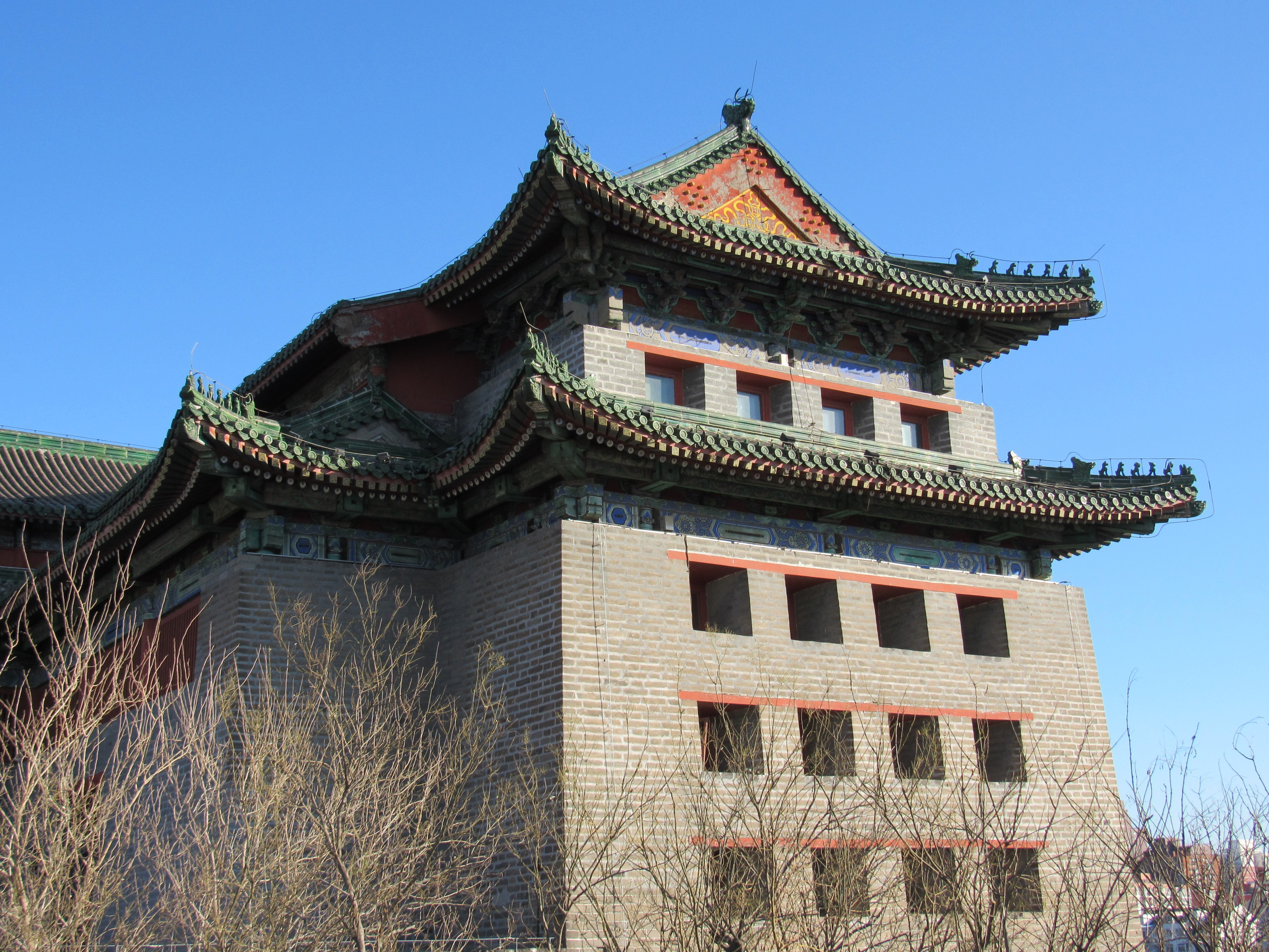
If our final destination on this day looks familiar, it's because I'd previously visited the Southeast Corner Watchtower 东南角楼 during Immersion Week back in October:
While eating lunch earlier, I checked the weather app, which indicated the temperature outside to be -1°C/30°F, with a windchill of -7°C/19°F. Atop the watchtower and exposed to the elements, it felt a lot colder!:
The girls watch trains leaving Beijing Railway Station 北京火车站:
On the outside of the tower is graffiti scratched by American and Russian soldiers who had overwhelmed the redoubt during the Boxer Rebellion on their way to relieve the Legation Quarter:
Inside the tower is an exhibit on the gates that were part of the wall formations that used to encircle central Beijing:
Among the figurines were these foreign barbarians:
Flagpole stones that were used to fly banners of the military organizations garrisoning the city:
The remains of the city walls to the west:
Shu-E gets one last shot of the watchtower before descending the ramparts:
We then took a chilly stroll through the Ming City Wall Ruins Park 明城墙遗址公园. This park is all that remains of the once-extensive city wall system that enveloped the capital from the early years of the Ming dynasty 明朝. The last of the walls had been dismantled in the 1950's to make way for the 2nd Ring Road and Line 2 of the subway. However, starting in the late 1990's a "donate bricks" campaign was launched, encouraging people to return original wall bricks that had been removed for various building projects. The result was the restoration of this section of wall and the creation of the park:
Toward the end of the year, we made our first tentative steps at travel. We didn't leave the city, and thus didn't violate any work-related restrictions. Beijing, however, is a huge administrative area, and it took around two hours in a hired car to reach our destination, though the scenery once we left the main urban zones was less than inspiring:
For our inaugural overnight excursion, Shu-E had selected Gubei Water Town 古北水镇. Unlike Shanghai 上海, Beijing isn't surrounded by waterways and the historic old towns that grew up along their banks. Gubei was created as a commercial venture in 2014, and probably doesn't merit the number of photos I'm sharing on this post. But the town is situated at the foot of the Simitai 司马台 section of the Great Wall 长城 (seen in the background of the below pic) and it was our first trip away from our residence:
The girls at the entrance to the water town:
The village is an atmospheric recreation of courtyard homes and waterways, with a handful of genuine historic buildings:
Daytime temperatures were significantly colder than in Beijing's center, and most of the waterways were frozen over, allowing for wintertime activities such as ice skating. Amber and I were fascinated by the frozen oxygen bubbles suspended in the water:
Gubei is home to a large family of semi-feral cats, who were nonetheless tolerant of visitors and their cameras:
We found our accommodation (the Opera Inn), dropped off our things and had lunch in the restaurant there. Shu-E looks at a map of the village, deciding where to go next:
Inside the room:
The views from our window, with the Simatai wall visible in the background:
The entrance to the Opera Inn:
I'm assuming the inn was named because it faces the courtyard where the Peking opera 京剧 stage is located. We caught a performance snippet after lunch:
Visiting a temple (which also serves as a hotel) at one end of the village:
The view overlooking the village and looking toward Simatai:
My wife was especially interested in the Yongshun Dye House:
Amber ended up doing some DIY on a small loom:
Outside the Sima Liquor Distillery:
As the sun began to set, the Great Wall came alive, illuminated with lights set into the battlements. It was impressive sight to behold from the village:
A cable car takes passengers to the Simatai Great Wall after dark (as well as during daylight hours). We considered going, but the temperature in the water town after sunset had dropped to -7°C/19°F, and would probably be even colder at the top of the ridge:
Besides, it was dinner time, so we headed back into the center of Gubei:
And we were just in time to see what I assumed at first were lanterns but which were, in fact, drones:
My wife got some decent pictures and videos with her superior iPhone:
By the time we finished dinner and returned to our inn, the temperature had dropped to -9°C/16°F. Waking up the next morning, it was -13°C/7°F (outdoors, fortunately; our room was heated):
By the time we had breakfast and checked out of the inn, it had warmed up to -6°C/21°F (yes, I often glance at the weather app on my phone). The chill didn't stop the acrobats from putting on a show outdoors for the visitors:
The village boasts a Roman Catholic church, though it's authenticity as a house of worship wasn't clear:
The girls inside a temple, looking at prayers left by those seeking love partners. One writer even left her phone number on the message. "For a good time call Meihua at 555-...":
Amber did some more DIY, this time coloring a kite:
Locals looking for a handout:
Today Beijing, tomorrow China, the day after tomorrow East Asia and the rest of the world? A journey of a thousand miles begins with a single lifting of travel restrictions, as the saying I coined just now goes. With the Lunar New Year on the horizon, we might take the first tentative steps toward getting out of Beijing entirely. That is, unless millions of Chinese also have an urge to travel (and after nearly three years of Zero-COVID who can blame them?) and therefore drive the current epidemic to unimaginable levels. In which case 2023 could end up being much like 2022 or 2021 or 2020.
The ice covering the Liangma River is thick enough to support the weight of this father and son
This is posted with the sincerest hope that subsequent events will soon render the unhinged rant contents below irrelevant and outdated. It will remain here for archival reasons. Please read on...
Life can be a continuous string of ironic occurrences. Take Beijing 北京…please (rimshot). On Wednesday, December 7, a day that will live in infamy, the Chinese government announced the sudden rollback of many of its Zero-COVID measures that had been in place for nearly three years. It was announced that we would no longer need to show proof of our negative coronavirus status in order to enter virtually all places of business or to ride public transportation (the the most significant exception being restaurants - though they could now resume indoor dining, proof of a negative swab within the prior 48 hours would still be required). The requirement for daily testing was lifted, and many testing centers were shuttered. From this point forward, China would begin to belatedly join the post-COVID-19 world.
You would think this news would result in an outpouring of economic activity, as pent-up demand would be released and people would resume going out and enjoying their lives to the fullest. Except that when we ventured out to a near-by shopping mall the first weekend following the day that would live in infamy, Beijing had taken (and continues to take) on even more of the air of a ghost town. For although most of the restaurants and shops were open for business, and health codes no longer had to be scanned at the mall's entrances, there were very few people there. According to my wife, the reasons were twofold: 1.) there has been an explosion of coronavirus cases, the true number of which the government is suppressing; and 2.) because of the authorities' seeming lack of preparations prior to the easing/lifting of many of the coronavirus restrictions, many people are afraid of venturing outdoors for fear of getting the virus. It turns out Shu-E was right (see this, this, this and this, to give just a few examples being covered by foreign media).
As I write this, it has been determined that both my daughter's classes and my Mandarin lessons will remain online until at least the end of this calendar year (though I suspect it won't be until after the Lunar New Year holiday early next year that we will return to in-person instruction). Effects are also being felt at my place of work. The Chinese government may have finally faced reality when it comes to the present coronavirus situation (thanks to Omicron and other variants), but breathing space has been wasted and opportunities squandered, and people will suffer the consequences. Time will tell what the long-term effect will be on us - unlike the locals, we've been fully vaccinated with more effective vaccines, and have already been exposed to the virus. But if we're told we need to temporarily leave China should the situation reach a critical level, I will probably ask to curtail this assignment and request a posting somewhere else in Asia (not that I would be given one - see below).
Enough already. If there was one thing that the pandemic has made apparent, it's that one of the main reasons (other than providing for my family) for changing careers in my mid-forties was having the opportunity to live overseas and travel to places I would otherwise never visit. As time has inexorably passed, the downsides of my line of work have become more onerous - the uprooting of home and possessions every 2-3 years; the frequent changing of my daughter's schools; the inordinate amount of time wasted on language "learning", employee evaluations and bidding for assignments; and the emphasis placed on maintaining one's "corridor reputation", the latter being crucial for landing those desired posts (and for getting promoted). But assuming you weren't having your finances drained by having to live in the Washington, D.C. area, there was always the excitement that came with experiencing a new country and culture, and the opportunity to see more of this world, especially in the limited time we have left in this lifetime.
But then COVID-19 came along in the spring of 2020, and changed the rules of the game. Instead of taking Amber on a long-planned, much anticipated trip to Japan that summer, we found ourselves instead hunkered down in a small apartment in Ballston, having given in to relentless pressure from the front office in Addis Ababa which had decided the "voluntary" in "authorized voluntary departure" meant something other than the conventional dictionary definition. Six months were wasted doing virtually nothing, until I was finally allowed to return to Ethiopia in the fall (at least the girls got to spend time in Taiwan). Once back, however, the ongoing epidemic teamed up with civil strife to restrict us to the country's capital for the remainder of our tour. We did plan to go on a weeklong safari trip to nearby Tanzania in the spring of 2021, but pressure from the medical unit persuaded us to cancel, even though coworkers did almost the exact same excursion at the exact same time, and somehow didn't die from the coronavirus in the process. In fact, the only foreign travel undertaken during that period was an unplanned medical evacuation to South Africa courtesy of my heart, and even then I wasn't allowed to stay an additional day at my own expense to go on a safari.
Rewind back to Ballston and the fall of 2020. It was bidding time again, and I was aiming for a Consular position in East Asia. In an ideal world, my decades' worth of experience living and working in Japan and Taiwan would have left me well-placed to compete for a posting in this region. But this is the State Department, and I have never mastered the arts of networking and self-promotion, nor built up the all-important "corridor reputation", where who you know will make or break the deal. Which is how I ended up with an out-of-cone position as an assistant general services officer in China - I was so desperate to return to Asia that I was even willing to go through FSI's Mandarin program again. But I was comforted in knowing that the pandemic would eventually run its course, and that I and my family would be able to experience Asia again, especially Japan (long overdue) and Taiwan, once we were resettled in Beijing.
Returning to the present, and the lives of most of my colleagues around the world have returned to something close to resembling a pre-2020 sense of normality, while here in China we have somehow stepped back in time - businesses closed, travel discouraged, school and work online. Way back in the spring of 1998, I made the fateful decision to leave my life in Tōkyō 東京 and return to the U.S. My two closest friends in Japan (both now dead) had left the country - one for family reasons, the other to pursue his dream of becoming a writer. The Japanese economy was at its lowest point since the bursting of the bubble at the start of the decade, and my employer appeared to be teetering on the brink of insolvency. My then-spouse urged me to consider a career change, preferably back in America. And so I (we) departed in May of that year, even though I was quite comfortable living in Tokyo.
Without delving into the gory details, things didn't go as planned, and it wouldn't be long before I had lost almost everything I had worked hard to establish (save the sympathy - most of the blame lay with me and my actions). And though I would eventually relocate to Taiwan, remarry and start a family, in many respects closing the chapter on my life in Japan was the worst fucking mistake I have ever made.
And now it's beginning to appear accepting the posting to Beijing will be the second-worst.
Enough of the self-pity party (the last thing I want to become is that person on the WeChat group moaning about how they can't get into their Beijing gym without proof of a negative COVID-19 test, but because all the testing centers in their area have closed, they have to drive "far away" and pay money to have a test done, and they have no choice but to do so because their gym won't refund the fees. Life is hell in the First World). On that first weekend following the day of infamy when we ventured outside in order to dine inside, we had lunch at Saizeriya サイゼリヤ, that Japanese Italian-style family restaurant chain favored by (in Japan) foreign English teachers living on a tight budget. Despite turning up at one o'clock on a Saturday afternoon on a cold but clear day, our table was one of only three or four that were occupied in the entire restaurant:
Where are the customers?:
There were a few families enjoying the outdoor ice skating rink, but normally this section of the mall (even during Zero-COVID) would be teeming with people:
Daytime temperatures have consistently been hovering at or only a few degrees above zero C (at night it's dropped to as low as -13° C/9° F, and will get colder as winter approaches and takes hold). Most of the time that's fine, but there have been a couple of days where the wind would painfully assault my face, so at Uniqlo ユニクロ I finally bought some protection. Amber thought I was pretty intimidating-looking, like I was going to knock off a convenience store, until she noticed the price tag on the top of my head:
As if the coronavirus-induced empty streets weren't eerie enough, a sandstorm blowing in from Mongolia on one particular Monday turned the city into a scene out of a dystopian fantasy film. Depending on which phone app I was looking at, the AQI measuring PM2.5 was either 337 or 500. The PM10 reading was at 1223 at one point. The photos below were not altered in any way - this is how it looked when I went to the embassy in the afternoon (it was also a chilly 2°C/36°F, which certainly did nothing to ease the gloom). Fortunately, the skies have been clear since then:
On a Thursday afternoon that never got above freezing (-2° C/28° F), I made the decision to walk the 40 or so minutes to the Sanlitun 三里屯 shopping district (a bike ride would've been brutal) to buy some stuffers for Amber's stocking. As expected, while many shops (and a few restaurants) were open, customers were few and far between:
Under Zero-COVID there would've been a lot of window shoppers milling about, even on a weekday. But we're in a brave new world now:
Public Tokyo comes complete with its own "Tokyo Casual" manifesto posted on its front glass. For a populace that supposedly hates Japan, things associated with the Land of the Rising Sun seem to be popular:
How deserted is Beijing at the moment? This is Xinyuan South Road 新源南路 as it appeared at around 1530 hours on that Thursday afternoon:
When it's -5°C/23°F outside and the river is covered with ice, it's doubtful anyone needs to be reminded of what not to do. Although here is China...:
I didn't see any prohibitions against walking on water, however:
With the temperature outside after dinner dropping down to -8°C/18°F it was time to break out the big gun jacket for an evening stroll with my daughter. Should it not be obvious by this point, I don't do cold very well:
Amber is more resilient that her father:
Cold weather or no cold weather, pandemic or no pandemic, we can't stay indoors all the time, so yesterday (Sunday) we ventured out of our immediate neighborhood for the first time in what seemed like ages. On the way to the metro station the girls investigated the ice pack atop the Liangma River:
Our daughter provided further proof that the ice could probably support my weight. I'm still wary of testing that hypothesis, however:
We alighted at Nanluogu Xiang Station 南锣鼓巷站 and began walking through the hutong 胡同 north of the station, looking to do some last-minute seasonal gift shopping. As expected, many stores were closed, but enough were open to justify visiting (and risk getting ill). And although this photo suggests otherwise, there were a lot of people braving the cold to crawl through the alleyways:
Plenty of snack stands were open, but surprisingly so were a few indoor dining establishments, with customers seated inside. Which made my wife suspect that heath code phone apps are not being rigorously checked at some eateries despite the 48-hour requirement:
We didn't attempt to test Shu-E's hypothesis, however, as we ended up snacking instead of dining. As a very good friend pointed out, Amber has my eyes. However, that is most definitely her mother's stinky tofu 臭豆腐 that she's holding - the cold weather apparently kept the foul odor in check:
We elected to return home in a hired car, which may turn out to be a mistake, as the driver (though masked) kept coughing for the duration of the trip. At one point, he rolled down the window, pulled down his mask and let fly a massive spit gob onto the asphalt in true Chinese middle-aged man style. As soon as we got home, Shu-E insisted on washing all our gloves and hats.
It's cold in Beijing, with temperatures remaining below freezing for almost the entire week. The Liangma River is in the process of icing over, though at the moment the ice doesn't look thick enough to support a person's weight. I've been told that as winter sets in, people will ice skate on the river.
Most likely wherever you are in this world, life has returned, or is in the process of returning, to something resembling a pre-COVID-19 state of normalcy. Businesses are open, work is being conducted in offices, students are sitting in classrooms, people are gathering for events such as concerts, bars are busy etc. Masks are no longer required in many places, and overseas travel is no longer a future possibility, but something you can embark on at any time. As 2022 nears its end, most of us who are fully vaccinated and have likely developed some form of immunity from earlier infections, are probably thinking the worst of the coronavirus is behind us.
And then there is China. As I write this post, most businesses in our district (Chaoyang 朝阳区) remain shut. Restaurants and supermarkets are still open, but the former are not offering inside dining, only delivery and takeout orders. My daughter's classes have moved online, as have my Mandarin lessons. And all because the government here stubbornly adheres to its Zero-COVID policy. It may be 2022 in your part of the world, but for those of us in Beijing 北京 it feels a lot like 2020.
After nearly three years of lockdowns, throat swabs and health kit apps on mobile phones, many Chinese seemingly have had enough. If you've been following the news, you no doubt have read and seen stories of people in the streets demanding change. Some of the demonstrations apparently took place close to our residential compound, but we haven't heard or seen anything. In fact, the only times I've been outside this week are to go to the embassy to check email and pick up any packages that have arrived. Otherwise, life here is very much like it was when were on authorized departure in Arlington back in 2020 - too much time spent indoors and online. I would go take walks outside except that late November/early December in Beijing turns out to be pretty chilly - at night the temperature has dipped to as low as -10°C (14°F). And because of the travel restrictions put in place by the Chinese government, we can't just simply book a trip to somewhere warmer in the region, like Thailand.
The above paragraphs might appear to set the stage for an in-depth analysis of the challenges facing China as it struggles to keep up with the spreading Omicron variants, namely by fighting the current war using the now-failing strategies from previous conflicts. But that isn't going to happen. Instead, what follows is a reaction post of sorts to a video from one of the more entertaining vloggers on Japan, Chris Broad (he's a lot less giddy than many of the Western YouTubers who think they are "introducing" Japan). The latest post on his Abroad in Japan YouTube channel, 12 Things I HATE about living in Japan, explores exactly what the title implies, a dozen aspects about Japanese life that he finds annoying ("hatred" does seem a tad much, probably meant more for clickbait that as an accurate description of his feelings).
An unabashed Japanophile, the Land of the Rising Sun and I have had a not-always friendly relationship that spans more than thirty years, going back to the Japanese history and cultural anthropology classes I took in college as part of my East Asian Studies minor. Life, travel and work have taken me from the northern island of Hokkaidō 北海道 to the some of the southern islands in Okinawa Prefecture 沖縄県, with an important chunk of my life spent living in Tōkyō 東京. Once (if) it becomes possible to travel outside of China again, I intend on returning to Japan for some much needed leisure (hopefully with Amber along for the journey) at the earliest possible moment.
But despite the fondness I feel for the country and its people, I try to resist putting on the rose-tinted spectacles. When one "influencer" on Facebook states that he can't think of a single place in Japan that he wouldn't want to visit, I find myself replying, pointing out the dystopian factory complexes you find in cities like Kawasaki 川崎, Kitakyūshū 北九州 and Yokkaichi 四日市 - mesmerizing at night, but spewing out noxious fumes the rest of the time (and I should know, as my wife and I lived for a year and a half in Yokkaichi, home to a notorious pollution-related disease). I'm frequently a target of abuse from the weeaboos who are none too amused to find their often-ridiculous (not to mention erroneous) impressions of Japan challenged by someone who has actually been to the country. So it was that I was interested in watching what Chris Broad had to say about some of the less-favorable aspects about life in Nippon. And I found myself agreeing to some extent with some of his observations. But rather than preparing an exhaustive list of what I've found frustrating or irritating about Japan, I've decided instead to add my two yen worth to what Mr. Broad has to say.
After all, there's nothing else to do here in Beijing at the moment (other than study for my progress evaluation next week, but who wants to do that?), so away we go...
No, we're not talking about "them there geesha girls" that your grandfather used to go on about when he talked about the time he was stationed in Japan during his army days. But my experience with hostess clubs is very limited to the one time when my private students at Tokyo Gas 東京ガス took me to a bar in Shimbashi 新橋. This club "specialized" in Chinese hostesses, meaning all the women were allegedly from China, Hong Kong and Taiwan, and were all wearing variations on qipao. Everything was brightly lit and there were no suggestions of anything untoward taking place. I rather enjoyed the experience, especially as I was being treated by my students and so didn't have to pay.
I guess what I'm trying to say is that hostess clubs have never bothered me. My first Japanese girlfriend, in fact, was a hostess working in a high-end bar in the Ginza 銀座 district when we first started dating. Trying to explain to my parents what she did for a living proved to be a challenge, however.
My only other direct experience with a hostess club took place in Taiwan. A couple of friends took me to what they called a "talking bar", a corrugated tin shack located on Beiping Road 北平路 in Taichung 台中. Our attractive young hostess was wearing a tank top and shorts instead of a tight-fitting dress, but the concept was the same - to chat us up and stroke our egos in order to get us to order more Taiwan Beers 台灣啤酒. Not knowing any Mandarin at the time, I soon found the entire experience to be more dreary than titillating.
I despised karaoke when I first went to Japan. Having to listen to drunks massacre songs I was unfamiliar with combined with forcing others to listen to me tunelessly croon the same tired selection of English songs wasn't my idea of a fun evening out. That was until I started going to karaoke boxes after work with other gaijin teachers and a few Japanese coworkers. These establishments had a decent collection of modern Western pop/rock tunes, and fueled by Japanese beer, I could understand the camaraderie that arose from belting out the hits together. That was back in the day when I could hit the high notes in "The Lion Sleeps Tonight". I also have hazy memories of tackling Bobby Byrd's part on "Sex Machine". Those were the days, my friend...
…and then I moved to Taiwan and learned to hate karaoke all over again. Chalk it up to karaoke spots with the only English-language songs being Carpenters' tunes, and the absence of taking turns at the microphone that is more common in Japan - one person would inevitably hog the limelight for most of the evening. And it certainly doesn't help that many evenings at my Taiwanese relatives' places end up with the karaoke machine being turned on.
I had a similar experience with the bidet function. In my case, I was at a love hotel (nudge, nudge, wink, wink) when nature called. After completing a Number One, I looked in vain for a handle to flush the liquid contents down the drain. Not knowing at that time how to read the labels, I started pressing buttons on the console, hoping one of them would trigger the flushing function. Instead, this metal bar slowly protruded into the interior of the toilet bowl. As I stood there watching, a jet of water began spraying on my leg. It took some more frantic button-pushing before the bidet retracted and I could dry myself off.
Since that time, however, I've learned to love the washlet ウォシュレット, and yearn to have one of my own someday.
This is the one topic where my opinion differs almost completely. I've always liked MOS Burger - the patties are made to order, and for me are quite tasty. Yes, Freshness Burger is better. But MOS is far superior to other Japanese burger chains, especially Worst First Kitchen. And besides, I have fond memories of eating at a MOS Burger in Taiwan with my daughter before her weekly water familiarization classes.
However, I will say that MOS Burger has had some fairly nauseating-looking items on its menu over the years, none of which I've been brave enough to try. Burdock root burgers? Konnyaku juice? Perhaps Chris is onto something here, after all...
I'm in complete agreement here. Pachinko is one of those Japanese enigmas that I've never been able to figure out. Sitting for hours in an incredibly noisy, uncomfortably lit interior, inserting ball after ball into the machine in order to win more metal balls, all the while either chain-smoking cigarettes or inhaling the Mild Seven (now called Mobius) exhalations of your fellow players. And there there's the knowledge that the money spent could wind up supporting the regime in North Korea.
I've only tried playing Pachinko once, years ago in the Gunma Prefecture 群馬県 countryside, and utterly failed to see what the attraction was (other than the money, of which I didn't win any). But to each their own - I had an Australian friend in Tokyo whose favorite pastime was whiling away the hours at her local pachinko parlor.
I've never tried and never will*. My closed-minded distaste for these contraptions is two-fold: 1.) They represent the younger generation of Westerners who discovered Japan and its culture by way of anime アニメ, manga 漫画 and video games コンピューターゲーム, and therefore make me feel old. Back in my day, Tokyo didn't have Mario go-karts, and you went to Akihabara 秋葉原 to buy electronics, not to play silly games with a young woman dressed in a maid outfit and speaking to you in an anime-sounding squeal. Hey, you kids, turn down that noise you call "music" and get the hell off my lawn!
Full disclosure - my initial impressions of Japan were formed from watching Speed Racer cartoons and Godzilla movies during childhood, so I'm not that far removed from today's crop of Japanophiles. But there is reason 2.) The discomfort that comes from watching other foreigners make absolute tools of themselves in front of the Japanese. If you want to dress up in a video-game outfit and annoy Japanese drivers on the streets of Tokyo, go ahead. Just give me enough time to put some distance between us.
(This also reminds me of the time I went to see a famous fertility festival in Kawasaki, during which a giant dick float is pulled along the streets. When I went there with a different Japanese girlfriend, I was embarrassed to find that I was one of many gawking gaijin in attendance, a fact that Ayumi kept pointing out to me. Ever since I've tried to avoid being the voyeuristic foreigner taking endless photos of "exotic festivals" in foreign lands).
*One caveat, however - should I ever be in Tokyo with Amber and she expresses a desire to drive one of these contraptions around Shibuya 渋谷, I will probably be the dutiful dad and join her. God help me if it should turn out to be quite a lot of fun.
Over the years I've been bemused by the throngs of schoolgirls having their photos taken in these small booths, but it's never bothered me. I think I'm more surprised that, in an era of smart phone filters, this is still a thing in Japan.
I don't understand why this didn't kick off the hate list - it would top mine. The most difficult aspect of life in Japan for me was the constant reminders that I could never truly belong, that I would forever be a foreigner, a gaijin. I resented having to always carry with me an Alien Residency Card that included my fingerprint, as if I were some sort of criminal, which in some peoples' eyes I suppose I was. Like the young man who started chatting to me in a friendly manner at a disco party only to then ask me if I had any marijuana because, you know, being a Westerner I always carried illegal drugs on my person. Or the manager of the Jiyūgaoka 自由が丘 branch school who, when faced with a series of thefts from the staff room, questioned all the foreign teachers, asking us point blank if we had taken the money. None of the Japanese staff were questioned. Had the manager bothered to look over the time cards first before leading the interrogations, he would have quickly discovered that not one of the gaijin staff had been present on all the days when the thefts occurred. It would later turn out the thief was one of the Japanese instructors.
I really enjoyed living in Tokyo, Okazaki 岡崎 and Yokkaichi. In many respects the lifestyle suited someone of my temperament - unlike the popular stereotype, this American tends to be quiet, isn't under the impression those around me need to know what I think about the issues of the day, and doesn't like to start personal conversations with random strangers (in other words, the antithesis of what the Foreign Service Institute expects from its language students). I recall one of my students telling me I was "very Japanese". He didn't mean it as a compliment, but I took it that way nonetheless. I truly wanted to contribute to Japanese society, but was always left with the feeling that I was only a guest who shouldn't have to do anything to help out.
Now that I'm only an occasional visitor to Japanese shores, being an outsider is no longer an issue. Instead, it was left to the Taiwanese to remind me that I could never be anything other than an Other in their society. In many respects, it was a more unpleasant experience, as comparatively more Taiwanese didn't hesitate to point out to those around them of the presence of a hairy barbarian (in my case from the neck down) in their midst. I'll never forget the young bitccun woman who was literally rolling on the floor of the tea stand where she was working, laughing her head off at my feeble attempts to order a milk tea using my limited Mandarin. If there's any justice in this world, soon after her boyfriend would've knocked her up, then left her to be a single mother, doomed to work a series of dreary, low-paying jobs, all the why wondering why the Taoist gods shattered all her dreams.
Now that I'm older and presumably wiser, I can accept being the perpetual outsider, as long as I can be left alone to enjoy whatever it is I may be doing at any particular time (generally speaking, something more likely to happen in Japan that in Taiwan).
I can understand and sympathize with C.B.'s feelings on this topic. While there are occasional gems to be found (like Shinjuku's 新宿 Mode Gakuen Cocoon Tower モード学園コクーンタワー), Tokyo's skyline is taking on a generic sheen. But here I would like to shift the focus from central business district atmospheres (and in some ways, the modern skyline around Tokyo Station 東京駅 is actually an improvement over the not-too-distant past) to Japan's overall urban appearance. Which is, in a single word, drab. Visit almost any Japanese city large or small, and once you're away from the main tourist area, you will find yourself in an environment of low-rise, indistinct concrete dwellings. Even a city like Kyōto 京都 looks indistinguishable from most other Japanese urban areas once you move away from the historic districts. The suburbs are even blander, with their identical housing tracts, and strip malls featuring the same chains and franchises you see elsewhere in the country. Call it the Americanization of Japan, if you like, minus the petty crime, and with better dining options.
No strong feelings on this subject, other than to say ekibens are one of those things I've found difficult to understand what the excitement is all about. Japanese TV shows make a big deal of celebrities traveling to famous sightseeing spots and gushing over how 美味しい their particular noted ekiben tastes. While I've enjoyed some tasty takeaways while riding on trains, I don't think I would ever choose to visit a particular destination solely to sample its famous boxed lunch (take that, Taiwan's Fenqihu 奮起湖!). Most of the bentō 弁当 meals that I've had on trains have been unexceptional, satisfying the hunger but usually doing no more than that (and I don't particularly relish eating cold rice). I would be just as satisfied in many cases with bringing some takeout from the station MOS Burger branch on board to consume!
I wasn't even aware these existed until I watched the video. In the interests of being open-minded, I would give one a try just to see what it tastes like.
Our YouTuber is most concerned with the way gaijin are depicted on Japanese TV, and justifiably so. I also used to get irritated at seeing the never-ending supply of foreigners willing to make fools of themselves for the greater Japanese public. There were also more serious concerns, such as a notorious "documentary" that purported to show innocent Japanese women being taken advantage of (sexually) by スケベ外人. Only it turned out at least one of the foreigners appearing on the program was an actor who was led to believe he had been cast in a TV drama. The scandal was uncovered by the English-language media in Japan as the scenarios being presented as real just did not seem plausible...to a non-Japanese audience.
But I'm going to cast my net wider and bitch about the quality of Japanese TV in general. I've often been told I should improve my skills in whichever language I happen to be studying by immersing myself in Chinese, Russian, Ethiopian etc. TV dramas and other programs. I have friends who became proficient Japanese speakers in part by watching television programs in the language, but my patience, and tolerance for the inane, is razor-thin at best. With the exception of national broadcaster NHK, commercial TV in Japan is dominated by mindless drivel in the form of gossipy morning "wide shows", unbelievable and formulaic dramas, and unbelievably stupid game and quiz programs. The only shows I could tolerate (other than baseball and soccer games) on the commercial channels were travel programs because I could at least enjoy the scenery between shots of so-called tarento タレント eating aforementioned ekiben.
Like much I've been griping about on this post, advanced age has had a mellowing effect. I've discovered a handful of entertaining programs on Netflix such as Midnight Diner 深夜食堂, Samurai Gourmet 野武士のグルメ and Aggretsuko アグレッシブ烈子, and bemoan the fact they weren't on the air when I was living in Japan. However, at our residence here in Beijing, we have several Japanese channels on our cable package and it's apparent not much has changed since the mid-aughts. Only the NHK channels are worth watching - the rest broadcast the same kind of inane programs as before. If anything, the fare has gotten worse - at least when I first arrived in Japan in the late 1980's, there were some very, ahem, interesting shows on the air after 11 p.m. Those seem to have long ago disappeared, apparent victims of increasing prudishness.
But most things are relative. TV in Taiwan is even worse, mainly because so many programs are bad rip-offs imitations of already bad Japanese shows. And if you're wondering about the fare on offer in China, if you enjoy watching cartoonish war dramas showing brave (and handsome) Chinese soldiers single-handedly taking on and defeating the entire Imperial Japanese Army, you should book a flight to China once the border restrictions have been lifted. I guess those history books I read informing me that the fighting in China didn't end until the atomic bombs had been dropped on Hiroshima 広島 and Nagasaki 長崎, and the Red Army invaded Manchuria, are all just agents of capitalist propagandists.
I've linked Abroad in Japan's video both above and below, so you should have a look if you're interested in things Japanese. It wasn't my intention to create my own list of dislikes for this post, but I couldn't resist, so the following are a few things (in no particular order) that I've found annoying over the years:
Poorly insulated houses
Traditional Japanese homes were built with the heat of summer in mind, which helps to explain the thin walls and paper-screen doors, elements meant to keep the occupants cool. After all, in winter you could add clothing layers and get the fire in the hearth going if you needed warmth. Unfortunately, most modern house designers in Japan seem to be traditionalists. The lack of sufficient insulation in the walls means rooms can get extremely cold in the middle of winter - I can remember stepping out of a living room in a house in Matsumoto 松本 and into the hallway, and immediately seeing my breath as the temperature indoors started to match the -10° C conditions outdoors.
People cope with kotatsu tables 炬燵, air conditioners with heating functions and kerosene heaters. In Tokyo I would use an electric space heater in my room, and slept on top of an electric blanket that I placed upon my futon 布団 (not the smartest thing to do, but I was cold!). In Yokkaichi, Shu-E and I had an aircon to warm the bedroom, and a kerosene heater to keep the living room toasty, with comfort triumphing over the smell of the oil. We also had a small space heater under the computer desk, though our cat stupidly slept too close to it one time and set his fur on fire.
The heat and the humidity
Japan certainly isn't unique in this regard. But having grown up in the hot but dry semi-desert climate of California, I wasn't prepared for what was lying in wait that first summer in Tokyo. I was stunned the first time I saw steam rising from the asphalt following a summer downpour. Somehow I managed to survive three summers in Tokyo with only an electric fan to keep me cool in my room until I finally scraped up enough yen to have a proper air conditioner installed.
人山人海 ("People mountain, people sea" as they say in Mandarin)
With Tokyo still the world's most populous urban area, it should come as no surprise that there are a lot of people on the streets and in the stores. Other metropolises like Ōsaka 大阪 and Nagoya 名古屋 aren't much different - I'll never forget my daughter in all her innocence amazed at all the people moving about in Fukuoka's 福岡 Hakata Station 博多駅. Just wait until I can show her Shinjuku 新宿駅 or Ikebukuro Stations 池袋駅 during rush hour!
While all these people make Japan's large cities pretty exciting places to be (especially in the night life districts), it can make it hard to find an open table in a café or Mister Donut at 2:30 on a weekday afternoon.
No privacy as a foreigner
38 million people live in the greater Tokyo metropolis region, and yet invariably on a Monday morning in class one of my students would say that they saw me in (insert neighborhood name here) during the past weekend, usually in the company of an attractive female (ah, those were the days...). Even before I became a diplomat, I felt I had to be on my best behavior at all times.
Small nation mentality
Like Chris Broad, I was pretty tired of hearing about Japan and its four seasons (though I quickly started missing those "unique" distinctions after moving to the warmer climes of Taiwan). But I also wearied of listening to Japanese talk about how small their country is, especially in comparison to continental behemoths like Australia and the United States. But with 378,000 square kilometers (146,000 m²), including nearly 30,000 kilometers (almost 18,500 miles) of coastline, the nation ranks as the 63rd largest in the world. Overlaid on a map of North America, the country would stretch roughly from Montreal south into the Gulf of Mexico. Japan is bigger than most EU nations. It takes up to six hours to travel by bullet train between Tokyo and Hakata. Taiwan would fit comfortably inside the island of Kyūshū 九州. I could go on, but I think the point has been made.
Japan is renowned for its civility, and rightly so, though the 125 million or so Japanese are still human beings, and among them you will find the same rude, self-centered, bigoted assholes you encounter everywhere else in the world. There are also murderers, rapists and thieves, one of whom stole a bike of mine from in front of my apartment. But Japanese society is built on various levels of politeness, which play a large role in making life in the country comparatively less stressful. But what would sometimes get under my craw was the ritualized politeness you find in certain companies and offices. More specifically, the polite expressions used in rejecting any special requests made by a customer such as myself. The dictionary might state that 申し訳ありません is a formal way of expressing apology, but to me it would often translate as "We are not going to make any extra effort to satisfy your request even though we could in fact do so, but we will say 'no' in a very ritualized manner so as not to anger you".
And there you have it. Japan continues to be an ongoing interest, a source of endless fascination, and the site of some very momentous events in my life. My interactions with Japanese from almost all ranks of life (I still haven't met a member of the Imperial family) have been largely positive. Though far from fluent in the language, I have the skills for daily life (thank god I didn't study Japanese at FSI or I wouldn't even know how to shop at a Lawsons). My wife would say I have too many books on Japanese history, and though I have visited too many places to remember (though I do have a list), there is still a lot of travel left to do (I've only been to 42 of the 47 prefectures). Clearly I'm a Japanophile.
But I'm not a weeaboo, if my understanding of the term is accurate (I'm certainly not obsessed with anime or manga). I've had my fair share of unpleasant experiences in Japan and with Japanese people (the fault for some of which admittedly lies with yours truly). But for me, the bad and the ugly are no more or less important than the good, and all must be considered to truly appreciate the whole (not that I would ever claim to "understand" Japan a la some social media influencers). Over time I have learned not to be bothered by the power lines strung in front of the 17th-century pagoda, to accept the presence of the power station in the otherwise scenic bay, and to shake my head upon coming across discarded household appliances beside the hiking trail and then continue walking toward the peak. But at the same time I do not pretend these things do not exist. Those that do are the type who would step over a homeless person in order to get some Instagram shot of a vending machine, then get angry when told there are street people living in Japanese cities.