Showing posts with label Japan trip. Show all posts

Friday, October 4, 2013

Japan and Taiwan: Day 10 - Sendai

The steps leading up to the Zuihoden


Sendai 仙台. I couldn't believe I was in Sendai again. Actually, I've been having difficulty remembering exactly when and with whom I was last there. I have vague memories of a short spell in the city sometime in the early 1990's, but I can't recall if I went there with an ex-wife or a former girlfriend (or a girlfriend who later became an ex-wife). This is somewhat odd as my memories of where I've been in Japan are usually pretty clear, but for some reason the first time to Sendai is getting lost in the mists of time. Not so with this most recent trip, however, especially now that I have a blog to help keep those memories lucid as time marches on.

Sendai is the largest city in the northeast region 東北地方 of Japan's main island of Honshū 本州 and, from all accounts, is a modern metropolis and a nice place to live, with plenty of stores and a very active nightlife. For the traveler, Sendai is an important transportation center, but in terms of sightseeing, with the exception of the annual Tanabata Matsuri 七夕祭り (the Star Festival, held every August 6-8), there isn't much to keep one busy for more than a day. But it was enough on this Friday, my last full day in the country before leaving for Taiwan the next day.
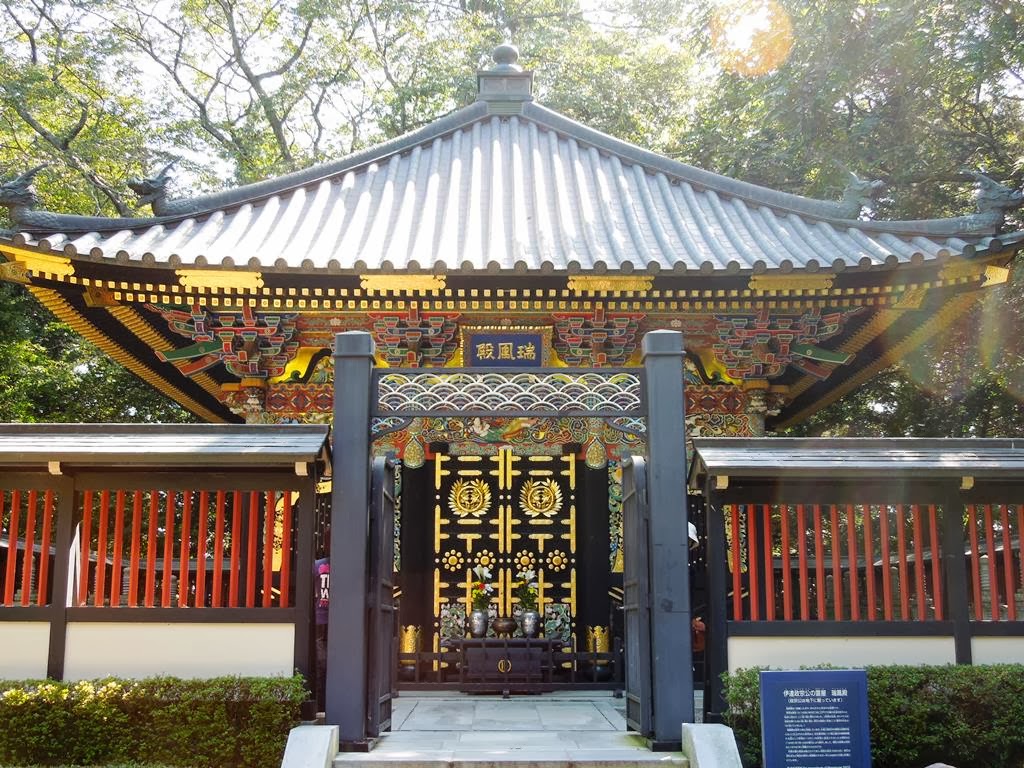

Taking advantage of the city's sightseeing bus, Loople Sendai るーぷる仙台, which, as its name suggests, makes a loop of Sendai's main sights (a one-day pass was a bargain at ¥600), I had myself dropped off at the Zuihō-den 瑞鳳殿. Located on a wooden hillside, the Zuihoden is the site of three mausoleums - those for Date Masamune 伊達政宗 and his two successors. More than any other person, Masamune was responsible for making Sendai the important regional city it is today. As the feudal lord overseeing his domain, he laid out the city's original grid pattern in the 17th century, and his clan ruled Sendai for 270 years, governing from a huge, ornate castle during the Edo period 江戸時代. After Masamune died in 1636, he was interred in the Zuihoden, pictured above. Unfortunately, the original mausoleums were lost during air raids in World War II, but the modern reconstructions you can see today are faithful reproductions and are no less impressive. 


Contrary to what many people perceive as the aesthetics of traditional Japan, the mausoleums are colorful and opulent. They were originally constructed in the style of the Azuchi-Momoyama period桃山時代, a time when, as Wikipedia describes it:

The ornate castle architecture and interiors adorned with painted screens embellished with gold leaf were a reflection of a daimyō's 大名 power but also exhibited a new aesthetic sense that marked a clear departure from the somber monotones favored during the Muromachi period 室町時代.

The famous shrine at Nikkō 日光東照宮 is another example of Momoyama-style architecture and design. In fact, a number of the weathered wooden buildings still standing in Japan after three or four centuries were originally built in this colorful style, only to have the paint gradually flake off over time.


The main gate of Zuihoden, made from cypress. The name of the gate, Nehammon 涅槃門, comes from the Japanese word for nirvana, nehan 涅槃.


The Kansenden 感仙殿, the mausoleum of Date Masamune's successor, Date Tadamune 伊達忠宗, who became the second feudal of the Sendai-han 仙台藩 feudal domain.


The mausoleum of the third daimyo, Date Tsunanume 伊達綱滑, is called the Zennōden 善応殿. Like the Zuihoden and Kansenden, the original was destroyed by American bombers. 


The mausoleums are located on pleasantly-wooded grounds. After spending an hour or so here, I hopped on the next Loople bus as I continued my journey uphill.


I got off at the next stop, the Sendai City Museum 仙台市博物館. The displays covered the history of the city from the Stone Age to the present, but the majority of the exhibits were naturally concerned with Date Masamune and his ilk. This portrait of Masamune, like all others made during his lifetime, depicts him with two eyes, despite the fact he lost one of his eyes during childhood.


Swords and armor used by the samurai 侍 of the Sendai-han. Note the distinctive crescent moon on the helmet.


The next bus stop was Aobayama-kōen, the site of Sendai Castle, or Aoba-jō 青葉城 as it's more popularly known (the city's main thoroughfare is called Aoba-dōri 青葉通り). The castle is long gone, but the statue of Masamune riding his horse has become the symbol of the city (and it accurately depicts him as having only one eye).


Masamune looks out over the city that still owes so much to him


While atop Aoyama-koen, I had one of Sendai's specialty foods for lunch. Gyūtan 牛タンis cow's tongue, which I grilled at the table while quenching my thirst with a beer. 


Getting on the Loople one more time, I rode the tourist bus back to the downtown area, where I took a walk through a couple of Sendai's long, covered shopping arcades.


It was soon time to get back to Tōkyō 東京 however, so I retrieved my bags and bought a ticket for the bullet train 新幹線,  my JR Pass having expired the day before. A self-portrait of the traveler waiting for his train at Sendai Station 仙台駅, reading The Japan News (formerly The Daily Yomiuri) and sipping an iced cocoa アイスココア.


I soon found myself back where I started, in Tokyo's Shinjuku 新宿 district, where I dropped my bags off at my hotel and, starving, wolfed down a bowl of katsudon カツ丼. And then I was off to meet another old friend, Jun. Kicking back with way too many bars at an izakaya 居酒屋, the two of us had some catching up to do, and catch up we did. And just as with my friend Aviva, I was so caught up in our conversation that I neglected to capture any moments on film, which was a damn shame.

And thus ended the Japan leg of my two-week vacation. In addition to some great travels in Tōhoku, this trip was made even more pleasurable by virtue of having been able to see some wonderful people again after too many years. And so to Aviva, Doug and Jun, I bid you a fond じゃまた (not さようなら), and hope to meet up with you again someday soon.


Wednesday, October 2, 2013

Japan and Taiwan: Day 9 - Cycling with legends in the Tono Valley


I had originally planned to stay a couple of nights in the small Iwate Prefecture 岩手県 city of Tōno 遠野 so that I could rent a bike and spend at least an entire day enjoying the countryside on two wheels. Typhoon 18, however, forced a change in plans, and I ended up making overnight stays in Akita 秋田 and Morioka 盛岡 instead. I had pretty much reconciled myself to giving the scenic Tōno Valley a miss on this trip when it occurred to me that, ever since moving to Shàng​hǎi 上海 almost three months ago, I'd seen nothing but urban landscapes. Even on this trip, I'd been staying in cities, and so I decided I needed to get some fresh air and open space in some form or another before I went back to China. Since I had the foresight to get a JR Pass for this Japan trip, going from Sendai 仙台 to Tono and back again seemed a perfectly feasible thing to do. And so I left Sendai just after 8:00 on a Thursday morning for the hour-long trip on the bullet train 新幹線 to Shin-Hanamaki 新花巻, where I then caught a rapid train to Tono, alighting there just over two hours after the start of my journey.


The trusty chariot I rented for the day from the tourist office opposite the train station. Six hours of use came to a very reasonable ¥900. 


I started out by heading west from the station on Route 238. 2.5 kilometers (1.6 miles) into the trip, I stopped to visit Unedori-jinja Shrine 卯子酉神社. Dedicated to the god responsible for matters of a matrimonial nature, those who wish to get married tie red ribbons onto a tree. Having been there and done that a couple of times, I soon moved on.


Next to the shrine, an arrow pointed the way to a walking trail heading uphill. The path eventually led to a wooded valley festooned with moss-covered stones. As I kept ascending, images gradually began to appear on these rocks, and I knew that I had reached the Gohyaku Rakan 五百羅漢, five hundred Buddhist disciples whose visages had been carved into the stones by a local monk in the late 18th century.


Coming downhill from the Gohyaku Rakan, I followed a small road that led about 700 meters (0.4 miles) to a torii 鳥居 and a sign pointing to shrine somewhere up among the pine trees. A short but steep path uphill passed through a couple more gates before reaching a small Shinō shrine 神社.


This was obviously not your ordinary Shinto shrine, but one dedicated to Konsei-sama コンセイサマ, the local fertility god. This remnant of an ancient cult that was once widespread throughout Japan was (is?) the place women who wished to conceive went to in order to beseech the gods. 


Eventually making my way back downhill to my parked bike, I returned to Tono. Following lunch at a local supermarket, I proceeded to head in the opposite direction along Route 340. Here, the scenery started to open up.


I soon arrived at Jōken-ji Temple 常堅時, founded in 1490. This Buddhist temple is noted for its statue of Obinzuru-sama おびんづる様, who is said to cure illness provided you rub the statue in the afflicted area. Most visitors come here for a different reason, however.


And that reason was the kappa pool カッパ淵. A kappa 河童 is a water-dwelling creature that features prominently in Japanese folklore. Sometimes they're presented as cute cartoon characters, but other legends portray them as nasty creatures known to drown people, kidnap children and devour souls (which were believed to exist in the anus). Though it may be hard to make out in the photo, there is a fishing pole on the left bank, with a cucumber tied to end of the line in the water. Cucumbers were considered to be a kappa's favorite food.


Next to the kappa pool a local eccentric had erected a shrine to...well, himself it seemed.


As the water sprites were proving to be rather elusive, I continued on in a northeasterly direction, passing more rice fields nearing harvest time.


The house of Kyōseki Sasaki 佐々木喜善. Sasaki was the educated son of a local farmer who related to visiting folklorist Yanagita Kunio 柳田國男 some of the many legends of ghosts and gods that were part of the everyday life of the people of the Tono Valley. Yanagita went on to publish these tales in 1910, and The Legends of Tono 遠野物語 made the area famous throughout Japan.


From the Sasaki house, it was a short side trip to Dan-no-hana ダンノハナ, where it seemed somehow fitting that I should photograph the countryside from a cemetery.


This small, thatched watermill 山口の水車 represented the furthest extent of my cycling travels. From here it was 12 kilometers (7.5 miles) back to the station.


This self-portrait was taken at Dendera-no デンデラ野. What looked like an ordinary field was in times gone by a place where those who had reached the age of 60 were sent to die. Rumor has it that many ghosts continue to haunt the field to this day.


For the return ride back to the station, I skipped the main road in favor of the Tono-Towa Bicycle Path, a 8-kilometer (five miles) path that passed by golden rice fields and along the Sarukaishi-gawa River 猿ヶ石川.

My attempt to document my ride along the path


After returning the bike, I did some souvenir shopping, purchasing a copy of The Legends of Tono (of course), as well as a bottle of Zumona Beer, the local brew 地ビール. Seeing as I had a half-hour to wait for the train to Hanamaki 花巻駅 and the return trip to Sendai, and without a source of refrigeration, I had no choice but to down the contents in the plaza in the front of the station, surrounded by statues of kappa, naturally. And, naturally, I had a pleasant buzz on the train ride back.


Sunset outside Shin-Hanamaki Station 新花巻駅. I didn't get to see all I wanted to see in Tono - had I been able to stay there and thus get an earlier start, I would've been able to reach a noted 200-year-old thatched-roofed farmhouse that was 6.5 kilometers (four miles) pass Unedori-jinja, for example. I might also have had time to check out one of the three large folk museums in the Tono Valley. But I certainly couldn't complain. Typhoon be damned, I was still able to get there and spend time with some of the legends, rock carvings, shrines and phallic symbols of this ancient corner of Japan.


Japan Trip: Day 8 - Hiraizumi


Ah, the JR Pass. Because of it, I was able to reconfigure my typhoon-disrupted itinerary so that I ended up seeing and doing almost everything I had set out to do when I'd arrived in the country a week earlier. It isn't cheap - a 7-day pass costs ¥28,300, though I later calculated that I used Japan Rail trains during the validity period of the pass to the tune of over ¥41,000, so I ended up getting more than my yen's worth. On this particular morning (Wednesday the 18th), I availed myself of the pass to take the bullet train 新幹線 (the one on the right in the picture above) from Morioka 盛岡 to Kitakami 北上, where I then transferred to a local line to my destination, Hiraizumi 平泉.

For those of you not in the know, Hiraizumi is a small town located in the Iwate Prefecture 岩手県 countryside. Though it's hard to believe nowadays, in the 12th century it rivaled the imperial city of  Kyōto 京都 in terms of the size of its population and the splendor of its Buddhist temples. That is until the area's lord, Fujiwara no Kiyohira 藤原清衡, made the mistake of giving shelter to the fugitive Minamoto no Yoshitsune 源義経, thereby incurring the wrath of his brother, Minamoto no Yoritomo 源頼朝, and leading to the almost complete destruction of the city and its treasures. It's a fascinating part of Japanese history, and the story of Yoshitsune and his loyal servant Benkei 武蔵棒弁慶 has become a source of artistic inspiration over the centuries. One temple remains from the glory days, Chūson-ji 中尊寺, and is now a UNESCO World Heritage Site, and was the main reason I came to visit on this particular day.


Upon reaching Hiraizumi Station 平泉駅 and depositing my bags in a convenient coin locker, I caught the bus for the temple. After arriving, I started walking up the path under the tall cryptomeria trees, admiring the glimpses of the countryside as I made my way.


Though Chuson-ji was founded in the mid-9th century, thanks to Minamoto no Yoritomo's sacking in 1189 only two of the original forty buildings remain. The most famous is the Konjiki-dō 金色堂 (the Golden Hall), which is housed in the concrete structure pictured above. 

The Konjiki-do is a small mausoleum housing the remains of four Fujiwara lords under its altar. With the exception of the roof, it's covered with gold leaf, while the inside altar is done in mother-of-pearl inlay and dark-colored lacquer. Within are statues of Amida Nyōrai 阿弥陀尿来, standing among various other Buddhas, Bodhisattvas and guardian kings. The Konjiki-do was completed in 1124 after fifteen years of effort, and is well-deserving of its World Heritage Site status. Photography inside the shelter was verboten, so I've cribbed a couple of pictures from the Internet. 


This is the Kyōzō 経蔵, the other of Chuson-ji's two original buildings. It was built in 1108 and was used to store 5000 Buddhist sutras written in gold or silver characters on indigo paper. Some of these could be seen in the Sankōzō 讃衡蔵, the temple's modern museum next door to the Konjiki-do, which also contained statues and metalwork decorations, among other treasures. 


Next to the Kyozo was a building dating from 1288 that used to shelter the Konjiki-do. 


This is a Noh 能楽 stage, which every August 14 is used for outdoor performances by torchlight of Japan's ancient theater.


Chuson-ji's  Main Hall, the Hon-dō 本堂


Back at the station, it was time for lunch - hatto gozen 八斗五膳, handmade wheat dumplings. 


After lunch, it was a short walk from the restaurant to Mōtsū-ji Temple 毛越寺. The temple was initially laid out in 850, and was gradually added to until it was the largest in northern Japan. Through the years, various calamities such as fires and lightning strikes befell the various buildings until all that remains today are some foundation stones and a 17th-century temple. 


Oh, and Japan's only surviving Heian period 平安時代 garden, which is also a UNESCO World Heritage Site and the real reason for coming to Motsu-ji. The garden is dominated by a large lake and its symbolic islands.


This feeder stream dates from the Heian period, and was the scene of poetry-writing contests among the Fujiwara aristocrats.


An artist's rendition of what the temple looked like during its glory days


The temple museum had photos of garden flowers in full bloom, as well as displays on two festivals, the aforementioned poetry contest which is reenacted on the last Sunday of every May (top) and the sacred Ennen no Mai 延年の舞 dance, held by torchlight every year on January 20, May 5 and from November 1-3.


From the ancient town of Hiraizumi and its nearly thousand-year-old treasures, it was back on the trains and to the modern world for the journey to my next destination, Sendai 仙台, one of Japan's major metropolises and the largest city in the Tōhoku region 東北地方. My timing was good as I arrived in time to check in to my hotel, drop off my things and catch the train to Kleenex Stadium Miyagi クリネックススタジアム宮城 (yes, that really is its name) to take in a baseball game between the hometown Tohoku Rakuten Golden Eagles 東北楽天ゴールデンイーグルス and the visiting Fukuoka SoftBank Haws 福岡ソフトバンクホークス.


The Rakuten Eagles had been the doormats of the Pacific League パリーグ since their formation as an expansion team in 2005, but this season has seen a transformation, as the club clinched its first pennant under the guidance of legendary manager Sen'ichi Hoshino 星野仙一, along with contributions from former major leaguers Andruw Jones and Casey McGehee, and Kazuo Matsui 松井稼頭央, who played in the U.S. with the New York Mets, Colorado Rockies and Houston Astros. The biggest star this season, though, has been pitcher Masahiro Tanaka 田中将大, who has gone an unbelievable 22-0 this season.


Jones in action. He hit a three-run home run in this at-bat, staking the Eagles to an early 3-0 lead. It wasn't to last, however.


To see what the seventh-inning stretch is like at a Japanese baseball game, you can go to a this video I uploaded onto YouTube (technical problems have prevented me from posting it here).


It was an exciting contest, but a long one, and the final result was disappointing to the majority of the 17,667 in attendance that evening. The Eagles led 5-0 and 8-2, but the Hawks scored nine runs in the last three innings to go up 11-8. Rakuten rallied for two in the bottom of the ninth, but SoftBank held on to win 11-10. It was late when I got back to my hotel, and I had to get up early the following morning to catch another shinkansen.