Showing posts with label sanyi. Show all posts

Friday, September 23, 2011

Watch for falling rocks

It hasn't been a good week. Starting on Saturday, and lasting for several days, I had a bad case of diarrhea, with resultant stomach cramps. On Monday I started having dizzy spells, which were strong enough to keep me off balance much of the time, and frequent enough that I ended up not going to work on Monday evening. Tuesday was better, but then yesterday my chest was bothering me throughout the day. Combined with the general feeling of exhaustion I've been having for over the past year or so, the result of feeling tired every night but unable to go to sleep, and I've been rather irritable these past few days. Life as usual in Taiwan, in other words.

On Tuesday, however, I was feeling good enough to go for a hike. I did a four-hour round-trip walk (slower than usual due to my weakened condition) on Huoyanshan 火炎山, that badly-scarred mountain located just to the left of the No. 1 Freeway 中山高速公路 if you're driving north from T'aichung 台中 to San'i 三義:


The mountain's appearance is most likely the result of having been stripped for the materials to manufacture concrete. There are several points along the hiking trail where we look right down into the abyss:


Half the fun of hiking Huoyanshan is being able to start several small rock slides. I just don't want to be up there the when the next large earthquake strikes.


The Beautiful Hair Salon. Many Taiwanese hair salons use Japanese script on their signs, an indication of how much influence Japan has on fashion and style in this country.

Business is another area in which the Japanese influence can be easily seen here. Japan Today posted an AFP article this morning on the signing of investment pact between Japan and Taiwan:

"Taiwan and Japan signed an arrangement Thursday to bolster mutual investment despite their lack of formal diplomatic ties.

The deal comes amid steadily improving ties between the sides. Relations hit a trough at the beginning of Taiwanese President Ma Ying-jeou’s 馬英九 term in office, but have blossomed in recent months, particularly after Taiwan extended substantial aid to Japan in the wake of the devastating earthquake and tsunami that hit the country in March.

Taiwanese Vice Economics Minister Hwang Jung-chiou said the arrangement is expected to help Taiwan lure more investment from Japan, including from companies considering moving production overseas to avoid supply chain disruptions caused by the March disaster.

'Japan has been the biggest source of technology for our industries,' Hwang said. 'Many of the big Japanese corporations have already invested here, but with the arrangement, we can attract those who were not as enthusiastic before, such as makers of machinery components, chemical materials, and biotechnology.'

Taiwan’s East Asia Relations Commission Chairman Peng Run-tsu signed the new agreement with his Japanese counterpart Mitsuo Ōhashi 大橋光夫, chairman of the Japan Interchange Association 財団法人交流協会.

The deal is not expected to draw protests from China, which claims sovereignty over Taiwan but has improved its own ties with its rival in recent years. The two sides split amid civil war in 1949.

Last year, China signed a landmark deal to offer tariff cuts for hundreds of Taiwan-made goods. Taiwanese officials say Japanese corporations may be lured to invest on the island to get access to the same preferential tariffs when exporting to China.

Hwang said Japanese investment in Taiwan has increased over the past two years, and that bilateral trade totaled nearly $70 billion in 2010.

Under the arrangement signed Thursday, companies from the two sides can enjoy the same benefits as local counterparts when investing in each other’s territories.

Both governments will be obligated to assure the free movement of money by their companies to the other side. Investment disputes can also be resolved by international arbitration agencies.

Tōkyō 東京 switched recognition from T'aipei 台北 to Beijing 北京 in 1972.

Hwang said the two sides will also consider the signing of a more comprehensive free trade agreement, which would involve liberalization of the service sector and removing remaining import and export barriers."

Another clip joint

Wednesday, April 6, 2011

Market Sweeping Day

One of the many perks of being married to a local is that come Tomb Sweeping Day (Ch'īng​míng​) 清明, we don't need to do anything. This has nothing to do with being a foreign barbarian, and everything to do with the traditional belief that when a woman gets married, she "leaves" her family and enters her husband's familial circle. As a result, she is no longer responsible for helping with the upkeep of her family's grave sites, and is expected instead to tend to those of her husband's various relations, like mine. Only in my case, my ancestors are entombed at scattered locations around the globe (well, in California and England, at least), and reside in cemeteries and memorial parks that are tended to by full-time groundskeeping staff. Ergo, it's a win-win situation for both my wife and myself on this particular national holiday.

My friend Steve, who is also married to a Taiwanese (and the father of two great kids) would probably agree with me, which is why he had time today to join me in an attempted hike of Huǒ​yán​shān​ 火炎山, in Miáo​lì​ County's 苗栗縣 Sān​ì 三義​. I say "attempted" because it seems the Taiwanese gods decided on a little payback for our not having tombs to tend to today. Not long after setting out on our triumphant conquest of the 602-meter (1975-foot) summit, the sole of my left hiking boot starting peeling off, having come unglued soon after we started climbing. That put an end to our hike, but it was still enjoyable for the two of us to spend some time together sans dependents, and I was able to get the boot resoled by a cobbler this evening in downtown Fēng​yuán​ 豐原, so I have nothing to carp about on this holiday. Here's Steve befriending an Alaskan Malamute that had been tied to a car and left behind while its owner presumably was also hiking on Huoyanshan​:


As mentioned above, Pamela, Amber and I went downtown this afternoon to have my hiking shoe seen to, and as we were already in the area, we killed time waiting for the boot to be repaired by snacking on Fengyuan's one-and-only tourist spot, the Miào​tūng​ Night Market 廟東夜市 food street. Among other treats, we sampled garlic rice (suànjòufàn) 蒜肉飯; spring rolls (ch'ūnchüǎn) 春捲; pork meat pie (chūjòu hsiènpǐng) 豬肉餡餅; and something called a "salad boat" (shālāch'uán) 沙拉船, a kind of long hot dog bun filled with meat and vegetables. It was quite tasty, though a little on the messy side. Munching this way ended up being far more expensive that having a sit-down meal at a proper restaurant, which is why we don't usually do this sort of thing, but Amber enjoyed the atmosphere. If you're looking for reflective patrons quietly sizing up the finer points of the various cuisines on offer, then food streets and night markets are places best avoided.

(上) Amber strikes a pose; (下) Kumaichi, purveyor of fine Taiwanese papaya milk drinks (mùkuā niúnǎi) 木瓜牛奶.

Which one do you choose?

Wednesday, January 5, 2011

Back to those burning hills

I spent Tuesday afternoon hiking in Huoyanshan 火炎山, those barren-looking hills that can be seen next to the No. 1 Freeway 中山高速公路 as you're driving north into Sanyi 三義. Appearances can be deceiving as there are plenty of trees (and birds). People, on the other hand, can be pleasantly few and far between - in four hours of walking, I saw only one other hiker out there. Best of all, there were tantalizing hints of unexplored trails, something to look forward to on my next visit.

Wednesday, September 29, 2010

Fire, fire on the mountain

I've really got to pay more attention to where I'm going. Today, while hiking up to the top of Huoyanshan 火炎山 in San'i 三義, Miaoli County 苗栗縣, I literally walked into four spider webs, inadvertently tearing them apart and getting my clothes covered in cobwebs. In addition, I had to destroy three other webs because there was no way to get around or under them. I pissed off a lot of orb spiders this afternoon, but rest assured, no arachnids were harmed in the making of this hike.


The last time I was on "Fire Mountain" was back in May, which you can read about here. At that time, I spent too long admiring the view of the barren hillsides, and didn't have enough time to see how far the trail went. This time I concentrated on the path, and in roughly two hours I reached the peak of Huoyanshan, 602 meters (1975 feet) above sea level. The trail continued on from there, but it soon narrowed into a ridge with steep drops on both sides, before becoming lost in the undergrowth. For all intents and purposes, the 602 meter-sign was the end of the road.


Though hazy, the view from the summit was still pretty impressive, with a country club in the foreground (golfers and carts being visible with the aid of binoculars), and, in the background, the power station at T'unghsiao 通霄 and the waters of the Taiwan Strait 台灣海峽.


Now that I knew how far the trail went, I could take my time and enjoy the views on the way back down, which is exactly what I did. In all, I was on the trail for over four hours this afternoon.


Today's hike is dedicated to the memory of Louis Johns, and John and Hetty Cargill, one of my best friends, and my uncle and aunt, respectively, who are sadly no longer with us.

Wednesday, September 1, 2010

Ruining my day

Some Tuesday afternoons are meant for hiking, others for exploring by scooter or by train. Despite the constant rain generated by not one, not two, but three tropical storms/typhoons lurking in the seas not far off Taiwan, today was one of the latter. Less than half an hour by bike from central Fengyuan 豐原, in the mountains outside of the town of San'i 三義, lies what Rough Guide calls the Lungt'eng Broken Bridge 龍騰断橋 while Lonely Planet insists on referring to it as the Lung T'eng Viaduct. In any event, it's a viaduct originally built in 1905 (or 1908), but destroyed in the magnitude 7.1 (or 7.3) Hsinchu-T'aichung earthquake 年新竹-台中地震 in 1935. Even on weekends, when the tour buses and vendors descend on the area, the ruins are photogenic, but they were especially so on this lonely, wet Tuesday.


Close to the broken viaduct lie more ruins, the abandoned rail tracks of the old mountain line. These make for a great walk to the Shenghsing Train Station 勝興車站, which used to be Taiwan's highest railway station back when it was in service, and which is now a tourist zoo on the weekends. Having done the walk before (and in better weather, and without the badly scraped elbow I incurred slipping and falling on a slick set of stones), I elected to walk only part of the way today, and instead enjoyed the misty mountain scenery.


After a couple of hours in the area, I got back on my scooter and rode up to the Liyu Reservoir 鯉魚潭水庫. The spillways were working to siphon off all the rainwater, an impressive sight to be sure...


...but what really caught my attention was the Formosan Rock Macaque 台灣獼猴 I espied in the parking lot as I returned to my parked scooter.


A couple more stops to check out some more of the scenery...


...then it was back home to meet the wife, pick up the child from school and have dinner with the family. Thoroughly soaked shorts and bloody elbow aside, it was a pretty good excursion by scooter this afternoon.

Wednesday, May 19, 2010

Making tracks

Today I took another train ride out to San'i 三義 for another walking excursion. My goal was to reach the old Shenghsing 勝興 train station on foot, a six-kilometer (3.7 miles) stroll one-way that didn't take nearly as long as I thought it would as I set out from Sanyi Station 三義車站 at around 1pm.

After about a kilometer (0.6 miles) along the ugly main drag of Sanyi, a sign pointed the way off to the left, where I soon found the unused (or so I thought) tracks of the decommissioned part of the Western (Old Mountain) Line 舊山線. It was a pleasant walk along the old railroad tracks, with the added bonus of getting a better view of the surrounding scenery than could be had from the road:


Soon after passing through a 726-meter (2382 feet) long tunnel ("Tunnel No. 2" - more on that later), I arrived at Shenghsing Station after about 70 minutes of walking:


When it was in operation, Shenghsing had the distinction of being the highest train station in Taiwan, at 403 meters (1322 feet). Now, it's a tourist magnet. Even on a hot Tuesday afternoon, the area was busy with visitors, including a group of earnest Western Mandarin learners (they always are). The atmosphere today, however, was much more preferable than what you find on weekends and holidays, when the narrow road is clogged with traffic and people, and the souvenir sellers and restaurateurs are in full tout mode. I've said it before and I'll say it again: Taiwan is the undiscovered tourist gem of East Asia, but if you come, be sure to visit the popular spots on weekdays (unless of you're a big fan of 人山人海):


I spent about an hour wandering around the station and the street, and even venturing into the hills overlooking the area, all the while resisting the temptation to buy an ice cream. I've managed to lose 4.1 kilograms (9 pounds) over the past five weeks, mainly by cutting down on my consumption of beer, milk tea and late night snacks, and I wasn't about to stop now, especially as there was a bottle of Gauloise Amber with my name on it waiting for me back home. All bets are off next week, however, when I'm in Japan. I'm hoping that what I consume in calories there will be burned off by all the walking and hiking I intend on doing. We'll see...

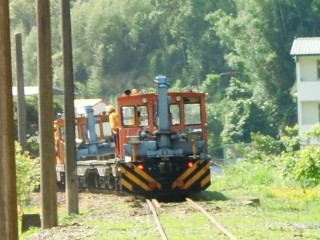
Eventually, it was time to return to Sanyi in order to catch the 4:25 train back to Fengyuan 豐原. I stuck to the road for the return leg, and soon after leaving Shenghsing, I started hearing the sound of a horn blaring somewhere behind me, but getting closer. I assumed it was a tour bus making its way along the narrow, winding road. However, as I was walking past the aforementioned Tunnel No. 2, a maintenance train of same kind emerged. Apparently, the Old Mountain Line does see some action after all:


I made it back to the station with about 15 minutes to spare. All in all, it was a pretty good outing today, one that I would recommend to anyone who doesn't mind hoofing it to get from place-to-place. Just don't do it on weekends!

The beauty and charm that is small-town Taiwan

Wednesday, May 5, 2010

Hiking Heaven

Anyone who has driven on National Highway No. 1 中山高速公路 near the town of San'i 三義 in Miaoli County 苗栗縣 has seen these, the Sanyi Huoyanshan 三義火炎山:


Obviously, at some point in time, massive landslides removed big chunks of the mountainside. I've often wondered if there were any hiking trails in them thar hills, and today I found out there were. Located near the spot where Sanfeng Road 三豊路 meets the freeway is a small parking lot, and some concrete steps leading up into the trees. The steps soon stop, and a trail begins winding its way up the hill. Deceptively gentle at first, it soon becomes rocky, and though not a technical climbing challenge (as if this pansy-ass weekend hiker, who prefers to go out on weekdays, would know), it's a lot more difficult than the wooden staircases that bring walkers to the top in Tak'eng. In many places, there are ropes to help the hiker along, and hiking clubs have left numerous ribbons tied to trees to indicate the way (useful in several spots). At one point, it's necessary to walk along some logs that have been tied to the hillside with ropes:


The best part about the trail is that it takes you right up to the denuded hillsides. The trail skirts the ridgetop, and there are several viewpoints that provide stunning vistas of the badlands:


Another great feature of today's walk was the fantastic views of the plain down below. Even on a hazy afternoon like today, it was possible to see far in almost all directions. On a clear day, the views must be spectacular:


About 90 minutes into the hike, I came to a clearing, where previous hikers had built a cairn. A perfect spot for a self-portrait:


The trail continued on from here, past another cairn (where I added a stone in memory of my beloved Uncle John, who died in his sleep last week), and further on along the top of the ridge. Unfortunately, at roughly two hours into the hike, I reached my fail-safe point, that moment when I had to turn around and head back to my scooter, so that I would have enough time to get home, have a shower and eat dinner, before going out to meet my private students. This is a trail that begs to be explored on an all-day outing, to see how far and where it goes. If you want to give it a try, be sure to wear gloves and a good pair of shoes, and bring plenty of fluids - I burned through two bottles of Pocari Sweat ポカリスエット, and I'm still feeling thirsty!

Without a doubt, today's route was the best trail I've come across so far in the greater T'aichung 台中 area.

Monday, April 26, 2010

Demonic (but friendly) drummers

In the central Taiwanese town of San'i  三義 there is a resort called West Lake Resortopia. You won't find it listed in any of the English-language guidebooks on Taiwan (there aren't that many to begin with), and for good reason - it wouldn't be of much interest to the average Western visitor in Taiwan, unless he/she wants to see what Asian European fantasies look like ("Versailles" rose gardens, "Dutch" wooden houses and so on). Except, however, when the resort plays host to Ondekoza 鬼太鼓座, a Japanese taiko 和太鼓 drumming troupe based in Fuji 富士市, Shizuoka Prefecture 静岡県. Pamela and I are both big fans of kumi-daiko 組太鼓, and we have an Ondekoza DVD, so naturally this was an opportunity that couldn't be passed up.

The group is performing at West Lake Resortopia as part of an annual festival centered around the blooming of the San'i area's Tung trees 油桐, so we knew today would be crowded. As a result, we were up at six this morning, and arrived at the resort shortly after nine. Good thing, too, as Amber was able to ride on the merry-go-round and a couple of kiddie trains without having to wait in interminably long lines. We were also able to find a space on the lawn right in front of the stage, with great views of Ondekoza as they performed their first show of the day at ten:


It wasn't all drums, flutes and cymbals. One member showed off some juggling skills involving a traditional Japanese toy called a kendama けん玉:


The highlight of the show, of course, was the Ōdaiko 大太鼓 solo...:


...a segment of which I recorded:


After the performance, Pamela bought a T-shirt, then we went backstage to have it autographed by a couple of the members, followed by some photos:


We spent the rest of the morning and afternoon walking around the resort. One of the stranger sights we encountered was this torii 鳥居:


It led past a chōzuya 手水舎, a Shintō shrine 神社 wash basin, to an artificial cave filled with statues of Kuanyin 觀世音菩薩, the Buddhist goddess of mercy.

There were Tung trees in bloom, but not as many as I'd expected:


For Amber, the highlights were the long slide and the obstacle course:


It took a while to get out of the parking lot and on the road back home (two words for the management of West Lake Resortopia to consider for next year: traffic control), but it was a fun day out for the three of us.

On a completely unrelated note, a brief Kyōdō News 共同通信社 article appeared in Sunday's Japan Today ("Taiwan arrests customs official over smuggling of Japanese beef"):

"A Taiwan customs official is in custody after allegedly covering up the smuggling of high-grade beef from Japan into Taiwan in defiance of a mad cow disease ban...Tang Lung-sheng, a section head at the T'aipei 台北 Customs Office, is alleged to have protected the smuggling operation that brought in more than 5,000 kilograms of Matsusaka beef 松阪牛 over more than a year. After intercepting the latest shipment Wednesday, prosecutors alleged that frozen meat importer Chang Shih-chun, 52, and others carried the beef in personal luggage on a weekly basis and that Tang ensured they passed through customs smoothly. Chang would then sell the beef to restaurants at more than twice the price he paid in Japan, prosecutors said. Health and agricultural officials are now attempting to determine where the beef was sold, officials said. Tang denied involvement in the operation, according to media reports, but he was detained as investigators looked for evidence of accomplices among his colleagues..."

Will there be an underground market for American cow tongues?

Wednesday, April 14, 2010

Afternoon Wood

I bought a new pair of hiking shoes last weekend in preparation for my trip to Japan next month (where I plan to climb a couple of mountains), and I've been wearing them every day in an attempt to break them in. Today, they received an extensive workout in the town of San'i 三義.

Mention Sanyi to a Taiwanese person, and "wood carving" will probably be the first thing that comes to mind. Ever since a Japanese military officer at the end of the 19th century discovered camphor trees growing in abundance in the area, the town has become known for wood sculpture. In recent years, the flowers of the Tung tree 油桐 have also attracted the tourists, and so I set out to walk what's known as the "April Snow Trail" 四月雪歩道.

Rather than riding my scooter from Fengyuan 豐原, I instead took a local train three stops to Sanyi Station 三義車站. From the station, it's a long, uphill walk along Chungcheng Road through an altogether unappealing part of the town. It took about 30 minutes to reach the turnoff to Kuangsheng Village, one of two areas in Sanyi cluttered with woodcarving stores.

On weekends, like other tourist hotspots in Taiwan, Kuangsheng Village is a zoo. On a Tuesday afternoon, things were much quieter, with only a few visitors. The shops were open, and quite aromatic:


At the end of the road is the Miaoli Wood Sculpture Museum (more on that later), and the start of the April Snow Trail. The path is an easy one, and my shoes will have to wait until the next time I go to Tak'eng to get a real workout. I actually came here with my wife about four years ago, not long after my daughter was born, and I carried Amber in my arms to the top and back down. Today was much easier! Unfortunately, it seemed I was too early for the tung blossoms. There were only a relative handful on the ground, though someone had thoughtfully arranged some of them for photographic purposes:


At the top, the path opens up onto a large tea field:


After walking around the tea bushes and back down the trail, and having plenty of time to kill before the next train back to Fengyuan, I paid the NT80 (¥240/$2.50) to go inside the aforementioned museum. With four floors of exhibits on Taiwan's wood culture, it makes for an interesting and informative visit - or would be, if you can read Chinese. English labeling is rather minimal, which is a pity. It's also a shame that photography isn't allowed, for the religious statues and examples of traditional Taiwanese furniture and architecture are a sight to behold, both in their craftsmanship and attention to detail.

After the museum, I left Kuangsheng Village and walked back down to Chungcheng Road. Turning right there, the road changes its name to Shuimei Street, and is Sanyi's other major grouping of woodcarving stores. I took a short walk along this road, until it was time to turn back and head downhill towards the train station.


In addition to wood and its many uses, Sanyi is also famed (within Taiwan) for Shenghsing Train Station 勝興車站, an abandoned rail outpost set higher up in the hills opposite Sanyi. I'll save this for another visit in the not too distant future.

Oh, and the shoes held up well.