Monday, July 4, 2011

Okinawa Getaway: Days 1 and 2 6月25日と6月26日

To commemorate my recently completed and very enjoyable 8-day visit to Okinawa, I've changed the theme of this blog to Ocean Blue, and my user pic to that of a Deigo flower デイゴ. We now return to our regularly scheduled blog update...

No T'ái​wān Beer 台灣啤酒 for this traveler while waiting for my China Airlines 中華航空 flight from T'ái​wān T'áo​yuán International Airport 臺灣桃園國際機場

My first day in Okinawa Prefecture 沖縄県 (though not my first trip; I visited Miyako Island 宮古島 back in the summer of 1993) was a short one. My flight arrived at Naha Airport 那覇空港 in the early evening on Saturday, and by the time I had taken the Yui Rail ゆいレール monorail into central Naha 那覇 and checked into the Tōyoko Inn 東横イン那覇旭橋駅前, there wasn't  much to do except take a brief walk around the neighborhood, and then call it a night. Sunday would prove to be much busier...

Following breakfast and checkout (and entrusting my bag in the capable hands of the hotel staff), I rode the monorail to the end of the line, Shuri Station 首里駅. From there, it was a 15-minute walk to Shuri Castle 首里城, formerly the seat of power of the rulers of the Ryūkyū Kingdom 琉球王国. For an overview of the kingdom's history, you can read the Wikipedia entry. For those who don't have the time, here's the condensed version: a unified kingdom was established in 1429, and governed from Shuri. The kingdom prospered as a vassal state of the Ming 明朝 and Qing 清朝 dynasties, until the armies of the Satsuma domain 薩摩藩 on Kyūshū 九州 invaded in 1609, and took over control of the Ryūkyū Islands 琉球諸島. The Satsuma rulers ruthlessly taxed and exploited the Ryukyuans, but maintained the fiction of an independent Ryukyuan royalty. This lasted until the end of the feudal era in Japan. The monarchy was abolished in 1872, and Japan annexed the islands as Okinawa Prefecture in 1879.

As for the castle itself, like much of Naha and southern Okinawa, it was devastated during the American invasion in 1945, and what can be seen today is a painstaking recreation of what once stood on the grounds of Shuri. But what a recreation it is! Everything has been done so well that the area has been declared a UNESCO World Heritage Site.

To reach the castle, you pass through a series of gates. First up is the Shurei-mon 守礼門, a beautiful sight even in the heavy rain (Sunday was the only day of frequent showers during my entire trip, fortunately):


The most impressive of the remaining gates is the next one, the Kankai-mon 歓会門, a guard tower set between limestone walls:


Finally, you reach the ticket gate and the central courtyard, and the colorful Seiden 正殿, which served as the palace for the Ryukyuan kings. Like so much of Okinawan culture, the architecture of the buildings in the Shuri-jō complex demonstrate both Chinese and Japanese styles:


Visitors can walk around the interior of the Seiden, the highlight of which is the upper-floor throne hall. The sign behind the throne is a gift from the Qing Dynasty Emperor Kang Xi 康熙帝, and reads Chūzanseido 中山世土, "For generations, Chūzan is a nation ruled under the King of Ryūkyū":


The fact that all of this splendor had to be recreated in the late 1980's and early 1990's was a sad reminder of what a senseless waste the Battle of Okinawa 沖縄戦 was, feelings that would be really be driven home later on in my trip.

After checking out the splendors of the Seiden, I walked over to Irino-Azana 西のアザナ, a lookout with a great view of Naha below, and the Kerama Islands 慶良間諸島 in the distance:


The ruins of Enkaku-ji Temple, the walls of which are pockmarked with shell holes from the war:


The last thing I did at Shuri Castle was watch a series of four short performances of traditional Ryukyuan dance:


Most of the dances were very slow and measured, but the third one was more uptempo. I managed to record most of it (in two parts):


At this point, it was time for lunch. I resolved on this trip to try as many different kinds of Okinawan dishes as I could, and at the restaurant inside the visitors center I had gōyā champurū ゴーヤーチャンプルー , bitter gourd, egg and pork fried together, and washed down with a mug of Orion Beer オリオンビール, the local brew. I ate well on this trip, if I do say so myself:


With lunch taken care of, it was time to return to the Toyoko Inn, retrieve my bag and take the monorail back to the airport for my flight to Ishigaki Island 石垣島. Alone among all the prefectures in Japan, Okinawa doesn't have any railroad lines, but Naha's monorail system was very convenient. Though it's only a single line, it runs between the airport and Shuri, and many of the city's sightseeing spots are a short walk from a station:


At the airport, I noticed this sign indicating the distances both to Ishigaki (414 kilometers/257 miles), and T'ái​pěi 臺北 beyond (655 kilometers/407 miles):


It only took an hour to fly from Naha to Ishigaki. Ishigaki Airport 石垣空港 had a very laid-back feel to it - you walk down the steps from the plane, across the tarmac, through the very small terminal and onto a waiting bus for the 20-minute drive into town. All this will probably change in 2013, however, when a newer (and more environmentally destructive) airport is due to open:


Once in Ishigaki city 石垣市, I checked into my home for the next five nights, Rakutenya 楽天屋, a 90 year-old traditional Okinawan home that has been turned into a guesthouse. My room was small, but it was a bargain at only ¥3000 ($37/NT1070), and the husband-and-wife owners were extremely friendly and helpful. The wife spoke very good English, and showed me the way to Amurita Noniwa あむりたの庭, a cool-looking restaurant where I had the local Yaeyama soba 八重山そば, but done with a twist - green curry soup (Yaeyama 八重山諸島 is the name of the island group of which Ishigaki is the most populous). And instead of Orion, I enjoyed the first of many Ishigaki Beers 石垣島地ビール, a local microbrew:


The young owners, Shingo and Sayuri Miyamoto, were very friendly, and kicking back with them was the perfect way to end what had been a very enjoyable day:


Akata Sundunchi 赤田首里殿内, "Inside Akata Shrine in Shuri"

Friday, June 24, 2011

Welcome to Fantasyland: the Commonwealth of Taiwan - The People and the Land

A brief mention of Taiwan’s native peoples and its land (their land?) as our exercise continues…


Taiwan 台湾 is unique when compared to Japan in its relative ethnic diversity. Whereas there are only a small number of native Ainu アイヌ peoples remaining in Hokkaidō 北海道, and the presence of roughly a million resident Koreans 在日韓国・朝鮮人, in Japan, the commonwealth is home to 14 aboriginal tribes that have received official recognition by the government in Taihoku: the Ami アミ, Atayal タイヤル, Bunun ブヌン, Kavalan クバラン, Paiwan パイワン, Puyuma プユマ, Rukai ルカイ, Saisiyat サイシャット, Tao タオ, Thao サオ, Tsou ツォウ, Truku タロコ, Sakizaya サキザヤ and Sediq セデック. Recognition as an indigenous community gives a tribe title to ownership of certain land tracts, as well as the right to use their native names on official documents, such as family registries 戸籍 and passports. The latter caused much friction with Japanese authorities, who insisted that as Japanese citizens, Taiwan’s aborigines must use kanji 漢字 in writing their surnames and given names. Eventually, the Japanese government acceded to repeated requests by aboriginal activists and Taiwanese authorities, and now allows native people to use kana 仮名 for purposes of transliteration.

Despite much progress in recent decades, the aboriginal peoples of Taiwan are still economically disadvantaged in comparison to other commonwealth ethnic groups. Entertainment, military service and sports continue to provide popular routes for aboriginals seeking to improve their economic status.

There are four areas designated as “state parks”, and administered by the commonwealth’s interior ministry. Three were established during the pre-war period – Daiton 大屯, Shintaka Arisan 新高阿里山 and Tsugitaka Taroko 次高タロコ – while the other one (Kontei 墾丁) was set up by the commonwealth authorities. These areas are not considered part of the Japanese national park system 国立公園. In addition, the commonwealth’s tourism bureau has designated twelve areas throughout the island as “scenic areas”.

As an external territory of Japan, Taiwan is responsible for its own environment, and thus administers a separate set of environment regulations from those in Japan. This has provoked a great deal of controversy among the Taiwanese public, especially in recent years, as many people feel the commonwealth government has not been stringent enough in its efforts to maintain a clean and healthy natural environment for its residents.

Wednesday, June 22, 2011

Welcome to Fantasyland: the Commonwealth of Taiwan - Legal Matters

From the wall of a Japanese restaurant, something about an old tree with its roots firmly attached to the ground, and its leaves to the branches, and still growing.

We now return to our regularly scheduled fantasy...


While Taiwan's 台湾 criminal justice system is organized along Japanese lines, its institutions enjoy a great deal of autonomy. Law enforcement is provided by a commonwealth police force under the oversight of a police agency headquartered in Taihoku 台北. The force is staffed almost entirely from top to bottom with Taiwanese, and operates independently from the National Police Agency 警察庁 in Japan. Operations are centralized, and police officers can, and often are, assigned to different areas of Taiwan during their careers.

The judicial system also operates separately from that in Japan. As with the police force, the number of Japanese officials has been reduced over the decades to the point where virtually all prosecutors, judges and corrections officers are Taiwanese. Taiwan has its own law schools which train students to become lawyers, and its own bar association, which administers qualifying exams for those wishing to practice law, as well as being responsible for seeing that its members adhere to its ethical standards. While the commonwealth government does recognize legal degrees and qualifications obtained in Japan, it still requires the holders of such to pass a modified bar exam if they wish to set up practice in Taiwan (the reverse holds true for Taiwanese aspiring to do the same in Japan).

The basic court system is divided into three tiers, with trial courts at the lowest level; district courts, which handle appeals of trial court decisions, as well as cases involving more technical matters; and a high court, which sits in Taihoku. In theory, Taiwanese are entitled to appeal high court decisions to the Supreme Court of Japan 最高裁判所 in Tōkyō 東京. In practice, however, such requests are usually rejected by the Japanese high bench, unless there are constitutional issues involved (see below). As is the case with all other official matters of business in Taiwan, Japanese is the language employed in the practice of law on the island.

Taiwanese courts have yet to follow the lead of courts in Japan and establish a lay judge system 裁判員制度, but the issue is currently being discussed in Taiwan's legislature.

Despite the autonomy enjoyed by the legal/criminal justice systems on Taiwan, there are a couple of important restrictions that must be noted. The first is that any act passed by the National Diet 国会 in Tōkyō can supersede any legislation enacted by the commonwealth's legislative assembly in Taihoku. Secondly, all laws promulgated in Taiwan must be in accordance with the Constitution of Japan 日本国憲法.

Monday, June 20, 2011

Dad's Day 父親節

The third Sunday in June is Father's Day in many countries, including the U.S.A. and Japan 父の日, but not here in T'ái​wān 台灣, due to some annoying cultural reasons, the day is always observed on August 8. Fortunately for this dad, our household follows the American calendar in these matters, and so the three of us celebrated, um, me at a beer restaurant in T'ái​chūng 臺中. Located on the 10th floor of the MODE Mall (just a short walk from the South Exit of T'ái​chūng Station 臺中車站, though today we took the car, and had a hell of a time finding a place to park), Bravo Beer is a T'ái​pěi 臺北-based (the best always are in this country) bar/restaurant that specializes in beers from Heaven...I mean Belgium. Needless to say, the couple of brews I had this afternoon were divine, and the food wasn't bad, either - the Scotland Boneless Chicken Thigh I ordered was pretty tasty. Surprisingly, although the restaurant was busy, it appeared only a handful of diners other than ourselves were drinking beer with their meals. Perhaps this isn't surprising after all - taking into consideration both the dominance of the locally-produced, mass-market (and tasteless) T'ái​wān Beer 台灣啤酒, and the miniscule number of microbreweries on this island, the vast majority of Taiwanese are not all that familiar with the taste of good quality beer.

As for all you Westerners out there who claim to enjoy Taiwan Beer, you're just hopeless...wait, what I mean is you should know better. Shame on you all (but Happy Father's Day if it was applicable).

Here's what I had this afternoon. My wife made do with a large draft Hoegaarden (sorry Barbara!):

First up was a Westmalle Tripel, one of the best-known brews outside of Belgium. The 9% alcohol content did a lot to alleviate my sore throat.

I had hoped to try a De Koninck ale, but it wasn't in stock at Bravo. They did have Karmeliet, however, which my daughter insisted I order after I told her it was an amber ale. I'm glad I took her advice.

Sunday, June 19, 2011

Family fun at the love hotel!

My daughter on occasion does some modeling work for a children's clothing wholesaler (this is what happens when your Asian wife is convinced that your Amerasian child needs to be shared with the entire world). Today was one of those days, only with a difference. Usually the photo sessions take place on a Saturday morning at the company's office, but on this Saturday, the time was changed to the early afternoon, and the location was at one of T'ái​chūng's 臺中 infamous boutique hotels, the Mùlán Motel 沐蘭旅館.

For those who are unfamiliar with the concept of boutique hotels, they are basically overdecorated, overpriced...sorry, "upmarket" versions of what the Japanese introduced to the world in the postwar period as "love hotels" ラブホテル. For NT10,000, you and your loved one (or whomever you just happened to have picked up that evening) can spend the night getting horizontal (or vertical, if the case may be) in a "high-class" room complete with a home entertainment system, jacuzzi, a themed bedroom and, for some strange reason, a toilet sans door (how that might excite one's erogenous zones is beyond my comprehension). Yes, that's $350 (or ¥28,000) for a night of sin in a room the aesthetics of which can best be described as appealing to a poor, barely educated farmer who suddenly struck it rich in the lottery. It's lust the nouveau riche way!

What I can't understand is why the company chose a love motel as the setting for photos of children wearing the latest summer fashions. While standing around outside waiting while the room was being readied, there was a busy stream of couples driving in and out of the motel, including a foursome in one car (cue the imagination to get a workout). I don't know what the visitors were making of the sight of seven adults, four kids and several bags of clothing and equipment, but hopefully their thoughts were of the clean and wholesome variety, even if their nights (and afternoons, in some cases) probably weren't.

The bedroom. The kids made a beeline for the bed and started bouncing up and down on it. Fortunately, none of them noticed the dish of condoms on the chest of drawers next to the bed, and so no awkward questions had to be answered.

The bathtub area, complete with tastefully arranged faux palm trees.

Amber strikes a pose. Yeah, baby!

For Amber and the other kids, the highlight of the afternoon came, no doubt, at the end, when they all got to play in the tub.

Saturday, June 18, 2011

Sunset...日没...日落

The sunset this evening in Fēng​yuán 豐原, following a brief but heavy late-afternoon downpour.

Friday, June 17, 2011

Welcome to Fantasyland: the Commonwealth of Taiwan - Security

Kaminoge's summer fantasy rolls on...

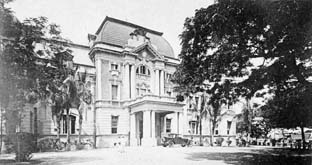
Taiwan Grand Shrine 台湾神宮, a Shintō shrine 神社 constructed in Taihoku 台北 in 1901

In addition to managing Taiwan’s 台湾 foreign relations, the central government in Japan is also responsible for the defense of the island. In order to avoid upsetting Chinese sensitivities, the Japanese Self-Defense Forces 自衛隊 keep a low profile on Taiwan, and the primary responsibility for the commonwealth’s security falls on Japan’s Coast Guard 海上保安庁. In particular, the JCG maintains a visible presence in the waters around the Hōko Archipelago 澎湖諸島, ensuring that Chinese and other foreign fishing vessels stay out of Taiwan’s exclusive economic zone.

Owing to its status as an external territory of Japan, Taiwan’s security is covered under the terms of the Treaty of Mutual Cooperation and Security between the United States and Japan 日本国とアメリカ合衆国との間の相互協力及び安全保障条約. As part of efforts to demonstrate American resolve regarding the defense of Japan, the U.S. military holds annual exercises on Taiwan in conjunction with the SDF.

Taiwan does not maintain a territorial army or an American-style national guard. Being Japanese citizens, Taiwanese are permitted to enlist in the Self-Defense Forces. In fact, a relatively high percentage of SDF members from Taiwan are made up of members from Formosa’s aboriginal tribes 台湾原住民, with military service having long been considered one of the most effective routes for Taiwan’s native peoples to escape from discrimination and economic inequality.