Sunday, July 6, 2014

A consensual visit to Nanjing (Part Deux)

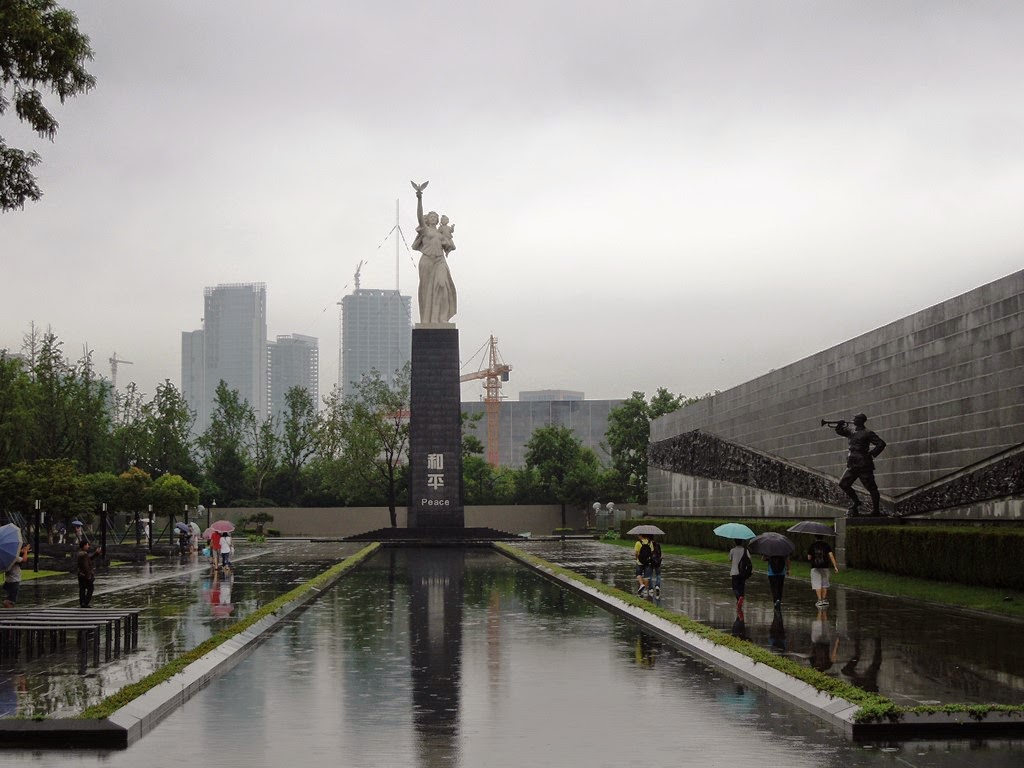
In a war that saw no shortage of crimes against humanity, the Nanking Massacre was one of the worst. Though it happened 76 years ago, continuing tensions between the Chinese and Japanese governments ensure the atrocity is kept alive for as long as it suits political purposes. No visit to Nánjīng 南京 would be complete without a visit to the Memorial Hall of the Nanjing Massacre 南京大屠杀纪念馆. I showed up at 8:30 on a Saturday morning just as the museum was getting ready to open, and was immediately struck by two things: one, even at that early hour, people were lined up waiting to get in; and, two, there were a lot of small children there. Personally, I wouldn't have exposed my eight-year-old to the strong images on display in the hall, but then it's never too early to inculcate the young.

One thing you will see throughout the museum is the figure 300,000, which according to the Chinese government is the number of victims slaughtered by marauding Japanese troops. The International Military Tribunal for the Far East put the toll at 200,000, while estimates by neutral historians range from 40,000 to over 300,000. The Chinese insist on 300,000, the rigidity of which has the unfortunate and unintended effect of giving massacre deniers in Japan ammunition in their attempt to whitewash the atrocity:


The exhibits are understandably disturbing.  The displays begin with the lead-up to the Battle of Nanking, showing the effects of the bloody Battle of Shanghai that preceded the attack on Nanjing, which at that time was the capital of the Republic of China 中華民國:


Some of the men who planned the advance on Nanjing:


Nanjing fell on December 13, 1937:


What followed was six weeks of arson, executions, looting and rape unleashed upon the civilians of Nanjing by Japanese troops, in what must have been a hell on earth for those who couldn't or didn't flee the city as the Japanese forces approached. Young and old, male and female, it seems no one was spared. The displays are graphic, as can be expected:


Westerners living in Nanjing formed a Nanking Safety Zone in an attempt to save Chinese civilians. They were led by John Rabe, a German businessman who was horrified by the events unfolding in the city. The irony was that Rabe was a loyal member of the Nazi party:


The museum goes on to detail what happened to those who perpetrated the massacre following the end of the war. Tribunals were set up by both the Allied powers and the Chinese government to try those responsible for the Rape of Nanking. Among those convicted and executed were Toshiaki Mukai 向井敏明 and Tsuyoshi Noda 野田毅, who were notorious for engaging in a contest to see who would be the first to behead 100 Chinese with swords:


Reactions from the contemporaneous world press over the Nanking Massacre:


The Massacre of Nanking was horrifying, and the exhibition hall does an excellent job of laying out what happened. Where it falls short, however, is in the captioning. Although most of the displays are captioned in English and Japanese as well as Mandarin Chinese, it's clear the exhibits are meant for a Chinese audience. Unlike the atomic bomb museum in Hiroshima 広島 which focuses more on what happened at the moment the bomb was dropped and how its victims suffered afterward, instead of dwelling on who was responsible for the bombing in the first place, the hall in Nanjing makes it constantly clear the "Japanese aggressors" were responsible. This caption below, with its references to "national humiliation" and "patriotic education" makes it evident that more than a simple "No more Nanjings" is at play in the memorial hall:


Upstairs, the museum details the history of Japanese military aggression against China, including the First Sino-Japanese War of 1894-1895, in which Japan and China fought over who would be the dominant power on the Korean peninsula (so much for self-determination for the Korean people - Korea had long been a vassal state of both the Ming and Qing Empires). This display on the Wushe Incident betrays its political prejudices - it's portrayed as a general uprising against Japanese rule rather than the localized incident it actually was, and the Atayal tribesmen who carried out the massacre are not identified as such, being referred to instead as gaoshan 高山 people. Several exhibits referred to Taiwan as having been "returned to the motherland" after the war:


Despite what elements of the far right in Japan may say, Japanese military forces committed unspeakable acts of inhumanity against Chinese, Koreans and many others in East and Southeast Asia. And though the Japanese government has expressed regret and remorse on numerous occasions, and the country has led a peaceful existence since 1945, the vocal actions of an influential minority in Japanese politics help to keep memories from being forgotten and hatreds left behind in the past:


However, it must be noted that memories of wartime atrocities serve important domestic purposes, particularly in China. As social problems arising from China's rapid economic growth present a potential threat to one-party rule, focusing attention on a foreign neighbor deemed to have not sufficiently atoned for the sins of the past serves a way to divert anger and resentment away from the government. And as China pushes its implausible territorial claims in the East China and South China Seas, it needs an enemy for its people to focus on. Hence, the nightly TV dramas showing heroic Chinese battling demonic Japanese invaders and museums such as the one in Nanjing:


It's almost as if the population is being prepared for the eventuality of war one day over, say, the Senkaku Islands 尖閣諸島. If such a scenario does play out, however, whether there or in the islands close to Vietnam or the Philippines, the people may be surprised to learn that they will be regarded as the new invaders, and not as the heroic resistors like those who kept the Imperial Japanese Army 大日本帝国陸軍 bogged down in its own Vietnam-like quagmire at great human and social cost:


The present Chinese government has gambled in placing so much stock on what happened in the past instead of looking toward a future of peaceful coexistence. The Memorial Hall of the Nanjing Massacre is an emotionally draining experience, but one that visitors to Nanjing should make an effort to see. It seems to me, however, that even if the Japanese government were tomorrow to apologize unequivocally to all those who suffered during the years 1931-1945, followed by sufficient compensation payments, the government here would still lay on the "patriotic education". To stop doing so would be too fraught with risks to those in charge:

Whereas the Memorial Hall of the Nanjing Massacre was an unpleasant experience due to the subject matter of the exhibits, my next stop, the Presidential Palace 总统府 was an unpleasant experience due to the sheer number of visitors:


A former palace in Ming-dynasty times that was destroyed during the Taiping Rebellion, the reconstructed building was briefly used as a presidential office by Sun Yat-sen 孙中山 in 1912, and then by the Kuomintang 国民党 between 1927 and 1949. As a result, it's high on the list of places to see in Nanjing by Chinese tourists. It was hard to appreciate the classical and Western touches with so many people pushing and shoving to see what was in the various rooms:


Nicer to appreciate, even in the falling rain, were the classical Ming gardens:


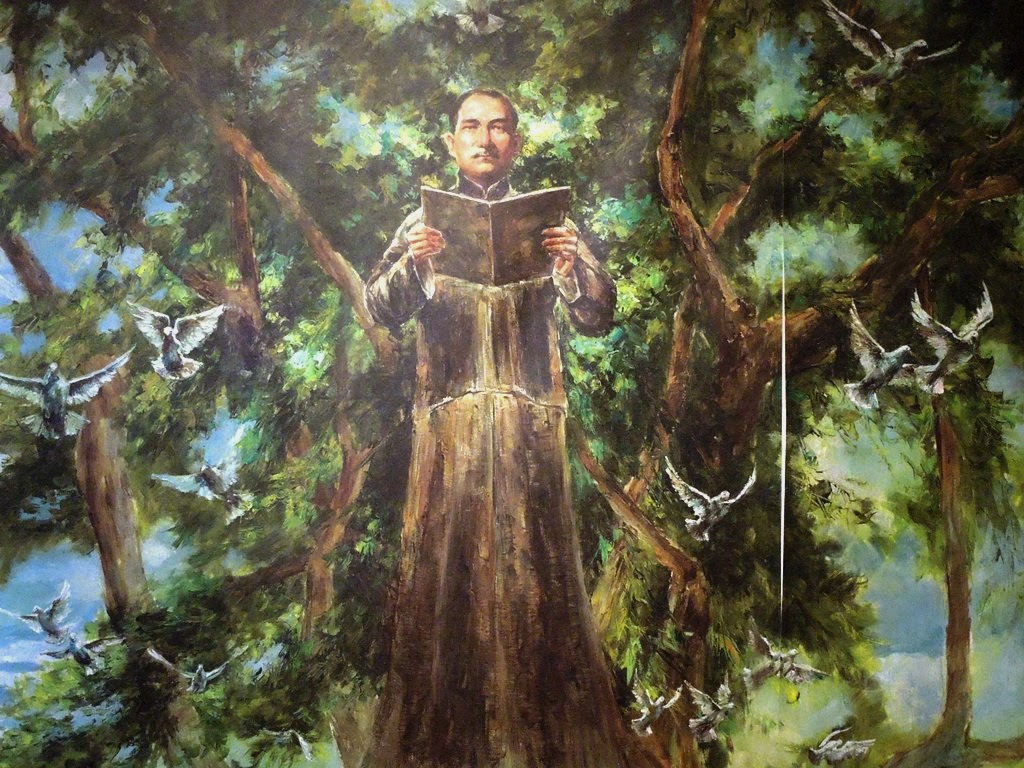
At this point in my China travels, I've seen more historical photographic exhibitions of Chinese historical and political personages than I care to remember. Still, the portraits of Sun Yat-sen on display at the Presidential Palace have reached new heights of ridiculousness, with the ultimate in deification having to be a portrait of him as literally some kind of tree of knowledge:


It was with a great deal of relief that I left the crowds back at the Presidential Palace and returned to modern-day Nanjing. Setting off in search of lunch, it was a long walk down a busy road that was inexplicably lacking in eateries, but where I could've purchased gold jewellery at more than a dozen locations. In the end, I seemingly had no choice but to have a miserable meal at a KFC, only to come across restaurant after restaurant after resuming my walk following lunch. Screw you, Nanjing:


Fortunately, the last sight I visited in Nanjing restored my faith in sightseeing in China. The Zhōnghuá Gate 中华门 is one of the surviving remnants of the original heavily-fortified 13 Ming-dynasty city gates. It's actually four gates, one inside another, and the seven enclosures could hold 3000 soldiers. Visitors can climb up to the top for views of the city:


The story goes that each brick used in the construction of the walls had the name of its place of origin, as well as the names of brick-maker and the person overseeing them:


In any event,  climbing the wall was a nice way to end my stay in Nanjing. The city can be safely skipped if you're only going to be visiting China once and your time is limited, but it does make for an interesting excursion from Shànghăi 上海:


The cavernous interior of Nanjing South Railway Station 南京南站:


A bowl of rāmen ラーメン for dinner went a long way toward making up for the debacle that was lunch:


Saturday, July 5, 2014

A consensual visit to Nanjing (Part 1)

Rain.

Every time I go on a trip, it seems, there will be rain. Areas suffering from severe droughts should invite me to come visit, for I'm sure to bring forth water down from the sky. Certainly the two days I spent in Nánjīng 南京, the former capital of the Republic of China 中華民國 before its government fled to Taiwan, and site of one of the most notorious war crimes of the Second World War, were very wet ones. Nevertheless, short of a typhoon (and I've experienced those as well when I'm on vacation), I still persevere in seeking out the sights no matter how soaked I and/or my belongings become in the process, and with that, I bring you a few impressions of one of China's most important historical cities.

For most Westerners, the name Nanjing probably conjures up the Rape of Nanking, and for that reason the first thing I did after arriving in the city by train from Shànghăi 上海 was to take the subway into the southwestern suburbs to visit the Memorial Hall of the Nanjing Massacre 南京大屠杀纪念馆. Surprisingly, for a rain-soaked late morning on a weekday, there were a lot of people lined up to go inside. The atmosphere was also unexpected - visitors were posing with the outdoor sculptures as if they were artworks in a public park, while vendors were hawking umbrellas and Chinese flags. I decided that perhaps it might be better to return the following morning before the museum opened and so beat a hasty retreat:


Instead, I made my way by Metro to the hilly area containing two of Nanjing's most visited sites, the Míng Xiàolíng Tomb 明孝陵 and the Sun Yat-sen Mausoleum 中山陵. It was a 1.6 kilometer (one mile) walk from the subway station uphill, but the walkway led through the kind of scenery never glimpsed in Shanghai:


After purchasing the entrance ticket and passing through a huge gate, the inside of which contained a statute of a giant turtle with a stele on its back...:


...the first section of the mausoleum containing the tomb of the founder of the Ming Dynasty is a 618 meter (2028 feet) "spirit path", lined with stone statues of animals both real and imaginary:


A second, shorter path has statues of generals and officials marking the way:


The route then enters into a courtyard and through several pavilions, including one containing a stele of homage from the second Qing emperor to his Ming predecessor of 300 years earlier:


Eventually, the mammoth mausoleum comes into view:


To get to the top, you first walk up through a tunnel, before mounting steps to the outside viewing platform:


Behind the mausoleum is nothing but hillside and forest:


On the way out, a chance to admire some of the details:


Lunch - overpriced but overdue, according to my rumbling stomach:


From the tomb, it's a short walk along the same wooded path to the other mausoleum, that of the father of modern China, Dr. Sun Yat-sen 孙中山:


The lousy weather did little to deter the crowds arriving by the busload from making their way up the 392 steps to the where Dr. Sun is entombed:


Inside the chamber sits a seated marble statue of Dr. Sun, complete with signs commanding visitors to "salute", while the ceiling is emblazoned with the emblem of the Kuomintang 國民黨. The remains of the man himself lie in a coffin contained further within, but it was closed off for viewing that day:


On the outside facade are carved the "Three Principles of the People". The book expounding these principles made life miserable for millions of Taiwanese schoolchildren:


Were I Chinese, I would probably be in awe of the man, a hero of the nation revered by both Nationalists and Communists. For me, however, it's hard to understand the reverence. This was a man who failed several times at organizing revolts to overthrow the Qing Dynasty, only to be completely taken by surprise (not to mention out of the loop) by the uprising that did bring to an end Imperial China. His reign as the first president of the Republic of China has to be considered a failure - the country was far from united, the central government was weak and following his death, the leadership fell into the authoritarian hands of Chiang Kai-shek 蔣介石, eventually leading to civil war and the rise of the communists. None of this has prevented a cult of personality from arising around Sun Yat-sen, as I would learn more on my second day in Nanjing:


Still, I had to buy a souvenir. Not surprisingly, the lighter didn't work when I tried it later in my hotel room:


I don't normally post pictures of signs with strange English on them as the subject has been done to death since the days even before the Internet (hard to imagine), but this one was too strangely-worded to pass by:


Dinner was had at a Mexican restaurant called Behind the Wall, where I was the only customer there until almost the end of my meal:


The end of a long, wet but interesting day in Nanjing:


Sunday, June 29, 2014

Zen and the art of bicycle riding in Shanghai

The girls are back in Taiwan and won't be back until late next month, which means I'm now a bachelor again...for the next three weeks, anyway. In theory, this could mean clubbing every night until the wee hours of dawn, followed by orgies back home with all the morally-loose sleazy young women I picked up over the course of the previous evening. In reality, I'll be sitting on the sofa in my underwear, watching TV and counting off the days on the calendar when my wife and daughter will be back and life can return to normal. 

One of the few silver linings in this cloud is that I now have time on the weekends to go for long bicycle rides. A little while ago, I purchased a Trek mountain bike as an early birthday present for myself, and I've been using it for short rides around the neighborhood. With family obligations now on hold for the time being, I can stretch my legs and begin exploring more of Shànghăi 上海. 


Granted, bike riding in a city of 24 million people is no idyllic ride in the countryside, let alone a grueling but satisfying conquest of mountain ranges. It's a constant battle with taxis, buses, motorbikes and pedestrians in a noisy environment of asphalt, concrete and pollution. On long stretches of the route I took this morning and afternoon (in particular, on Nánjīng 南京路 and Bějīng Roads 北京路), I was forced to use sidewalks as bicycles were prohibited from riding in the street due to the absence of dedicated motorbike lanes. Still, I made it to my destination and back in one piece, stopping en route at a cafe to lunch on spaghetti and Tsingtao Beer 青岛啤酒:


And what was my destination, you might be asking? The answer is one of Shanghai's best modern art showcases, the Rockbund Art Museum 上海外滩美术馆, located just a couple of blocks from the city's iconic Bund 外滩 area.  This private museum is housed in the former Royal Asiatic Society building, dating from 1933:


The current exhibition is titled "Advance through Retreat". According to the guide to the exhibit:

"Advance through retreat" is a stratagem elaborated in the Chinese military treatise "The Art of War"... (It) is a strategy relevant for artistic production in China today. Taking the image of the general in disguise of a hermit and his strategic retreat, this exhibition sets out to present artistic positions using traditional media and procedures, such as divination, the game, gambling and the vernacular, as well as traditional strategies - for instance, "advance through retreat" - in order to develop autonomous languages uttering such positions of resistance to the assimilating tendency and the power of structures generated and maintained by a lingua franca.

Perhaps this all makes more sense in Mandarin. In truth, it was difficult to see what the four floors of exhibits had in common with each other:


This truck was used in an outdoor installation in the German city of Stuttgart as a May Day realization of the Suprematist manifesto. Suprematism was hardly relevant in 1997 when the truck took part in a parade that day - it's even less so in 2014:


The most interesting exhibits were both video installations. In one, people would walk up to a man seated at a desk and hand him an object such as a parcel or a piece of fruit. The man would smash the item with a rock, then take out a notepad, stamp and a sign a piece of paper as if he were a bureaucrat (and I should know!), and then hand the document to the person. The other was a documentary on Pablo Wendel's disguising himself as one of the Terracotta Army soldiers and attempting to hide among the famous figurines. 

The exhibits were interesting, but it didn't take long to see everything. The best part about visiting the museum is that the 30 RMB ($4.80) admission ticket included a free cup of coffee, which could be taken on the 6th-floor patio. Despite the haze, there were good views to be had of the Bund and Pŭdōng 浦东...:


...as well as of the surrounding neighborhood...:


...plus opportunities for selfies:


Back inside, the view of across the street from the museum:


The air quality today left much to be desired. On the other hand, this summer has been cooler than normal, with temperatures still only in the high 20's Celsius, quite a change from last year's record-breaking furnace-like conditions. And although we've had a lot of rain in recent weeks, today there were only a few drops in the early evening. And the smog did lend Pudong a certain mysterious aura:


Going home and having to use the sidewalk on Beijing Road. This picture gives you an idea of the narrow walkways and pedestrians with their eyes glued to their smartphones. For whatever reason, many Chinese, whether they're behind the wheel of a moving vehicle or using their feet and legs in order to get around, appear oblivious to what is going on around them. Note to self: install a bell on your bike:


The always scenic Yán'ān Road 延安路:


At most, I only covered  about 25 kilometers  (15.5 miles) today, and all the exhaust fumes and smog that I breathed in while riding (not to mention the stress of having to dodge people on the pavement and keep a watch out for turning cars and buses) probably negated whatever health benefits that are usually accrued from cycling. On the other hand, since I started riding, my surgically-repaired left knee has become a lot more flexible. And even though I was a sweaty mess by the time I rolled back into my compound (a quick dip in our still-cold swimming pool solved that), I still felt that I had actually done something useful with all that free time. So watch out, citizens of Shanghai: I'll be back to run you down on the sidewalks very soon!