Taiwan has its "old towns" - usually a block or two (sometimes more) lined with buildings the facades of which date from the time when the Japanese administered the island. Saved from destruction by the tourist trade, they form simultaneously interesting and depressing glimpses into Taiwan's past and present: elegant structures whose survival now depends on selling the same snack foods and souvenir knick knacks that can be found all over Taiwan to the weekend and holiday hordes. They may have been saved from destruction, but it's hard to distinguish one "old town" from another.
In Shànghăi's 上海 case, it's the "water towns", centuries-old burgs which developed along the network of canals, lakes and rivers that populate the plains surrounding the city, that owe their survival to late 20th-century economic reforms and the early 21st-century tourist boom that has followed in their wake. Canal towns such as Zhōuzhuāng 周庄, Tónglĭ 同里 and Wūzhèn 乌镇 offer evocative glimpses of a China gone by, but at the same time it's hard to distinguish one from the other, each one offering similar foods, gift items, restaurants and even bars and dance clubs. Survival comes with a price, and Xītáng 西塘, only an hour's drive from Shanghai and where we spent last night, was no exception.
The Lunar New Year may be almost upon us, but the reason we had time to visit a canal town this weekend was due to Presidents Day, which this year happens to fall three days before the start of the Year of the Sheep. We'll be spending the Lunar New Year break in Kagoshima 鹿児島 in Japan, but for the time being please enjoy a few photos from our overnight visit to Xitang:


We stayed Sunday night at the Time Walk Theme Inn, one of many homes converted into Chinese-style B&B's (only minus the breakfast, at least in our case). Ours was situated along a quiet (though filthy) canal and had a loft that my daughter quickly declared to be hers for the night.


The weather had been rainy starting in the morning and throughout the drive from Shanghai, but by the time we arrived at Xitang, the skies had cleared and there were some nice views of the waterways. I was surprised by the lack of traffic on the expressways, as well as by the relatively few numbers of visitors in the town yesterday.


When in Xitang, do as the...For Amber, that meant frozen yogurt; for my wife, stinky tofu.


Boats were on hand to take visitors up and down the canals. They weren't very busy in the daytime, but the situation changed once night fell.
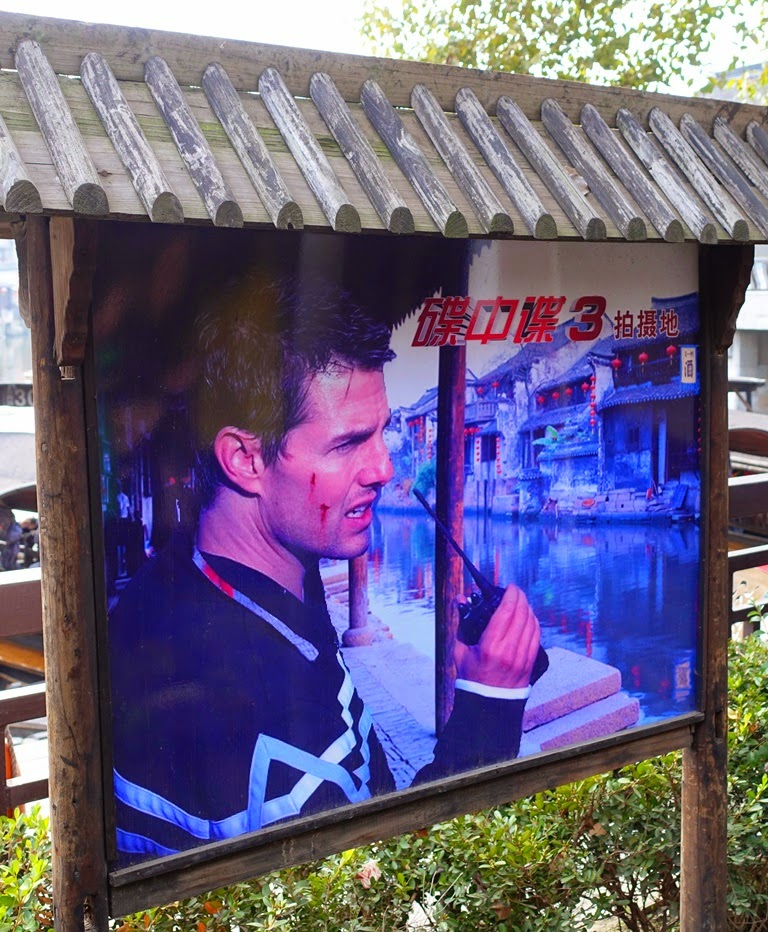
I've seen Mission: Impossible III, but I don't remember the scenes filmed in Xitang. There were billboards, however, to help me jog my memory.

When the rain started coming down again, I was grateful the town's residents had the foresight to build roofs over many of the walkways. One section, in particular, was covered for about a kilometer.

While many of the same snack foods could be found all over Xitang, I only saw one establishment catering to those visitors hankering for a scorpion or a centipede.

Little did I know Xitang is also a fashion mecca. My wife had to have this outfit.

For some reason, all the locally-brewed beer I've had so far in China has been extremely weak, the opposite of what you find in the United States. Xitang Beer weighed in at a puny 2.8% alcohol content.

They may be tourist traps at times, but the canal towns do look lovely at night. In Xitang the thing to do is to launch a paper holder shaped to look like a lotus leaf, and with a burning candle in the center, into one of the canals. We were going to to the same until the rain started coming down hard.


Xitang, unfortunately, had a bar street that was unsurprisingly garish and noisy. Dance clubs alternated with bars where the entertainment at the latter seemed exclusively the realm of Chinese guitar-pickin' singer-songwriters, baring their souls at full amplification.

The three of us went for a boat ride after dinner. It was hard to take photographs due to our position in the middle of the craft, but the lights along the canals were pretty nice.

I'm not sure why I woke up at 6:20 this morning. It was either the alarm on my wife's smartphone that she forgot to turn off before going to bed last night, or the fireworks going off at that early hour of the morning (and continuing until lunchtime), or a combination of both. Across the canal from our room was a temple.

The canals were quiet in the early morning hours. Surprisingly, however, Xitang would soon get busier on this Monday than it was yesterday. Some people, apparently, were getting a head start on their Lunar New Year holiday.

It took some walking around, but we eventually found a place to have breakfast. My daughter enjoyed some dòhuā 豆花, while I had some steamed dumplings 小笼包, accompanied by a bowl of warm soya milk.

The sky was an ugly gray which later revealed itself to be heavy smog as we drove back to Shanghai.


Xitang does not have any "must see" sights, but there are some attractions that are included in the 100 RMB ($16) admission ticket to the canal town (our tickets were only half that, and Amber was admitted free of charge, due to the fact that we stayed overnight in the town). My daughter and I checked out an old mansion while Pamela took in a traditional Chinese garden.

A purchase for the home: it's the character fú 福, meaning "good fortune", "happiness" or "luck". The characters in the red area of the wall hanging are stylized renderings of that one character.


Some final views of the canal and the town before the short drive back to Shanghai. The expressways were again relatively empty, a great relief considering the nightmarish traffic jams that can happen in China (and Taiwan) during the Lunar New Year holiday period.

No visit to a canal town is complete without purchasing some locally-made alcohol. No doubt because I was the designated driver, my wife sampled just about every variety there was at the shop before deciding on a couple of bottles.


