Saturday, March 14, 2015

Conceding to the French


For once, the rain was welcomed. Not because Shànghăi 上海 is in the midst of a crippling drought (it isn't). No, the rain meant that the heavy mist we saw as we left our house around noon today wasn't smog as we first thought, but was actually the result of precipitation. Or maybe the rain clouds just showed up later and washed all the PM2.5 from the sky.

In any event, the rain failed to put a damper on our walk around the eastern part of the French Concession 法租界. The area may have been a source of humiliation to many Chinese both then and (thanks to post-June 4, 1989 "patriotic education" efforts) now, and was home to many of Shanghai's most notorious gangsters and prostitutes (not to mention revolutionaries and writers), but its legacy to the city can be seen today in the elegant homes and tree-lined streets that make the French Concession one of Shanghai's nicest neighborhoods. There are no "must-see" sightseeing spots, but any visitor to Shanghai should take some time to explore its streets and soak up some of the atmosphere.

We began by exiting from the South Shaanxi Road subway station 陕西南路站 and walking over to Ruìjīn Èr Lù 瑞金二路, where my wife quickly spotted a shop specializing in wicker ware. Following the end of her shopping spree, our daughter spent the remainder of the afternoon looking as if she was on her way to a picnic:


Further south along Ruijin Er Lu is the Ruìjīn Hotel 瑞金宾馆, formerly the estate of Benjamin Morris, whose family owned the North China Daily News and who used to raise greyhounds for the Shanghai Race Club. According to my Rough Guide to Shanghai guidebook, the houses were spared from the insanity of the Cultural Revolution due to their being occupied by high officials in the Chinese Communist Party. Those radical revolutionaries certainly had good taste, as a walk around the grounds of the hotel showed:


Pamela was less impressed, however, commenting that if the Morris family missed England so much, they should've returned to Albion rather than trying to recreate home in the middle of Shanghai. We exited the grounds onto Màomíng Nán Lù 茂名南路, where the boutiques and tailor shops grew in number the further north we walked. Along the way we passed the Cathay Theater, dating from 1932 and still showing movies today:


We entered the grounds of another of the French Concession's five-star hotels, the Ōkura Garden Hotel Shanghai 花园饭店上海, erected on the site of the old French Club. As we walked around, the Art Deco masterpiece (or monstrosity, depending on your point of view) that is part of the Jĭnjiāng Hotel complex loomed on the other side of the road:


Preparations were being made for an outdoor wedding as we walked around the garden. Today had probably been chosen after the couple had consulted a fortune teller for an "auspicious" date. Too bad he or she couldn't have predicted the weather (forecasting wasn't in the cards or the tea leaves?):


Amber strikes a pose in the lobby of the hotel:


The building housing the rooms towers over the old French club, which serves as the reception area (there's also a small Mitsukoshi 三越 on the ground floor). Outside, a few plum blossoms were showing off:


The three of us then crossed Maoming Road to the Jinjiang Hotel complex to get an up-close look at the Art Deco colossus, known as the Grosvenor Villa. Prior to World War II, this was the most fashionable (and therefore most expensive) residence in Shanghai:


Amber poses in front of another building in the complex, while the Okura Garden Hotel rises in the background:


Another Art Deco building on Maoming Nan Lu is the 1931 Lyceum Theater, the former home of the British Amateur Dramatic Club:


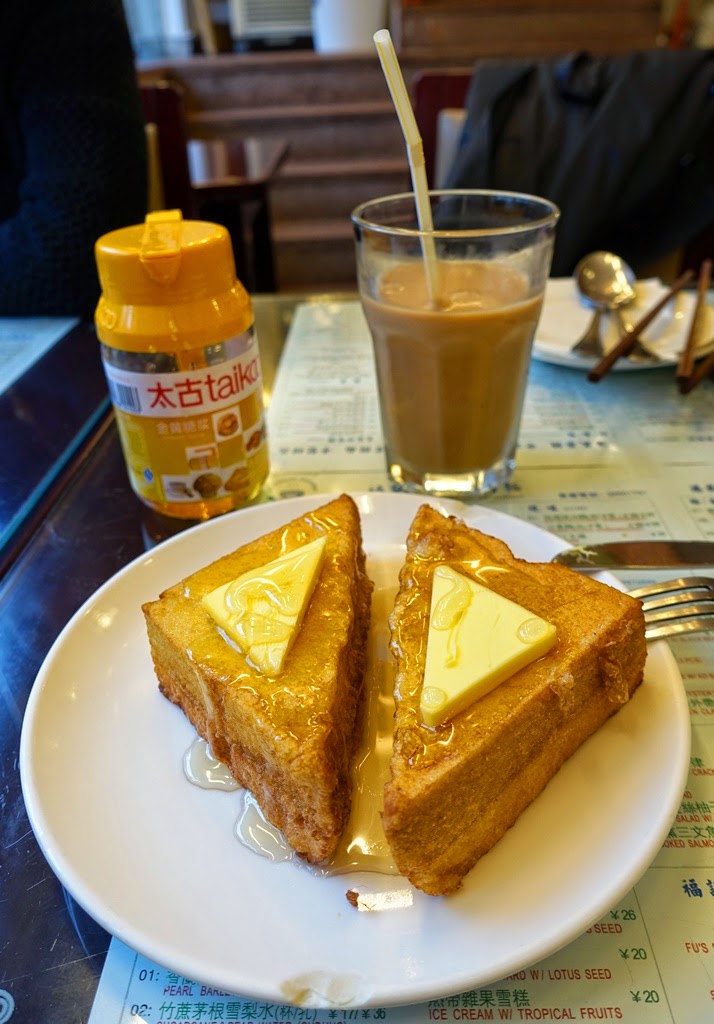
Taking a break of French toast and milk tea at a Hong Kong-style cafe on Shaanxi South Road, complimenting the lunch we had earlier at a Hong Kong-style restaurant across the street from the subway station. Our feet may have been in Shanghai, but our stomachs this afternoon were someplace else:

The Héngshān Moller Villa 衡山马勒别墅饭店 is yet another former residence that has been converted into an upscale hotel, with grounds open to members of the public to come in and have a look around. The house belonged to Eric Moller, a Swedish businessman, until it was taken over in 1949 by the Communist Youth League. The story goes that the residence was designed by Moller's 12-year-old daughter, which might explain its fairy-tale appearance. In any event, my daughter got a kick out of it:


On the way back to the subway station, we stopped off at Garden Books, one of Shanghai's best foreign-language bookshops and a great source for publications on China in general, and on Shanghai in particular. Pamela ended up purchasing four books for children on various topics related to China, including emperors both good and bad, Chinese food and filial piety. The last one produced a classic whinge from my daughter, who uttered a complaint that only a bi-cultural kid could make: "But I don't want to learn about filial piety!":


The beautiful Russian Orthodox Mission Church. Since the establishment of the People's Republic in 1949, it's been used as a washing machine factory, a disco and a teahouse. It's now currently unused, which is a shame. I'd like to see it revert to its original function or become a museum. In any event, I'd just like to be able to go inside and have a look:


As I finish up writing this in the warmth and dryness of our home, it's time to relax with a Jaga Draft beer じゃがドラフト, one of several varieties of Abashiri Beer 網走ビール from Japan sitting in my fridge:


Wednesday, March 11, 2015

Early morning Bunding

 
Because of a visiting delegation in town from Washington, D.C., my services were not required in the office this morning; instead, I was summoned to spend that time at an undisclosed location down near the Bund 外滩, that most iconic of Shànghăi 上海 landmarks. I've been to the Bund a number of times, but never early in the morning, so I arrived about an hour beforehand to have a look around. Without the usual crowds of sightseers, and with the sky clear, it made for a pleasant walk before my shift began. What follows are some pictures I took between 7:45 and 8:30 this morning as I strolled the riverside promenade:


From left to right: the Wàibáidù Bridge  外白渡桥, Broadway Mansions 上海大厦, the Russian Consulate 俄罗斯领事馆 and the Astor House Hotel 浦江饭店 (partially visible behind the consulate).


The Monument to the People's Heroes is a socialist anachronism in Huángpŭ Park 黄浦公园, totally out of character with the rest of the Bund. The park, incidentally, was China's first, laid out in 1886.


Walking south along the promenade


Pŭdōng 浦东 (of course)


The Former Palace Hotel (1909) on the left (now known as the Swatch Art Peace Hotel), with its larger neighbor the Fairmont Peace Hotel (1929). The crowd-control barrier in the foreground is the city government's response to the stampede that occurred at that spot on New Year's Eve, killing 36 people and injuring 49.


The same hotels from another angle. In its heyday, the Fairmont (then known as the Cathay) was one of the finest hotels in Asia, along with the Peninsula in Hong Kong and Singapore's Raffles.


Custom House (1927). The bell tower was called "Big Ching" and was the largest of its kind in Asia. It still chimes every quarter of an hour, just like a certain clock in London.


The Hongkong & Shanghai Bank Building (1923)


Continuing south along the Bund...


Because you can never have enough photos of the Pudong skyline...


As my shift was getting ready to start, it was time to turn around and start heading north...


The Bund at street level


Inside a certain iconic Shanghai hotel, a certain English playwright wrote a certain play while he holed up in his room with a bad case of the flu.


The view from where I was working this morning


The Oriental Pearl TV Tower 东方明珠广播电视塔. One of my Chinese colleagues, a Shanghai native, described it as being "hideous". Good call. 


The Huángpŭ River 黄浦江 sees a lot of ship traffic

I returned to my office in the afternoon, walking as usual through the Bubbling Well Road Apartments 静安别墅, a traditional Shanghai housing complex concentrated around a long lane and known as a lĭlòng 里弄. These three-story red-brick houses were put up between 1928 and 1932:


And, as usual, I passed through a section of the French Concession 法租界 on my to the subway station after work was over for the day. Only this time I had a camera with me:


The rather obvious standout in this tableaux is the Shanghai Exhibition Center 上海展览中心, the former Palace of Sino-Soviet Friendship and one of the few remaining examples of Stalinist architecture to be found in Shanghai.


I go by the Moller House 马勒别墅 almost every weekday evening and never tire of seeing it. The story goes it was designed by the 12 year-old daughter of its Swedish owner.


Sunday, March 1, 2015

Lunar New Year: Fukuoka

Early morning street scene near our hotel

In retrospect, it might've been better to have spent our last night in Kagoshima 鹿児島 rather than going to Fukuoka 福岡. I'd been to Fukuoka a couple of times before, and while the city, with its many restaurants, department stores and nightlife spots, would be a great place to live and work, in terms of sightseeing attractions there isn't a whole lot to see (though the metropolis makes an excellent base for traveling around Kyūshū 九州). Our flight back to Shànghăi wasn't until the late afternoon on Monday, meaning we could've stayed longer in Kagoshima to see more of the city. But the girls had never been to Fukuoka (and for my daughter, this was only her second trip to Japan), and so we decided to spend our last night and day of our Lunar New Year break there. 

A short walk from our hotel is Fukuoka's oldest Shintō shrine, Kushida-jinja 櫛田神社, founded in 757. Though the grounds are small, the shrine contains a number of buildings and other things to look at:


A ceremony for a large group of visiting students was being held at the main hall:


Kishida-jinja is the home of Fukuoka's Hakata GionYamakasa 博多祇園山笠 festival, held every July 1-15. During the festival, seven teams careen through the streets pulling one-ton floats while being doused with water by spectators. After the festival is over, all but one of the floats are destroyed; the survivor is displayed for a year at the shrine:


Another veteran float from the Gion Yamakasa Festival can be seen in the Kami-Kawabata-Dōri 上川端通り covered shopping arcade, which we strolled through after exiting the shrine. As it was still only mid-morning on a Monday, the covered, pedestrian-only street was still quiet:


Across the road from the arcade is the Fukuoka Asian Art Museum 福岡アジア美術館, located on the 7th and 8th floors of the Hakata Riverain shopping complex. The collection is small but contains interesting works of contemporary art from 23 countries and regions from across Asia. Unlike most museums in Japan, this one is open on Mondays:


I Love Tiananmen Square, Beijing by the Luo Brothers (China), 1996-97


Study for Little Bird by Dhruva Mistry (India), 1984


Calendar Poster for Cosmetics Company, Kwona Sana Hona Ltd. by Hang Zhiying/Zhiying Studio (China), 1920-30's

Amber and Pamela try out a fully-kitted Bangladeshi rickshaw:


My daughter in particular enjoyed the museum as there were several interactive displays, plus opportunities to do some coloring. Here she is manipulating a couple of keyboard pads to change the movements of patterns on the dishes in the display cabinet. The commands she input also altered the lighting and sound:


The view from the 8th floor of the Fukuoka Asian Art Museum

Feeling hungry after visiting the museum, we returned to Kami-Kawabata-Dori, which was now busy with lunchtime patrons. Lunch for me was a yakiniku set 焼肉:


The three of us split up after lunch - Amber and Pamela returned to Canal City キャナルシティ to do some window shopping, while I took a walk through Fukuoka's somewhat sleazy but always interesting (at night) Nakasu 中洲 district, though a dead zone on a Monday afternoon. After meeting up again back at the hotel, we retrieved our bags, took the subway to Fukuoka Airport 福岡空港 and watched with bemusement while the Chinese passengers tried to find space in the overhead luggage bins for all the electric rice cookers they'd purchased in Fukuoka. Despite numerous articles in the press in recent months on Ugly Chinese traveling overseas, the Japanese police didn't need to board the plane and take away any passengers, and we returned to Shanghai on time.

Throughout our brief stay in Kyushu, I was reminded over and over again of the importance to the regional economy of tourists from China, South Korea and Taiwan. Many of the sightseeing attractions we visited offered information in Korean and Mandarin Chinese (simplified characters for the Chinese tourists, traditional ones for the Taiwanese visitors), while many shops posted multilingual signs offering discounts and tax rebates for foreign-passport holders. We encountered Mandarin-speaking visitors in many places, though fortunately we did not witness any bad behavior, most likely due to the fact that a.) most of the tourists were traveling in small groups of families or friends and not in large tour group herds; and b.) judging from the way they were speaking Mandarin, many appeared to have come from Taiwan. Kyushu has gone out of its way to make these visitors feel welcome; last Sunday evening, when the strap broke on Pamela's old suitcase and my wife went into Canal City to buy a new one, she was attended to by a Chinese clerk who had grown up in Japan. The visitors return the favor by buying tons of stuff; at the airport we saw Chinese checking in lots of large boxes (as well as carrying on the aforementioned rice cookers). Westerners like to complain of the high cost of visiting Japan, which is something of a myth as it's no more expensive to get around the archipelago than it is to do the same in North America or Western Europe; we found eating out in Belgium last September to be far more costly than it was in Kagoshima or Fukuoka, for example. For those from China, however, where the taxes on imported luxury items are often prohibitive, Japan is a relative bargain.

As for me, I didn't do much shopping, but I did get to see some new areas of the country as well has enjoy some unusual experiences, such as witnessing a volcano erupt and getting buried in hot sand at a beach. The joys of driving were such that I hope to rent cars again on future trips and venture even further into the provinces. My next assignment will take me away from Asia, but as long as there's the family link to Taiwan, I think I'll be able to stop in Japan as well.

Sign for an entertainment establishment in Nakasu