Showing posts with label japanese era. Show all posts

Sunday, October 6, 2013

Japan and Taiwan: Day 14 - Japanese Tainan

Tainan 台南 is Taiwan's fourth-largest city in terms of population. As a result of its status as the first capital of the island (beginning under the rule of the Dutch in the 17th-century), the city has accumulated a remarkable collection of historical sights and temples, making it a major sightseeing destination for Taiwanese and foreign visitors alike. One aspect of Tainan's history that often gets overlooked by the tourists, however, is the sights related to the time when Taiwan was under Japanese control (1895-1945). Tainan was an important administrative center during the Japanese period, and a number of outstanding examples of architecture dating from that time are still standing, many of which are within walking distance of the city's central train station 台南車站. It was this side of Tainan that drew me one Tuesday on the last full day of my vacation.


Getting to Tainan involved taking advantage of Taiwan's not-always-convenient-as-it-seems High Speed Rail system 台灣高鐵. Convenient for the time it takes to get from one place to another (only about 40 minutes between Taichung 台中 and Tainan), inconvenient due to the locations of most of the stations, located far from the city centers they ostensibly serve and reached by either shuttle buses or slow local train connections. My friend Steve kindly drove me to the Taichung HSR Station, located out in the wilds of Wuri 烏日, from where I traveled at high speed to the Tainan HSR Station, situated in the rural Guiren 歸仁 area and connected to central Tainan by the TRA Shalun Line 沙崙線.


Once finally in Tainan's downtown area, I could begin my explorations. The first site of note that I came to was the 1911 Former Tainan Meeting Hall. 


Admission was free, which was good as the exhibits inside were pretty sparse. One section had been turned over to a photographic exhibition.


Behind the hall was a classical-style Chinese garden, a perfect spot for admiring the fighter jets from a nearby air force base as they roared by overhead.


Also on the same grounds was a Japanese-style wooden building housing a cafe. I wasn't sure if it was original or a reconstruction, but in any event it did serve as a nice spot for a break, even if the milk teas were a bit pricey at NT100 ($3.40). Taiwan: the Bradt Travel Guide by Steven Crook laid out the course I followed this morning and afternoon. Bradt Guides often provide different perspectives on less popular travel destinations, and I recommend using Crook's guide in conjunction with either the Lonely Planet or Rough Guide books if you're serious about seeing what Taiwan has to offer. 


Possibly the oldest surviving Japanese-era building in Taiwan (according to the Bradt Guide), this pepper-pot-shaped structure is known as the Old Weather Station. 


Inside were various weather-measuring instruments and seismographs from days gone by, all proudly shown to me by the attendant, who also insisted on taking my picture.


Next up was a visit to arguably the best-preserved piece of Japanese-era architecture in all of the island. Completed in 1916 as Tainan's city hall, the Museum of Taiwanese Literature is now devoted to local writers and their works. It's worth a visit just to see the building (and there was no admission - again!).


Inside, it was possible to see the original foundation of the building


The exhibits were extensive, and exhaustively captioned in English. Truth be told, however, unless you are a linguist or have a deep interest in the history of Taiwanese literature, there probably won't be much to hold your attention for very long.


A modern annex has been seamlessly crafted onto the rear of the old city hall, in a job well-done.


Around the corner from the literature museum was another well-preserved structure. The Old Tainan Martial Arts Academy was built in 1936 and now serves as an auditorium for an elementary school. As such, it can't be visited during school hours, so I wasn't able to go inside. 


This 1937 Art Deco colossus is still being used as a bank today
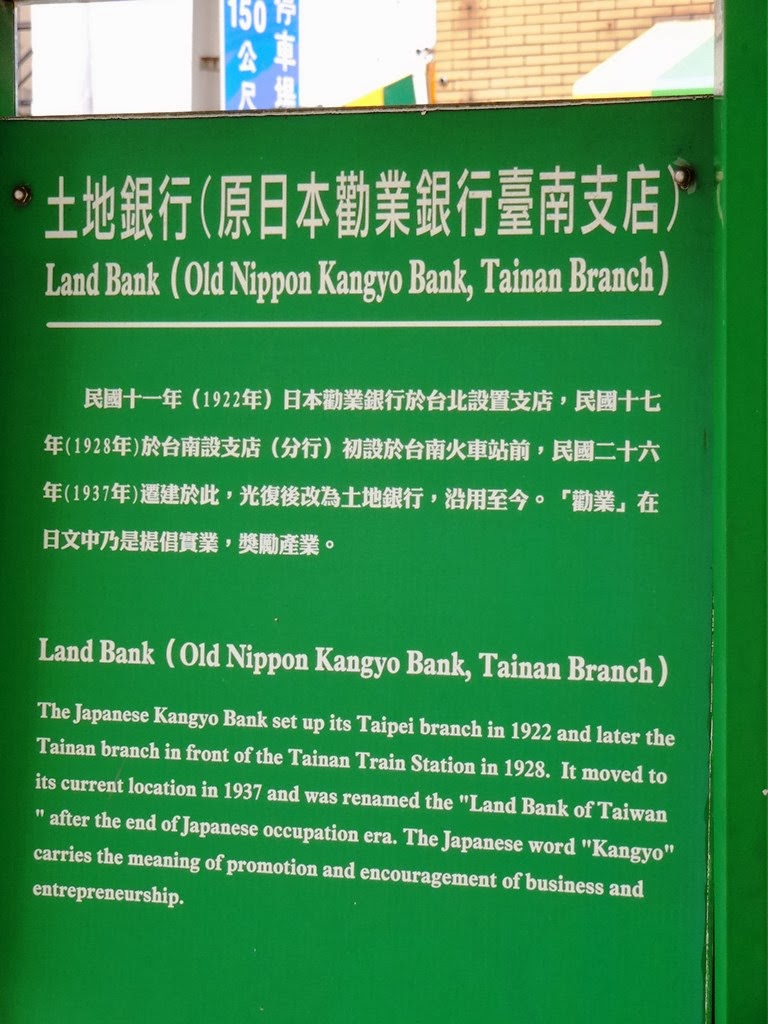

A signboard explaining the story of the Land Bank building. On past visits to Tainan, I came away impressed with the efforts made by local authorities to explain the significance of the city's historical relics, and this outing was no exception.


Diagonally across from the Land Bank was the 1932 Hayashi Department Store which, at the time of its opening, boasted Taiwan's first elevator. The structure has apparently stood vacant for many years, and it still wasn't clear (to me, anyway) what the future holds in store (rimshot), but when I looked through the first-floor windows, workers could be seen doing some kind of renovation work. 


Looking at the Hayashi Department Store from another angle, the old Shintō shrine 神社 on the rooftop could just be made out. Whatever someone has planned for this building, I hope they'll preserve the form, make it accessible to the public and keep the shrine in its original state.


Lunch. And, no, I'm not sure what is was supposed to be, either


The 1936 train station building, currently wrapped up in scaffolding
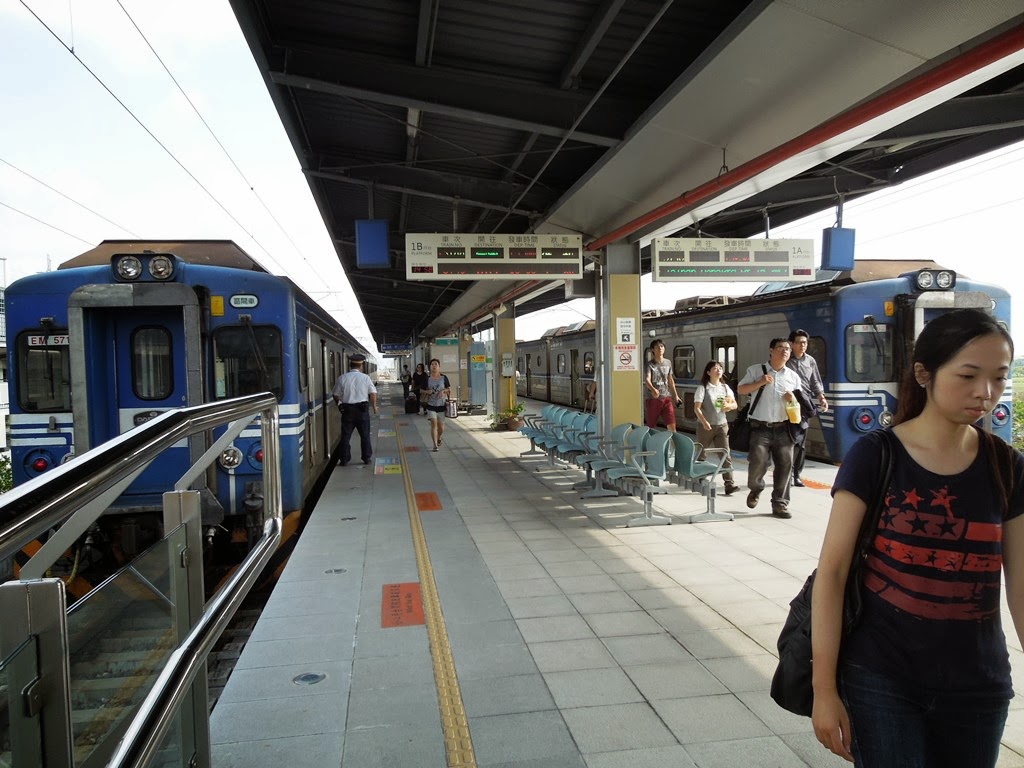

Moving from the TRA Shalun Station 沙崙車站 platform to the adjacent THSR Tainan Station 高鐵台南站 for the trip back to Taichung.


Seen in downtown Taichung


Wednesday, December 15, 2010

新古

The new and the old were on display this afternoon at the Fengyuan Train Station 豐原車站. As you walk up the steps leading to the ticket gates, you are greeted by a large map showing the elevated railway project of the Taichung Metropolitan Area Rapid Transit 台中捷運 development...:


...while the walls of the waiting area upstairs are adorned with old photographs of Taichung 台中 taken during the Japanese colonial era 台灣日治時期:


Monday, October 26, 2009

Return with us now to those thrilling days of yesteryear...

Today was a beauty, weather-wise, with clear blue skies and warm, pleasant temperatures. The three of used this nicest of days to take a step back into Taiwan's past by visiting an old train station dating back to the Japanese period. T'aian Station 泰安車站 on the old Mountain Route 舊山線 of the Western Railway Line 縱貫線 dates back to 1910, and was in service until 1998, when a new double-tracked Mountain Route was opened, along with a newer Taian Station. Today, the old station sits along a quiet country lane, in front of a large hill and facing old homes and rice fields.

The original wooden station building was destroyed in the 1935 Shinchiku-Taichū earthquake 1935年新竹-台中地, and was rebuilt in sturdier but less attractive concrete. There is a monument erected by the Japanese which lists the damage caused to bridges, roadbeds, stations and tunnels by the quake:


Amber enjoyed blowing bubbles, throwing rocks and walking around on the platform and tracks. I did as well, with the only disappointment lying with a signposted hiking trail, which looked promising as it headed up the forested hill behind the station. However, it soon disappeared into the underbrush as it became obvious that trail maintenance was not a high priority:


After checking out the old station (which didn't take long), we drove about five minutes to the modern T'aian Station, built on an elevated platform about five stories (I forgot to count the flights of stairs as we walked up) above the surrounding countryside. There, Amber and I waited for the train to take us back to Fengyuan 豐原, while my wife drove on ahead to meet us there. What the new station lacks in architectural charm, it makes up for in great views. Nine minutes, two stops and 15NT (45¢/¥40) later, we were back in Fengyuan at the end of a lazy Sunday afternoon, just the way the Small Faces would've wanted it:


Wednesday, September 9, 2009

Hitting the tourist trail in Taichū

As I did a month ago, I used my one free weekday afternoon today to play tourist in T'aichung 台中. This time I checked out T'aichung Park 台中公園, which I believe was Taiwan's first western-style park (though I could be wrong). Originally called "New Park", it was established by the Japanese in 1903 on the site of an 18th-century military post called Tatun (an old gate is all that remains of the fort in the park grounds). Though some Chinese touches have been added to the park over the years, anyone who has spent time in Japan will probably find Taichung Park to be very familiar-looking. The symbol of the park is undoubtedly the Wang Yueh Pavilion in the middle of a lake. Built in 1908 as a rest house for Prince Kan'in Kotohito 閑院宮載仁親王, who was in town to observe a ceremony celebrating the completion of the Western Line 縱貫線 railway, it's probably the most recognizable symbol of the city of Taichung:


Taichung Park was also the site of Taichū Shrine 台中神社, of which several relics remain. There is the old torii 鳥居 gate, now lying in pieces on the ground:


The stone lantern-lined path to the shrine itself, though now only the bases are still standing:


There are also two pairs of statues left from the shrine, the koma-inu 狛犬 guardian lion-dogs and a couple of horses:


I also came across this monument hidden just outside the park boundaries, behind the tennis courts. It was erected in 1902 to commemorate Japanese soldiers who died during the takeover of Taiwan. I'm surprised it's been allowed to stand all these years:


After leaving the park, I walked east along Tzuyu Road for about one kilometer (0.6 miles). A perusal of the Taiwan blogosphere will no doubt bring up entries from enthusiastic Westerners about the island's "beautiful" Taoist temples. There certainly are a number of such attractive places, but there are also plenty of examples like the house of worship I visited next, the Nant'ien Temple. The draw here is a garish, 48 meter (157 feet)-high statue of the god Kuan Yu 關羽, sitting atop the structure. Truth be told, I've seen velvet Elvis paintings from Tijuana done more tastefully than this representation. Nonetheless, it's worth a visit, as you can climb up to the sixth floor, just beneath the "Beautiful Whiskered One", for a decent view of Taichung.


Monday, July 20, 2009

Rinnai Shrine 林内神社

On a day when only relatives had any physical contact with my daughter, we visited my wife's side of the family in her hometown of Xiluo 西螺 in Yunlin County 雲林縣. On the way we stopped off in the nearby township of Linnei 林內 to visit one of the few remaining Shintō shrines 神社 in Taiwan (or what's left of it, anyway). The shrine isn't too hard to find - just follow the signs pointing to Linnei Park, and you will soon come across a large torii 鳥居 spanning the road:


A Chinese-style roof has been added to the top, and it now bears the name of the park in Chinese characters, but there is no mistaking the familiar shape of a shrine gate.

Up the road from the large torii is a small set of stairs leading to a smaller torii, and flanked by two stone lanterns:


Beyond the second torii is another pair of large stone lanterns. Close by is Lin Chung Elementary School, which has a display with some interesting photographs of the shrine during its brief existence:


Rinnai-jinja was built in 1940 in what was then the Toroku District 斗六郡 of Tainan Prefecture 台南州. It enshrined Prince Kitashirakawa Yoshihisa 北白川宮能久親王, the tutelary deity 鎮護の神 of Taiwan; the Three Kami Deities of Cultivation 開拓三神, Ōkunitama no Mikoto 大国魂命, Ōnamuchi no Mikoto 大己貴命 and Sukunahikona no Mikoto 少彦名命; and Toyōke no Ōmikami 豊受大神. Don't worry, this won't be on the test.

Past the second set of lanterns and the elementary school is a long staircase, at the top of which stands a Taoist temple where the main shrine building once looked out over the plains below:


While Pamela took one look at the stairs and decided to stay with my mother-in-law by the car, Amber didn't flinch. Not only did she make it to the top without running out of steam, she even continued for a bit along one of the walking trails that continue up past the temple:


The views from the top were limited by the rainy conditions, but the park appears to be well laid-out, and a good place for a stroll. On the way down, I noticed a building that seemed to incorporate a torii into its design:


Once back in the car, we left Linnei Park and drove on to Xiluo, where we spent the rest of the afternoon with Pamela's two sisters and their families. On the way home, we drove across the Xiluo Bridge 西螺大橋, another relic from the Japanese period. Construction initially began in 1937, had to be suspended with the onset of World War II, and was ultimately finished after the war in 1952 with the help of American foreign aid:


Traffic was moving pretty slowly on the freeway, but at least we had a great sunset to compensate:


Unless you're friend or family, hands off!