Showing posts with label japanese era architecture. Show all posts

Sunday, October 6, 2013

Japan and Taiwan: Day 14 - Japanese Tainan

Tainan 台南 is Taiwan's fourth-largest city in terms of population. As a result of its status as the first capital of the island (beginning under the rule of the Dutch in the 17th-century), the city has accumulated a remarkable collection of historical sights and temples, making it a major sightseeing destination for Taiwanese and foreign visitors alike. One aspect of Tainan's history that often gets overlooked by the tourists, however, is the sights related to the time when Taiwan was under Japanese control (1895-1945). Tainan was an important administrative center during the Japanese period, and a number of outstanding examples of architecture dating from that time are still standing, many of which are within walking distance of the city's central train station 台南車站. It was this side of Tainan that drew me one Tuesday on the last full day of my vacation.


Getting to Tainan involved taking advantage of Taiwan's not-always-convenient-as-it-seems High Speed Rail system 台灣高鐵. Convenient for the time it takes to get from one place to another (only about 40 minutes between Taichung 台中 and Tainan), inconvenient due to the locations of most of the stations, located far from the city centers they ostensibly serve and reached by either shuttle buses or slow local train connections. My friend Steve kindly drove me to the Taichung HSR Station, located out in the wilds of Wuri 烏日, from where I traveled at high speed to the Tainan HSR Station, situated in the rural Guiren 歸仁 area and connected to central Tainan by the TRA Shalun Line 沙崙線.


Once finally in Tainan's downtown area, I could begin my explorations. The first site of note that I came to was the 1911 Former Tainan Meeting Hall. 


Admission was free, which was good as the exhibits inside were pretty sparse. One section had been turned over to a photographic exhibition.


Behind the hall was a classical-style Chinese garden, a perfect spot for admiring the fighter jets from a nearby air force base as they roared by overhead.


Also on the same grounds was a Japanese-style wooden building housing a cafe. I wasn't sure if it was original or a reconstruction, but in any event it did serve as a nice spot for a break, even if the milk teas were a bit pricey at NT100 ($3.40). Taiwan: the Bradt Travel Guide by Steven Crook laid out the course I followed this morning and afternoon. Bradt Guides often provide different perspectives on less popular travel destinations, and I recommend using Crook's guide in conjunction with either the Lonely Planet or Rough Guide books if you're serious about seeing what Taiwan has to offer. 


Possibly the oldest surviving Japanese-era building in Taiwan (according to the Bradt Guide), this pepper-pot-shaped structure is known as the Old Weather Station. 


Inside were various weather-measuring instruments and seismographs from days gone by, all proudly shown to me by the attendant, who also insisted on taking my picture.


Next up was a visit to arguably the best-preserved piece of Japanese-era architecture in all of the island. Completed in 1916 as Tainan's city hall, the Museum of Taiwanese Literature is now devoted to local writers and their works. It's worth a visit just to see the building (and there was no admission - again!).


Inside, it was possible to see the original foundation of the building


The exhibits were extensive, and exhaustively captioned in English. Truth be told, however, unless you are a linguist or have a deep interest in the history of Taiwanese literature, there probably won't be much to hold your attention for very long.


A modern annex has been seamlessly crafted onto the rear of the old city hall, in a job well-done.


Around the corner from the literature museum was another well-preserved structure. The Old Tainan Martial Arts Academy was built in 1936 and now serves as an auditorium for an elementary school. As such, it can't be visited during school hours, so I wasn't able to go inside. 


This 1937 Art Deco colossus is still being used as a bank today
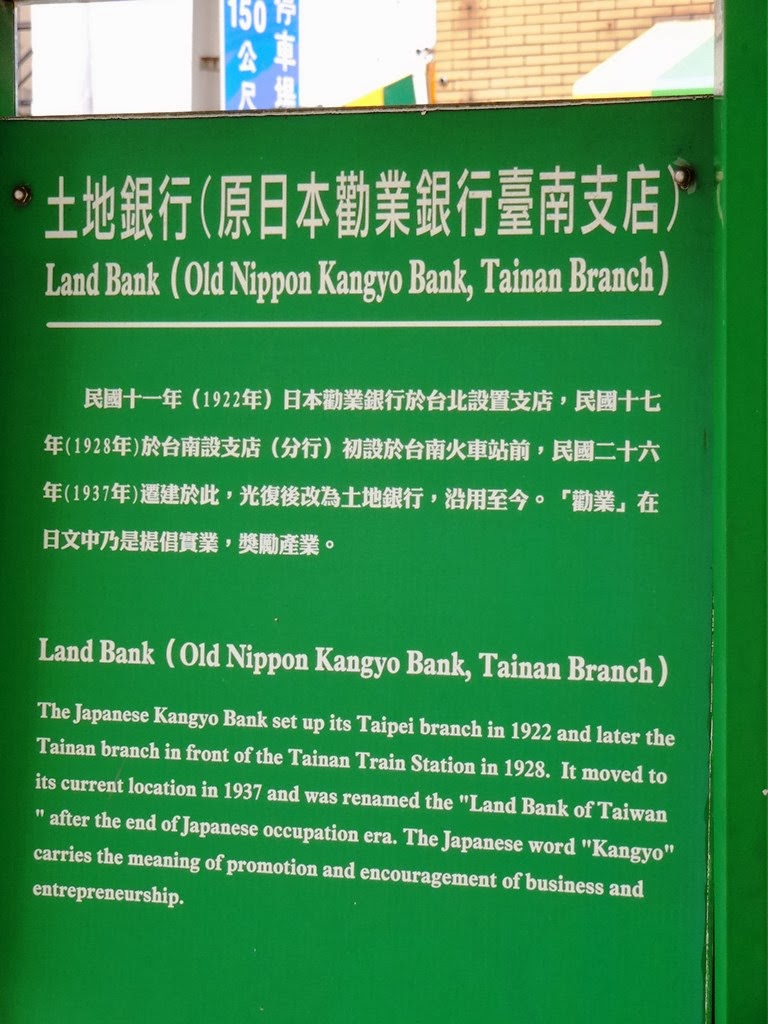

A signboard explaining the story of the Land Bank building. On past visits to Tainan, I came away impressed with the efforts made by local authorities to explain the significance of the city's historical relics, and this outing was no exception.


Diagonally across from the Land Bank was the 1932 Hayashi Department Store which, at the time of its opening, boasted Taiwan's first elevator. The structure has apparently stood vacant for many years, and it still wasn't clear (to me, anyway) what the future holds in store (rimshot), but when I looked through the first-floor windows, workers could be seen doing some kind of renovation work. 


Looking at the Hayashi Department Store from another angle, the old Shintō shrine 神社 on the rooftop could just be made out. Whatever someone has planned for this building, I hope they'll preserve the form, make it accessible to the public and keep the shrine in its original state.


Lunch. And, no, I'm not sure what is was supposed to be, either


The 1936 train station building, currently wrapped up in scaffolding
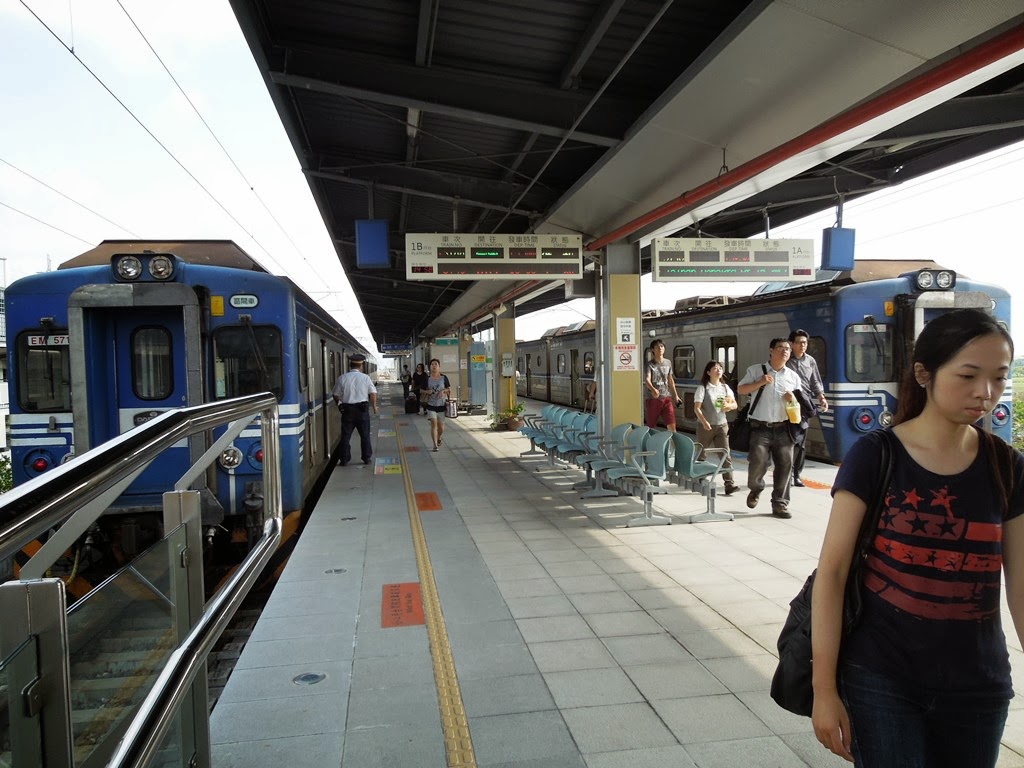

Moving from the TRA Shalun Station 沙崙車站 platform to the adjacent THSR Tainan Station 高鐵台南站 for the trip back to Taichung.


Seen in downtown Taichung


Thursday, May 12, 2011

New traditions


Though it may be hard to believe from the poor-quality photograph above (taken in poor lighting on an overcast afternoon), these are pretty flowers. What you are looking at are the blossoms of the t'úng​ 桐 tree, an annual floral event that happens at this time of year in central T'ái​wān​ 台灣. A important part of the culture of the Hakka people 客家, Taiwanese poets of centuries past penned odes to the beauty of the tung blossom 桐花, while groups of people would gather under the trees when the flowers were in full bloom, to drink tea and engage in merriment…

…or so the tourist authorities would have you believe. In actuality, until about ten years ago, few people gave much thought to the humble tung blossom. The trees had always been there, but they hardly registered on the radars of most Taiwanese. What changed was that in the early part of this century (around the year 2002), the government implemented a five-day work week. This, in turn, triggered a leisure boom among the local populace. With the standard litany of sightseeing spots having been exhausted long ago, there was suddenly a demand for new places to visit, and new things to do, on the weekends. Some bright mind (or minds) took note of the beautiful tung trees flowering every April or May, and conjured up an image of the white blossoms that had fallen to the ground looking like a carpet of snow. On this island of almost-perpetual warm weather, snow is of great interest, and it wasn’t long before the tour buses and family cars descended on those areas blessed (or cursed?) with numerous t'úng trees. And, thus, a new tradition was born.

The above picture was taken on Tuesday afternoon in the hills of the Tà​k'ēng​ area 大坑風景區, but THE place to see the tung blossoms has to be Sān​'ì 三義​, in Miáo​lì​ County 苗栗縣. Sanyi itself has greatly benefited from the five-day work week. There was a time when the town was known only for its wood sculptures (and sculptors), and people would go there to browse in the shops, and perhaps come home with a nice souvenir. Back then, the disused Shèng​hsīng​ train station 勝興車站 was just that – an abandoned stop on a discontinued rail line that no one gave much thought to. At the turn of this century, when my wife and I first started seeing each other, she took me to Shengxing. I recall there being only a couple of restaurants and very few (if any) souvenir stands. It may have been possible that that we were the only two visitors there that afternoon. In any case, it was definitely a far cry from the present day, when even on weekdays, you can find a lot of people walking around, and doing what Taiwanese tourists do best – taking pictures of themselves, eating high-calorie snack foods and buying tacky souvenirs. If you go on weekends, be prepared – words like “circus” or “zoo” can’t begin to describe the way in which this part of Sān​'ì has “benefited” from the ongoing leisure boom.

(BTW, I was so intent on photographing the t'úng blossoms that I failed to notice the huge Formosan macaque [T'ái​wān mí​hóu​] 台灣獼猴​ sitting on a branch in that very tree…until it jumped over to the next tree, leaping with a loud crash, before disappearing into the forest before I had a chance to point the camera at it. A pheasant scurrying along the ground a few minutes earlier also eluded my attempts to get a picture of it. I’m not destined to be a nature photographer.)


Just when you think you’ve seen all the reminders of the past around here, something else pops up from history’s dusty drawer. While walking around the area near Sān​mín​ Road 三民路 in T'ái​chūng​ 臺中 this evening in search of a tea stand, I passed this building, which looked to date from the Japanese period 台灣日治時期. It turns out it did. According to a plaque on the outside, upon its erection in 1921, it served as the site of the Department of Food, part of the Bureau of Agriculture and Business in the Taiwan Governor’s 台灣總督府「台湾総督府」 Office. These days, the building is still a functioning government location, acting as the Taichung branch of the Council of Agriculture 行政院農業委員會. Kudos go out to those who not only elected to keep the structure intact, but to maintain it as an active workplace, as opposed to a dusty museum.

Wednesday, March 23, 2011

Walking from Hōgen (Toyohara) to Tōsei, and back again

On this sometimes warm, sometimes cold afternoon, I took a long walk along the Tūng​fēng Bicycle Trail 東豐自行車緑廊. And I do mean long, for if the distance markers were correct (and my sore feet have me thinking they were), I covered roughly 16 kilometers (9.9 miles) round-trip in about 3¼ hours. Next time I'll know better than to wear my ordinary shoes.

The cherry blossoms 櫻花「サクラ」 were still hanging in there today.

The Tūng​fēng Iron Bridge 東豐鐵橋, the ostensible reason for my walk today. The last time I strolled this route , I was stopped by the Tà​chiǎ​ River 大甲溪, as the bridge didn't exist at that time. Crossing over to the Tūng​shì​h 東勢 side meant that I had finally walked every part of this trail. Mission accomplished!

The trail looks prettier now than it did almost four years ago.

On the site of the old Méi​tzu Station 梅子車站, there was a photo display of scenes of damage from the Sept. 21, 1999 Chí​chí​ earthquake 921大地震 (the Fēng​yuán 豐原/Dongshi​ area was hit hard by the quake). How apropos in light of recent events in Japan.

An old Japanese-style home.

A section of railroad track near the former Shíhkāng​ Station 石岡車站 that had buckled as a result of the 921 quake.

One difference between walking this trail today compared to October 2007 was that there were a lot more cyclists out riding on this weekday afternoon. Still, it was a pleasant walk, and proof that bicycle trails are not just for bikes.

Monday, March 7, 2011

The hills of Taiko are alive with the sound of strawberries

Tù​chuān​ 杜鵑, or what an online Chinese-English dictionary translates as "Indian Azalea"

The above-pictured flower could be seen this afternoon at Fǎ​yúnch'án​ssù 法雲禪寺, a Zen 禅 temple (English name: Fayun Monastery) located ​​in the hills overlooking the town of Tà​hú 大湖​ in Miáo​lì​ County 苗栗縣. Though the drive up to ​​Dahu from our home was mostly through a thick layer of ugly haze, by the time we reached Fayunchan Temple, the skies had cleared up somewhat:


The temple was built during the Japanese colonial period 台灣日治時期, and the exterior of the reconstructed main hall retains the original Japanese-style Buddhist temple architecture:


Also dating from the Japanese period is this monument below, erected to commemorate the "opening up" of the area by the Japanese:


After taking in the view and soaking up the history, we drove down the hill and into Tà​hú, where we partook of my daughter's favorite outdoor activity, picking strawberries (again - see last week's blog entry):


Amber is so crazy about the edible fruit of this flowering plant that, upon reflection, it would've been more accurate to have named her Ichigo Caomei at the time she was born.

In order to cash in on the hordes of weekend visitors coming to pick 草莓, a Strawberry Culture Museum 草莓文化館 has been established in the town:


The actual "museum" section was surprisingly informative, and the English captions were generally well-presented. My wife was annoyed to discover that it was none other than the Japanese who first introduced strawberries into T'ái​wān 台灣, but let's face it - studying the Japanese colonial period is like watching the "What have the Romans ever done for us?" scene from Monty Python's Life of Brian.

Educational displays aside, the main purpose of the strawberry museum is to sell strawberries, with the gift shop probably resembling what Amber's idea of heaven looks like. Here being Taiwana​, the buildings are surrounded by a market pushing all manner of snacks and drinks, many with a strawberry theme, such as strawberry sausages, strawberry tarts and strawberry wine, though, sadly, no strawberry beer. For my wife, the throngs that had descended upon the complex were an integral part of the eating and shopping experience, adding that much-needed touch of jè​nao​ 熱鬧 ("bustling with noise and excitement / lively") that had been lacking back at the zen temple (there was irony at play in her outlook on these things, but I just couldn't make the effort to point it out to her). For me, I found relief in the view of the surrounding countryside from the museum's rooftop "sky garden"...until the fireworks started going off, that is.


Pamela ended up buying a couple of bottles of strawberry vinegar, plus a jar of strawberry jam for Amber (and, of course, there was the box of strawberries that we had picked earlier). Somehow, our lunch and dinner in Dahu​ didn't involve any strawberries, as we ate instead at Hakka restaurants 客家菜. It took only about an hour to drive back to Fēng​yuán​ 豐原 - fortunately, there was hardly any traffic on the road going back, which was quite a contrast with last weekend's outing. Considering the close proximity of Tà​hú and its other attractions, such as hiking and hot springs, I wouldn't mind spending a weekend there sometime soon.

BTW, Amber took some photos in Dahu which can be seen on her blog.

Monday, December 20, 2010

We're going to the zoo

It's less than a week until Christmas, and the shopping isn't finished, so in order to give my wife time to hit the stores today, Amber and I took up my friend Thoth's offer to visit him in Hsinchu 新竹. It took about an hour and a quarter on the local train from Fengyuan 豐原 to Hsinchu Station 新竹車站, where we were met by Thoth:


From the station, Thoth took us to Hsinchu Park, where Amber checked out an old cannon battery...


...before heading over to what was undoubtedly the highlight of my daughter's day, the Zoological Gardens 新竹動物公園. Though I had been warned that the zoo wasn't much of an attraction, it turned out to be far more interesting than I'd thought, and the admission fee was a bargain at only NT10 (33¢/¥28). Amber enjoyed seeing monkeys, tigers, and, bless her heart, reptiles (especially the swimming python). Getting to feed a baby Sika Deer was especially enjoyable:


Leaving the zoo, we walked back towards the train station in search of a place to have lunch. Following a leisurely meal at a cafe just a stone's throw from the train tracks, Thoth took us to one of the best-preserved Japanese-era 台灣日治時期 houses I've seen so far in Taiwan. Officially called "The Residence of Hsin Chih-Ping", and dating from 1922, the building has been carefully preserved in its original condition, and walking around inside, it's easy to forget its location near the center of a bustling Taiwanese city. Unfortunately, interior photography was forbidden, but some nice photographs of the tatami mat 畳 rooms could be seen on the free pamphlets available inside. The English captions describing the various rooms were also well done. In addition to the house, an equally well-maintained wooden lecture hall could be visited just behind the residence:


If you're wondering just who Hsin Chih-ping was, he was an educator from China who came to Taiwan after the Second World War to become the principal of the Japanese-built Hsinchu High School. Apparently, Hsin didn't let any resentment he may have felt from fighting the Japanese (he served in the Nationalist Chinese military during the war) stop him from appreciating the aesthetic beauty of a well-designed traditional Japanese wooden home.

By now, it was getting late in the afternoon, so we returned to the train station, thanked Thoth for taking the time to show us around and caught an express train back to Fengyuan. Amber couldn't wait to show her mother the gifts we had picked up for her in Hsinchu, namely the packages of Hairei Meatballs and Hsinchu Rice Noodles. Yes, when in Rome...: