Tainan 台南 is Taiwan's fourth-largest city in terms of population. As a result of its status as the first capital of the island (beginning under the rule of the Dutch in the 17th-century), the city has accumulated a remarkable collection of historical sights and temples, making it a major sightseeing destination for Taiwanese and foreign visitors alike. One aspect of Tainan's history that often gets overlooked by the tourists, however, is the sights related to the time when Taiwan was under Japanese control (1895-1945). Tainan was an important administrative center during the Japanese period, and a number of outstanding examples of architecture dating from that time are still standing, many of which are within walking distance of the city's central train station 台南車站. It was this side of Tainan that drew me one Tuesday on the last full day of my vacation.

Getting to Tainan involved taking advantage of Taiwan's not-always-convenient-as-it-seems High Speed Rail system 台灣高鐵. Convenient for the time it takes to get from one place to another (only about 40 minutes between Taichung 台中 and Tainan), inconvenient due to the locations of most of the stations, located far from the city centers they ostensibly serve and reached by either shuttle buses or slow local train connections. My friend Steve kindly drove me to the Taichung HSR Station, located out in the wilds of Wuri 烏日, from where I traveled at high speed to the Tainan HSR Station, situated in the rural Guiren 歸仁 area and connected to central Tainan by the TRA Shalun Line 沙崙線.

Once finally in Tainan's downtown area, I could begin my explorations. The first site of note that I came to was the 1911 Former Tainan Meeting Hall.

Admission was free, which was good as the exhibits inside were pretty sparse. One section had been turned over to a photographic exhibition.


Behind the hall was a classical-style Chinese garden, a perfect spot for admiring the fighter jets from a nearby air force base as they roared by overhead.


Also on the same grounds was a Japanese-style wooden building housing a cafe. I wasn't sure if it was original or a reconstruction, but in any event it did serve as a nice spot for a break, even if the milk teas were a bit pricey at NT100 ($3.40). Taiwan: the Bradt Travel Guide by Steven Crook laid out the course I followed this morning and afternoon. Bradt Guides often provide different perspectives on less popular travel destinations, and I recommend using Crook's guide in conjunction with either the Lonely Planet or Rough Guide books if you're serious about seeing what Taiwan has to offer.

Possibly the oldest surviving Japanese-era building in Taiwan (according to the Bradt Guide), this pepper-pot-shaped structure is known as the Old Weather Station.


Inside were various weather-measuring instruments and seismographs from days gone by, all proudly shown to me by the attendant, who also insisted on taking my picture.


Next up was a visit to arguably the best-preserved piece of Japanese-era architecture in all of the island. Completed in 1916 as Tainan's city hall, the Museum of Taiwanese Literature is now devoted to local writers and their works. It's worth a visit just to see the building (and there was no admission - again!).

Inside, it was possible to see the original foundation of the building


The exhibits were extensive, and exhaustively captioned in English. Truth be told, however, unless you are a linguist or have a deep interest in the history of Taiwanese literature, there probably won't be much to hold your attention for very long.

A modern annex has been seamlessly crafted onto the rear of the old city hall, in a job well-done.


Around the corner from the literature museum was another well-preserved structure. The Old Tainan Martial Arts Academy was built in 1936 and now serves as an auditorium for an elementary school. As such, it can't be visited during school hours, so I wasn't able to go inside.


This 1937 Art Deco colossus is still being used as a bank today
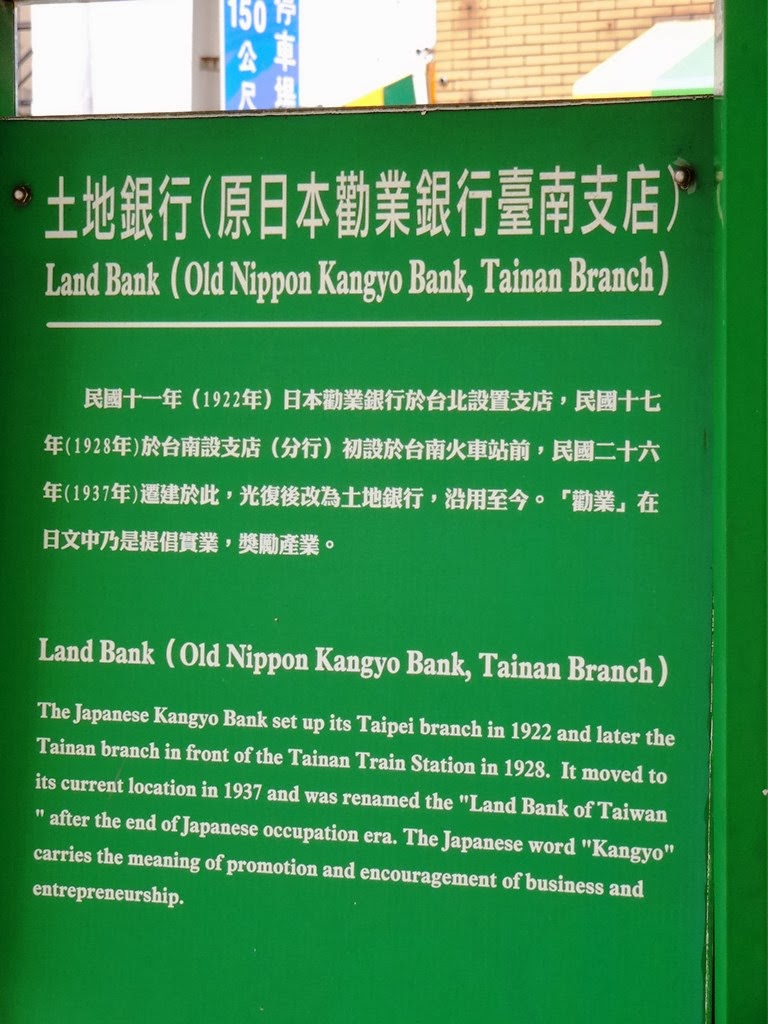
A signboard explaining the story of the Land Bank building. On past visits to Tainan, I came away impressed with the efforts made by local authorities to explain the significance of the city's historical relics, and this outing was no exception.

Diagonally across from the Land Bank was the 1932 Hayashi Department Store which, at the time of its opening, boasted Taiwan's first elevator. The structure has apparently stood vacant for many years, and it still wasn't clear (to me, anyway) what the future holds in store (rimshot), but when I looked through the first-floor windows, workers could be seen doing some kind of renovation work.


Looking at the Hayashi Department Store from another angle, the old Shintō shrine 神社 on the rooftop could just be made out. Whatever someone has planned for this building, I hope they'll preserve the form, make it accessible to the public and keep the shrine in its original state.

Lunch. And, no, I'm not sure what is was supposed to be, either

The 1936 train station building, currently wrapped up in scaffolding
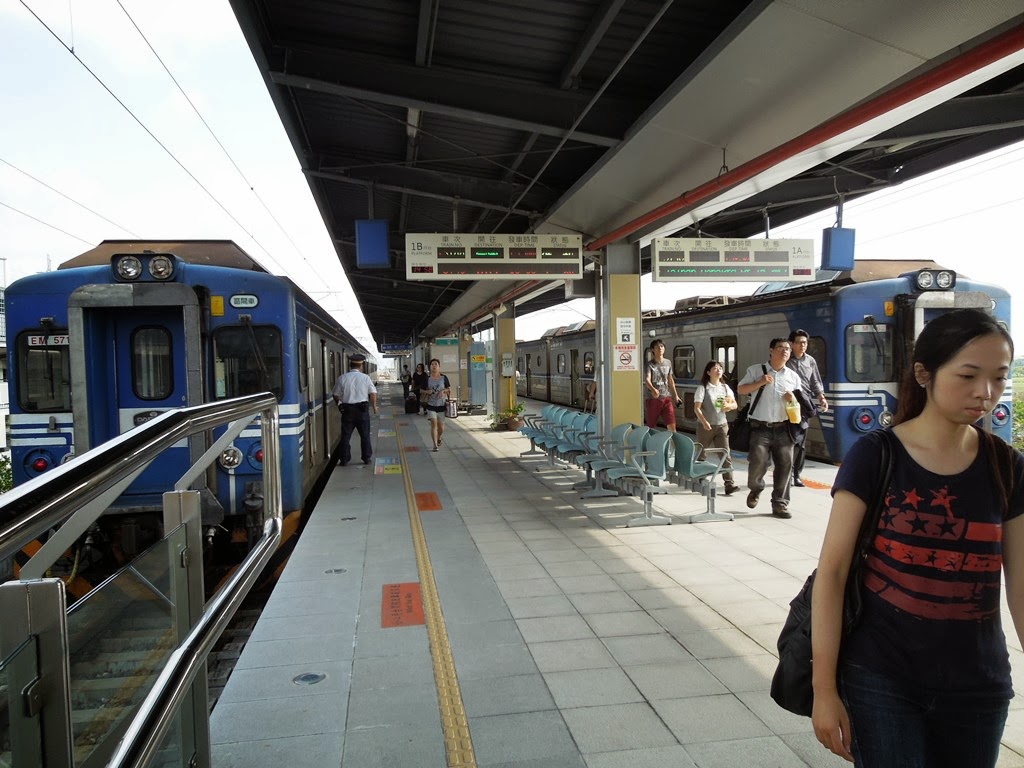
Moving from the TRA Shalun Station 沙崙車站 platform to the adjacent THSR Tainan Station 高鐵台南站 for the trip back to Taichung.

Seen in downtown Taichung

