Monday, March 7, 2011

The hills of Taiko are alive with the sound of strawberries

Tù​chuān​ 杜鵑, or what an online Chinese-English dictionary translates as "Indian Azalea"

The above-pictured flower could be seen this afternoon at Fǎ​yúnch'án​ssù 法雲禪寺, a Zen 禅 temple (English name: Fayun Monastery) located ​​in the hills overlooking the town of Tà​hú 大湖​ in Miáo​lì​ County 苗栗縣. Though the drive up to ​​Dahu from our home was mostly through a thick layer of ugly haze, by the time we reached Fayunchan Temple, the skies had cleared up somewhat:


The temple was built during the Japanese colonial period 台灣日治時期, and the exterior of the reconstructed main hall retains the original Japanese-style Buddhist temple architecture:


Also dating from the Japanese period is this monument below, erected to commemorate the "opening up" of the area by the Japanese:


After taking in the view and soaking up the history, we drove down the hill and into Tà​hú, where we partook of my daughter's favorite outdoor activity, picking strawberries (again - see last week's blog entry):


Amber is so crazy about the edible fruit of this flowering plant that, upon reflection, it would've been more accurate to have named her Ichigo Caomei at the time she was born.

In order to cash in on the hordes of weekend visitors coming to pick 草莓, a Strawberry Culture Museum 草莓文化館 has been established in the town:


The actual "museum" section was surprisingly informative, and the English captions were generally well-presented. My wife was annoyed to discover that it was none other than the Japanese who first introduced strawberries into T'ái​wān 台灣, but let's face it - studying the Japanese colonial period is like watching the "What have the Romans ever done for us?" scene from Monty Python's Life of Brian.

Educational displays aside, the main purpose of the strawberry museum is to sell strawberries, with the gift shop probably resembling what Amber's idea of heaven looks like. Here being Taiwana​, the buildings are surrounded by a market pushing all manner of snacks and drinks, many with a strawberry theme, such as strawberry sausages, strawberry tarts and strawberry wine, though, sadly, no strawberry beer. For my wife, the throngs that had descended upon the complex were an integral part of the eating and shopping experience, adding that much-needed touch of jè​nao​ 熱鬧 ("bustling with noise and excitement / lively") that had been lacking back at the zen temple (there was irony at play in her outlook on these things, but I just couldn't make the effort to point it out to her). For me, I found relief in the view of the surrounding countryside from the museum's rooftop "sky garden"...until the fireworks started going off, that is.


Pamela ended up buying a couple of bottles of strawberry vinegar, plus a jar of strawberry jam for Amber (and, of course, there was the box of strawberries that we had picked earlier). Somehow, our lunch and dinner in Dahu​ didn't involve any strawberries, as we ate instead at Hakka restaurants 客家菜. It took only about an hour to drive back to Fēng​yuán​ 豐原 - fortunately, there was hardly any traffic on the road going back, which was quite a contrast with last weekend's outing. Considering the close proximity of Tà​hú and its other attractions, such as hiking and hot springs, I wouldn't mind spending a weekend there sometime soon.

BTW, Amber took some photos in Dahu which can be seen on her blog.

Sunday, March 6, 2011

Happy cycling trails to you


Why did the chicken cross the road? My daughter ponders the age-old question as she looks at a rooster that has done just that. The shirt she is wearing is emblazoned with the self-serving (for her father) words パパ大好き, or "I ♥ Daddy" in Japanese, which I picked up for her last year when I was in Beppu 別府.

The picture above was taken this afternoon on the T'án​yǎ​shén​ cycling trail 潭雅神綠園道, a bicycle path linking the former townships of T'án​tz​ῠ 潭子, Tà​yǎ 大雅 and Shén​kāng​​ 神岡, all three of which were merged late last year into a Greater T'ái​chūng​ 大臺中. Amber rode about 3 kilometers (1.86 miles) round-trip on her Hello Kitty ハローキティ bike, which isn't a bad workout for a 5 year-old getting around with the help of training wheels. The trail was active today, but not crowded, which is quite a contrast with Sundays, when it's usually 人山人海, "jénshān​ ​jén​hǎi​" or "People mountain, people sea". Unfortunately, some Taiwanese ride bicycles in the same manner in which they drive cars - carelessly, recklessly and with little or no regard for others sharing the same road (or trying to cross it). In short, like absolute morons. 星期天 are days best avoided.


Just in case there was any doubt the above entry describes events taking place in Asia, this picture of a rice paddy and palm trees should put those doubts to rest.

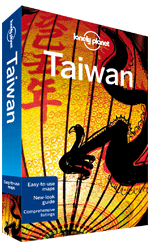
Speaking of cycling, the new Lonely Planet guide to T'ái​wān 台灣 is out, and it devotes a lot of ink to where visitors can ride their bikes on the island of Formosa. There is also much more coverage on hiking (perhaps one day LP can publish a hiking guide to Taiwan, similar to their book on hiking in Japan, which I've used on several occasions), and a new design layout. The latter will take some getting used to, but I like how many of the entries are individually identified, such as "museum", "scenic area", "Buddhist temple" and so on. On the down side, the descriptions for many of the listed sightseeing attractions seem to be shorter compared to past editions, and there are also fewer recommendations for places to stay and eat. Worst of all, the "Getting There and Away" and "Getting Around" sections are generally unsatisfactory - for some places, we're told to ask at tourist information offices for how to get to where we might want to go. While this would pose little trouble for a resident such as myself who has a car and/or scooter, for those short-term visitors dependent on public transportation, it would have been better to have provided more specific advice on which buses to take, for example.

I'm still going through the new LP guide, so the jury is out for now. Rough Guide will be publishing its updated Taiwan guide very soon, and the British travel publisher Bradt will be coming out with its first book on Taiwan at about the same time. I have both books on order from Amazon (I admit it, I'm a guidebook junkie), so it'll be interesting to see how the three guides compare with each other, and which one I'll end up turning to the most often on our travels around Formosa (Fú​mó​sà​) 福摩薩.

Friday, March 4, 2011

Sakura, Thou Art Here

Well, what do you know? We didn't have to endure gridlocked roads last weekend in a futile attempt to see cherry blossoms 櫻花 「サクラ」after all. It turns out that there a couple of trees in the area close to my apartment building, and both are in full bloom. Their surroundings, however, are less than ideal for hanami 花見 parties:


Freshwater eels ウナギ are a common component of Japanese cuisine 日本料理, whether grilled and served over rice 鰻丼, or as a sushi 寿司 item. The traditional calendar in Japan has a day called "doyō ushi no hi" 土用の丑の日, falling on the hottest day of the year, when the consumption of unagi is supposed to provide a source of stamina during the sticky hot summers. Despite the fame of places like Lake Hamana 浜名湖 in Shizuoka Prefecture 静岡県 as sources of unagi, it turns out that roughly 90% of the eels consumed every year by Japanese diners is imported from China and T'ái​wān​ 台灣. Naturally, the 10% that is cultivated domestically is considered to be of a higher quality, which is why the following Kyōdō News 共同通信社 story from Japan Today shouldn't come as a surprise ("Eel importer ordered to pay Y5 mil fine for false labeling"):

"The Tōkyō District Court 東京地方裁判所 on Wednesday fined a Tōkyō 東京 -based eel importer ¥5 million ($60,740/NT1.8 million) for falsely labeling eels farmed in Taiwan as domestically raised products in violation of the unfair competition prevention law. The court also sentenced Hirokazu Iwai, 55, former board member of the precursor of Clover Trading Co, to 18 months in prison, suspended for three years, for masterminding the falsification, and fined him ¥1 million ($12,150/NT358,000). Judge Mariko Goto said the importer 'harmed the confidence of consumers,' while Iwai 'played the central role in the falsification.' According to the ruling, Iwai conspired with two officials of an Ōsaka 大阪 -based marine products firm to disguise 970 kilograms (2140 pounds) of Taiwanese-produced grilled eels as products originated in Aichi Prefecture 愛知県 between 2009 and 2010 to sell them to a Kyōto 京都 -based wholesaler for ¥3.2 million (/$38,875NT1.15 million)."

Wednesday, March 2, 2011

Post 228

This sign would be funnier if it were the name of a cafe, and not of a boutique:

Did anybody notice this sentence from the first paragraph of today's front-page story in the China Post 英文中國郵報 on Ma Ying-jeou's 馬英九 formal apology to the victims of the 228 Incident 二二八事件?:

"Many immigrants to Tái​wān 台灣​ from China were killed in bloody clashes during a military crackdown 64 years ago in the incident."

Shouldn't that be more like "Many thousands of residents on Tái​wān were killed by soldiers from China..." or "Many thousands of Taiwanese were killed..."? The Post a few years back ran an editorial on the events of 1947 by looking back mournfully on the "hundreds" of mainlanders killed by the above-mentioned immigrants to Tái​wān in the incident, before briefly referring to the "thousands" of Taiwanese who lost their lives at the hands of soldiers who came from you-know-where.

(A bit of advice on semantics to the China Post news staff: according to Merriam-Webster, an "immigrant" is defined as "a person who comes to a country to take up permanent residence", while one of the entries under "country" refers to "a political state or nation or its territory".)

This magnificent monster of a moth was taking a rest atop a urinal in the public restroom at the entrance to the No. 2 Trail in the Dà​kēng 大坑​ area:


Roadside detritus left over from the recently observed Lunar New Year 春節 and Lantern Festival 元宵節:


Yet another Yomiuri Shimbun 読売新聞 article on the Japan-Tái​wān alliance in the chip-making industry (from the Daily Yomiuri ザ・デイリー読売 "Elpida, eyeing China, listed in Tái​wān" ):

"Elpida Memory Inc. エルピーダメモリ, the world's third-largest Dynamic Random Access Memory (DRAM) chipmaker, became the first Japanese company to be listed on the Tái​wān Stock Exchange  臺灣證券交易所 on Friday, and hopes tie-ups with Tái​wān firms will help it tap the vast mainland market. 'We are joining hands to expand into the Chinese market,' Elpida President Yukio Sakamoto said at a ceremony celebrating his firm's listing on the bourse in Taipei 臺北 ​. Tái​wān newspapers showed considerable interest in Elpida's listing. The Economic Daily News reported that Elpida plans to compete with South Korean giants through a Japan-Tái​wān alliance, while the Liberty Times  自由時報 said Elpida is eyeing integration with other Tái​wān DRAM makers. Elpida shares closed at NT21.7 (about ¥60/73¢) after their first day of trading, slightly higher than its initial public offering price of NT21.3. Elpida reportedly raised a total of ¥12 billion ($146 million) through the listing. Elpida has already reached an agreement to purchase the DRAM business of Tái​wān's Powerchip Technology Corp. 力晶科技股份有限公司, the world's sixth-largest maker of the chips. Elpida is also negotiating a business integration with Tái​wān's ProMOS Technologies Inc., the globe's seventh biggest. Elpida's moves are a bid to survive in the DRAM market for personal computers, which has seen severe price competition recently. The firm will transfer its DRAM production base from Japan to Tái​wān, which is currently the world's biggest production center for computer parts. Tái​wān authorities welcomed Elpida's stock listing, calling it a major step toward realizing a Japan-Tái​wān semiconductor alliance. One high-level Tái​wān official said, '[The listing] will greatly contribute to the integration of Japanese and T'ái​wān DRAM production, and to deepening technological cooperation.'

Tái​wān apparently aims to gain a leg up in international competition by merging its well-established management, production and sales networks in China with Japan's technology. Taiwan is strongly promoting investment in China, evident in its signing of the Economic Cooperation Framework Agreement 海峽兩岸經濟合作架構協議 , similar to a free trade pact, with China in June last year. Taiwan investment in China in 2010, including investment via third parties, was about $14.6 billion (¥1.19 trillion/NT43 trillion), far surpassing the $4.2 billion Japan has in the country. The unification of the Taiwan and Chinese economies, dubbed 'Chaiwan,' grows closer every year. Taiwan's real gross domestic product growth in 2010 was 10.82 percent, even higher than China's 10.3 percent. However, Taiwan has been increasingly concerned that domestic firms might be left behind by burgeoning South Korean and Chinese companies.

In addition to Elpida, many other Japanese companies are looking into integrating with Taiwan firms to establish a foothold in the huge Chinese market, a place that is extremely attractive but also considerably risky. During the past year, Japanese and Taiwan firms have formed alliances in the electricity, publishing, distribution and foods industries, among others. Many Japanese firms believe tie-ups in Taiwan will get them into the Chinese market by riding on the coattails of T'ái​wān's ever-deepening economic relationship with the mainland. Japanese companies doing business on their own in China have faced various difficulties, such as strikes by local employees demanding more pay and difficulty cutting through red tape to open new factories. Referring to these problems, a senior official at a major Taiwan IT company said, 'We understand the temperament of the Chinese as well as Japanese business practices.' A top Taiwan official said the Japan-Taiwan alliance would be very beneficial. 'The success rate of business in China by Japanese companies on their own is about 60 percent. But partnering with Taiwan firms will increase this by more than 10 percent,' the official said."

Tuesday, March 1, 2011

Hitting for the cycle

Today was 228 Peace Memorial Day 228和平紀念日 in T'ái​wān 台灣​, a day off for many people, but not for my wife, unfortunately. The owners of the company where she works feel that there is no reason to observe this particular national holiday, apparently believing the slaughter of tens of thousands of islanders by forces from the Chinese mainland, and the ushering in of forty years of repressive authoritarian rule, isn't worth remembering. Pamela's bosses may or not be blue (politically speaking), but the sky was definitely azure on this gloriously warm day, and my daughter and I had a nice time together today.

We began by going to Chúng​chèng​ Park 中正公園 for a short hike. The trail I had intended for us to take was closed, however, so we had to make due with a stroll. Amber enjoyed checking out a couple of Taoist temples, and looking for the biggest stones to launch from a bridge into a creek down below.


Amber beseeches the gods of Tào​ism 道教 for whatever favors a five year-old girl might think of.

In the afternoon, we drove into Tái​chúng​ 臺中, where we met up with my friend Steve and his children, Zoey and Eli. Going to a nearby park, the kids enjoyed riding their bikes, playing with bats and balls, digging in the dirt and making mud pies, and generally just enjoying childhood. Which was probably the best way to enjoy this holiday, when you think about it.

My future big-league star.

A marauding biker gang terrorizing the streets of Tái​chúng.

Monday, February 28, 2011

Sakura Sakura, O Where Art Thou?

It won't be long before winter is officially over, and already things have started to warm up here in central Tái​wān​ 台湾. In tandem with the rising temperatures, the cherry flowers are starting to bloom, so we decided to take advantage of the beautiful weather and check out the cherry blossoms (Japanese: sakura サクラ; Chinese: yīng​huā​ 櫻花).

Big mistake. In Japan, the 桜 can be seen everywhere, but in T'ái​wān​, the best concentrations of blossoms are in the mountains. Take that fact into account, add in the sunshine and warmth, the middle day of a three-day weekend (Monday, Feb. 28, is a national holiday - 228 Peace Memorial Day 228和平紀念日), narrow mountain roads and the reality that there is only a finite number of things to see and do on this small island, and you've got the recipe for one, long frustrating traffic jam. Which is what we encountered this morning (and stretching into the beginning of the afternoon) in Túng​shì​h 東勢, as we attempted to see the blooming trees (British expletive pun intended). Sure, the cherry blossom season in Japan can result in mass concentrations of people, too. Ueno Park 上の恩賜公園 in Tōkyō 東京 turns into a circus when the flowers are at their park, while noted 花見 spots such as Yoshino 吉野 are swamped with visitors, but it is also quite possible to see beautiful pinks and whites without venturing far from your home - in Yokkaichi 四日市, for example, there was a winding river lined with cherry trees along both sides just a short bicycle ride from our apartment building, and it was never crowded. Unfortunately, we don't have that luxury where we live in Greater Tái​chúng​ 大臺中​. After an interminable length of time creeping along a narrow, winding lane, we made the decision to give up and turn around when we started seeing cars parking along the side of the road, and people getting out to walk to the leisure farm where all the cherry trees were (and with the park entrance still being some distance away). It just wouldn't have been worth the hassle (not the mention the prospect of the return traffic jam on the trip home later in the day), so we made our way back to central Túng​shì​h.

Amber eats lunch at a restaurant in downtown Túng​shì​h. At that point we would probably have still been stuck in traffic up on the mountain, and with rumbling stomachs further adding to our collective misery. With plenty of time left in the day following lunch, I suggested driving out to Tà​hú​ 大湖.

Central Chó​lán​ 卓蘭, where we stopped to buy some tea. A typical town involved in a typical daydream. All a friend can say is ain't it a shame...

Pamela suggested driving up to a Buddhist temple dating from the Japanese era 台灣日治時期 that offered a beautiful view of the plains below, but on the way there we encountered another long traffic jam. No problem, however. A quick U-turn, and in no time we were at a strawberry farm, filling up a basket with fresh strawberries. This was heaven for Amber, for 草莓 are her favorite fruit in the world, if not her favorite food.

Smiles aside, picking the right berries was serious business for my daughter.

Amber poses with the fruit of her labor. She's also holding a small carton of ice cream...strawberry, as if there was any doubt.

The view from outside the strawberry farm. It's hard to see in the photo, but if you look under the green and brown traffic signs, you can make out the tops of the long line of cars heading toward Dahu.

With one contented child in the backseat, we headed back to Fēng​yuán​ 豐原, stopping off along the way at a viewpoint overlooking the Lǐ​yú​ Reservoir 鯉魚潭水庫. It was crowded, of course.

The water level in the reservoir looked low. Are we in for a dry year this year?

Leaving the scenic viewpoint, we encountered...get ready for it...yet another traffic jam. As it was nearing 4 in the afternoon, a lot of folks were no doubt on their way home. Fortunately, when we turned off and headed in the direction of Sān​yì​ 三義, most of the other cars continued on in the other direction, and we made it back to Fēng​yuán​ without much fuss or bother. Despite the clogged arteries, we managed to enjoy ourselves. Amber got her strawberries, and I was pleased to discover that 7-Eleven has Samuel Adams Boston Lager in stock again! All in all, I shouldn't complain - those who drove up to Wǔ​líng​ Farm 武陵農場 today (Sunday) to see the cherry blossoms spent 7½ hours stuck in traffic! Perspective - what a concept.

The writing on the seal of Amber's orange juice cup says "Handmade pork cutlet sandwiches". Which is a rather odd thing to see in a hot pot/spaghetti restaurant.

From the Japan Today website:


"Elpida Memory Inc エルピーダメモリ has raised 4.2 billion New Taiwan dollars ($145 million/¥11.5 billion) in a secondary listing on the Tái​wān Stock Exchange 臺灣證券交易所 as the Japanese memory chip maker seeks alliances amid fierce competition. The money will be used in Elpida’s development and production of cutting-edge 20- and 30-nanometer chips, said company president and CEO Yukio Sakamoto at a Tái​pěi​ 臺北 news conference. Elpida’s listing in the form of T'ái​wān Depositary Receipts comes amid closer ties with Taiwanese firms who are also facing tough competition from South Korea’s Samsung Electronics and Hynix Semiconductor. The market for DRAM, or dynamic random access memory, is expected to recover from a long slump in the April-June quarter, with demand for mobile chips expected to surge with the growing sales of tablet PCs and smartphones, Sakamoto said. Rexchip Electronics, a Taiwanese maker in which Elpida has a majority stake, will add mobile chips to its production lines in the second half this year, he said. He said Elpida’s output will also gain from its alliance with Tái​wān’s Powerchip Technology 力晶科技股份有限公司 , which has suspended its own marketing efforts to become a subcontractor for the Japanese maker. Elpida is seeking additional cooperation with other Taiwanese DRAM makers, Sakamoto said, but refused to give details. Amid a glut of DRAM supply following the 2008 global financial crisis, the Taiwanese government sought to consolidate its six DRAM makers into a new company working with either Elpida or U.S.-based Micron Technology. But the project fell apart."

Then there was this article in the Japan Times ジャパンタイムズ ("ELEMENTARY ENGLISH: Asian, European peers have big head start but success unquestioned"), comparing the state of elementary school English education in Japan with those in several other questions, including Tái​wān​. The relevant sections are listed below:

"While all elementary schools in Japan are scheduled to start teaching English this April, other parts of Asia and Europe have been doing it for years. They are teaching English earlier, longer and with more advanced content. Some even have teachers who are specialists in teaching the language. According to the education ministry 文部科学省, South Korea began teaching English in elementary schools in 1997. China and Tái​wān​ started in 2001, and Germany and France followed suit in 2004 and 2005, respectively. What's more, students in those countries are learning it at a younger age — from third grade in China, South Korea, Tái​wān​ and Germany, and from first grade in France. Japan's English-language schedule will consist of a lesson a week, or 35 per year. According to the ministry, however, Tái​wān​ and Germany give two lessons a week, France gives 54 hours of lessons a year, South Korea gives two lessons a week for third- and fourth-graders, and three a week for fifth- and sixth-graders...The lessons in Japan will be 45 minutes long, compared with 40 minutes in Tái​wān...The curricula differ as well. In Japan, students will learn to listen and speak English through songs, games and self-introductions, among other activities. They will also engage in cultural exchange activities by meeting foreigners and attending cultural events, as well as do their ABCs...In Tái​wān, pupils are required to write down around 180 vocabulary words and to speak about 300...The ministry also said teachers in charge of English in China and some urban parts of Tái​wān are specialists, unlike in Japan. Japan does not require teachers to have a qualification in English proficiency, but one city in T'ái​wān requires its teachers to have scored at least 213 on the TOEFL, or Test of English as a Foreign Language."

Sunday, February 27, 2011

Washington, Part 13: the 12th and 13th of February

As the saying goes, all good things must...and so, with much regret, we bade goodbye to family and country, and returned to T'ái​wān​ 台灣. Thanks to the International Date Line, we left Seattle-Tacoma International Airport on a Saturday afternoon sometime after 1pm, and arrived at Tái​wān Táo​yuán​ International Airport 臺灣桃園國際機場 late on Sunday night (around 10:30 or so). It was a long flight (though thankfully a smooth one), with delays at both ends - at Sea-Tac, we had to wait on the runway while the Delta crew tried to deal with a "weight imbalance", while our first landing attempt at Táo​yuán 桃園 had to be aborted due to "foreign objects" on the runway there (we touched down on our second try, and on a different runway). By the time we had cleared Immigration, claimed our bags, picked up our car from a nearby long-term parking garage and made the drive to Fēng​yuán​ 豐原 on the freeway, it was already 1:30 on a Monday morning (and I didn't actually get into bed until around 3:30 after showering and unpacking). I should be forgiven, then, for electing go into work in the afternoon rather than in the morning.

All three of us had a great time in Washington. For my wife, it was a much-needed break from her job, and she enjoyed just taking it easy at my parents house. For me, it was a much-needed (though too-brief) respite from T'ái​wān, as well as a treasured time to see my Mom and Dad again, and to spend time with my sister and her family. As for my daughter, it was a much-needed opportunity to reconnect with her other culture, and I'm pleased to report that she did so swimmingly! Amber had no trouble at all dealing with the different environment - in fact, she plunged right in from Day One. I was especially relieved to see her play with other kids using only English.

One day I hope our flight to the USA will be on a one-way ticket, instead of a round-trip from T'ái​wān. Until that day comes, all of us are looking forward to our next opportunity to visit my family in the Pacific Northwest.

The silhouette of Mount Fuji 富士山 was visible from the terminal at Narita International Airport 成田国際空港 as were changing flights. In all the many times I've been to, from and through Narita, I'd never seen Fuji-san from there before.

A tired-looking Amber shows off the "red envelope" 紅包 she received upon arriving at Táo​yuán​. Inside was a NT1 (3¢/¥3) coin. I thought it was a nice gesture to welcome the kids back to Tái​wān​ during the Lunar New Year 春節 holiday.