Sunday, October 13, 2013

Catholicism, Shanghai-style? To hell with it!


OK, perhaps the title of this post is somewhat of an overreaction, but it was disappointing this afternoon paying a visit to St. Ignatius Cathedral 徐家汇天主教堂, located in Shàng​hǎi's 上海 Xú​jiā​huì 徐家汇 area. On the surface, the cathedral seemed appealing in three key areas:

1.) History. Xujiahui is the sight of Shanghai's oldest international settlement, with the Jesuits having been here since the 17th century and the cathedral dating from 1910;

2.) Architecture. Red-brick, Gothic-style buildings aren't that commonplace in China;

and 3.) Faith.

(A brief explanation on that last point: although I was baptized into the Church of England when I was a child, I'm not a practicing Anglican, nor a Christian for that matter. My family stopped attending the local Episcopalian church when I was around seven years old over the disgust felt by my mother when the priest ran off with a married member of the congregation, and I haven't been back since, save for the occasional sightseeing visit to a European cathedral. However, I am interested in matters pertaining to religion, and I do enjoy visiting places of worship such as Buddhist and Taoist temples, Shintō shrines 神社 and, yes, Christian churches.)


Unfortunately, visiting St. Ignatius didn't go the way I'd expected. True, it was an impressive building, both on the inside and out. However, things turned annoying right off the bat when we were told we couldn't get in without tickets. Admission was free and the ticket office was nearby, but it just seemed thoroughly pointless. Then it started to get sour when my wife was denied entry, solely on the grounds that the sandals she was wearing lacked a strap on the back. It's that old irony that some churches still don't seem to get, namely that they would refuse Jesus himself admission should he turn up at their doors today just because he wouldn't be properly attired.

In any event, Pamela, who wasn't particularly interested in seeing the church in the first place, said that she didn't mind waiting outside, so Amber and I went in. Photography wasn't allowed inside, which was too bad as the interior was beautiful, but it was a rule I could understand and therefore respected.  The original stained glass windows didn't survive the Cultural Revolution 文化大革命, but the replacements were appealing in their own right:


Inside, access to the altar was blocked by a wedding that was taking place. I could complain by saying that I'd be willing to bet my as-yet-not furloughed-paycheck that the Chinese couple getting married this afternoon chose St. Ignatius not because they were devout followers of the teachings of Christ, but because holding it there appealed to the superficiality so prevalent in local culture. But then who am I to quibble about such things, seeing as I hold the Bible to be a collection of stories and not the words of a supreme being. Besides, the ceremony did add to the atmosphere inside St. Ignatius, and it was good to see the cathedral actually being used as something more than just a sightseeing spot. It might an interesting place to observe a mass being held, except for the matter of the guards.

Guards. I don't know if it's because China is an authoritarian state, or whether it's due to the simple fact that the Chinese just don't trust each other, but the country is full of them. From public schools to shopping plazas and Catholic cathedrals, guards are posted everywhere to make sure only the right people get in and the riffraff stay out. So much for socialist egalitarianism. The whole time Amber and I were inside St. Ignatius, we observed the guards constantly telling people what they couldn't do. Granted, most Chinese probably don't have a clue as to how to behave properly inside a church, and people did need to be reminded not to put their feet up on the places where you should kneel when praying, for example. But it was the sheer rudeness of the guards that irritated me. Yes, this is China, where, in general, people treat each other with utter contempt. But a church is supposedly a house of God, a place in which people are meant to go so as to feel closer with their maker, and visitors deserve a modicum of respect. The people I saw in the church weren't doing anything to disrupt the proceedings (certainly nothing along the lines of behavior some of their compatriots have been accused of engaging in while on overseas tours), and yet they were shown the kind of contempt meted out to migrant workers trying to buy train tickets home during the New Year holidays.


Next door to St. Ignatius is the Bibliotheca Zi-Ka-Wei 徐家汇藏书楼. Built in 1847 and home to what has been described as a magnificent collection of rare books, a tour of the library there sounds like something I would want to do. Except that if the way St. Ignatius is run is any indication, I don't want to have anything to do with the Jesuits or the Shanghai Diocese.


Amber watches a Chinese bullet train zip by as we make our way to her twice-weekly Go (known as wéiqí 圍棋 in Mandarin and igo 囲碁 in Japanese) lesson. 


My daughter enjoys playing the strategic board game, and has been doing so since kindergarten. She was inspired by the Japanese anime アニメ Hikaru no Go ヒカルの碁, which she used to watch when we were living in Taiwan. The cover of her Go homework book features the two main characters from the series, Hikaru and his ghost mentor, Fujiwara-no-Sai 藤原佐為. 


A bowl of niúròufàn 牛肉饭 and some xiǎojiě's 小姐 at a supposed "Taiwanese-style night market" not far from Amber's Go school.


Enjoying a stick of jīròu chuàn 鸡肉串, skewers of chicken meat. Unfortunately, the rest of the meal didn't taste as good as this. 

What saved the day in the end was going to Shanghai's Bund 外滩 to see the night view, something we hadn't done before. Let there be lights, lots of them!


Sunday, October 6, 2013

Japan and Taiwan: Day 14 - Japanese Tainan

Tainan 台南 is Taiwan's fourth-largest city in terms of population. As a result of its status as the first capital of the island (beginning under the rule of the Dutch in the 17th-century), the city has accumulated a remarkable collection of historical sights and temples, making it a major sightseeing destination for Taiwanese and foreign visitors alike. One aspect of Tainan's history that often gets overlooked by the tourists, however, is the sights related to the time when Taiwan was under Japanese control (1895-1945). Tainan was an important administrative center during the Japanese period, and a number of outstanding examples of architecture dating from that time are still standing, many of which are within walking distance of the city's central train station 台南車站. It was this side of Tainan that drew me one Tuesday on the last full day of my vacation.


Getting to Tainan involved taking advantage of Taiwan's not-always-convenient-as-it-seems High Speed Rail system 台灣高鐵. Convenient for the time it takes to get from one place to another (only about 40 minutes between Taichung 台中 and Tainan), inconvenient due to the locations of most of the stations, located far from the city centers they ostensibly serve and reached by either shuttle buses or slow local train connections. My friend Steve kindly drove me to the Taichung HSR Station, located out in the wilds of Wuri 烏日, from where I traveled at high speed to the Tainan HSR Station, situated in the rural Guiren 歸仁 area and connected to central Tainan by the TRA Shalun Line 沙崙線.


Once finally in Tainan's downtown area, I could begin my explorations. The first site of note that I came to was the 1911 Former Tainan Meeting Hall. 


Admission was free, which was good as the exhibits inside were pretty sparse. One section had been turned over to a photographic exhibition.


Behind the hall was a classical-style Chinese garden, a perfect spot for admiring the fighter jets from a nearby air force base as they roared by overhead.


Also on the same grounds was a Japanese-style wooden building housing a cafe. I wasn't sure if it was original or a reconstruction, but in any event it did serve as a nice spot for a break, even if the milk teas were a bit pricey at NT100 ($3.40). Taiwan: the Bradt Travel Guide by Steven Crook laid out the course I followed this morning and afternoon. Bradt Guides often provide different perspectives on less popular travel destinations, and I recommend using Crook's guide in conjunction with either the Lonely Planet or Rough Guide books if you're serious about seeing what Taiwan has to offer. 


Possibly the oldest surviving Japanese-era building in Taiwan (according to the Bradt Guide), this pepper-pot-shaped structure is known as the Old Weather Station. 


Inside were various weather-measuring instruments and seismographs from days gone by, all proudly shown to me by the attendant, who also insisted on taking my picture.


Next up was a visit to arguably the best-preserved piece of Japanese-era architecture in all of the island. Completed in 1916 as Tainan's city hall, the Museum of Taiwanese Literature is now devoted to local writers and their works. It's worth a visit just to see the building (and there was no admission - again!).


Inside, it was possible to see the original foundation of the building


The exhibits were extensive, and exhaustively captioned in English. Truth be told, however, unless you are a linguist or have a deep interest in the history of Taiwanese literature, there probably won't be much to hold your attention for very long.


A modern annex has been seamlessly crafted onto the rear of the old city hall, in a job well-done.


Around the corner from the literature museum was another well-preserved structure. The Old Tainan Martial Arts Academy was built in 1936 and now serves as an auditorium for an elementary school. As such, it can't be visited during school hours, so I wasn't able to go inside. 


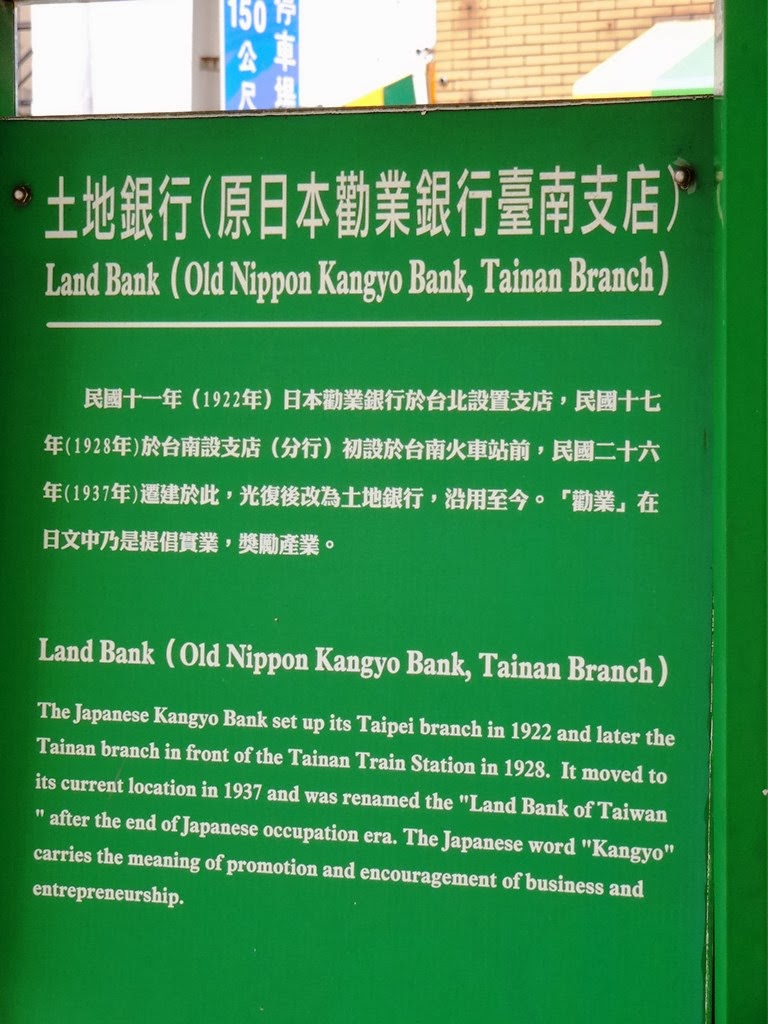
This 1937 Art Deco colossus is still being used as a bank today


A signboard explaining the story of the Land Bank building. On past visits to Tainan, I came away impressed with the efforts made by local authorities to explain the significance of the city's historical relics, and this outing was no exception.


Diagonally across from the Land Bank was the 1932 Hayashi Department Store which, at the time of its opening, boasted Taiwan's first elevator. The structure has apparently stood vacant for many years, and it still wasn't clear (to me, anyway) what the future holds in store (rimshot), but when I looked through the first-floor windows, workers could be seen doing some kind of renovation work. 


Looking at the Hayashi Department Store from another angle, the old Shintō shrine 神社 on the rooftop could just be made out. Whatever someone has planned for this building, I hope they'll preserve the form, make it accessible to the public and keep the shrine in its original state.


Lunch. And, no, I'm not sure what is was supposed to be, either


The 1936 train station building, currently wrapped up in scaffolding


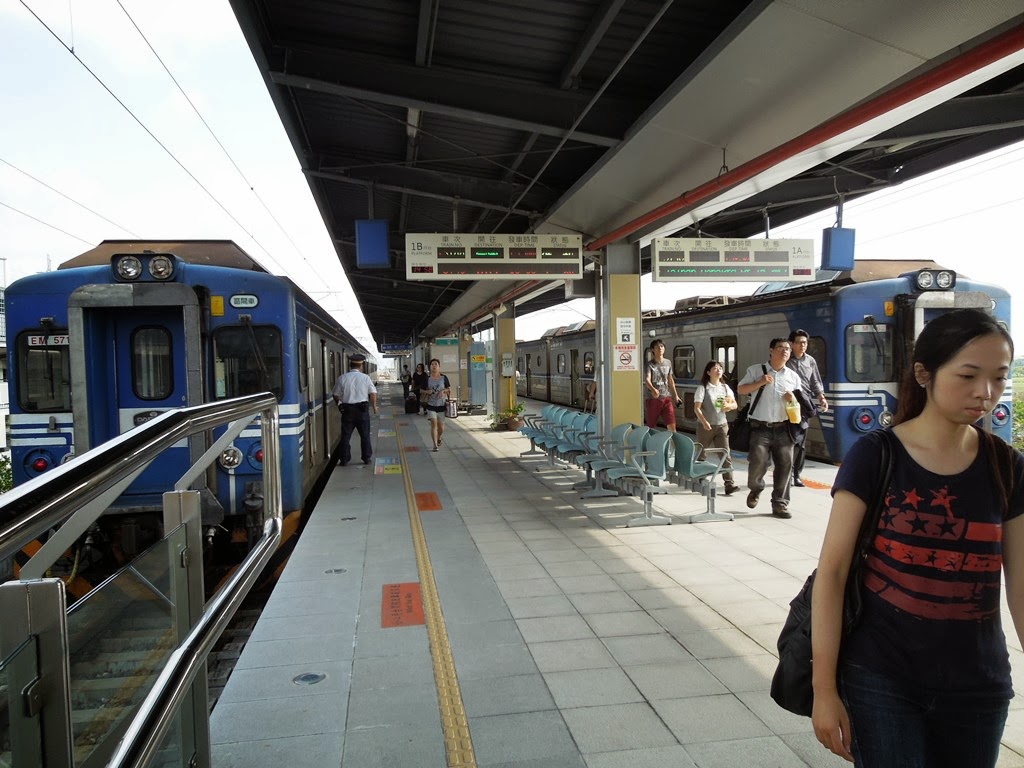
Moving from the TRA Shalun Station 沙崙車站 platform to the adjacent THSR Tainan Station 高鐵台南站 for the trip back to Taichung.


Seen in downtown Taichung


Saturday, October 5, 2013

Japan and Taiwan: Days 11-13 and 15.

After ten days traveling in Japan, I flew from Haneda Airport 羽田空港 in Tōkyō 東京 to Taipei's 台北 Songshan Airport 台北松山機場. Once again, a typhoon threatened to change my plans. Announcements were made prior to boarding that the flight may have to be diverted or even forced to return to Tokyo due to the storm that was on course to batter much of Taiwan. But as things turned out, we arrived at Songshan on time and in just a light rainfall. 

I would stay four days in total, all of them at the Taichung 台中 home of my best friend Steve and his family. With the exception of a day trip to the southern city of Tainan 台南 (the subject of a later blog post), I didn't do any sightseeing. Instead, I spent the time catching with Steve, whom I hadn't seen in over a year. I also had the opportunity to meet up with others, including having lunch with some old students of mine from my teaching days in Fengyuan 豐原, Stacey, Amanda and Eric; sitting down to dinner and drinks with Michael Turton; and spending an enjoyable afternoon with Michael Klein, his wife Hui-chen and their adorable daughter Phoenix. I said hello to my parents-in-law and had a good chat over a meal with my brother-in-law; and I even stopped in at the kindergarten where I used to work in order to pay a courtesy call. There were many others I wish I could've gotten together with, but didn't have enough time on this brief visit; hopefully, the next time I'm in Taiwan, I'll be able to do so.
Coming back to Taiwan after a 16-month absence and after having lived almost four months in Shàng​hǎi 上海 drove home just how different the former is from China, despite the all the ideology and propaganda. My apologies for hurting the feelings of the Chinese people, but that's the reality. Truth be told, Taichung (and even Tainan) looked much grittier and more run-down in comparison to Shanghai, but in terms of friendliness and quality of service, China still has a lot to learn from the Taiwanese. Still, while it was nice to be back on Formosa, I have no regrets about moving on, and have no desire to go back to my old life there. Then again, while I'm enjoying living and working here in Shanghai, I'm glad we're only scheduled to be here for two years. An Old China Hand is one thing I don't want to become.


Bidding a fond farewell to Tokyo and the rest of Japan from the observation deck at Haneda.


Somewhere between Taipei and Taichung on Taiwan's High-speed Rail 台灣高鐵


Steve and his son Eli pose in front of his school, Teacher John English, located in the southern part of Taichung. Steve has worked hard getting his school ready, which hasn't always been easy as he's tried to follow all the regulations (read obstacles) as determined by Taiwan's impressive bureaucracy (it's no wonder so many kindergartens and bǔ​xí​bān 補習班 operate outside the law). The result has been official certification, as shown by the white sign on the wall to the right of the entrance.


Eli and I on the grounds of the large library across the street from Steve's school. It was rainy off-and-on while I was in Taichung, but the feared typhoon never reached us.


The view from the third floor of the house where Steve, his wife March, daughter Zoey and son Eli reside.


I'm not sure why Zoey found this so amusing. It was the time of the Mid-Autumn Festival 中秋節, after all.


Steve, Zoey and Eli...and a lot of ducks


A typical Taichung street scene


Waiting for a train at Daqing Station 大慶車站 . Taichung is in the midst of two massive transportation projects - one the construction of the city's first subway system and the other, which you can get a glimpse of here, is the elevation of parts of the railroad tracks that run through it. 


On the local train heading north out of Taichung. This shot was taken somewhere between Houli 后里車站 and Tai-an 泰安車站 stations.


The scene out in front of Xinfeng Station 新豐站, in Hsinchu County 新竹縣. It was here that I was met by the Bushman himself, who took me to his home, introduced me to his 11-month-old cutie of a daughter, treated me to lunch at a neighborhood restaurant and then went to the trouble of driving me out to Taoyuan Airport 台灣桃園國際機場. Michael is one of the nicest people I've had to pleasure to meet in Taiwan, and I look forward to meeting up with him again (and of being able to return some favors) when the chance comes.


After years of criticizing the beer situation in Taiwan (I had a bottle of Taiwan Beer 台灣啤酒 the other night here in Shanghai, and it was just as awful as ever), I was pleasantly surprised to find this. Ignore the Taiwan Beer glass - King Wujhou isn't produced by the government-run Taiwan Tobacco and Liquor Corporation 台灣菸酒公司. Unfortunately, I can't find anything about in English online. It was good, though.


Michael with his wife Hui-chen and daughter Phoenix


One last milk tea 奶茶 at Taoyuan Airport while waiting for my flight to Shanghai


After touching down at Shanghai's Pǔ​dōng Airport 浦东机场, I treated myself to a ride on the Shanghai Maglev Train 上海磁浮示范运营线. It only took six minutes from the airport to the terminus at the Lóng​yáng Road Metro station龙阳路站 , but the 301-kmh (187-mph) journey did cut some time off the trip back to our home in the Hóng​qiáo 虹桥  area...


...and it was a fun ride.